


IMF: Middle East Faces Pivotal Economic Moment

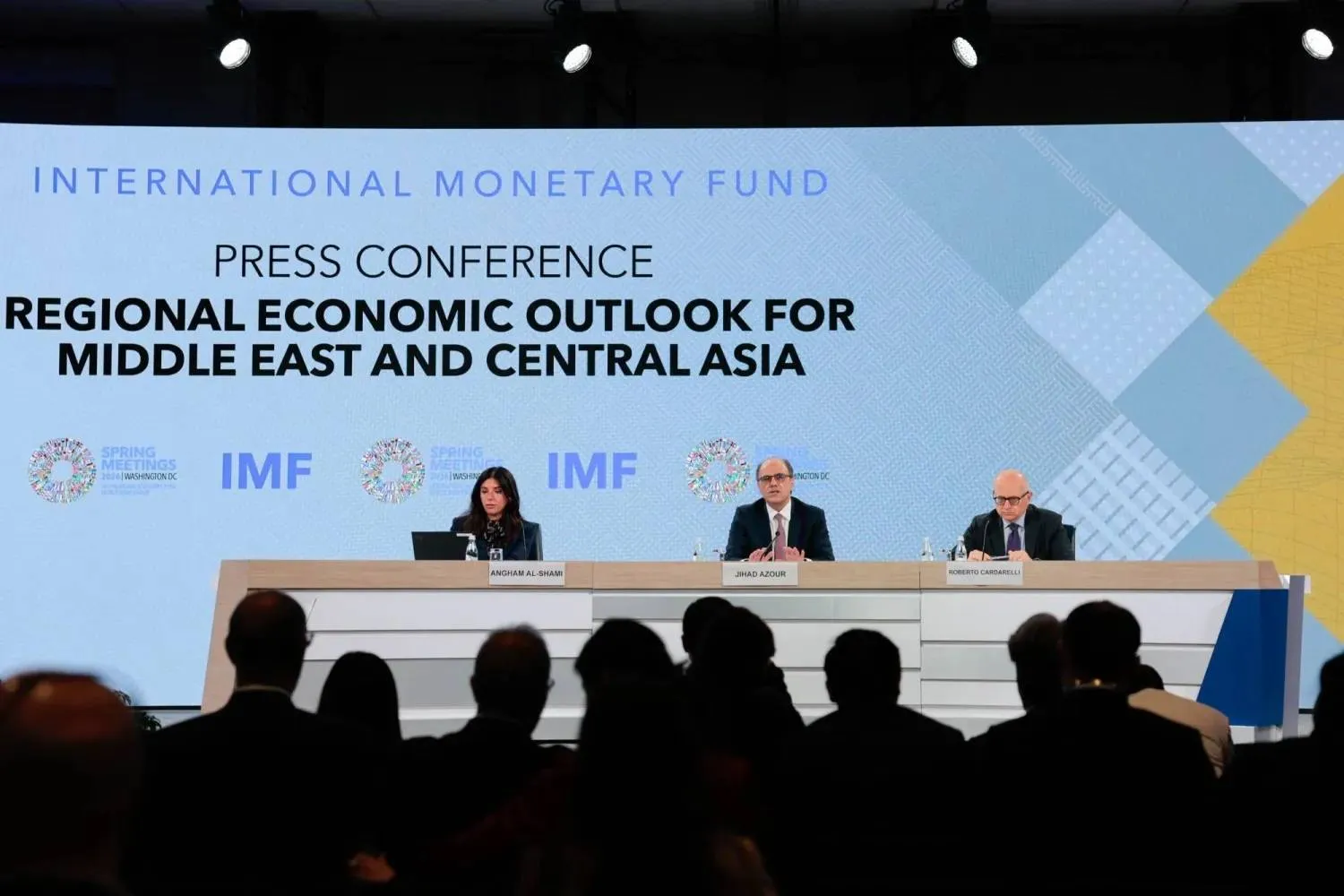
Azour speaks during a presentation of the Regional Economic Outlook update (AFP)
TT

IMF: Middle East Faces Pivotal Economic Moment

Azour speaks during a presentation of the Regional Economic Outlook update (AFP)

The International Monetary Fund said the Middle East, North Africa, and Pakistan were facing a pivotal and exceptionally difficult moment in their modern economic history after the war that broke out on Feb. 28, 2026, describing it as a severe and multifaceted shock to one of the world’s most strategically important economic corridors.

The IMF said the conflict was not merely a border crisis but had disrupted “three pillars of stability, energy markets, trade routes, and business confidence,” triggering a global energy shock and weakening supply chains.

Amid these challenges, Saudi Arabia’s economy emerged as a model of resilience, showing what the IMF described as “exceptional sturdiness” that enabled it to absorb the impact of disruptions to the Strait of Hormuz and a decline in regional output, supported by the pillars of Vision 2030, which strengthened fiscal discipline and logistical flexibility.

Jihad Azour, director of the IMF’s Middle East and Central Asia Department, said while presenting an update of the Regional Economic Outlook in Washington, on the sidelines of the IMF and World Bank Spring Meetings, that the war was reshaping the region’s economic outlook.

At the center of the shock was energy, he said, noting that the Strait of Hormuz, “the world’s most critical energy chokepoint, through which roughly one-fifth of global oil supply and about one-quarter of global LNG trade normally transit,” had come close to a standstill.

He said disruptions and shutdowns had cut oil and gas output across Gulf Cooperation Council countries, pushing Brent crude above $100 a barrel, while “European gas prices rose by roughly 60 percent, exceeding the spike observed after Russia’s invasion of Ukraine,” putting global energy security at risk.

He said energy disruptions caused by the war would weigh heavily on Gulf exporters, while oil-importing countries such as Egypt and Jordan were facing higher commodity prices and weaker remittance flows.

More broadly, the Middle East and North Africa region is expected to see a marked slowdown in growth this year, with real GDP projected at about 1.1%, significantly below pre-war forecasts, before a recovery in 2027, according to the IMF.

Azour said the shock extended beyond oil and gas, noting that “commodity disruptions extend beyond oil and gas,” affecting fertilizers, chemicals, and other products in which the region holds a strategic position.

He warned that rising food costs were directly threatening vulnerable populations, saying that “these price increases translate directly into higher food costs for some of the world’s most vulnerable populations,” particularly in import-dependent economies across the region and beyond.

He added that the conflict had also affected services, saying, “air traffic collapsed at major Gulf hubs, maritime insurance premiums surged, shipping routes lengthened, and logistics chains weakened,” highlighting the broad impact on aviation and logistics.

The IMF said some oil-importing economies in the region relied heavily on Gulf countries for energy imports and financial flows, leaving them exposed if the conflict intensified or persisted.

Saudi experience

Azour said one of the most important lessons from the war and the disruption of the Strait of Hormuz was the need to diversify trade routes.

“This shock underscores the importance of building greater resilience and strengthening integration,” he said, adding that this includes “diversifying trade routes and deepening regional cooperation,” to ensure the continued flow of goods and energy.

He said Saudi Arabia’s approach under its strategic vision went beyond infrastructure development to a broader reshaping of logistics networks. By expanding alternative ports on the Red Sea and strengthening land and rail connectivity, the kingdom reduced its reliance on a single maritime chokepoint.

He said this ability to create parallel trade routes allowed Saudi trade to continue effectively despite disruptions to regional corridors, offering a model for protecting economic security and ensuring uninterrupted supply flows.

Egypt

Azour said economic reforms implemented by Egypt, along with stronger policy buffers, were helping the country better manage external shocks.

He said allowing the exchange rate to become more flexible helped absorb shocks, while higher reserves provided reassurance to markets.

Regional divergence

The IMF report highlighted a sharp divergence across countries. Qatar faced a steep downgrade to growth forecasts due to damage to its gas infrastructure, while Oman showed relative resilience given its geographic position outside the Strait of Hormuz.

At the same time, financing pressures increased on Egypt, Pakistan, and Jordan as sovereign spreads widened, prompting Azour to stress that the IMF stood ready to support countries.

He said that if oil production recovered and the Strait of Hormuz fully reopened, countries would be able to increase output quickly, adding that higher oil prices compared with pre-2026 levels would help producers recover some of their losses from the crisis.

Saudi Stock Market Edges Lower in First Session of the Week

An investor monitors a stock screen at the Saudi financial market in Riyadh (AFP)
TT

Saudi Stock Market Edges Lower in First Session of the Week

An investor monitors a stock screen at the Saudi financial market in Riyadh (AFP)

Saudi Arabia’s stock market index ended trading slightly lower, falling 0.25 percent to close at 10,968 points, amid trading turnover of around SAR2.9 billion, the lowest level since January 2026.

Mining giant Maaden fell 2 percent to close at SAR62.7, while SABIC declined by the same percentage to SAR59.4. Arabian Drilling slipped 1 percent to SAR86.6.

In the banking sector, Saudi National Bank shares fell 0.26 percent to SAR38.5.

Meanwhile, Saudi Aramco, the index’s heaviest-weighted stock, rose 0.3 percent to close at SAR27.78.

ACWA Power also gained 2 percent to SAR181.10.

Kingdom Holding rose 6 percent to SAR11.01, while Solutions climbed 4 percent to close at SAR229.6.


Oman Inflation Rises 3.2% in April

Shoppers at a food and beverage store in Oman. (Reuters)
TT

Oman Inflation Rises 3.2% in April

Shoppers at a food and beverage store in Oman. (Reuters)

Oman’s consumer price index (CPI) rose 3.2 percent in April compared with the same month in 2025, based on 2018 as the reference year.

The National Center for Statistics and Information said in data carried by the Oman News Agency on Sunday that average inflation during the period from January through April increased by 2.6 percent.

The data showed that the miscellaneous personal goods and services group recorded the highest increase at 9.2 percent, followed by food and non-alcoholic beverages at 6.2 percent, and transport at 6 percent.

The food and non-alcoholic beverages group recorded increases across most categories in April compared with the same month last year, led by vegetables at 25 percent, followed by fruits at 11.6 percent, and fish and seafood at 6.1 percent.

The data also showed varying inflation rates across Oman’s governorates at the end of April compared with the corresponding period last year. Al Dhahirah Governorate recorded the highest increase at 4.4 percent, followed by Al Dakhiliyah and Muscat governorates at 3.7 percent, and Al Buraimi Governorate at 3.5 percent.


Gulf, International Initiative to Assess War’s Impact on Private Sector

A previous meeting of the Federation of GCC Chambers in Riyadh. (SPA)
TT

Gulf, International Initiative to Assess War’s Impact on Private Sector

A previous meeting of the Federation of GCC Chambers in Riyadh. (SPA)

Asharq Al-Awsat has learned of a joint initiative by the Federation of GCC Chambers and the International Labor Organization to conduct a rapid assessment of the impact of the war on the private sector and labor markets across Gulf Cooperation Council countries.

The initiative is expected to contribute directly to the formulation of actionable recommendations aimed at preserving labor market stability and supporting business continuity.

The initiative seeks to assess the impact of the current crisis and conflict on private sector institutions, with particular focus on small and medium-sized enterprises, as well as on labor markets across GCC states.

According to the information obtained, the Federation of GCC Chambers has asked private sector companies and institutions across member states to document the impact of the war, whether they market their products domestically or in regional and international markets.

The federation is also seeking to determine the effects of the current regional crisis on supply chains and private sector operations, including delays in receiving imported inputs, shortages of critical materials affecting operations, higher transportation and logistics costs, and disruptions in the distribution of goods and services to markets and customers.

It is also examining the direct impact of disruptions to maritime trade routes, including the Strait of Hormuz, on businesses, particularly in terms of rerouting shipments through alternative routes or transport methods, difficulties shipping or receiving goods by sea, increased shipping and insurance costs, declining import and export volumes, and shipment or order delays and cancellations.

The federation has further requested information on the extent to which the crisis has affected overall operating expenses, whether significantly, moderately or not at all, as well as its impact on companies’ investment plans, including whether firms intend to cancel, reduce or indefinitely postpone investments, or instead increase spending to adapt, restructure or respond to new conditions.

Among the challenges the federation is seeking to assess are companies’ ability to cover operating and fixed costs, revenue conditions, and the immediate measures taken regarding their workforce in response to the crisis, including reducing working hours, shifting employees to part-time arrangements, freezing recruitment and hiring, cutting wages and benefits, or reallocating staff to different roles and functions.

Secretary-General of the Gulf Cooperation Council Jasem Albudaiwi recently said that a series of Gulf economic and financial achievements had strengthened regional integration and reinforced financial stability in the face of evolving challenges.

Speaking during the 125th meeting of the GCC Financial and Economic Cooperation Committee in mid-May, Albudaiwi said the current war crisis requires Gulf states to move beyond traditional coordination toward a higher level of practical integration and effective response.

He said the accelerating crises and growing economic challenges facing the region underscore the urgent need for a conscious response and measures capable of mitigating their impact on GCC economies, which have long been characterized by openness and deep engagement with the global economy.

Albudaiwi also stressed the need to expedite the completion of key joint Gulf projects, including transportation and logistics initiatives, while accelerating implementation of the GCC railway project and strengthening the regional electricity interconnection network.

He further called for studying the establishment of oil and gas pipeline networks, a GCC water interconnection project, strategic Gulf stockpile zones, and measures to ensure adequate liquidity reserves at central banks.
