


Trump Says Steep Copper Tariffs in Store as He Broadens His Trade War

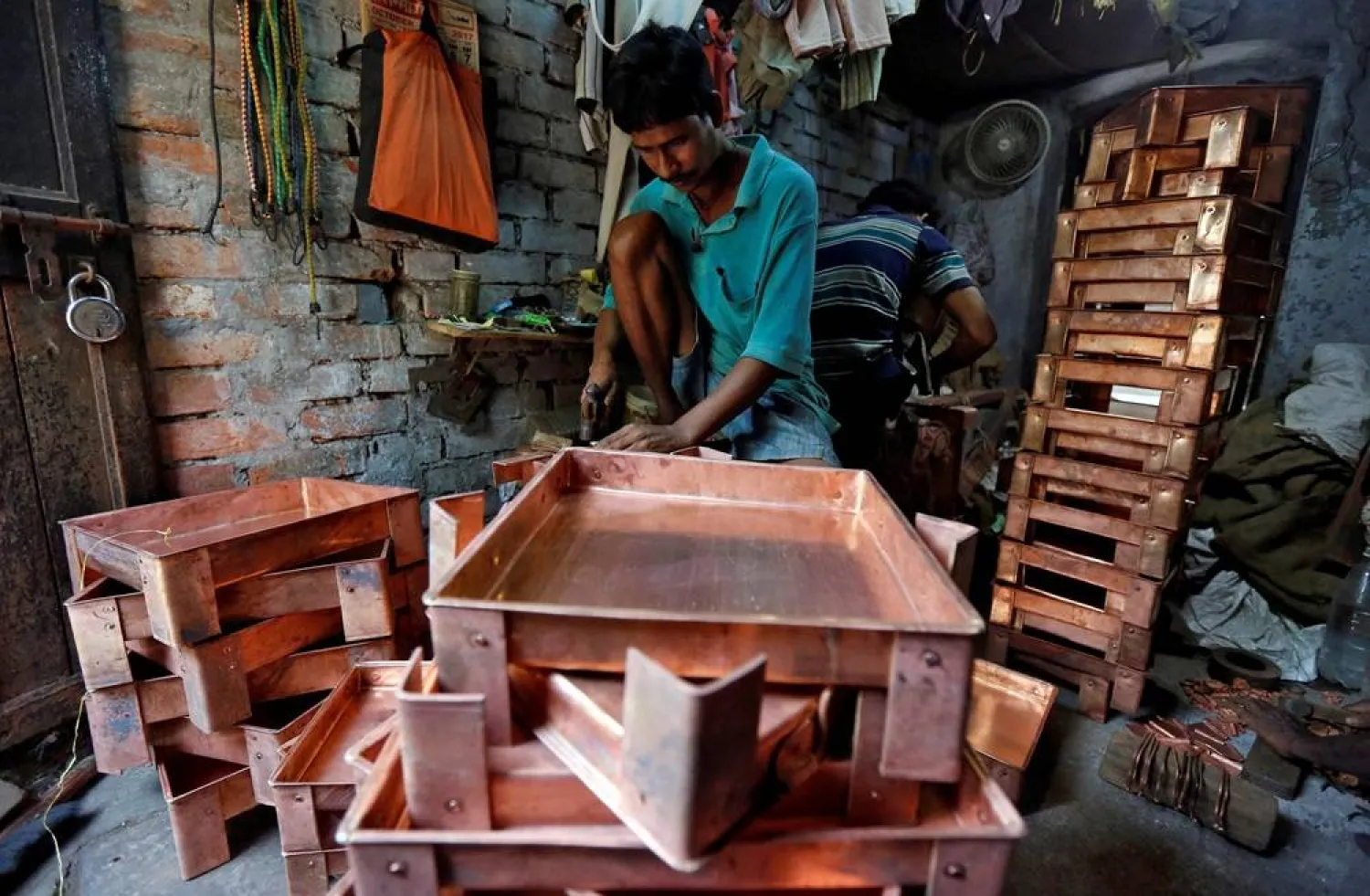
A worker makes copper trays inside a workshop in Kolkata, India, October 26, 2017. Picture taken October 26, 2017. (Reuters)
TT

Trump Says Steep Copper Tariffs in Store as He Broadens His Trade War

A worker makes copper trays inside a workshop in Kolkata, India, October 26, 2017. Picture taken October 26, 2017. (Reuters)

US President Donald Trump on Tuesday said he would impose a 50% tariff on imported copper and soon introduce long-threatened levies on semiconductors and pharmaceuticals, broadening his trade war that has rattled markets worldwide.

One day after he pressured 14 trading partners, including powerhouse US suppliers like South Korea and Japan, with sharply higher tariffs, Trump reiterated his threat of 10% tariffs on products from Brazil, India and other members of the BRICS group of countries.

He also said trade talks have been going well with the European Union and China, though he added he is only days away from sending a tariff letter to the EU.

Trump's remarks, made during a White House cabinet meeting, could inject further instability into a global economy that has been shaken by the tariffs he has imposed or threatened on imports to the world's largest consumer market.

US copper futures jumped more than 10% after Trump's announcement of new duties on a metal that is critical to electric vehicles, military hardware, the power grid and many consumer goods. They would join duties already in place for steel, aluminum and automobile imports, though it was unclear when the new tariffs might take effect.

US pharmaceutical stocks also slid following Trump's threat of 200% tariffs on drug imports, which he said could be delayed by about a year.

Other countries, meanwhile, said they would try to soften the impact of Trump's threatened duties after he pushed back a Wednesday deadline to August 1.

Trump's administration promised "90 deals in 90 days" after he unveiled an array of country-specific duties in early April. So far only two agreements have been reached, with the United Kingdom and Vietnam. Trump has said a deal with India is close.

Trump said countries have been clamoring to negotiate.

"It's about time the United States of America started collecting money from countries that were ripping us off ... and laughing behind our back at how stupid we were," he said.

Trading partners across the globe say it has been difficult to negotiate even framework agreements with the US given the haphazard way new tariffs are announced, complicating their internal discussions about concessions.

HIGHEST LEVELS SINCE 1934

Following Trump's announcement of higher tariffs for imports from the 14 countries, US research group Yale Budget Lab estimated consumers face an effective US tariff rate of 17.6%, up from 15.8% previously and the highest in nine decades.

Trump's administration has been touting those tariffs as a significant revenue source. Treasury Secretary Scott Bessent said Washington has taken in about $100 billion so far and could collect $300 billion by the end of the year.

The United States has taken in about $80 billion annually in tariff revenue in recent years.

The S&P 500 finished slightly lower on Tuesday, a day after Wall Street markets sold off sharply following Trump's new tariffs announcement.

Trump said he will "probably" tell the European Union within two days what rate it can expect for its exports to the US, adding that the 27-member bloc had been treating his administration "very nicely" in trade talks.

The EU, the largest bilateral trade partner of the US, aims to strike a deal before August 1 with concessions for key export industries such as aircraft, medical equipment and spirits, according to EU sources. Brussels is also considering an arrangement that would protect European automakers with large US production facilities.

However, German Finance Minister Lars Klingbeil warned that the EU was prepared to retaliate if necessary.

"If we don't reach a fair trade deal with the US, the EU is ready to take counter measures," he said in the lower house of parliament. Japan, which faces a possible 25% tariff, wants concessions for its large automobile industry and will not sacrifice its agriculture sector, a powerful domestic lobby, for the sake of an early deal, top trade negotiator Ryosei Akazawa said on Tuesday.

South Korea, which also faces a possible 25% tariff, said it planned to intensify trade talks over the coming weeks "to reach a mutually beneficial result."

Washington and Beijing agreed to a trade framework in June, but with many of the details still unclear, traders and investors are watching to see if it unravels before a separate, US-imposed August 12 deadline or leads to a lasting detente.

"We have had a really good relationship with China lately, and we're getting along with them very well. They've been very fair on our trade deal, honestly," Trump said, adding that he has been speaking regularly with Chinese President Xi Jinping.

Trump said the United States would impose tariffs of 25% on goods from Tunisia, Malaysia and Kazakhstan; 30% on South Africa and Bosnia and Herzegovina; 32% on Indonesia; 35% on Serbia and Bangladesh; 36% on Cambodia and Thailand; and 40% on Laos and Myanmar.

Cambodia hailed as a big success a reduction in the tariff rate from 49% to 36% and said it was seeking to negotiate a further cut. The tariffs have been an issue for Cambodia's garments and footwear sector, the biggest driver of its economy.

The US is also the main export market for Bangladesh's ready-made garments industry, which accounts for more than 80% of its export earnings and employs 4 million people.



Internet Shutdown Squeezes Iran’s Ailing Businesses Already Hurt by Crashing Currency

Iranians walk in street in Tehran, Iran, 20 January 2026. (EPA)
TT

Internet Shutdown Squeezes Iran’s Ailing Businesses Already Hurt by Crashing Currency

Iranians walk in street in Tehran, Iran, 20 January 2026. (EPA)

Iranians have been struggling for nearly two weeks with the longest, most comprehensive internet shutdown in the history of the country — one that has not only restricted their access to information and the outside world, but is also throttling many businesses that rely on online advertising.

Authorities shut down internet access on Jan. 8 as nationwide protests led to a brutal crackdown that activists say has killed over 4,500 people, with more feared dead. Since then, there has been minimal access to the outside world, with connectivity in recent days restored only for some domestic websites. Google also began partially functioning as a search engine, with most search results inaccessible.

Officials have offered no firm timeline for the internet to return, leading to fears by businesses across the country about their future.

One pet shop owner in Tehran, who spoke on the condition of anonymity like others for fear of reprisals, said his business had fallen by 90% since the protests. “Before that, I mainly worked on Instagram and Telegram, which I don’t have access to anymore. The government has proposed two domestic alternatives. The point is our customers are not there — they don’t use it.”

Internet outages are the latest squeeze on businesses

The internet outage compounds economic pain already suffered by Iranians. The protests, which appear to have halted under a bloody suppression by authorities, began Dec. 28 over Iran’s rial currency falling to over 1.4 million to $1. Ten years ago, the rial traded at 32,000 to $1. Before the 1979 revolution, it traded at 70 to $1.

The currency’s downward spiral pushed up inflation, increasing the cost of food and other daily necessities. The pressure on Iranians’ pockets was compounded by changes to gasoline prices that were also introduced in December, further fueling anger.

Iran’s state-run news agency IRNA quoted a deputy minister of communications and information technology, Ehsan Chitsaz, as saying the cut to the internet cost Iran between $2.8 to $4.3 million each day.

But the true cost for the Iranian economy could be far higher. The internet monitoring organization NetBlocks estimates each day of an internet shutdown in Iran costs the country over $37 million.

The site says it estimates the economic impact of internet outages based on indicators from multiple sources including the World Bank and the International Telecommunication Union, which is the United Nations’ specialized agency for digital technology.

In 2021 alone, a government estimate suggested Iranian businesses made as much as $833 million a year in sales from social media sites, wrote Dara Conduit, a lecturer at the University of Melbourne in Australia, in an article published by the journal Democratization in June.

She cited a separate estimate suggesting internet disruptions around the 2022 Mahsa Amini protests cost the Iranian economy $1.6 billion.

The 2022 internet disruptions' "far-reaching and blanket economic consequences risked further heightening tensions in Iran and spurring the mobilization of new anti-regime cohorts onto the streets at a time when the regime was already facing one of the most serious existential threats of its lifetime," Conduit wrote.

More than 500 people were reportedly killed during that crackdown and over 22,000 detained.

Prosecutors target some businesses over protest support

Meanwhile, prosecutors have also begun targeting some businesses in the crackdown.

The judiciary's Mizan news agency reported Tuesday that prosecutors in Tehran filed paperwork to seize the assets of 60 cafes it alleged had a role in the protests.

It also announced plans to seek the assets of athletes, cinema figures and others as well. Some cafes in Tehran and Shiraz have been shut down by authorities, other reports say.

Internet cuts drive more outrage

The financial damage also has some people openly discussing the internet blackout.

In the comments section of a story on the internet blackout carried by the semiofficial Fars news agency, believed to be close to the country’s paramilitary Revolutionary Guard, one reader wrote: “For heaven’s sake, please do not let this internet cut become a regular thing. We need the net. Our business life is vanishing. Our business is being destroyed.”

Another commentator questioned why the internet remained blocked after days with no reports of street protests.

It’s not just the internet blackout that is hurting businesses. The violent crackdown on the protests, and the wave of a reported 26,000 arrests that followed, also have dampened the mood of consumers.

In Iran's capital, many shops and restaurants are open, but many look empty as customers focus primarily on groceries and little else.

“Those who pass by our shops don’t show any appetite for shopping,” said the owner of an upscale tailor shop in Tehran. “We are just paying our regular expenses, electricity and staff ... but in return, we don't have anything.”


Larry Fink from Davos: In Age of Artificial Intelligence, Trust Is Hardest Currency

Chairman and CEO of BlackRock, Larry Fink, attends the 56th annual World Economic Forum (WEF) meeting in Davos, Switzerland, January 21, 2026. (Reuters)
TT

Larry Fink from Davos: In Age of Artificial Intelligence, Trust Is Hardest Currency

Chairman and CEO of BlackRock, Larry Fink, attends the 56th annual World Economic Forum (WEF) meeting in Davos, Switzerland, January 21, 2026. (Reuters)

CEO of BlackRock Larry Fink kicked off the World Economic Forum on Tuesday with a stark message, acknowledging a significant erosion of trust in global institutions and elites.

Speaking at the 56th Annual Meeting of the WEF in Davos, which gathered around 65 heads of state and government and nearly 850 of the world's top CEOs and chairpersons, he acknowledged that the gathering has lost trust and “feels out of step with the moment.”

“But now for the harder question: Will anyone outside this room care? Because if we’re being honest, for many people this meeting feels out of step with the moment: elites in an age of populism, an established institution in an era of deep institutional distrust,” he admitted.

Fink, who was appointed interim co-chair of the World Economic Forum in August 2025, said it is also obvious that the world now places far less trust in the forum to help shape what comes next.

“If WEF is going to be useful going forward, it has to regain that trust,” he said.

The billionaire boss of the world’s largest asset manager said that prosperity is not just growth in the aggregate. “It can’t be measured by GDP or the market caps of the world’s largest companies alone. It has to be judged by how many people can see it, touch it, and build a future on it.”

Fink said that since the fall of the Berlin Wall, more wealth has been created than in any time prior in human history, but in advanced economies, that wealth has accrued to a far narrower share of people than any healthy society can ultimately sustain.

He noted that now AI threatens to replay the same pattern.

Fink said early gains are flowing to the owners of models, data, and infrastructure, questioning what AI does to white-collar work what globalization did to blue-collar.

He urged those gathered at Davos to create a “credible plan” for broad participation in the gains AI can deliver.

“Not with abstractions about the jobs of tomorrow, but with a credible plan for broad participation in the gains.”

In another dimension of change, Fink said the forum shouldn’t want panels where everyone agrees 95% of the time.

“The objective isn’t agreement. It’s understanding. It’s sitting with people we disagree with, taking their arguments seriously, and being willing to admit that they might see something we don’t,” he said.

Fink also noted that the central tension of the forum is that many of the people most affected by what participants talk about will never come to the conference. “Davos is an elite gathering trying to shape a world that belongs to everyone.”

He added, “That’s why this year’s theme is the Spirit of Dialogue. Because dialogue is the only way a room like this earns the legitimacy to shape ideas for people who aren’t in it.”

Fink called for WEF to start doing something new: showing up and listening in the places where the modern world is actually built. “Davos, yes. But also places like Detroit and Dublin and cities like Jakarta and Buenos Aires. The mountain will come down to earth.”


China’s Vice Premier Tells Davos World Cannot Revert to 'Law of the Jungle'

20 January 2026, Switzerland, Davos: Vice Premier of the People's Republic of China He Lifeng speaks during "Special Address by He Lifeng, Vice-Premier of the People's Republic of China session" at the World Economic Forum annual meeting in Davos. (Boris Baldinger/World Ecomonic Forum/dpa)
TT

China’s Vice Premier Tells Davos World Cannot Revert to 'Law of the Jungle'

20 January 2026, Switzerland, Davos: Vice Premier of the People's Republic of China He Lifeng speaks during "Special Address by He Lifeng, Vice-Premier of the People's Republic of China session" at the World Economic Forum annual meeting in Davos. (Boris Baldinger/World Ecomonic Forum/dpa)

Chinese Vice Premier He Lifeng warned Tuesday the world must not revert to the "law of the jungle", speaking at the World Economic Forum in Davos as Washington steps up its bid to take Greenland.

"A select few countries should not have privileges based on self-interest, and the world cannot revert to the law of the jungle where the strong prey on the weak," He said in a speech which came as US President Donald Trump pushes his increasingly assertive America First agenda, and demands NATO ally Denmark to cede Greenland to him.

"All countries have the right to protect their legitimate interests," He added.

In a veiled reference to Trump's mercurial trade policies, He slammed the "unilateral" actions and trade agreements of "some countries" which he said violates the rules of the World Trade Organization.

Beijing and Washington last year were locked in a blistering trade war that saw both countries impose tit-for-tat tariffs on each others' products.

"The current multilateral trading system is facing unprecedented and severe challenges," He said.

"We must firmly uphold multilateralism and promote the improvement of a more just and equitable international economic and trade order."