
Gold Eases on Firmer Dollar, Solid US Data

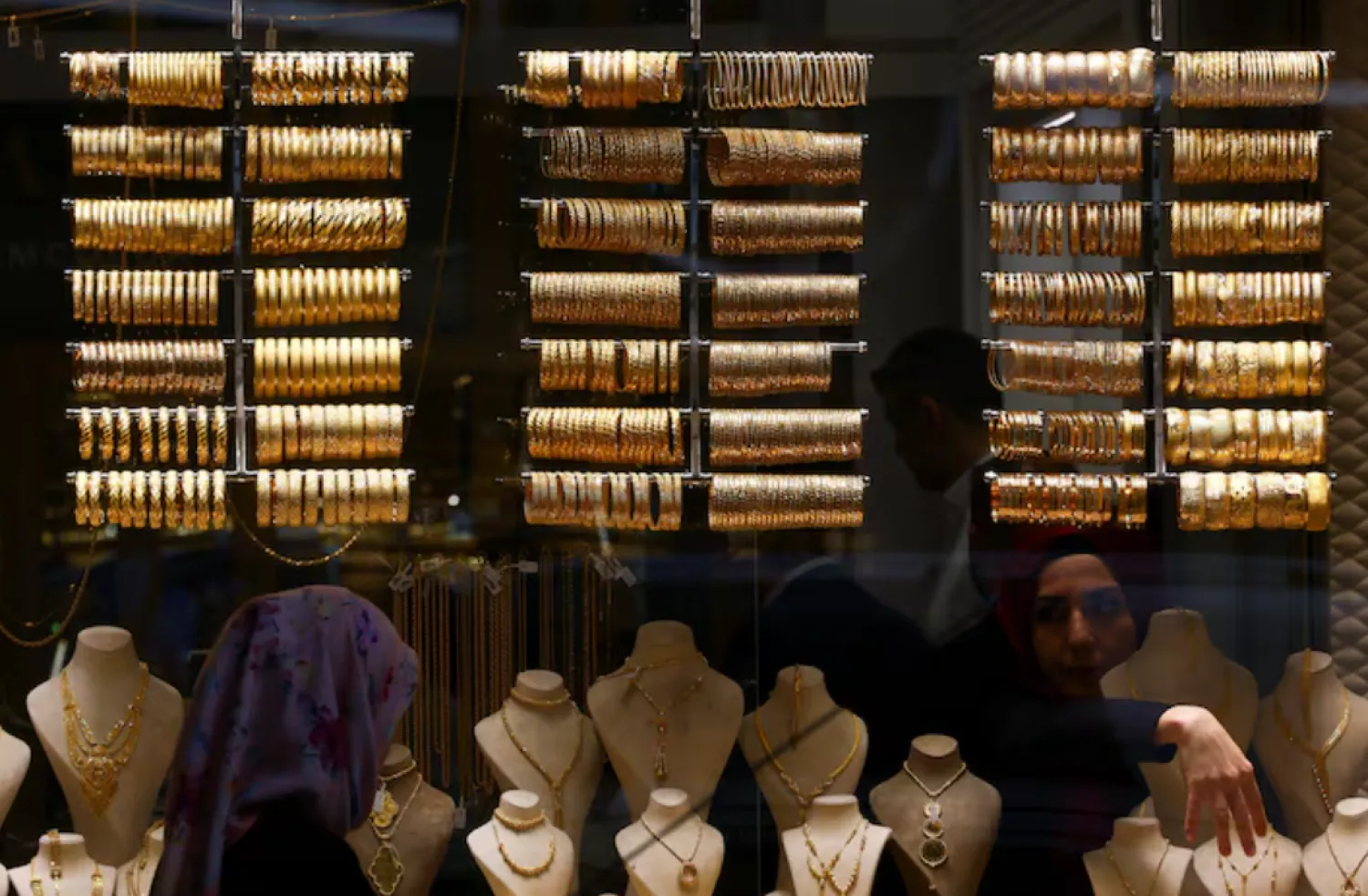
A person passes by a gold shop in Ankara, Turkey May 29, 2023. REUTERS/Yves Herman/File Photo
TT

Gold Eases on Firmer Dollar, Solid US Data

A person passes by a gold shop in Ankara, Turkey May 29, 2023. REUTERS/Yves Herman/File Photo

Gold prices edged lower on Thursday, weighed down by a stronger dollar and robust US economic data, while caution persisted as markets awaited clarity on tariff developments.

Spot gold fell 0.3% to $3,337.43 per ounce by 0155 p.m. EDT (1755 GMT) after hitting a session low of $3,309.59.

US gold futures settled 0.4% lower at $3,345.3.

Following the latest US data, "there was a bit of rise in the dollar and US Treasury yields are higher. So, it's put a little weakness in the gold market," said Bob Haberkorn, senior market strategist at RJO Futures, Reuters reported.

The dollar gained 0.3%, making the greenback-priced gold more expensive for foreign currency holders.

US jobless claims fell last week, pointing to steady job growth in July, while retail sales data beat expectations, adding 0.6% last month, though some of the gain likely reflected tariff-driven price increases.

Fed Governor Adriana Kugler said the Fed should not cut interest rates "for some time" as the impact of Trump administration tariffs begins to pass through to prices.

Gold is often regarded as a hedge against uncertainty and inflation, but higher interest rates diminish its appeal, as it yields no interest.

On the trade front, Japan's top trade negotiator held talks with the US Commerce Secretary on US tariffs, as Tokyo races to avert a 25% levy that will be imposed unless a deal is clinched by an August 1 deadline.

"If Trump follows through on his threats and trade tensions escalate, it’s not a stretch to imagine gold challenging — and potentially breaking- its record highs again," said Fawad Razaq, market analyst at City Index and FOREX.com.

Meanwhile, gold exports from Switzerland jumped 44% month-on-month in June as bullion flew back to the vaults in the United Kingdom from the US via Swiss refineries, Swiss customs data showed on Thursday.

Palladium was up 3.8% at $1,277.78, reaching its highest level since September 2023.

Fears of an escalating war in Russia, a major palladium exporter, are fuelling supply concerns and driving prices higher, Haberkorn said.

Elsewhere, spot silver added 0.3% to $38.07 per ounce and platinum gained 3.1% to $1,460.13.


UK Suffers OECD's Biggest Growth Downgrade as Iran War Pushes Up Energy Costs

This overhead view shows buildings along the River Thames in London on March 25, 2026. (Photo by JUSTIN TALLIS / AFP)
TT

UK Suffers OECD's Biggest Growth Downgrade as Iran War Pushes Up Energy Costs

This overhead view shows buildings along the River Thames in London on March 25, 2026. (Photo by JUSTIN TALLIS / AFP)

Britain's economic ‌growth prospects this year received the sharpest downgrade of any major economy in the OECD's interim forecast update on Thursday following the US-Israeli war ​on Iran, while inflation is set to rise faster too.

The Paris-based international body cut its 2026 forecast for British economic growth by half a percentage point to 0.7%, compared with a 0.4 percentage point downgrade for the euro zone and a 0.3 percentage point upgrade for the United States.

"Planned fiscal tightening and higher energy prices ‌are anticipated to keep ‌growth subdued in the United ​Kingdom, ‌though the ⁠impact ​will be ⁠attenuated by lower policy rates next year," Reuters quoted the OECD as saying in its report.

Following are further highlights from the report and other context:

Britain's growth forecast for 2027 is unchanged at 1.3%.

Britain's inflation forecast for 2026 is revised up by 1.5 percentage points from December to 4.0%, the ⁠biggest upward revision of any large, advanced ‌economy.

UK inflation in 2027 ‌is forecast to be 2.6%, 0.5 percentage ​points higher than in ‌December and above the Bank of England's 2% target.

Poorer UK households spend more on gas and electricity than in other rich countries, though total energy spending makes up a smaller share of UK inflation than elsewhere.

The OECD expects the ‌BoE to keep interest rates unchanged this year then cut in Q1 2027 as inflation ⁠eases.

⁠Britain's Office for Budget Responsibility, in forecasts finalized just before the start of the conflict, predicted GDP growth of 1.1% this year and 1.6% in 2027.

The BoE this month forecast inflation would rise to 3.0-3.5% over the next couple of quarters.

Prime Minister Keir Starmer has made boosting growth and reducing the cost of living top goals for his government.

Finance minister Rachel Reeves said the forecasts showed the war in the Middle East ​was affecting Britain but ​she would still focus on "regional growth, embracing AI and innovation, and establishing a closer relationship with the EU."


Gold Drops More than 1% as Markets Assess Mideast Ceasefire Prospects

FILED - 16 March 2023, Bavaria, Munich: Gold bars and coins lie on the table at the Precious metal dealership Pro Aurum. Photo: Sven Hoppe/dpa
TT

Gold Drops More than 1% as Markets Assess Mideast Ceasefire Prospects

FILED - 16 March 2023, Bavaria, Munich: Gold bars and coins lie on the table at the Precious metal dealership Pro Aurum. Photo: Sven Hoppe/dpa

Gold prices fell on Thursday, weighed down by increased expectations of US Federal Reserve rate hikes this year as elevated oil prices stoked inflation worries, with investors awaiting clarity on Middle East de-escalation efforts.

Spot gold fell 1.2% to $4,451.47 per ounce by 0811 GMT. US gold futures for April delivery lost 2.3% to $4,448.

"You're ‌seeing an ‌acceleration of the idea that... this war will ‌mean ⁠inflation and inflation ⁠will mean a response from central banks, which will mean higher interest rates," said Ilya Spivak, head of global macro at Tastylive.

Brent crude futures climbed back above $100 a barrel on concerns that protracted fighting in the Middle East will further disrupt energy flows.

Higher crude prices tend to fuel inflation, and while rising inflation typically boosts gold's appeal ⁠as a hedge, high interest rates weigh on ‌demand for the non-yielding asset.

Markets see ‌a 37% chance of a US rate hike by December this year ‌with almost no chance of a cut now, according to ‌CME Group's FedWatch Tool. Before the conflict, markets were expecting at least two rate cuts.

US President Donald Trump said Iran was desperate to make a deal to end nearly four weeks of fighting, contradicting the Iranian foreign ‌minister who said his country was reviewing a US proposal but had no intention of holding talks ⁠to wind down ⁠the conflict.

"In the next 24 to 48 hours, (gold prices) will just be about reacting to headlines about negotiations," said Kyle Rodda, a senior financial market analyst at Capital.com.

"The really big moves will happen probably at the start of next week when it becomes clearer whether the US launches a ground invasion in Iran over the weekend."

Trump has vowed to hit Iran harder if Tehran fails to accept that the country has been "defeated militarily", White House press secretary Karoline Leavitt said on Wednesday.

Spot silver fell 2.7% to $69.36 per ounce. Spot platinum was down 2.3% at $1,874.90, while palladium dropped 2.5% to $1,387.53.


Oil Climbs and Equities Sink amid Mixed Messages on 'Talks'

FILE PHOTO: An oil refinery in the Keihin Industrial Zone in Kawasaki, south of Tokyo, Japan March 17, 2026.  REUTERS/Issei Kato/File Photo
FILE PHOTO: An oil refinery in the Keihin Industrial Zone in Kawasaki, south of Tokyo, Japan March 17, 2026. REUTERS/Issei Kato/File Photo
TT

Oil Climbs and Equities Sink amid Mixed Messages on 'Talks'

FILE PHOTO: An oil refinery in the Keihin Industrial Zone in Kawasaki, south of Tokyo, Japan March 17, 2026.  REUTERS/Issei Kato/File Photo
FILE PHOTO: An oil refinery in the Keihin Industrial Zone in Kawasaki, south of Tokyo, Japan March 17, 2026. REUTERS/Issei Kato/File Photo

Oil prices jumped and equities fell Thursday as investors tracked developments in the Middle East amid hopes that US and Iranian officials will bring an end to a conflict that has ramped up fears of an unprecedented global energy crisis.

Markets have been buoyed since late Monday after Donald Trump backed down on a threat to destroy Iran’s energy infrastructure and said the two sides were in peace talks.

But while crude prices are down from last week and the mood on trading floors has been better than most of March, uncertainty and the virtual closure of the Strait of Hormuz -- through which around 20 percent of oil and gas passes -- continue to cast a dark shadow.

Washington presented a 15-point plan to end the war, including Iran giving up its enriched uranium and opening up the waterway, while Tehran's state-run TV reported officials had put forward their own five conditions for hostilities to end.

Trump on Wednesday threatened to "unleash hell" if Iran did not strike a deal, but Foreign Minister Abbas Araghchi said his country does not intend to negotiate.

But the US president also said Iran was taking part in peace talks and the denials were because negotiators feared being killed by their own side.

"Pressure on energy prices, shipping flows and broader financial conditions remains one of the few meaningful sources of leverage (Iran) retains," said Saxo Markets' Charu Chanana.

"There is therefore little incentive to relinquish that leverage prematurely, particularly if market stress strengthens its negotiating position.

However, she added: "It would be imprudent to assume diplomacy is absent simply because it is not visible. In conflicts of this nature, public rhetoric and private negotiation often diverge materially.

"Markets understand this dynamic, and they also tend to inflect before the political endgame is formally in place."

With investors holding on to hope that a deal can be struck, oil prices have stabilized this week, with Brent just above $100 and WTI around $90.

Both contracts rallied Thursday.

Stocks in Wall Street and Europe rose but Asian markets struggled after a two-day rally.

Tokyo, Hong Kong, Shanghai, Seoul, Sydney, Taipei, Singapore, Manila, Bangkok and Jakarta fell along with London, Paris and Frankfurt.

City Index's Fiona Cincotta said for any recovery to gain traction, "investors will want to see clearer signs of de-escalation, including the reopening of the Strait of Hormuz".

Her remarks come after the head of the International Chamber of Commerce, John Denton, warned the conflict could cause the "worst industrial crisis" in decades.

"The head of the International Energy Agency has warned that the world is facing an energy crisis more severe than the oil shocks of the 1970s," he added.

"From a business perspective, we believe this could yet become the worst industrial crisis in living memory."

Meanwhile, the World Trade Organization said disruptions to fertilizer supplies posed a double threat to global food security through scarcity and high prices, with a third of the global fertilizer supply normally transiting the Strait of Hormuz.