


Saudi-Syrian Investment Forum 2025 Aims for Lasting Economic Partnership

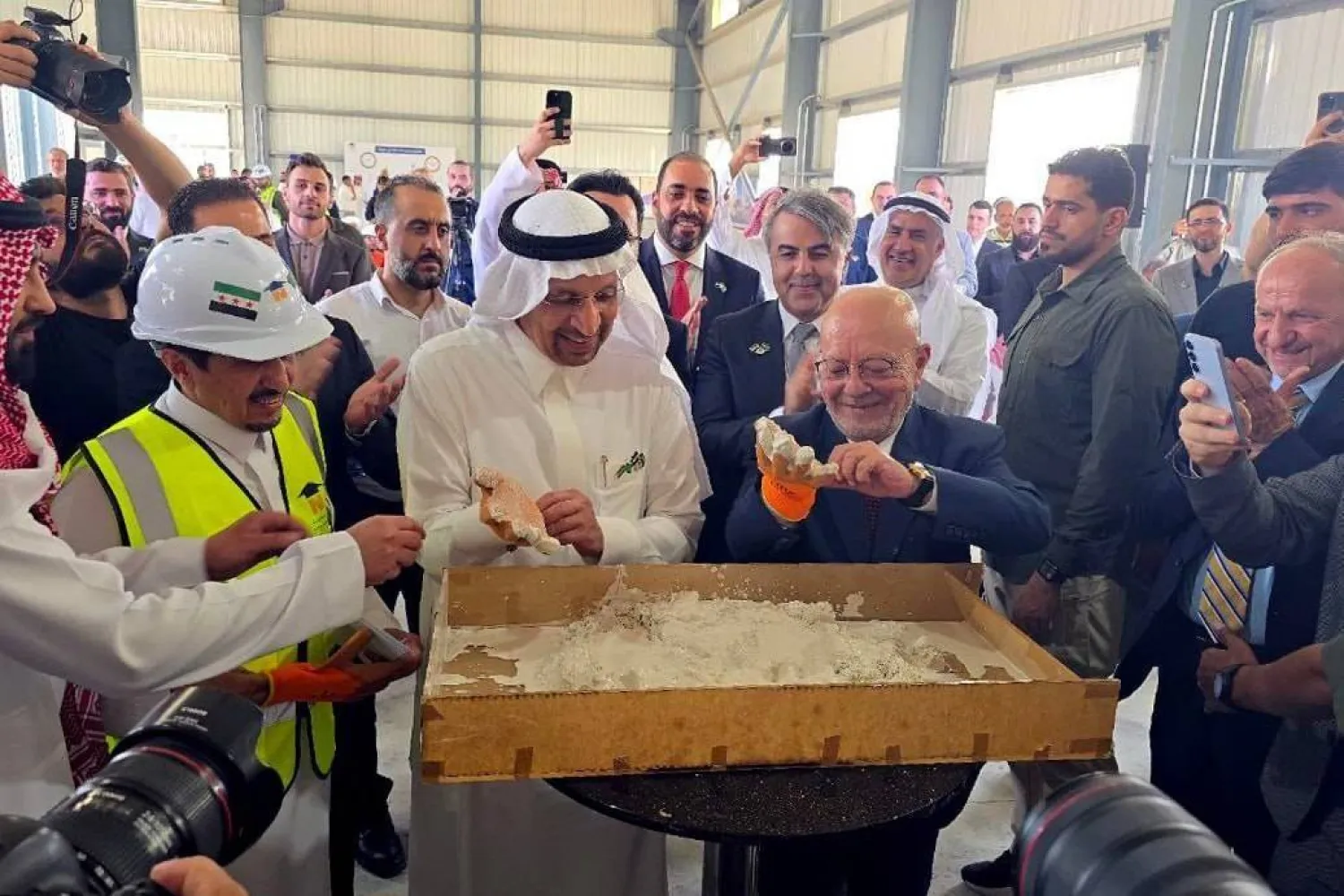
Investment Minister Khalid Al-Falih laid the foundation stone for the “'Fayhaa'” white cement factory in Adra Industrial City, northeast of Damascus (SANA)
TT

Saudi-Syrian Investment Forum 2025 Aims for Lasting Economic Partnership

Investment Minister Khalid Al-Falih laid the foundation stone for the “'Fayhaa'” white cement factory in Adra Industrial City, northeast of Damascus (SANA)

Saudi Arabia’s growing role in Syria’s post-war reconstruction took a major step on Thursday with the launch of the 2025 Saudi-Syrian Investment Forum in Damascus, underscoring Crown Prince Mohammed bin Salman’s push to anchor Riyadh’s influence in shaping Syria’s future economy.

Held under the Crown Prince’s directive, the forum marks a significant political and economic milestone, signaling the Kingdom’s intent to forge a sustainable partnership with the Syrian government and position itself as a key driver of reconstruction and development in the war-ravaged country.

High-Level Delegation and Billion-Dollar Deals

A Saudi delegation led by Investment Minister Khalid Al-Falih arrived in Damascus on Wednesday, accompanied by more than 120 investors. The high-level visit, expected to result in the signing of dozens of agreements worth billions of dollars, was met with an official reception by Syria’s ministers of economy, energy, and telecommunications.

Also greeting the delegation were Saudi Ambassador to Syria Faisal Al-Mujfel, embassy officials, and figures from both public and private sectors.

The forum, announced earlier by Saudi Arabia’s Ministry of Investment, aims to deepen bilateral economic ties and identify joint investment opportunities across key sectors.

Saudi Investment on the Ground

During the visit, Al-Falih laid the foundation stone for the “'Fayhaa'” white cement factory in Adra Industrial City, northeast of Damascus. The facility, slated for completion within months, is among the first major Saudi investments in Syria following a series of exploratory business visits.

Speaking to reporters at the site, Al-Falih said dozens of Saudi companies were ready to invest in Syria across construction, energy, agriculture, IT, and industrial sectors.

“We will announce tomorrow the planned investment volumes for the Syrian market,” he added.

The white cement plant is valued at around 100 million riyals ($27 million) with a projected annual output of 150,000 tons. It is expected to create 130 direct jobs and more than 1,000 indirect positions.

Reviving a War-Torn Economy

The forum comes as the Syrian government, now led by President Ahmed Al-Sharaa following the ouster of Bashar al-Assad late last year, seeks to attract international investors to help rebuild a country devastated by 14 years of war.

While UN estimates put Syria’s reconstruction needs at $400 billion, Damascus says the actual cost could reach $600 billion.

Riyadh has also led high-level diplomatic efforts to ease Western sanctions on Syria. The campaign culminated in US President Donald Trump’s decision to lift certain restrictions during his recent visit to Riyadh, following discussions with the Saudi Crown Prince.

"Start of a New Chapter"

Issam Zuhair Al-Ghreiwati, Deputy Chairman of the Syrian Chambers of Commerce and head of Damascus’s Chamber of Commerce, called the Saudi delegation “the largest and most significant from any Arab country.”

“This is the most important economic event in Syria since the liberation and the relaunch of our economy,” Al-Ghreiwati told Asharq Al-Awsat.

He said Saudi investors were returning after 14 years of absence, marking a “new era of cooperation” between the two countries.

“Syria was off the investment map due to the previous regime,” he said. “Now, with the rise of a new government and the immense financial surpluses in Saudi Arabia looking for emerging markets, we are entering what could become the largest Arab economic partnership.”

Al-Ghreiwati said Syria had reformed investment laws, liberalized foreign exchange controls, and modernized trade regulations, rapidly shifting toward a free-market economy. “We now have one of the most attractive investment landscapes in the region,” he said.

Saudi Commitment Seen as Transformational

He added that the most critical takeaway from the forum was Saudi Arabia’s confidence in Syria’s recovery. “This isn’t just about money; it’s about belief in Syria’s future,” he said. “The Kingdom sees Syria as a nation rebounding from crisis, not a liability. There’s no turning back.”

The private sector, he said, sees this event as “the official green light for reconstruction, with Saudi Arabia leading the economic charge.”

Challenges Remain

Despite the optimism, experts warn that Syria’s fragile economy faces major hurdles, including inflation, currency volatility, and limited purchasing power.

Mohammad Al-Hallak, deputy head of the Economic Sciences Association and former vice president of Damascus’s Chamber of Commerce, said the focus now must be on restoring industrial output and job creation.

“We need to restart the production cycle quickly,” Al-Hallak told Asharq Al-Awsat. “This forum must go beyond talks. We need actionable partnerships.”

He urged Saudi Arabia to support Syrian exports through specialized exhibitions and to foster demand for Syrian products. “Increased demand drives production, which creates jobs and strengthens purchasing power,” he said.

Al-Hallak also called for the creation of a Saudi-Syrian joint bank to facilitate cross-border financial transactions and investment flows. “That would be the most practical first step to convert goodwill into real momentum,” he said.

‘Syria Is Thirsty for Investment’

“There are enormous investment opportunities here—in tourism, trade, industry, agriculture, insurance, banking, and the stock market,” Al-Hallak said. “Syria is one of the most investment-hungry nations in the world right now.”

He emphasized that Riyadh’s leadership sees Syria not through a lens of transactional interest but as a country to support and integrate into a shared economic future.

“Crown Prince Mohammed bin Salman is not dealing with Syria as an equal party in negotiation,” he said. “He sees it as a responsibility—Saudi Arabia is stepping in to help rebuild, not to exploit.”

When asked if there was an estimate of the total investment Syria needs in the next phase, Al-Hallak replied: “There’s no ceiling. Syria will absorb every dollar that comes its way. This is just the beginning.”



Saudi Industry Ministry Signs MoUs to Advance Manufacturing Empowerment

The agreements were signed during the "Industrial Transformation Saudi Arabia 2025” Exhibition. SPA
TT

Saudi Industry Ministry Signs MoUs to Advance Manufacturing Empowerment

The agreements were signed during the "Industrial Transformation Saudi Arabia 2025” Exhibition. SPA

The Ministry of Industry and Mineral Resources has signed a number of memoranda of understanding (MoUs) with leading local and international companies to advance advanced manufacturing, support local content, and strengthen national supply chains, enhancing the regional and global competitiveness of Saudi industry.

The agreements were signed during the "Industrial Transformation Saudi Arabia 2025” Exhibition, organized by the ministry in partnership with Deutsche Messe and Riyadh Exhibitions Company Ltd.

The ministry signed two memoranda to provide innovative financing solutions for industrial establishments, strengthen national supply chains, and support local content.

Additionally, the ministry's National Center for Advanced Manufacturing and Production signed several memoranda of understanding with local and international industrial and advisory companies to support the path of advanced manufacturing, develop supply chains, enhance technological innovation, and boost the competitiveness of national factories, in line with the National Industrial Strategy and Saudi Vision 2030.

These strategic partnerships are part of the ministry's ongoing efforts to develop the Kingdom's industrial ecosystem, enable manufacturers to access the latest industrial solutions, support supply chain development, and stimulate innovation, contributing to the building of a sustainable industrial sector that competes regionally and globally.


China Says Working on Streamlining Rare Earth Export Licenses

FILE PHOTO: Workers transport soil containing rare earth elements for export at a port in Lianyungang, Jiangsu province, China October 31, 2010. REUTERS/Stringer/File Photo
TT

China Says Working on Streamlining Rare Earth Export Licenses

FILE PHOTO: Workers transport soil containing rare earth elements for export at a port in Lianyungang, Jiangsu province, China October 31, 2010. REUTERS/Stringer/File Photo

China said on Thursday it is working on streamlining rare earth export licenses - a key promised outcome after a meeting between US President Donald Trump and his counterpart Xi Jinping.

"The government is actively adapting," Commerce Ministry spokesman He Yadong told reporters at a weekly briefing, adding that authorities "were aligning themselves with general license mechanisms".

Reuters reported on Tuesday that at least three Chinese rare earth magnet makers had secured licenses enabling them to accelerate exports to some customers.

He did not say if new licenses had been issued.

China began designing the new rare earth licensing regime following a late October meeting between Trump and Xi that eased trade tensions between the two countries.


Saudi Aramco's Jafurah Gas Plant Begins Output with 450 Million Cubic Feet Per Day

The resources at Jafurah are now estimated at 229 trillion standard cu ft of gas and 75 billion barrels of condensates. (Saudi Aramco)
TT

Saudi Aramco's Jafurah Gas Plant Begins Output with 450 Million Cubic Feet Per Day

The resources at Jafurah are now estimated at 229 trillion standard cu ft of gas and 75 billion barrels of condensates. (Saudi Aramco)

The first phase of oil giant Aramco's Jafurah gas plant is complete and production has begun with a capacity of 450 million cubic feet per day, the Saudi finance ministry said on Tuesday.

The finance ministry, in its 2026 budget statement, listed the milestone as an achievement reached in 2025.

Jafurah's gas output will be used for domestic power generation, freeing up crude for export that is currently used for power in the kingdom.

Aramco has said its unconventional gas program at peak production is expected to generate electricity equivalent to displacing 500,000 barrels per day of oil.

The $100 billion Jafurah project, estimated to contain 229 trillion standard cubic feet of raw gas, is central to Aramco's ambitions to become a major global player in natural gas and boost its gas production capacity.

Aramco's gas production was 12.6 billion cubic feet per day at the end of September, up from 12 bcfd a year earlier.

Aramco last month said it was boosting its gas growth target to 80% above 2021 levels from a previous targeted growth of 60%.

In its 2021 annual report, Aramco said it reached a single-day record gas output at the time of 10.8 bcfd.

Aramco CEO Amin Nasser, who has called Jafurah a crown jewel in the company's portfolio, said during an earnings call last month the first phase was on track for completion by the end of this year.