
Trump, EU Chief to Meet Sunday in Push for Trade Deal

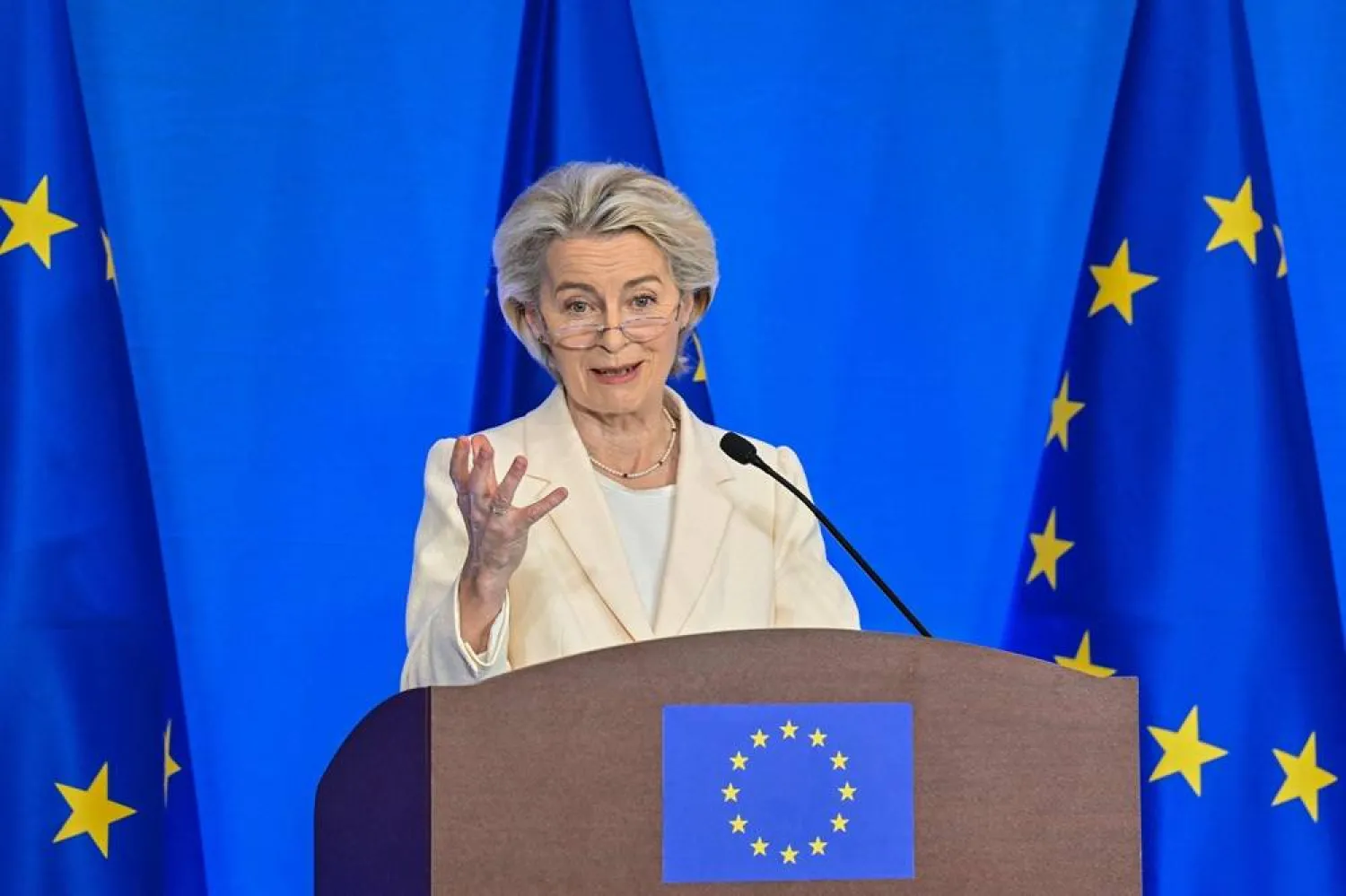
 President of the European Commission Ursula von der Leyen speaks during a joint press conference with President of European Council Antonio Costa after the 25th EU-China summit in Beijing on July 24, 2025. (AFP)
President of the European Commission Ursula von der Leyen speaks during a joint press conference with President of European Council Antonio Costa after the 25th EU-China summit in Beijing on July 24, 2025. (AFP)
TT

Trump, EU Chief to Meet Sunday in Push for Trade Deal

 President of the European Commission Ursula von der Leyen speaks during a joint press conference with President of European Council Antonio Costa after the 25th EU-China summit in Beijing on July 24, 2025. (AFP)
President of the European Commission Ursula von der Leyen speaks during a joint press conference with President of European Council Antonio Costa after the 25th EU-China summit in Beijing on July 24, 2025. (AFP)

EU chief Ursula von der Leyen and US President Donald Trump said Friday they would meet in Scotland this weekend in a decisive push to resolve a months-long transatlantic trade standoff.

In a drive to slash his country's trade deficits, Trump has vowed to hit dozens of countries with punitive tariff hikes if they do not hammer out a pact with Washington by August 1.

The EU -- which is facing an across-the-board levy of 30-percent -- has been pushing hard for a deal with Trump's administration, while also planning retaliation should talks fall short.

Von der Leyen first announced the meeting, writing on X: "Following a good call with POTUS, we have agreed to meet in Scotland on Sunday to discuss transatlantic trade relations, and how we can keep them strong."

Arriving on UK soil late Friday, Trump confirmed he would meet the head of the European Commission, which has been negotiating with Washington on behalf of the 27-nation bloc.

"I'll be meeting with the EU on Sunday, and we'll be working on a deal," he told reporters as he touched down at Prestwick Airport near Glasgow.

"Ursula will be here -- a highly respected woman. So we look forward to that," Trump said.

"We'll see if we make a deal," added the president -- who reiterated earlier comments saying the chance of a deal was "50-50", with sticking points remaining on "maybe 20 different things."

"But we're meeting ... with the European Union. And that would be, actually, the biggest deal of them all, if we make it," he said.

The high-level meeting follows months of negotiations between top EU and US trade officials, and days of signals suggesting the sides were moving towards an agreement.

According to multiple European diplomats, the agreement under consideration would involve a baseline 15-percent US levy on EU goods -- the same level secured by Japan this week -- and potential carve-outs for critical sectors.

Von der Leyen's spokesperson Paula Pinho said "intensive negotiations" had been taking place at technical and political level in the run up to Sunday's meeting.

"Leaders will now take stock and consider the scope for a balanced outcome that provides stability and predictability for businesses and consumers on both sides of the Atlantic," she said.

Hit by multiple waves of tariffs since Trump reclaimed the White House, the EU is currently subject to a 25-percent levy on cars, 50 percent on steel and aluminium, and an across-the-board tariff of 10 percent, which Washington threatens to hike to 30 percent in a no-deal scenario.

The EU wants to avoid sweeping tariffs inflicting further harm on the European economy -- already suffering from sluggish growth -- and damaging a trading relationship worth an annual 1.6 trillion euros ($1.9 trillion) in goods and services.

EU member states gave the European Commission a mandate to pursue a deal to avoid hefty US tariffs, with retaliation held out as a last resort if talks fail.

Seeking to keep up the pressure in the final stretch of talks, EU states on Thursday backed a package of retaliation on $109 billion (93 billion euros) of US goods including aircraft and cars -- to kick in in stages from August 7 if there is no deal.

Most states prefer a deal to no deal -- even with undesirable levies of 15 percent -- but exemptions are key, with aircraft, steel, lumber, pharmaceutical products and agricultural goods under discussion, diplomats said.

Concerning steel, diplomats say a compromise could allow a certain quota to enter the United States, with amounts beyond that taxed at 50 percent.

Since launching its tariffs campaign, Trump's administration has so far unveiled just five agreements, including with Britain, Japan and the Philippines.

While EU hopes have been rising for a deal, the approaching August 1 deadline also comes with a sense of deja-vu: earlier this month, EU officials also believed they were on the cusp of a deal, before Trump hiked his tariff threat to 30-percent.

"The final decision is in the hands of President Trump," an EU diplomat stressed this week.


Oil Climbs and Equities Sink amid Mixed Messages on 'Talks'

FILE PHOTO: An oil refinery in the Keihin Industrial Zone in Kawasaki, south of Tokyo, Japan March 17, 2026.  REUTERS/Issei Kato/File Photo
FILE PHOTO: An oil refinery in the Keihin Industrial Zone in Kawasaki, south of Tokyo, Japan March 17, 2026. REUTERS/Issei Kato/File Photo
TT

Oil Climbs and Equities Sink amid Mixed Messages on 'Talks'

FILE PHOTO: An oil refinery in the Keihin Industrial Zone in Kawasaki, south of Tokyo, Japan March 17, 2026.  REUTERS/Issei Kato/File Photo
FILE PHOTO: An oil refinery in the Keihin Industrial Zone in Kawasaki, south of Tokyo, Japan March 17, 2026. REUTERS/Issei Kato/File Photo

Oil prices jumped and equities fell Thursday as investors tracked developments in the Middle East amid hopes that US and Iranian officials will bring an end to a conflict that has ramped up fears of an unprecedented global energy crisis.

Markets have been buoyed since late Monday after Donald Trump backed down on a threat to destroy Iran’s energy infrastructure and said the two sides were in peace talks.

But while crude prices are down from last week and the mood on trading floors has been better than most of March, uncertainty and the virtual closure of the Strait of Hormuz -- through which around 20 percent of oil and gas passes -- continue to cast a dark shadow.

Washington presented a 15-point plan to end the war, including Iran giving up its enriched uranium and opening up the waterway, while Tehran's state-run TV reported officials had put forward their own five conditions for hostilities to end.

Trump on Wednesday threatened to "unleash hell" if Iran did not strike a deal, but Foreign Minister Abbas Araghchi said his country does not intend to negotiate.

But the US president also said Iran was taking part in peace talks and the denials were because negotiators feared being killed by their own side.

"Pressure on energy prices, shipping flows and broader financial conditions remains one of the few meaningful sources of leverage (Iran) retains," said Saxo Markets' Charu Chanana.

"There is therefore little incentive to relinquish that leverage prematurely, particularly if market stress strengthens its negotiating position.

However, she added: "It would be imprudent to assume diplomacy is absent simply because it is not visible. In conflicts of this nature, public rhetoric and private negotiation often diverge materially.

"Markets understand this dynamic, and they also tend to inflect before the political endgame is formally in place."

With investors holding on to hope that a deal can be struck, oil prices have stabilized this week, with Brent just above $100 and WTI around $90.

Both contracts rallied Thursday.

Stocks in Wall Street and Europe rose but Asian markets struggled after a two-day rally.

Tokyo, Hong Kong, Shanghai, Seoul, Sydney, Taipei, Singapore, Manila, Bangkok and Jakarta fell along with London, Paris and Frankfurt.

City Index's Fiona Cincotta said for any recovery to gain traction, "investors will want to see clearer signs of de-escalation, including the reopening of the Strait of Hormuz".

Her remarks come after the head of the International Chamber of Commerce, John Denton, warned the conflict could cause the "worst industrial crisis" in decades.

"The head of the International Energy Agency has warned that the world is facing an energy crisis more severe than the oil shocks of the 1970s," he added.

"From a business perspective, we believe this could yet become the worst industrial crisis in living memory."

Meanwhile, the World Trade Organization said disruptions to fertilizer supplies posed a double threat to global food security through scarcity and high prices, with a third of the global fertilizer supply normally transiting the Strait of Hormuz.


EU to Vote on Trump Tariff Deal -- but Eyes Rest of World

The European Parliament will vote on whether to cut EU tariffs on some US imports. CHARLY TRIBALLEAU / AFP/File
TT

EU to Vote on Trump Tariff Deal -- but Eyes Rest of World

The European Parliament will vote on whether to cut EU tariffs on some US imports. CHARLY TRIBALLEAU / AFP/File

European Union lawmakers are on track to give a green light -- with conditions -- Thursday to the bloc's tariff deal with US President Donald Trump, which Europe hopes to salvage while also racing to diversify its trade ties around the globe.

Brussels and Washington clinched the deal last summer that had set tariffs at 15 percent for most EU goods.

But Trump's 2025 tariff blitz, including hefty levies on steel, aluminium and car parts, has jolted the 27-country bloc into cultivating trade ties around the world.

From deals signed with South America to Australia, the EU has its eyes on many prizes.

But that doesn't mean the EU intends to walk away from the 1.6 trillion euro ($1.9 trillion) relationship with its main trade partner, the United States, AFP reported.

The European Parliament is voting Thursday on whether to cut EU tariffs on some US imports -- as a first step towards implementing the 2025 deal -- but with additional safeguards.

The potential green light comes after months of delay as lawmakers resisted approving the accord due to transatlantic tensions over Greenland -- and then put it on hold again following the US Supreme Court's ruling striking down Trump's levies.

The ball started rolling again after the European Commission, in charge of EU trade policy, said it would stick to the pact despite the US ruling and called on lawmakers to do the same, having received reassurances from Washington.

Trump, however, retaliated after the ruling with a new tariff regime -- pushing EU lawmakers to tighten the existing agreement with numerous safeguards.

- Losing access to US energy? -

Lawmakers leading on trade have added several provisions: making an EU tariff reduction automatically lapse in March 2028, and tying tariff cuts on steel and aluminium goods to similar reductions by the US side.

Not all members of the parliament are convinced. French EU lawmakers from the centrist Renew group have said they will vote against the agreement.

"The only political value this agreement had to offer was stability and predictability, even if many say it's an unfair deal. If it no longer even provides predictability, there's no reason to support the deal, even if it has been improved," said MEP Pascal Canfin.

The United States has urged the bloc to implement the agreement.

Washington's ambassador to the EU Andrew Puzder told the Financial Times that if the bloc delayed further, it risked losing "favorable" access to US liquefied natural gas at a time when the Middle East war has led to surging energy costs.

Before the US tariff deal is implemented by the bloc, it still needs to be negotiated with EU member states -- although Brussels hopes talks will go quickly.

- 'Trump factor' -

It is the EU's vulnerability to the consequences of wars and other shocks that has pushed Commission chief Ursula von der Leyen to make diversifying trading partners a priority, to cut overdependence on the United States and China.

The frenzy began with a long-awaited accord signed with the South American Mercosur bloc in January. Weeks later, Brussels struck another pact with India and just this week clinched a stalled deal with Australia.

"The Trump factor sped up their conclusion, for us as well as for our partners," economist Andre Sapir said.

Spurred by Trump, Sapir said, the EU has been pushing to create the world's largest network of free trade areas -- a strategy with a "defensive dimension" allowing it to resist trade "coercion".

"This free trade network carries weight in our discussions with the two giants, the United States and China," he said.

"These agreements are part of our arsenal," Sapir, of the Bruegel think tank, added. "Our strategic weapons in the international order."


China Shipping Giant Cosco Resumes Bookings to Some Gulf Countries

A cargo ship operated by Cosco Shipping is docked at the foreign trade container terminal of Qingdao Port, operated by Shandong Port Group, in China's eastern Shandong province on March 25, 2026. (Photo by CN-STR / AFP)
TT

China Shipping Giant Cosco Resumes Bookings to Some Gulf Countries

A cargo ship operated by Cosco Shipping is docked at the foreign trade container terminal of Qingdao Port, operated by Shandong Port Group, in China's eastern Shandong province on March 25, 2026. (Photo by CN-STR / AFP)

Chinese shipping giant Cosco said on Wednesday that it was resuming new bookings for container shipments to some Gulf countries, after a three-week suspension in response to the Middle East war.

The state-owned, Shanghai-based firm was among several major shipping groups to pause operations in the Strait of Hormuz, a key waterway through which one-fifth of the world's oil and gas passes normally.

Tehran has said several times it was not targeting friendly nations, but transits through the Strait had nevertheless largely ground to a halt.

Iran said in a statement circulated by the International Maritime Organization on Tuesday that "non-hostile vessels" would be granted safe passage through the waterway.

Cosco "resumed new bookings for general cargo containers for shipments" from the "Far East" to the UAE, Saudi Arabia, Bahrain, Qatar, Kuwait, and Iraq "with immediate effect", according to a company statement.

It did not mention shipments travelling in the opposite direction, from the Gulf.

"New booking arrangements and the actual carriage are subject to change due to the volatile situation in the Middle East region," it added.

Cosco, which operates one of the world's largest oil tanker fleets, announced on March 4 that it would suspend new bookings for services for routes through the Strait of Hormuz owing to the "escalating conflicts in the Middle East region and resultant restrictions on maritime traffic".