Oil Regains Ground from 2-month Lows ahead of Trump-Putin Meeting

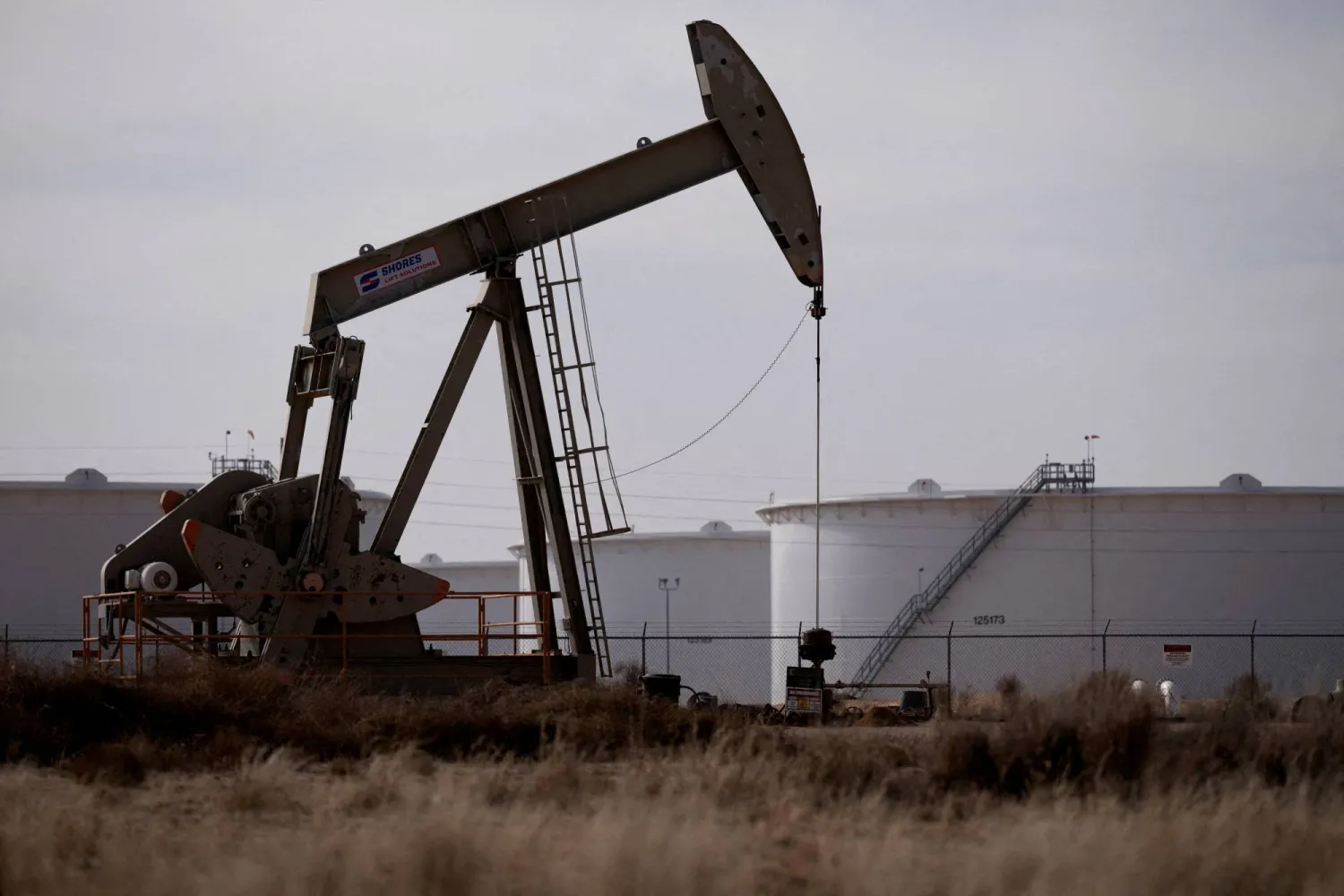
FILE PHOTO: A pump jack operates near a crude oil reserve in the Permian Basin oil field near Midland, Texas, US February 18, 2025.  REUTERS/Eli Hartman/File Photo
FILE PHOTO: A pump jack operates near a crude oil reserve in the Permian Basin oil field near Midland, Texas, US February 18, 2025. REUTERS/Eli Hartman/File Photo
TT

Oil Regains Ground from 2-month Lows ahead of Trump-Putin Meeting

FILE PHOTO: A pump jack operates near a crude oil reserve in the Permian Basin oil field near Midland, Texas, US February 18, 2025.  REUTERS/Eli Hartman/File Photo
FILE PHOTO: A pump jack operates near a crude oil reserve in the Permian Basin oil field near Midland, Texas, US February 18, 2025. REUTERS/Eli Hartman/File Photo

Oil prices edged higher on Thursday, regaining ground after a sell-off in the previous session, with the upcoming meeting between US President Donald Trump and his Russian counterpart Vladimir Putin raising risk premiums in the market.

Brent crude futures were up 28 cents, or 0.43%, at $65.91 a barrel at 0057 GMT, while US West Texas Intermediate crude futures rose 23 cents, or 0.37%, to $62.89.

Both contracts hit their lowest in two months on Wednesday after bearish supply guidance from the US government and the International Energy Agency (IEA), reported Reuters.

Trump on Wednesday threatened "severe consequences" if Putin does not agree to peace in Ukraine. Trump did not specify what the consequences could be, but he has warned of economic sanctions if the meeting in Alaska on Friday proves fruitless.

"The uncertainty of US-Russia peace talks continues to add a bullish risk premium given Russian oil buyers could face more economic pressure," Rystad Energy said in a client note.

"How Ukraine-Russia crisis resolves and Russia flows change could bring some unexpected surprises."

Another support for oil is that the expectation that the US Federal Reserve will cut rates in September is at close to 100% after US inflation increased at a moderate pace in July.

Treasury Secretary Scott Bessent said he thought an aggressive half-point cut was possible given recent weak employment numbers.

The market is putting the odds of a quarter-percentage point cut at the Fed's September 16-17 meeting at 99.9%, according to the CME FedWatch tool.

Lower borrowing rates would drive demand for oil. The dollar was hovering near multi-week lows against the euro and sterling on Thursday as traders ramped up bets for the Fed to resume cutting interest rates next month.

Oil prices were kept in check as crude inventories in the United States unexpectedly rose by 3 million barrels in the week ended on August 8, according to the US Energy Information Administration on Wednesday, against expectations in a Reuters poll for a 275,000-barrel draw.

Also, holding oil back was an International Energy Agency forecast that 2025 and 2026 world oil supply would rise more rapidly than expected, as the Organization of the Petroleum Exporting Countries and its allies, together known as OPEC+, increase output and production from outside the group grows.


UAE Announces it Is Leaving OPEC, OPEC+

The OPEC logo on the building prior to the 186th Ordinary Meeting of the Organization of Petroleum Exporting Countries (OPEC) at the OPEC headquarters in Vienna, Austria, 03 June 2023. (EPA)
TT

UAE Announces it Is Leaving OPEC, OPEC+

The OPEC logo on the building prior to the 186th Ordinary Meeting of the Organization of Petroleum Exporting Countries (OPEC) at the OPEC headquarters in Vienna, Austria, 03 June 2023. (EPA)

The United Arab Emirates said on Tuesday it was quitting OPEC and OPEC+ with the decision going into effect on May 1.

“This decision reflects the UAE’s long-term strategic and economic vision and evolving energy profile, including accelerated investment in domestic energy production, and reinforces its commitment to a responsible, reliable, and forward-looking role in global energy markets,” it said in a statement carried by the WAM state news agency.

“This decision follows a comprehensive review of the UAE’s production policy and its current and future capacity and is based on our national interest and our commitment to contributing effectively to meeting the market’s pressing needs.”

“The UAE joined OPEC in 1967 through the Emirate of Abu Dhabi and continued its membership following the formation of the United Arab Emirates in 1971. Throughout this period, the UAE has played an active role in supporting global oil market stability and strengthening dialogue among producing nations,” read the statement.

“The decision reflects a policy-driven evolution in the UAE’s approach, enhancing flexibility to respond to market dynamics while continuing to contribute to stability in a measured and responsible manner.”

“Following its exit, the UAE will continue to act responsibly, bringing additional production to market in a gradual and measured manner, aligned with demand and market conditions.”

“This decision does not alter the UAE’s commitment to global market stability or its approach based on cooperation with producers and consumers. Rather, it enhances the UAE’s ability to respond to evolving market needs.”

The UAE “reaffirmed that its production policies will be guided by responsibility and market stability, taking into account global supply and demand.”

“It will continue investing across the energy value chain, including oil, gas, renewables, and low-carbon solutions, to support resilience and long-term energy system transformation.”


Google Cloud CEO to Asharq Al-Awsat: Our Data Centers Are Crisis-Resilient, Not Bound by Borders

Thomas Kurian, CEO of Google Cloud, speaks to Asharq Al-Awsat. (Asharq Al-Awsat)
TT

Google Cloud CEO to Asharq Al-Awsat: Our Data Centers Are Crisis-Resilient, Not Bound by Borders

Thomas Kurian, CEO of Google Cloud, speaks to Asharq Al-Awsat. (Asharq Al-Awsat)

At Google Cloud Next in Las Vegas, Thomas Kurian, chief executive of Google Cloud, responded to a question from Asharq Al-Awsat about attacks on hyperscale cloud data centers amid regional tensions by moving quickly beyond physical protection. The issue, he suggested, is no longer simply how to defend infrastructure, but how to ensure customers are not left dependent on one location when disruption occurs.

Kurian said Google Cloud has managed through global conflict scenarios for many years and has built not only physical safeguards, but also a private global network with extensive redundancy linking its data centers.

The company can shift workloads away from affected locations and replicate them globally because its cloud regions operate as a unified and consistently synchronized architecture, he explained. For customers, he argued, that means they are not tied to a single physical site.

His response moved the discussion from infrastructure protection toward a broader strategic question: whether cloud architecture itself has become part of business continuity planning.

From experimentation to operations

That framing also offered one of the clearest ways to understand Google Cloud’s broader message at Next 2026. Throughout the event, attended by more than 30,000 participants, the company sought to underscore that enterprise AI is moving from experimentation into what it calls the agentic enterprise.

Google Cloud said roughly 75 percent of its customers already use its AI-powered products. Some 330 customers processed more than one trillion tokens over the past 12 months, while more than 35 customers surpassed 10 trillion tokens. The company also said its frontier models now process more than 16 billion tokens per minute, up from 10 billion in the previous quarter.

The purpose of those figures was to signal that AI is no longer a side experiment, but an operational layer companies want to use across their businesses.

Integration and openness together

Perhaps most revealing in the private Q&A with Kurian was what he suggested about where competition is heading. He argued that Google Cloud’s distinguishing advantage lies in combining proprietary chips, frontier models, infrastructure and tools, allowing the company to optimize the entire stack, from computing power to the efficiency of AI agents.

The broader argument was that the next phase of AI will not be determined only by who has the strongest model, but by who can design the broader system around it most effectively. At the same time, Kurian paired this with another point equally important to enterprise customers: openness. He stressed that he does not expect companies to rely exclusively on Google Cloud and said the company has deliberately kept its architecture open.

He pointed to support for multiple models, Google’s own chips, close collaboration with NVIDIA, compatibility with different data platforms and partnerships with third parties in security.

That matters because enterprises want the efficiency of deep integration without being locked into a closed environment. Google Cloud is signaling it can provide a vertically integrated stack while still operating across diverse enterprise technology environments.

Sovereignty at the forefront

Sovereignty also emerged as a major theme. Asked whether European customers would receive the full product offering, Kurian said the broader product is already available in Europe in compliance with sovereignty regulations, hosted across multiple sites including Germany, France, Belgium, the Netherlands, Finland and the United Kingdom.

Though the answer focused on Europe, its significance extends beyond the continent. Enterprise customers, including Saudi Arabia, increasingly want advanced AI services without giving up control over where their data is hosted and processed. That is not a side issue, but part of the architecture of trust itself.

Connectors make the difference

Kurian also addressed another practical issue tied to one of enterprise AI’s real bottlenecks.

Asked who would build the connections between Gemini Enterprise and the many applications companies already use, he said Google Cloud is doing so itself. The company already offers more than 100 connectors covering document repositories, software-as-a-service applications and databases.

He added that Google Cloud also provides a framework for building connectors and supports standards such as Bring Your Own MCP for custom-built systems.

The significance of that point lies at the heart of why many enterprise AI projects struggle: a model may be impressive in isolation, but it only becomes useful when it connects to where work actually happens — documents, business applications, records and databases.

AI and defense

The cybersecurity portion of the discussion was no less significant.

Kurian said Google Cloud recognized some time ago that as models improve at understanding software, malicious actors would use them to analyze code, discover vulnerabilities and attack systems. In his view, the response must also be driven by AI.

He described one layer focused on analyzing and repairing a company’s own code, pointing to a new model called Code Defender that helps fix vulnerabilities.

A second layer focuses on external threats, including threat hunting and threat intelligence. He pointed to Dark Web Intelligence announced at the conference, saying it can prioritize the threats customers should defend against with about 90 percent accuracy.

He also linked this logic to Google Cloud’s acquisition of Wiz, describing a layered model in which a red agent probes systems for weaknesses, a blue team identifies the needed fixes and a green layer carries out remediation.



Saudi Industry Minister Discusses Boosting Industrial Cooperation with Oman

Saudi Minister of Industry and Mineral Resources Bandar Alkhorayef and President of Oman's Public Authority for Special Economic Zones and Free Zones Qais Al-Yousef meet in Riyadh on Monday. (SPA)
TT

Saudi Industry Minister Discusses Boosting Industrial Cooperation with Oman

Saudi Minister of Industry and Mineral Resources Bandar Alkhorayef and President of Oman's Public Authority for Special Economic Zones and Free Zones Qais Al-Yousef meet in Riyadh on Monday. (SPA)

Saudi Minister of Industry and Mineral Resources Bandar Alkhorayef met in Riyadh on Monday with President of Oman's Public Authority for Special Economic Zones and Free Zones Qais Al-Yousef for talks on boosting industrial cooperation and developing joint investments between their countries.

They tackled means to strengthen cooperation in the fields of industrial cities and special economic zones, in addition to developing strategic partnerships that enhance industrial integration between the two countries in a manner that supports regional supply chains and boosts the competitiveness of the Saudi and Omani economies.

They stressed the importance of expanding industrial and investment partnerships, exchanging expertise and experiences in developing industrial infrastructure, and enabling high-quality investments in priority industrial sectors. This aligns with the objectives of the two countries’ national visions, contributing to sustainable economic development and achieving shared interests.

The meeting comes within the framework of strengthening economic relations between Saudi Arabia and Oman and advancing cooperation in the industrial sector to achieve the goals of economic development and industrial integration between them.