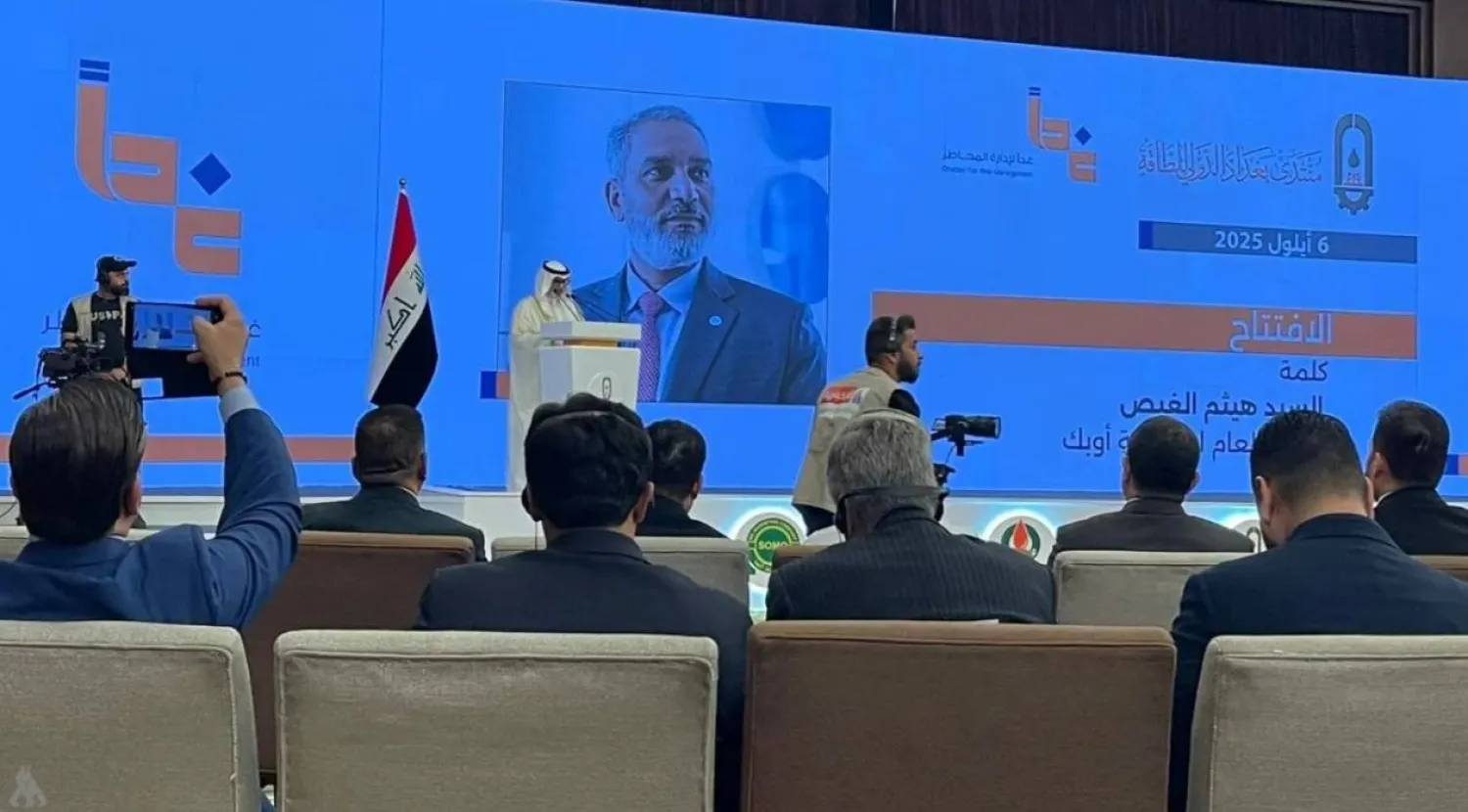
Al Ghais: OPEC+ Projected to Lift Output to Around 64 Million bpd by 2050

OPEC Secretary General Haitham Al Ghais speaks at the Baghdad International Energy Forum. Photo: X
TT

Al Ghais: OPEC+ Projected to Lift Output to Around 64 Million bpd by 2050

OPEC Secretary General Haitham Al Ghais speaks at the Baghdad International Energy Forum. Photo: X

OPEC Secretary General Haitham Al Ghais said on Saturday that projections indicate oil output from OPEC+ under the leadership of OPEC members will increase to around 64 million barrels per day by 2050 from 49 million bpd.

Speaking at the Baghdad International Energy Forum, Al-Ghais said that increasing production will be aimed at stabilizing oil markets, while noting that demand for oil will increase in the coming period.

"The organization remains committed to working towards a sustainable energy future that balances development needs with environmental protection,” he stressed.

"It is important to understand that the future of energy varies with time and place. History has taught us that progress in energy does not mean elimination."

Al-Ghais also noted that abandoning oil and gas is “unrealistic.”

“Oil is the global lifeline and the backbone of food supply," he said, explaining that OPEC’s estimates indicate that oil demand will continue to rise.

Iraqi Prime Minister Mohammed Shia Al-Sudani said in his speech at the forum that Iraq hopes other oil-producing countries will reconsider its export quota to better reflect its production capacity.

Al-Sudani also pointed to arrangements being made to facilitate the entry of major oil companies into the country.

He added that Iraqi oil will continue to supply global markets for more than 120 years at the very least, "despite the fact that our export quota does not reflect the size of our reserves, production capacity, or population size."

He also stressed "Iraq’s openness to welcoming oil companies interested in investing in oil and gas."


France Says Still Loyal to Syria Kurds, Hails Ceasefire

Syrian army personnel celebrate as government forces enter Raqqa city following the withdrawal of Syrian Democratic Forces, in Raqqa, Syria, January 18, 2026. REUTERS/Karam al-Masri
TT

France Says Still Loyal to Syria Kurds, Hails Ceasefire

Syrian army personnel celebrate as government forces enter Raqqa city following the withdrawal of Syrian Democratic Forces, in Raqqa, Syria, January 18, 2026. REUTERS/Karam al-Masri

France on Monday welcomed a ceasefire between the Syrian government and Kurdish-led forces and stressed it remained loyal to the latter who spearheaded the battle against the ISIS group.

"France is faithful to its allies," the foreign ministry said, urging all sides to respect the ceasefire deal, which will also see the Kurdish administration and forces integrate into the state after months of stalled negotiations.


Lucid in 2026: 'Made in Saudi Arabia' Label Goes Global

Mark Winterhoff, interim CEO of Lucid (Company) 
TT

Lucid in 2026: 'Made in Saudi Arabia' Label Goes Global

Mark Winterhoff, interim CEO of Lucid (Company) 

Saudi Arabia is positioning itself as a global launchpad for Lucid, the electric-vehicle manufacturer, not merely as a consumer market, but as a manufacturing and export hub serving markets worldwide.

Speaking from Riyadh during his participation in the Future Minerals Forum, Mark Winterhoff, interim chief executive officer of Lucid — whose largest shareholder is Saudi Arabia’s Public Investment Fund (PIF) — outlined the company’s next phase, which focuses on disciplined expansion, resilient supply chains, and a strategic shift from ultra-luxury vehicles toward a broader consumer segment.

In remarks to Asharq Al-Awsat, Winterhoff described the forum as a critical platform for the electric-vehicle industry, given its heavy reliance on minerals and rare earth elements, particularly those used in magnets. He praised Saudi Arabia’s leadership in this area, noting its direct impact on multiple industrial sectors. Winterhoff oversees the execution of Lucid’s strategy and leads teams responsible for product design, engineering, and manufacturing efficiency.

Saudi Arabia as an Export Base

Winterhoff said Lucid’s Saudi factory - the company’s first manufacturing facility outside the United States - was designed from the outset as a major export platform, not solely to meet domestic demand.

Under current plans, only 13 to 15 percent of production will be allocated to Gulf Cooperation Council (GCC) markets, with the majority destined for export. He confirmed that Lucid remains on track to begin production at the facility by the end of this year, specifically in December.

In January 2025, Lucid joined the “Made in Saudi Arabia” program, enabling it to use the national manufacturing label on vehicles produced locally. The company is the first automotive original equipment manufacturer (OEM) to receive the designation, reflecting Saudi Arabia’s push to localize advanced industries, deepen partnerships with global manufacturers, and establish itself as a hub for electric-vehicle production and exports.

Strong Growth Momentum

Winterhoff said Lucid posted strong growth in both production and deliveries in 2025. Annual production more than doubled, while deliveries rose 55 percent year-on-year. The fourth quarter recorded particularly strong results in the United States and the Middle East, especially Saudi Arabia.

He noted that Lucid was the only electric-vehicle manufacturer in the US to report higher deliveries in the fourth quarter of 2025, at a time when many competitors saw sharp declines.

According to company figures, Lucid produced about 18,378 vehicles in 2025, up 104 percent from 2024, while deliveries reached 15,841 vehicles. In the fourth quarter alone, production climbed to 8,412 vehicles — up 116 percent from the previous quarter — while deliveries rose 31 percent to 5,345 vehicles.

While Lucid currently operates in the luxury segment, its most significant strategic shift involves developing a mid-size vehicle priced at around $50,000. Winterhoff said this model, aimed at a much wider consumer base, will form the backbone of production at the Saudi plant and enable the facility to reach its targeted maximum capacity.

Supply Chain Challenges and Outlook

Winterhoff identified supply chains - particularly for minerals, rare earth elements, and semiconductors - as ongoing challenges for the industry. He said Lucid faced repeated difficulties over the past year in sourcing magnets and securing stable semiconductor supplies. Forums such as the Future Minerals Forum, he added, are part of the solution, helping build a more stable and sustainable resource ecosystem.

Looking ahead, Winterhoff expressed confidence in Lucid’s trajectory. The company currently leads US electric-vehicle sales in the luxury sedan segment and ranks third when internal combustion vehicles are included. With the launch of its mid-priced model, Lucid expects higher production volumes and, in 2026, plans to enter the autonomous robotaxi market, an emerging sector it views as a key source of future growth.


China's Economy Grows 5% in 2025, Buoyed by Strong Exports Despite Trump's Tariffs

A deliver worker transfers the merchandise outside the Ritan International Trade Center in Beijing, Monday, Jan. 19, 2026. (AP Photo/Andy Wong)
TT

China's Economy Grows 5% in 2025, Buoyed by Strong Exports Despite Trump's Tariffs

A deliver worker transfers the merchandise outside the Ritan International Trade Center in Beijing, Monday, Jan. 19, 2026. (AP Photo/Andy Wong)

China's economy expanded at a 5% annual pace in 2025, buoyed by strong exports despite US President Donald Trump's tariffs.

However, growth slowed to a 4.5% rate in the last quarter of the year, the government said Monday. That was the slowest quarterly growth since late 2022, when China was beginning to loosen stringent COVID-19 pandemic restrictions. The economy, the world’s second largest, grew at a 4.8% annual pace in the previous quarter.

China’s leaders have been trying to spur faster growth after a slump in the property market and disruptions from the pandemic rippled through the economy.

As expected, annual growth last year was in line with the government’s official target for an expansion of “around 5%.”

In quarterly terms, the economy grew 1.2% in October to December.

Strong exports helped to compensate for weak consumer spending and business investment, contributing to a record trade surplus of $1.2 trillion.

Chinese exports to the US suffered after President Donald Trump returned to office early last year and began raising tariffs. But that decline was offset by shipments to the rest of the world. Soaring imports of Chinese goods are leading some other governments to take action to protect local industries, in some cases raising import duties, The Associated Press reported.

Trump and Chinese leader Xi Jinping agreed to extend a truce in their bruising tariffs war, also helping to alleviate pressure on China’s exports. But China's exports to the US still fell 20% last year.

“The key question is how long this engine of growth can remain the primary driver,” Lynn Song, chief economist for Greater China at Dutch bank ING wrote in a recent note. “Should more economies also start ramping up tariffs on China, as Mexico has done and the EU has threatened to do, eventually, a tighter squeeze will be seen."

China’s leaders have repeatedly highlighted boosting domestic demand as a policy focus, but their effects have so far been limited. A trade-in program for drivers to replace older cars with more energy-efficient models, for example, has been losing steam in recent months.

“Stabilization, not necessarily recovery, of the domestic property market is key to revive public confidence and, hence household consumption and private investment growth,” said Chi Lo, senior market strategist for Asia Pacific at BNP Paribas Asset Management.

China has also provided trade-in subsidies for home appliances such as refrigerators, washing machines and TVs. While major consumer stimulus policies in 2025 -- including such subsidies -- are set to continue in 2026, they may be scaled back, Weiheng Chen, global investment strategist at J.P. Morgan Private Bank, said in a recent note.

Investments in artificial intelligence and other advanced technologies remain a key priority for China’s ruling Communist Party as it moves to boost self-reliance and rival the US.

Meanwhile, many ordinary Chinese and small businesses are struggling with tough times and troubling uncertainty over jobs and incomes.

Liu Fengyun, a 53-year-old noodle restaurant owner in a small county in southwestern China’s Guizhou province, said business has become very difficult these days. Some of her customers told her that “money is hard to earn now” and “making breakfast at home is cheaper.”

“People all say, ‘The overall environment is not good right now — what more can you expect? People don’t have money anymore. Nothing is easy to do now,’” Liu said.

Kang Yi, head of China’s National Bureau of Statistics, on Monday told reporters that China’s economy had sustained "steady progress in 2025 despite multiple pressures” and has “solid foundations" in countering risks.

Some economists and analysts believe China’s actual economic growth in 2025 was slower than official data suggest. The Rhodium Group, a think tank, said last month it expected China’s economy to grow only by 2.5% to 3% last year.

The Chinese economy expanded at a 5% annual rate in 2024, and 5.2% in 2023, according to government data. Ambitious official growth targets have also trended down over the past few years, from 6% to 6.5% in 2019 to “around 5%” in 2025.

A slower annual expansion is expected for 2026. Deutsche Bank forecasts that China’s economy will grow about 4.5% in 2026.

A strong and stable economy is considered crucial for social stability, a primary priority for China's leaders. While China could probably maintain social stability even at lower economic growth rates, Beijing “wants the economy to keep growing”, said Neil Thomas, a fellow at the Asia Society Policy Institute’s Center for China Analysis.

China likely needs to sustain a roughly 4%-5% annual expansion in order to reach its soft target by 2035 of $20,000 gross domestic product (GDP) per capita, he said.