Trump to Impose $100,000 Fee Per Year for H-1B Visas, in Blow to Tech

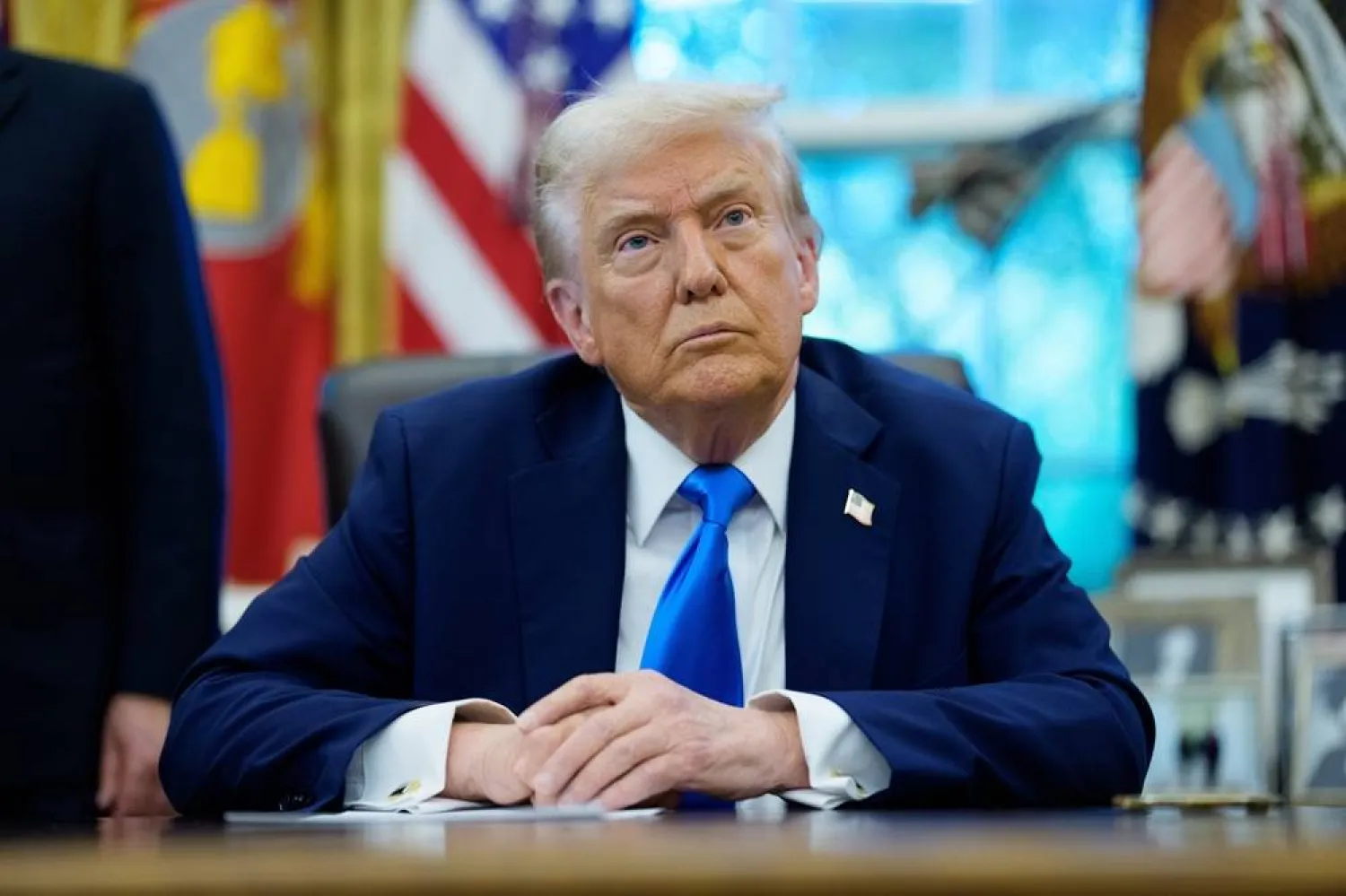
United States President Donald J Trump looks on to the media during an Executive Order signing which authorizes the new Trump Gold Card, a visa program to be overseen by the Secretary of Commerce 'that will facilitate the entry of aliens who have demonstrated their ability and desire to advance the interests of the United States by voluntarily providing a significant financial gift to the nation' in the Oval Office of the White House in Washington, DC, USA, 19 September 2025. (EPA)
TT

Trump to Impose $100,000 Fee Per Year for H-1B Visas, in Blow to Tech

United States President Donald J Trump looks on to the media during an Executive Order signing which authorizes the new Trump Gold Card, a visa program to be overseen by the Secretary of Commerce 'that will facilitate the entry of aliens who have demonstrated their ability and desire to advance the interests of the United States by voluntarily providing a significant financial gift to the nation' in the Oval Office of the White House in Washington, DC, USA, 19 September 2025. (EPA)

The Trump administration said on Friday it would ask companies to pay $100,000 per year for H-1B worker visas, prompting some big tech companies to warn visa holders to stay in the US or quickly return.
The change could deal a big blow to the technology sector that relies heavily on skilled workers from India and China, said Reuters.
Since taking office in January, Trump has kicked off a wide-ranging immigration crackdown, including moves to limit some forms of legal immigration. The step to reshape the H-1B visa program represents his administration's most high-profile effort yet to rework temporary employment visas.
"If you're going to train somebody, you're going to train one of the recent graduates from one of the great universities across our land," said Commerce Secretary Howard Lutnick. Train Americans. Stop bringing in people to take our jobs."
Trump's threat to crack down on H-1B visas has become a major flashpoint with the tech industry, which contributed millions of dollars to his presidential campaign.
Microsoft, JPMorgan and Amazon responded to the announcement by advising employees holding H-1B visas to remain in the United States, according to internal emails reviewed by Reuters.
They advised employees on the H-1B visas who were outside the US to return before midnight on Saturday (0400 GMT on Sunday), when the new fee structures are set to take effect.
"H-1B visa holders who are currently in the US should remain in the US and avoid international travel until the government issues clear travel guidance," read an email sent to JPMorgan employees by Ogletree Deakins, a company that handles visa applications for the US investment bank.
Microsoft, JPMorgan, law firm Ogletree Deakins, which represents the bank on the issue, and Amazon did not immediately respond to Reuters requests for comment.
Critics of the H-1B program, including many US technology workers, argue that it allows firms to suppress wages and sideline Americans who could do the jobs. Supporters, including Tesla CEO and former Trump ally Elon Musk, say it brings in highly skilled workers essential to filling talent gaps and keeping firms competitive. Musk, himself a naturalized US citizen born in South Africa, has held an H-1B visa.
Some employers have exploited the program to hold down wages, disadvantaging US workers, according to the executive order Trump signed on Friday.
The number of foreign science, technology, engineering and mathematics (STEM) workers in the US more than doubled between 2000 and 2019 to nearly 2.5 million, even as overall STEM employment only increased 44.5% during that time, it said.
MOVE COULD DETER GLOBAL TALENT
Adding new fees "creates disincentive to attract the world's smartest talent to the US," said Deedy Das, partner at venture capital firm Menlo Ventures, on X. "If the US ceases to attract the best talent, it drastically reduces its ability to innovate and grow the economy."
The move could add millions of dollars in costs for companies, which could hit smaller tech firms and start-ups particularly hard.
Reuters was not immediately able to establish how the fee would be administered. Lutnick said the visa would cost $100,000 a year for each of the three years of its duration but that the details were "still being considered."
Under the current system, entering the lottery for the visa requires a small fee and, if approved, subsequent fees could amount to several thousand dollars.
Some analysts suggested the fee may force companies to move some high-value work overseas, hampering America's position in the high-stakes artificial intelligence race with China.
"In the short term, Washington may collect a windfall; in the long term, the US risks taxing away its innovation edge, trading dynamism for short-sighted protectionism," said eMarketer analyst Jeremy Goldman.
INDIA ACCOUNTS FOR MOST H-1B VISAS
India was the largest beneficiary of H-1B visas last year, accounting for 71% of approved beneficiaries, while China was a distant second at 11.7%, according to government data.
In the first half of 2025, Amazon.com and its cloud-computing unit, AWS, had received approval for more than 12,000 H-1B visas, while Microsoft and Meta Platforms had over 5,000 H-1B visa approvals each.
Lutnick said on Friday that "all the big companies are on board" with $100,000 a year for H-1B visas.
"We've spoken to them," he said.
Many large US tech, banking and consulting companies declined to comment or did not immediately respond to requests for comment. The Indian embassy in Washington and the Chinese Consulate General in New York also did not immediately respond to requests for comment.
Shares of Cognizant Technology Solutions, an IT services company that relies extensively on H-1B visa holders, closed down nearly 5%. US-listed shares of Indian tech firms Infosys and Wipro closed between 2% and 5% lower.
IMMIGRATION CRACKDOWN
Aaron Reichlin-Melnick, policy director of the American Immigration Council, questioned the legality of the new fees. "Congress has only authorized the government to set fees to recover the cost of adjudicating an application," he said on Bluesky.
The H-1B program offers 65,000 visas annually to employers bringing in temporary foreign workers in specialized fields, with another 20,000 visas for workers with advanced degrees.
Nearly all the visa fees have to be paid by the employers. The H-1B visas are approved for a period of three to six years.
Trump also signed an executive order on Friday to create a "gold card" for individuals who can afford to pay $1 million for US permanent residency.



Iraq’s Oil Minister Says Talks Ongoing with Chevron on West Qurna 2 Oilfield

A Chevron logo at the Chevron building in Houston, Texas, US August 19, 2025. (Reuters)
TT

Iraq’s Oil Minister Says Talks Ongoing with Chevron on West Qurna 2 Oilfield

A Chevron logo at the Chevron building in Houston, Texas, US August 19, 2025. (Reuters)

Iraq's oil minister said on Saturday that talks were ‌ongoing ‌with ‌US ⁠major Chevron regarding ‌the Lukoil-operated West Qurna-2 field, the Russian company's ⁠largest foreign ‌asset.

Chevron ‍and ‍Exxon Mobil ‍are among potential bidders for Lukoil's overseas assets following US ⁠sanctions on the Russian oil producer.


China’s Consumer Inflation Scales 3-Year High but Deflation Battle Far from Over

 Chinese girls dressed in Qing Dynasty attire take pictures outside the Forbidden City in Beijing, China, Wednesday, Jan. 7, 2026. (AP)
Chinese girls dressed in Qing Dynasty attire take pictures outside the Forbidden City in Beijing, China, Wednesday, Jan. 7, 2026. (AP)
TT

China’s Consumer Inflation Scales 3-Year High but Deflation Battle Far from Over

 Chinese girls dressed in Qing Dynasty attire take pictures outside the Forbidden City in Beijing, China, Wednesday, Jan. 7, 2026. (AP)
Chinese girls dressed in Qing Dynasty attire take pictures outside the Forbidden City in Beijing, China, Wednesday, Jan. 7, 2026. (AP)

China's annual consumer price inflation accelerated to a 34-month high in December, but the full-year rate slumped to the lowest in 16 years while producer deflation persisted, backing market expectations for more stimulus to shore up soft demand.

Imbalances in the $19 trillion economy have worsened over the past year even as growth is on course to meet Beijing's target of "around 5%" for 2025, buoyed by policy support and resilient goods exports.

US President Donald Trump's global trade war has added to persistently soft consumer demand, which has remained a drag on confidence and growth for years amid a prolonged property crisis.

The December consumer price index (CPI) rose 0.8% from the same month in 2024, National Bureau of Statistics (NBS) data showed on Friday, matching expectations in a Reuters poll and perking up from the 0.7% increase in November.

The rise was mainly driven by food prices, especially those of fresh vegetables and beef, which expanded 18.2% ‌and 6.9% respectively, Dong ‌Lijuan, a statistician at NBS, said in a statement. Pre-New Year holiday shopping ‌and ⁠supportive policies also helped ‌boost consumer prices, Dong added.

Chinese policymakers have repeatedly pledged to support a rebound in prices with monetary policy and have cracked down on excessive competition. They have also vowed to boost people's income to unleash consumption potential and better align the country's supply and demand.

Yet, the underlying demand impulse in the economy remains weak.

"Despite expectations of a recovery, inflation remains relatively low and should not preclude further monetary easing this year," said Lynn Song, ING's chief economist for Greater China.

Zichun Huang, China economist at Capital Economics, said the elevated headline CPI was not due to the government campaign to curb so-called "involution", adding that overcapacity and deflationary pressures will persist in the coming ⁠years in the absence of stronger demand-side measures.

WHERE HAS INFLATION GONE?

Indeed, for the entire 2025, consumer price growth was flat, well below the "around 2%" goal policymakers were ‌aiming for, a sign that stimulus measures, such as a consumer goods trade-in scheme, ‍have yielded only modest results in lifting sentiment and containing ‍deflationary pressure.

Prices of gold jewellery surged 68.5%, NBS data showed.

Core inflation, ‍which excludes volatile prices of food and fuel, rose 1.2% year-on-year last month, unchanged from November.

Goldman Sachs economists estimate that core price gauge excluding gold prices edged down in December from the prior month.

Annual growth in China's consumer prices has for years failed to meet policymakers' targets as the economy struggled to recover from the pandemic.

A prolonged property market crisis and a weak job market have contributed to lackluster household demand as well as overcapacity and price competition among producers.

On a monthly basis, CPI climbed 0.2% in December, compared with a 0.1% dip the previous month and a forecast for a 0.1% rise.

The producer ⁠price index (PPI) fell 1.9% year-on-year in December, remaining in a deflationary funk for more than three years even as it eased from a 2.2% drop in November. The gauge was expected to have fallen 2% in the Reuters poll.

NBS's Dong attributed the moderation in factory-gate deflation to both global commodity prices, including rising prices of non-ferrous metals, and policies for controlling capacity in key industries.

Capital Economics' Huang, however, said there hasn't been "any fundamental improvement in overcapacity."

"Prices of consumer durables continued to fall at a faster pace than during the depths of the global financial crisis, highlighting that the issue of excess supply remains unresolved in much of the manufacturing sector," she said.

For the whole year, PPI fell 2.6%.

Given the slowdown in economic momentum in the second half of last year, the market is watching for signs of additional government support measures in 2026 as top leaders have committed to pursuing a more proactive macroeconomic policy framework.

The central government has allocated 62.5 billion yuan ($8.95 billion) from special treasury bond proceeds to local governments to ‌keep funding the consumer goods trade-in scheme in 2026.

The government has also pledged to flexibly use monetary policy tools, such as cuts to interest rates and banks' reserve requirement ratio, to keep liquidity ample and spur growth.


Business-Friendly Climate Draws 123,000 New Commercial Registrations in Saudi Arabia

 Employees at the Saudi Business Center (SPA). 
 Employees at the Saudi Business Center (SPA). 
TT

Business-Friendly Climate Draws 123,000 New Commercial Registrations in Saudi Arabia

 Employees at the Saudi Business Center (SPA). 
 Employees at the Saudi Business Center (SPA). 

Saudi Arabia’s business environment attracted 123,000 new commercial registrations in the fourth quarter of 2025, pushing the total number of active registrations past 1.8 million by year-end. Foreign investment in the healthcare sector surged by nearly 560 percent over the past three years, highlighting strong international confidence in the Saudi market.

According to a recent report by the Ministry of Commerce, reviewed by Asharq Al-Awsat, the number of active sole proprietorship registrations reached 1.26 million by the end of 2025, reflecting 20 percent growth over the past five years.

Active limited liability companies (LLCs) totaled 571,000, with a sharp 183 percent increase over five years. Meanwhile, the number of joint-stock companies grew 50 percent over the same period to 4,733 active registrations.

Regional and Sectoral Performance

Riyadh led the Kingdom in new commercial registrations during the final quarter of 2025 with 45,600 records, followed by the Eastern Province with more than 20,000, and Makkah Region with 19,200.

The construction sector topped all industries, with more than 66,000 registrations issued during the quarter. It was followed by wholesale and retail trade with 24,900, and manufacturing industries with 23,700, while the remainder was spread across other activities.

The report also highlighted a strong rise in e-commerce sales conducted via Mada cards in October, which hit a record SAR 30.7 billion ($8.1 billion) - a 68 percent year-on-year increase, up SAR 12.4 billion ($3.3 billion) from October 2024, according to data from the Saudi Central Bank (SAMA).

Healthcare Sector Momentum

The Ministry of Commerce said Saudi Arabia continues to roll out development projects aimed at improving healthcare quality and capacity by strengthening national talent, adopting innovative digital solutions, and upgrading medical facilities.

The Kingdom ranks first regionally in healthcare investment, with agreements signed at the recent Global Health Exhibition in Riyadh valued at about SAR 133 billion ($35.4 billion). Foreign investment in the sector has expanded by more than 560 percent in three years, with healthcare contributing 5 percent of GDP.

Healthcare-related activities saw strong growth in the fourth quarter, including medical laboratories (+33%), pharmaceutical manufacturing (+31%), physiotherapy centers (+31%), and telemedicine and remote care services (+30%).

E-Commerce and High-Growth Sectors

Active e-commerce registrations rose 9 percent year-on-year to 43,800 by the end of the fourth quarter, up from 40,000 in the same period of 2024. Strengthening the e-commerce ecosystem is a key objective of the National Transformation Program, with Saudi Arabia ranked among the world’s top 10 fastest-growing e-commerce markets.

Promising sectors highlighted by the report include artificial intelligence, gaming, cybersecurity, health software, and electric vehicle charging stations. AI-related registrations grew 34 percent to more than 19,000, while gaming rose 27 percent to 841 registrations. UI/UX design activities climbed 28 percent to 18,900.

Cybersecurity registrations increased 27 percent to 9,700, while health and medical software surged 85 percent to 4,300. Power generation and distribution activities grew 27 percent, and EV charging station operations expanded 26 percent to 4,300 registrations.

Investment Deals and Forums

The report cited the success of the Biban Forum, recently held in Riyadh, which generated agreements and launches exceeding SAR 38 billion ($10.1 billion). Investment deals worth SAR 22.2 million ($5.9 million) benefited 55 startups, with participation from 1,021 companies across 66 countries.

It also highlighted the Northern Borders Forum, which offered more than 240 investment opportunities valued at SAR 40 billion ($10.6 billion) across sectors including livestock, food, mining and energy, tourism, environment, and logistics.