

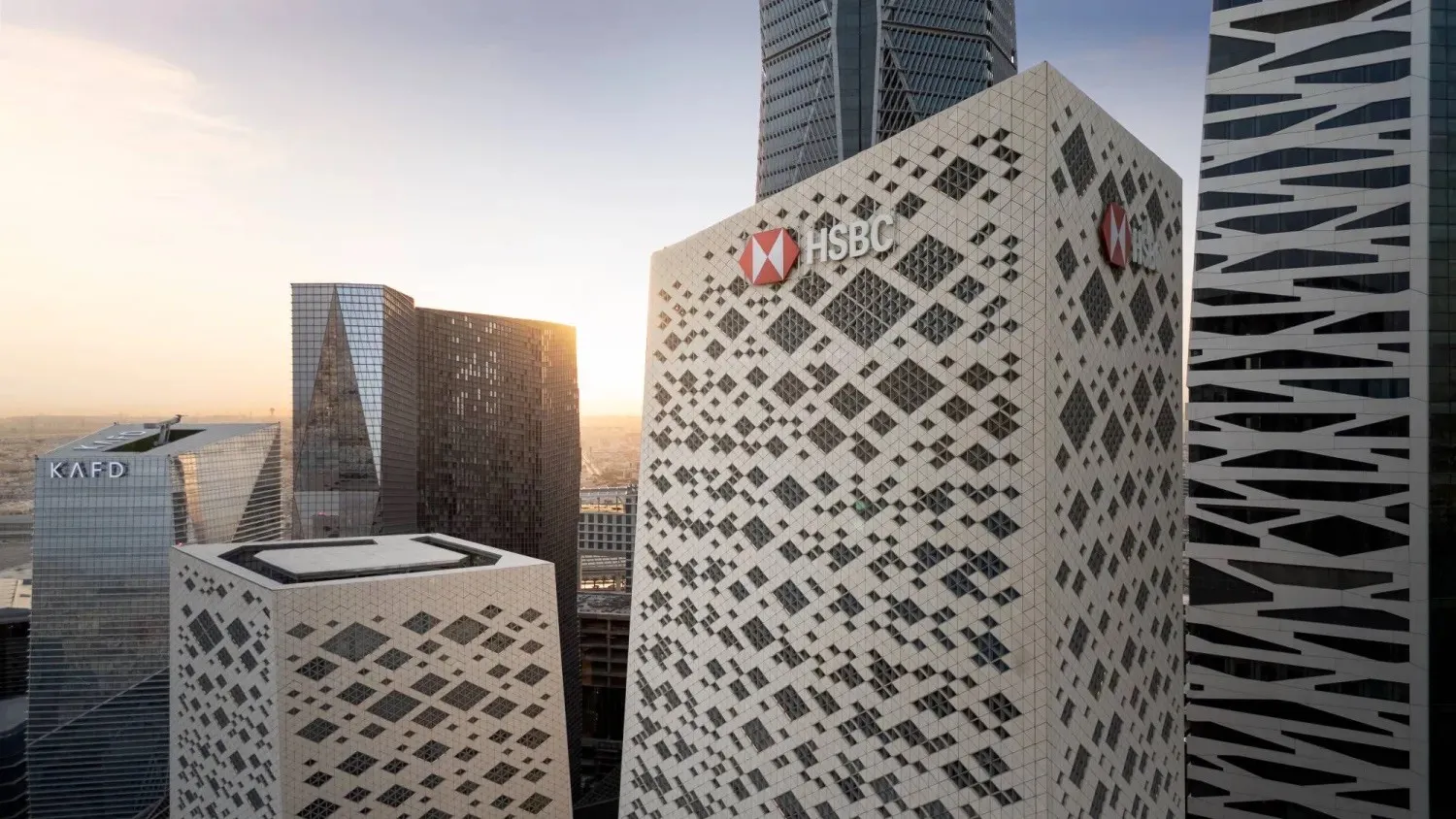

HSBC Chief: Saudi Arabia is the Center of Regional Growth

HSBC Group headquarters in the Saudi capital, Riyadh (Asharq Al-Awsat)
TT

HSBC Chief: Saudi Arabia is the Center of Regional Growth

HSBC Group headquarters in the Saudi capital, Riyadh (Asharq Al-Awsat)

Georges Elhedery, Chief Executive Officer of HSBC Group, has outlined the bank’s strategic direction following a global restructuring launched in October last year. He said that the transformation has delivered steady progress toward building a more efficient, resilient, and growth-oriented institution.

In an interview with Asharq Al-Awsat on the sidelines of the Future Investment Initiative in Riyadh, Elhedery stressed that HSBC remains firmly on track to achieve its cost and restructuring targets.

The bank completed 11 divestments this year, all in non-core operations, allowing it to redirect capital toward higher-growth areas. He pointed to the proposed partial privatization of Hang Seng Bank as an example of how the group is reinvesting strategically to fuel future expansion.

According to Elhedery, the restructuring aims to simplify operations, reduce complexity, and strengthen HSBC’s long-term growth capabilities. The recent divestments, he explained, have freed up capital for redeployment in markets where the bank holds a competitive advantage.

He underlined that this reorganization reinforces HSBC’s deep and enduring commitment to the Middle East and North Africa region and Türkiye.

With a presence in the Middle East for more than 130 years, the bank has helped establish trade networks, create sovereign wealth funds, develop capital markets, and finance national infrastructure.

He noted that this legacy underpins HSBC’s confidence in the region’s long-term potential, particularly in linking new economic corridors and expanding wealth management services.

As part of its strategic realignment toward Asia, HSBC has exited merger and acquisition advisory and equity capital markets operations in Europe, the United Kingdom, and the United States.

The move is expected to generate annual savings of around $300 million, which will be reinvested in more profitable areas. Elhedery explained that reallocating resources to Asia and the Middle East is expected to deliver stronger returns and greater value for clients.

Elhedery highlighted that geopolitical tensions and trade barriers have long been part of the global economy, though recent disruptions have become faster and more complex.

Some of these changes, he noted, are structural and align with HSBC’s strengths, particularly the expansion of trade between the Middle East, North Africa, Türkiye, and Asia, and the rapid growth of trade in services.

He argued that HSBC’s strong balance sheet, extensive global network, and local expertise position it to help clients navigate volatility and uncertainty.

According to the bank’s New Capital Networks survey, 80 percent of companies plan to expand trade and investment in Saudi Arabia within five years, while 89 percent regard the Kingdom as a dependable regional and international hub despite global instability.

Elhedery noted that the Middle East and North Africa continue to demonstrate resilience supported by solid fiscal fundamentals, sweeping economic reforms, and accelerating diversification in the Gulf. Sustained public investment in infrastructure, tourism, and industry is driving domestic demand and creating new opportunities for private-sector expansion.

He highlighted the region’s growing trade and investment links with Asia as a major driver of transformation, reshaping capital flows and reinforcing its position as a bridge between East and West.

This shift in liquidity toward the east, combined with active sovereign bond issuance and the expansion of regional capital markets, is drawing both local and international investors.

In Saudi Arabia, Elhedery underscored the strong momentum generated by Vision 2030. The Kingdom, he explained, lies at the heart of regional economic expansion, with its transformation program creating tangible growth and attracting global investors.

HSBC forecasts Saudi GDP growth of 4.3 percent in 2025, with non-oil output now more than 40 percent higher than pre-pandemic levels.

A recent HSBC survey of 4,000 business leaders found that nearly three-quarters would recommend Saudi Arabia as an investment destination. Elhedery noted that the bank has expanded its capabilities over the past decade to support the development of the Kingdom’s financial infrastructure and continues to invest in this area.

HSBC Saudi Arabia will relocate early next year to the King Abdullah Financial District, signaling a new phase of growth. The bank now employs more than 300 investment banking and capital markets professionals in Riyadh and maintains one of the region’s largest equity capital markets teams, with leadership hubs in both Saudi Arabia and the United Arab Emirates.

Elhedery reaffirmed that the Middle East sits at the center of HSBC’s next growth phase. The bank is strengthening its presence in Saudi Arabia, the UAE, Qatar, and Egypt, while expanding its offering in trade finance, transaction banking, markets, and wealth management.

In September, HSBC opened its first regional wealth center in the UAE as part of its strategy to deliver advanced wealth and asset management services across the region.

The bank is also accelerating its digital transformation across payments, trade, and securities operations and investing in sustainable finance solutions to help clients transition toward clean energy and diversified growth.

According to Elhedery, these initiatives reflect HSBC’s long-term confidence in the Middle East, North Africa, and Türkiye as vital hubs for global trade, capital, and innovation.



Saudi Industry Ministry Signs MoUs to Advance Manufacturing Empowerment

The agreements were signed during the "Industrial Transformation Saudi Arabia 2025” Exhibition. SPA
TT

Saudi Industry Ministry Signs MoUs to Advance Manufacturing Empowerment

The agreements were signed during the "Industrial Transformation Saudi Arabia 2025” Exhibition. SPA

The Ministry of Industry and Mineral Resources has signed a number of memoranda of understanding (MoUs) with leading local and international companies to advance advanced manufacturing, support local content, and strengthen national supply chains, enhancing the regional and global competitiveness of Saudi industry.

The agreements were signed during the "Industrial Transformation Saudi Arabia 2025” Exhibition, organized by the ministry in partnership with Deutsche Messe and Riyadh Exhibitions Company Ltd.

The ministry signed two memoranda to provide innovative financing solutions for industrial establishments, strengthen national supply chains, and support local content.

Additionally, the ministry's National Center for Advanced Manufacturing and Production signed several memoranda of understanding with local and international industrial and advisory companies to support the path of advanced manufacturing, develop supply chains, enhance technological innovation, and boost the competitiveness of national factories, in line with the National Industrial Strategy and Saudi Vision 2030.

These strategic partnerships are part of the ministry's ongoing efforts to develop the Kingdom's industrial ecosystem, enable manufacturers to access the latest industrial solutions, support supply chain development, and stimulate innovation, contributing to the building of a sustainable industrial sector that competes regionally and globally.


China Says Working on Streamlining Rare Earth Export Licenses

FILE PHOTO: Workers transport soil containing rare earth elements for export at a port in Lianyungang, Jiangsu province, China October 31, 2010. REUTERS/Stringer/File Photo
TT

China Says Working on Streamlining Rare Earth Export Licenses

FILE PHOTO: Workers transport soil containing rare earth elements for export at a port in Lianyungang, Jiangsu province, China October 31, 2010. REUTERS/Stringer/File Photo

China said on Thursday it is working on streamlining rare earth export licenses - a key promised outcome after a meeting between US President Donald Trump and his counterpart Xi Jinping.

"The government is actively adapting," Commerce Ministry spokesman He Yadong told reporters at a weekly briefing, adding that authorities "were aligning themselves with general license mechanisms".

Reuters reported on Tuesday that at least three Chinese rare earth magnet makers had secured licenses enabling them to accelerate exports to some customers.

He did not say if new licenses had been issued.

China began designing the new rare earth licensing regime following a late October meeting between Trump and Xi that eased trade tensions between the two countries.


Saudi Aramco's Jafurah Gas Plant Begins Output with 450 Million Cubic Feet Per Day

The resources at Jafurah are now estimated at 229 trillion standard cu ft of gas and 75 billion barrels of condensates. (Saudi Aramco)
TT

Saudi Aramco's Jafurah Gas Plant Begins Output with 450 Million Cubic Feet Per Day

The resources at Jafurah are now estimated at 229 trillion standard cu ft of gas and 75 billion barrels of condensates. (Saudi Aramco)

The first phase of oil giant Aramco's Jafurah gas plant is complete and production has begun with a capacity of 450 million cubic feet per day, the Saudi finance ministry said on Tuesday.

The finance ministry, in its 2026 budget statement, listed the milestone as an achievement reached in 2025.

Jafurah's gas output will be used for domestic power generation, freeing up crude for export that is currently used for power in the kingdom.

Aramco has said its unconventional gas program at peak production is expected to generate electricity equivalent to displacing 500,000 barrels per day of oil.

The $100 billion Jafurah project, estimated to contain 229 trillion standard cubic feet of raw gas, is central to Aramco's ambitions to become a major global player in natural gas and boost its gas production capacity.

Aramco's gas production was 12.6 billion cubic feet per day at the end of September, up from 12 bcfd a year earlier.

Aramco last month said it was boosting its gas growth target to 80% above 2021 levels from a previous targeted growth of 60%.

In its 2021 annual report, Aramco said it reached a single-day record gas output at the time of 10.8 bcfd.

Aramco CEO Amin Nasser, who has called Jafurah a crown jewel in the company's portfolio, said during an earnings call last month the first phase was on track for completion by the end of this year.