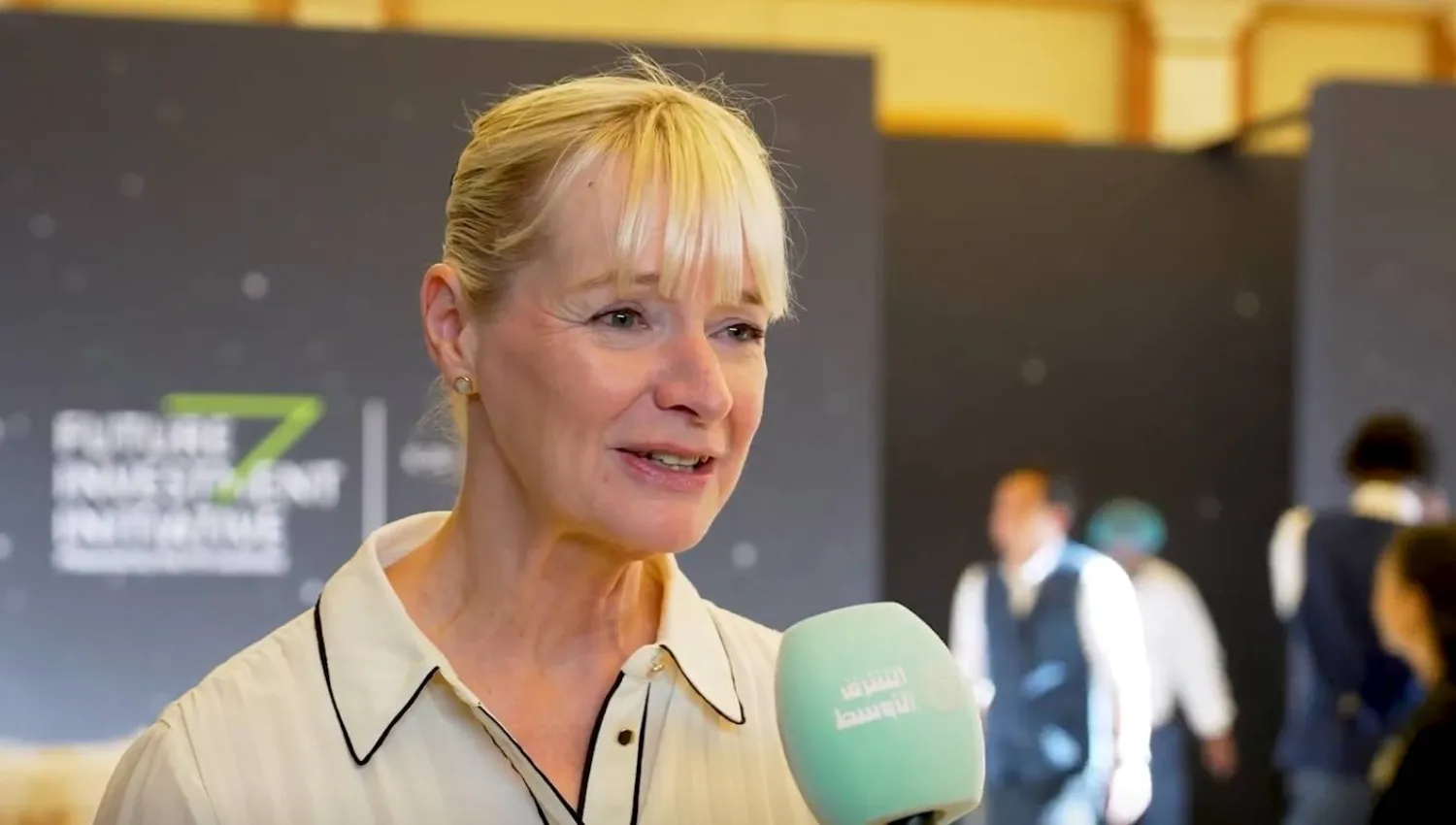

Secretary General of the World Energy Council Dr. Angela Wilkinson said Saudi Arabia plays an influential diplomatic role on the global stage, noting that its contribution is often underappreciated.
In remarks to Asharq Al-Awsat on the sidelines of the ninth edition of the Future Investment Initiative (FII) conference in Riyadh, Wilkinson highlighted that the council’s member community in Saudi Arabia is working on several fronts to ensure wider access to reliable and sustainable energy — not only within the Kingdom but also through initiatives such as the Saudi Green Initiative and the Middle East Green Initiative, as well as broader international efforts.
She said she is always pleased to visit the Kingdom and observe the tangible progress being made, while also following Saudi-supported projects in Africa and Southeast Asia that aim to improve living conditions in developing regions.
World Energy Congress
Wilkinson said Riyadh will host the World Energy Congress in October 2026, describing the gathering as an opportunity to reunite a global energy sector increasingly marked by fragmentation and polarization.
She noted that the event will provide a platform to assess the world’s current position amid rapid transformation and explore how countries can embrace new opportunities and advance together.
Her ambition, she added, is to deliver the most successful World Energy Congress in the council’s history and showcase the progress taking place in Saudi Arabia and other parts of the world.
Geopolitical shifts and sustainability
Wilkinson discussed ongoing geopolitical changes in the energy landscape, saying that the introduction of new technologies and the entry of more countries and players have made providing cleaner, more accessible energy for billions of people one of the defining challenges of the century.
She emphasized that energy transitions cannot follow a single universal model, underscoring the need for each nation to balance energy security, affordability, accessibility, and environmental sustainability.
For two decades, the World Energy Council has published the World Energy Trilemma Index, which measures national performance across these areas and supports knowledge-sharing to strengthen policy and management practices.
Winds of change from the Middle East
According to Wilkinson, the Middle East has become a key driver of global energy transformation. While countries such as China and Japan face the pressures of aging populations, the Middle East remains youthful and dynamic, with distinct demographic and climatic conditions that are reshaping energy systems.
She noted that the new frontiers of energy extend beyond digitalization to encompass demographic and environmental dimensions that will define future demand and supply patterns.
Humanizing energy
Wilkinson said the global conversation on energy is shifting toward a deeper understanding of how demand evolves and how societies can adapt to changing needs. She reaffirmed the council’s vision of “Humanizing Energy,” which focuses on cooperation and shared responsibility.
Energy, she stressed, is a collective endeavor that underpins civilization and human progress, and ensuring its equitable and sustainable flow is essential for a prosperous future for all.