

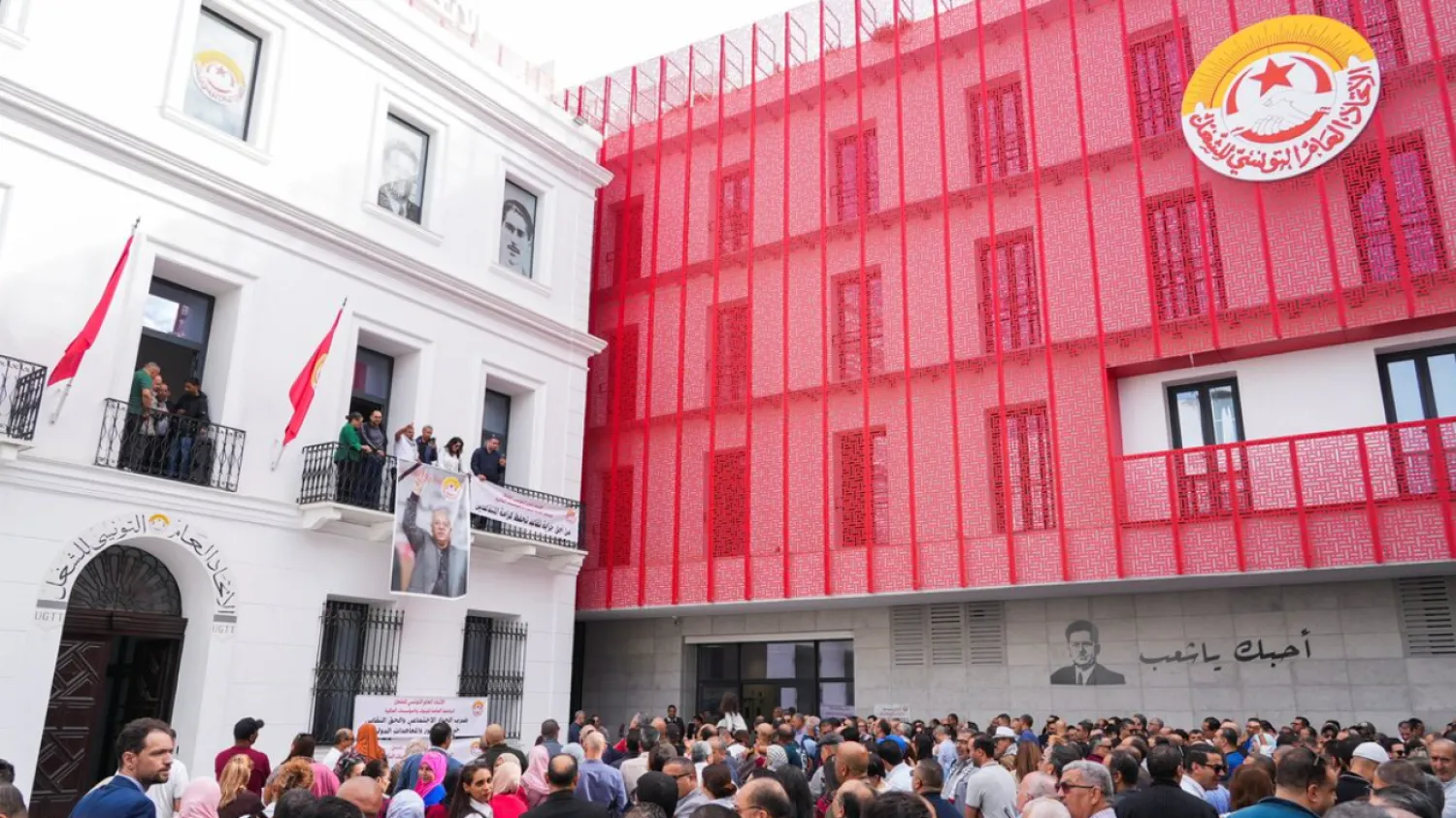

Tunisian Banks Strike over Wages, Halting Transactions

Tunisian bank employees gather in front of the Tunisian General Labour Union (UGTT) headquarters during a strike to demand salary increases, in Tunis, Tunisia, November 3, 2025. REUTERS/Jihed Abidellaoui
TT

Tunisian Banks Strike over Wages, Halting Transactions

Tunisian bank employees gather in front of the Tunisian General Labour Union (UGTT) headquarters during a strike to demand salary increases, in Tunis, Tunisia, November 3, 2025. REUTERS/Jihed Abidellaoui

Tunisian bank workers began a two-day strike on Monday to demand pay rises, halting all financial transactions as the country struggles with an economic crisis.

Lines formed at cash points as the walkout started, but customers said many of the machines were broken.

"We are struggling with everything. Many medicines are missing. Some goods are in short supply ... The cost of living is extremely high, and now we are left paralysed without cash,” one woman, Imen Ben Slama, said, Reuters reported

The powerful UGTT union called the strike after talks over pay and working conditions broke down with the banking council, which represents all public and private banks.

The union says rising living costs have eroded employees’ purchasing power and is demanding "urgent adjustments" to salaries. The government was not immediately available for comment.

UGTT head Noureddine Taboubi told hundreds of bank workers gathered near his headquarters on Monday that "union rights, as well as public and individual freedoms, were under attack".

"Trade unionists are fighting not only for their rights but also for their dignity," he added.

Tunisia is grappling with a severe economic crisis, with a shortage of foreign funding and investment, weak economic growth, public debt exceeding 80% of GDP, shortages of some essential goods and poor public services.

“Bank employees are suffering like all Tunisians with rising cost of living," bank worker Abdel Aziz told Reuters at the rally.



Saudi Industrial Production Index Increases by 9.3% in September

GASTAT said Saudi Arabia’s Industrial Production Index for September 2025 rose by 9.3%. SPA
TT

Saudi Industrial Production Index Increases by 9.3% in September

GASTAT said Saudi Arabia’s Industrial Production Index for September 2025 rose by 9.3%. SPA

The General Authority for Statistics (GASTAT) announced on Monday that Saudi Arabia’s Industrial Production Index for September 2025 rose by 9.3% compared to the same month last year.

Compared to September 2024, the sub-indices for mining and quarrying and for manufacturing activities rose by 11.0% and 6.3%, respectively.

The sub-index for electricity, gas, steam, and air conditioning supply increased by 12.6%, while the sub-index for water supply, sewerage, waste management, and remediation activities grew by 9.2%.

The oil activities index increased by 10.1%, while the non-oil activities index rose by 7.3% compared to September 2024.


Riyadh, Ottawa Launch Foreign Investment Agreement and Reactivate Joint Commission

The Saudi Minister of Investment meets with the Canadian Minister of Trade. Asharq A-Awsat
TT

Riyadh, Ottawa Launch Foreign Investment Agreement and Reactivate Joint Commission

The Saudi Minister of Investment meets with the Canadian Minister of Trade. Asharq A-Awsat

Saudi Arabia and Canada have launched negotiations on a Foreign Investment and Protection Agreement in the Canadian capital, Ottawa, a move reflecting the shared commitment to strengthening bilateral economic relations.

The talks coincided with a visit by a high-level Saudi delegation led by the Minister of Investment, Eng. Khalid Al-Falih, during which both sides announced the reactivation of the Joint Economic Commission.

These developments are gaining significant momentum, supported by Canada’s endorsement of Saudi Vision 2030 and the two countries’ willingness to expand their economic partnership across vital and non-oil sectors.

The Canadian Ambassador to Saudi Arabia, Jean-Philippe Linteau, told Asharq Al-Awsat that Canada was thrilled to welcome Al-Falih.

“His meetings with Prime Minister Mark Carney, Minister of Trade Maninder Sidhu and Foreign Minister Anita Anand, as well as with senior Canadian business leaders, were a clear illustration of Canada’s desire to grow the economic partnership between Saudi Arabia and Canada,” said Linteau.

The diplomat added that “there is growing momentum because of Canada’s support for the Kingdom’s Vision 2030 goals and the visit helped advance key engagement on trade and investment as well as partnerships in sectors such as education, mining, AI and infrastructure.”

In 2024, Saudi Arabia was Canada’s largest merchandise trading partner in the Middle East. Two-way merchandise trade between the two countries in 2024 was valued at approximately $4.1 billion.

Over 150 Canadian companies are active in Saudi Arabia, offering competitive solutions in artificial intelligence and frontier technology, healthcare, infrastructure, mining, defense products, and creative industries.

During their meeting in Ottawa, Sidhu and Al-Falih announced the launch of negotiations for a Foreign Investment and Protection Agreement between Canada and Saudi Arabia. They also announced the reactivation of the Joint Economic Commission, a treaty-based mechanism to promote trade and economic initiatives of mutual benefit.

Sidhu and Al-Falih welcomed the October 23 signing of a memorandum of understanding between Export Development Canada and the Saudi EXIM Bank.

The increased partnership between Canada and Saudi Arabia will boost business opportunities, increase bilateral trade and unlock export opportunities and investments in Canadian and Saudi Arabian companies alike.

The two ministers also discussed future strategic sector partnerships between Canadian and Saudi Arabian companies, including in the areas of artificial intelligence and frontier technologies, healthcare, infrastructure, mining, defense, and creative industries.

They also met with business leaders and industry stakeholders, participated in a business round table with Invest in Canada and focused on deepening Canada-Saudi relations by highlighting commercial success stories between Canadian and Saudi companies.

“Saudi Arabia is an important market for Canada as our largest bilateral merchandise trading partner in the Middle East. We’re committed to advancing economic cooperation and mutually beneficial investment opportunities to foster greater commercial prosperity for Canadians and Saudis,” Sidhu said in a statement.

“I look forward to strengthening the relationship between our two countries and promoting continued cooperation for our businesses, industries and workers,” he added.


Egypt Inflation Accelerates to 12.5% in October 

A huge banner hangs off a building along the ring road, advertising the opening of the Grand Egyptian Museum (GEM) in Giza, as vehicles drive towards the southwestern outskirts of the capital Cairo on November 1, 2025. (AFP)
TT

Egypt Inflation Accelerates to 12.5% in October 

A huge banner hangs off a building along the ring road, advertising the opening of the Grand Egyptian Museum (GEM) in Giza, as vehicles drive towards the southwestern outskirts of the capital Cairo on November 1, 2025. (AFP)

Egypt's annual urban consumer price inflation rose more than expected to 12.5% in October, ending a four-month downward trend, data from statistics agency CAPMAS showed on Monday.

The median forecast had been for inflation to rise to 12% in a poll of 14 analysts, some of whom cited an increase in fuel prices and a new law allowing landlords to raise rents. The inflation rate rose from 11.7% in September.

Month-on-month, prices rose by 1.8% in October, CAPMAS said. Food and beverage prices rose by an annual 1.5% and by a monthly 1.2%, it said.

The government on October 17 increased the price of a wide range of fuel products by nearly 13%.

A new law letting landlords raise monthly rents took effect in early August, applicable with the first subsequent rent payment. This means the first increases would have been reflected in September inflation figures.

The annual inflation rate has plunged from a record 38% in September 2023, helped by an $8 billion financial support package from the International Monetary Fund in March 2024.

M2 money supply growth, at an annual 22.9% in September, was little changed from August, central bank data showed.

Slowing inflation prompted Egypt's central bank to cut its overnight lending rate by 100 basis points on October 2, following an August 28 cut of 200 basis points, this year's third and fourth reductions.