


European Nations Agree 30% Boost in Three-year Space Budget

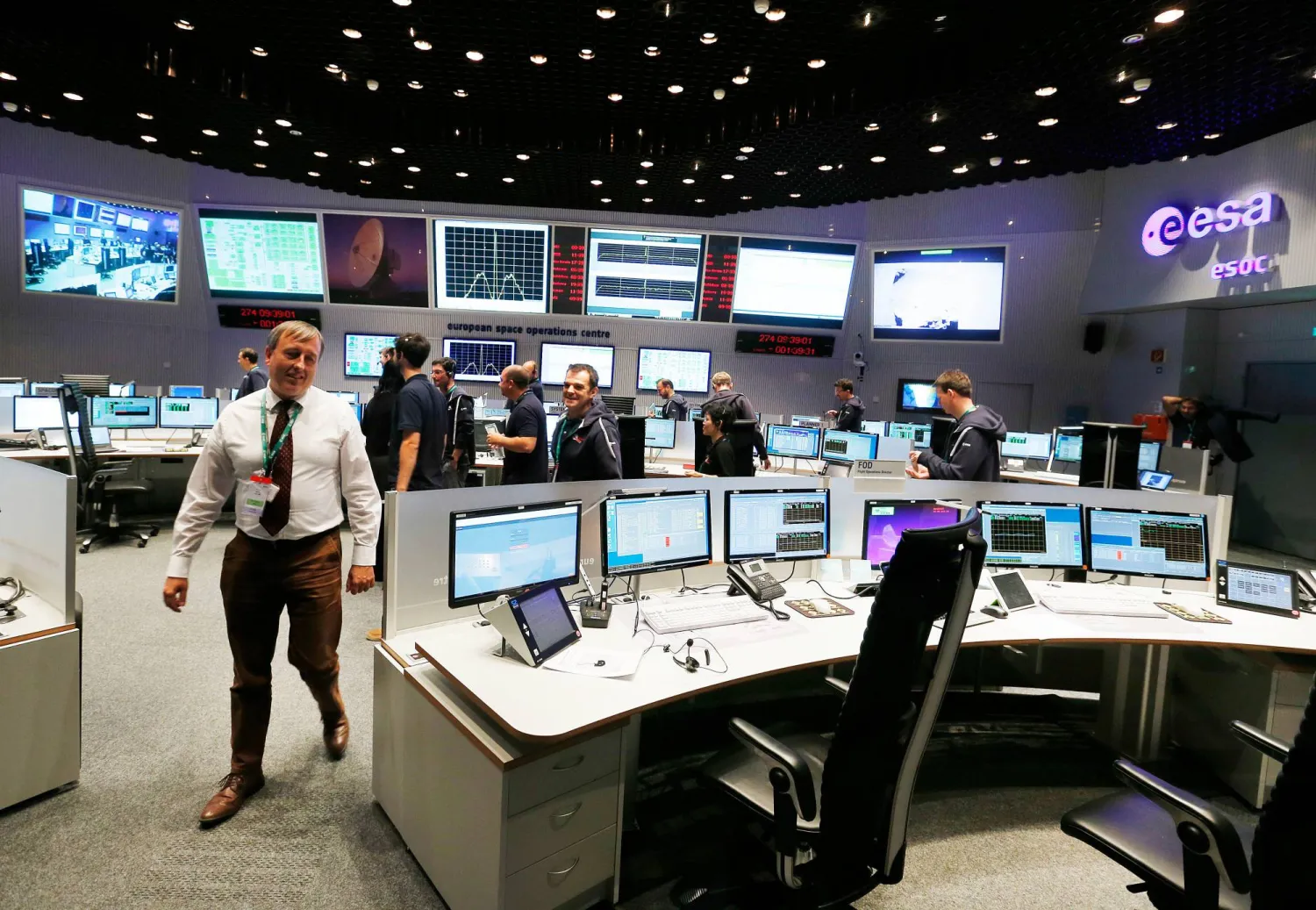
FILE- A view of the control room at the European Space Agency in Darmstadt, Germany, on Sept. 30, 2016.(AP Photo/Michael Probst, File)
TT

European Nations Agree 30% Boost in Three-year Space Budget

FILE- A view of the control room at the European Space Agency in Darmstadt, Germany, on Sept. 30, 2016.(AP Photo/Michael Probst, File)

European nations agreed on Thursday to increase spending on space over the next three years by about 30% to 22.1 billion euros, part of an effort to try to catch up to the US, China and private firms zooming ahead in the space race.

The European Space Agency had asked its 23 nations to provide some 22 billion euros to fund launches, satellites and other research programs for the next three years, up from 16.9 billion in 2023-2025.

ESA Director General Josef Aschbacher, during a news conference after two days of ministerial talks in Bremen, said it was the first time he could recall where member states in the 50-year-old organization had met the agency’s request.

The agreement highlights the importance of space, including as a rapidly growing economic sector and for security and defense purposes, Reuters quoted him as saying.

"It is a domain where Europe has to catch up."

The European focus on space is driven in part by an urge to seek greater autonomy from the United States in security matters, sparked since the outbreak of war in Ukraine.

The triennial meeting was held against the backdrop of an ongoing budget crisis in France, home of the European space base in French Guiana.

The new space budget excludes the UK-led TRUTHS mission to provide a satellite-based climate observatory, after Britain pulled out of the project for budget reasons, officials said.

ESA is an intergovernmental body whose mandatory scientific programs are funded by each country according to the size of its economy. It also passes the hat among its members for contributions to optional launcher and satellite programs at ministerial negotiating sessions held every three years.

Its decisions set the tone for Europe's space industry as it also seeks to stimulate new private launch companies.

Ministers agreed to spend 4.4 billion euros on space transportation, a 20% increase over the previous period, and 3.5 billion euros on Earth observation, up 16%.



Riyadh Air and Mastercard Partner to Transform Global Travel Experience

Riyadh Air and Mastercard Partner to Transform Global Travel Experience
TT

Riyadh Air and Mastercard Partner to Transform Global Travel Experience

Riyadh Air and Mastercard Partner to Transform Global Travel Experience

Riyadh Air and Mastercard today unveiled an alliance that brings together payments, travel, and technology to reshape how people and businesses experience global travel. Riyadh Air is uniquely positioned to jointly build an extensive financial and payment ecosystem.

According to a press release issued by Riyadh Air, the collaboration introduces a powerful suite of innovations spanning consumer payments, premium airport experiences, and next-generation B2B travel payments – positioning Saudi Arabia at the forefront of global travel evolution.

Chief Financial Officer at Riyadh Air Adam Boukadida said: “Our deep collaboration with Mastercard clearly reflects not only our commitment to be a digital native airline but strong confidence in our future trajectory. It allows us to build a travel experience that is seamless, digital and distinctly differentiated."

"We are fortunate to be in a highly unique situation where we can implement many different solutions at the same time, from integrated payments and rewards to premium airport experiences and innovative virtual payment solutions," he added, SPA reported.

President of Mastercard's Eastern Europe, Middle East and Africa Dr. Dimitrios Dosis stated: “Together with Riyadh Air, we are creating an integrated digitally-native ecosystem that delivers value at every touchpoint—for guests, travel agents, airlines, and hospitality partners—while reinforcing Saudi Arabia’s role as a global travel hub.”

The release added that Riyadh Air has also become the first airline globally to introduce an airline-branded virtual card program for travel trade settlements. Through this streamlined payment solution, Riyadh Air will be offering travel intermediaries worldwide improved efficiency, security and reconciliation while unlocking new growth opportunities across the travel value chain.

According to Mastercard’s Travel Trends Report 2025, Riyadh is experiencing a sharp surge in passenger traffic, reflecting Saudi Arabia’s accelerating emergence as a global travel and business hub.


Bitcoin Under $70,000 for First Time Since Trump's Election

FILE PHOTO: Representation of Bitcoin cryptocurrency in this illustration taken September 10, 2025. REUTERS/Dado Ruvic/Illustration/File Photo
TT

Bitcoin Under $70,000 for First Time Since Trump's Election

FILE PHOTO: Representation of Bitcoin cryptocurrency in this illustration taken September 10, 2025. REUTERS/Dado Ruvic/Illustration/File Photo

Bitcoin, the world's biggest cryptocurrency, extended its price slump Thursday to trade under $70,000 for the first time since Donald Trump's presidential election victory in November 2024.

The digital currency dropped as low as $69,821.18 before climbing back above $70,000.

Bitcoin has fallen sharply in recent weeks as investors pull back from risky assets. It had reached a record high above $126,000 in October.

"Bitcoin continues to suffer... caught up in the broader risk-off mood and geopolitical turmoil that has pushed investors away from riskier assets towards safe havens," noted Victoria Scholar, head of investment at Interactive Investor.

The volatile cryptocurrency soared after Trump was elected as he was widely viewed as a strong supporter of the sector.

He publicly celebrated bitcoin crossing $100,000 for the first time in December 2024, AFP reported.

However it suffered a sharp setback in April last year, falling below $75,000 after the president's announcement of sweeping US tariffs rattled global markets.

It went on to reach a record-high of $126,251.31 six months later.

The latest downturn is driven largely by regulatory uncertainty.

While the US Congress passed a law in July to regulate stablecoins -- a form of cryptocurrency backed by traditional assets -- a broader crypto bill, the Clarity Act, has stalled in the Senate.

Bitcoin's has been hit also by Trump recently nominating former Federal Reserve governor Kevin Warsh to head of the US central bank.

Warsh, seen by observers as a defender of the Fed's independence, reassured traditional markets, prompting investors to sell safe-haven assets such as gold and silver, whose prices plunged.

Many investors rushed also to sell cryptocurrencies and other risky assets to help raise cash.

Trump's close ties to the crypto sector have sparked accusations of conflicts of interest, as he has promoted his own cryptocurrency-related ventures since returning to office.

According to recent Bloomberg estimates, his family's fortune grew by $1.4 billion last year from digital assets alone.

Just hours before his inauguration in January 2025, the 79-year-old billionaire launched his own cryptocurrency, $TRUMP, which slumped after a blockbuster debut.


National Minerals Program Propels Saudi Arabia’s Global Mining Footprint

File photo of the Saudi flag/AAWSAT
TT

National Minerals Program Propels Saudi Arabia’s Global Mining Footprint

File photo of the Saudi flag/AAWSAT

The National Minerals Program, recently approved by the Saudi Cabinet, represents a cornerstone of the Kingdom’s strategy to strengthen its position on the global mining map and respond to economic transformations that have made minerals essential for modern industries.

Managed by the Ministry of Industry and Mineral Resources, the program seeks to establish an integrated system that bridges supply chain gaps and standardizes governance and coordination across relevant entities, the Saudi Press Agency said on Thursday.

It aims to ensure the sustainability of mineral raw material supplies, reduce risks associated with foreign mining investments, enhance the efficiency and quality of existing and future supply chains, and secure the Kingdom’s strategic mineral needs.

The program responds to rapid global changes that have challenged supply chains, from the impacts of the COVID-19 pandemic to geopolitical tensions, making the securing of critical minerals a top priority for industrial economies and a prerequisite for sustaining clean energy, digital technologies, and AI industries.

Saudi Arabia leverages significant competitive advantages, with untapped mineral resources valued at approximately SAR9.3 trillion. The Kingdom also aims to raise the share of renewable energy in electricity generation to 50% by 2030, enhancing the competitiveness and sustainability of local mineral processing investments.