
Saudi Arabia, Syria Discuss Industrial Investment Partnerships

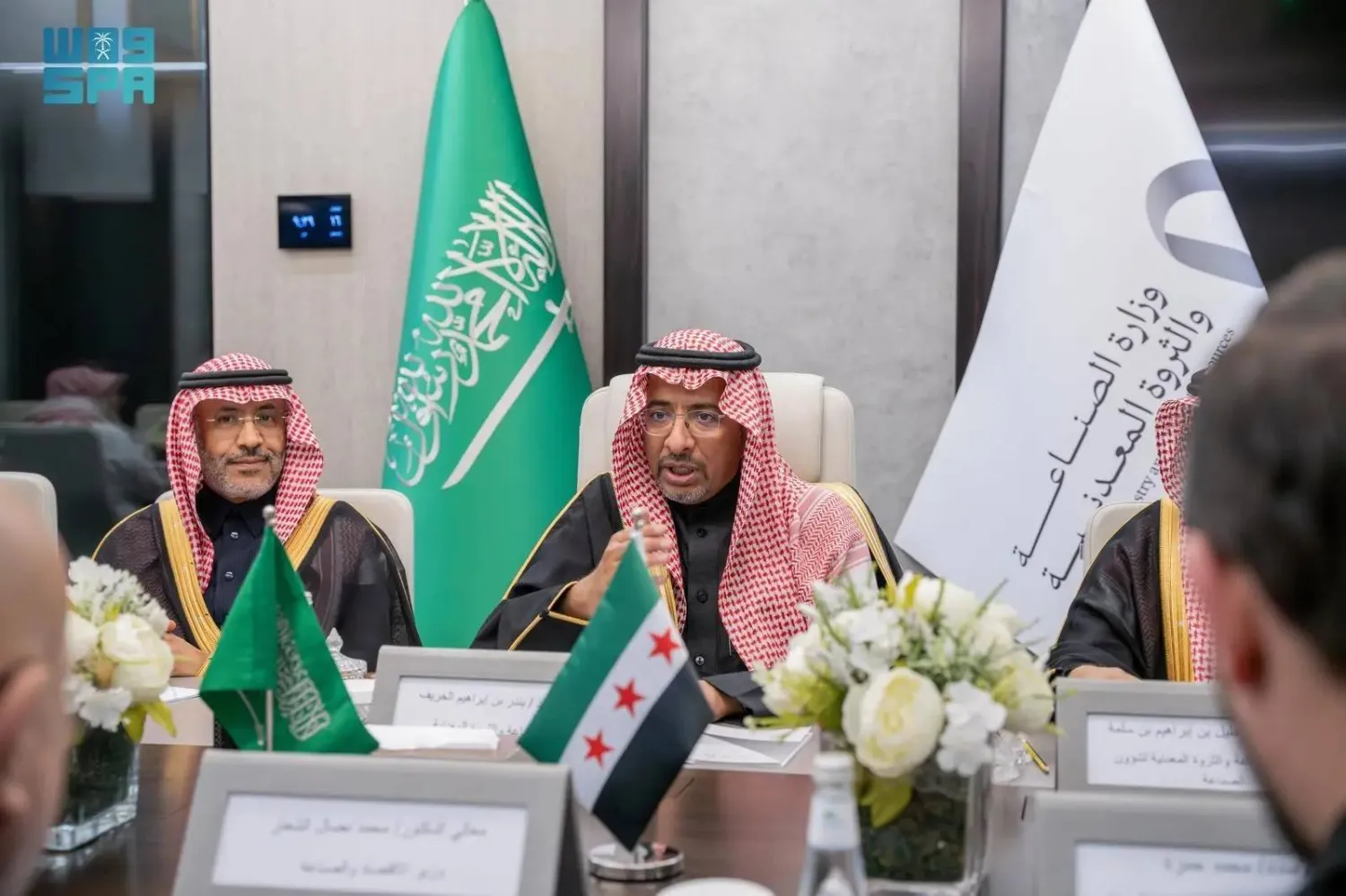
Saudi Minister of Industry and Mineral Resources Bandar Alkhorayef during Tuesday's meeting. (SPA)
TT

Saudi Arabia, Syria Discuss Industrial Investment Partnerships

Saudi Minister of Industry and Mineral Resources Bandar Alkhorayef during Tuesday's meeting. (SPA)

Saudi Minister of Industry and Mineral Resources Bandar Alkhorayef held talks in Riyadh on Tuesday with Syrian Minister of Economy and Industry Nedal Al-Shaar on ways to strengthen economic relations and develop industrial investment partnerships between their countries.

Alkhorayef praised Syria’s participation as Guest of Honor in the third edition of the Made in Saudi Expo, noting that this reflects the depth of fraternal relations and the shared economic ties between the two countries.

The officials discussed aspects of industrial cooperation and the opportunities for Syria to benefit from the Kingdom’s expertise and successful experience in developing its industrial sector.

They addressed prominent export opportunities that can support trade growth, strengthen industrial and economic integration between Saudi Arabia and Syria, and advance their developmental goals and shared interests.

Separately, Alkhorayef revealed that the Kingdom’s non-oil exports reached SAR307 billion in the first half of this year, marking the highest semiannual growth on record. 

He made the announcement during his participation in a dialogue session with Al-Shaar on the sidelines of the Made in Saudi Expo 2025. 

Alkhorayef explained that Saudi Vision 2030, through its initiatives, has driven record performance and sustained growth in non-oil exports over the past few years by unlocking national industrial capabilities, boosting the quality of Saudi products, and expanding their access to global markets. 

He highlighted opportunities for cooperation between Saudi Arabia and Syria in developing industrial cities, enabling Damascus to benefit from the Kingdom’s successful experience in export development and local content support, thereby contributing to its economic growth. 

Alkhorayef underlined the level of efficiency, skill, and craftsmanship demonstrated by Syrian investors in the Kingdom’s industrial sector, hoping that the industrial sector would become a key pillar of Syria’s economic advancement. 

He also addressed trade development between the two countries, noting that Saudi non-oil exports to Syria totaled SAR1.2 billion in the first nine months of 2025. 


Oil Falls as Trump Pledges Economic War on Iran

LOS ANGELES, CALIFORNIA - AUGUST 21: Diesel prices over $7 a gallon are displayed on a pump at a gas station on August 21, 2026 in Los Angeles, California. Justin Sullivan/Getty Images/AFP
TT

Oil Falls as Trump Pledges Economic War on Iran

LOS ANGELES, CALIFORNIA - AUGUST 21: Diesel prices over $7 a gallon are displayed on a pump at a gas station on August 21, 2026 in Los Angeles, California. Justin Sullivan/Getty Images/AFP

Oil prices fell on Monday as investors braced for details of a US plan to isolate the Iranian economy that President Donald Trump billed as the "most crushing" financial operation ever against Tehran.

Asian stocks were mostly down, with South Korea's tech-rich Kospi falling more than three percent after Samsung Electronics said it spent $80 billion to buy back its own shares following weeks of turbulent trading.

The chip giant's shares, along with those of rival SK hynix, peaked in June on optimism for the artificial intelligence boom, but have since fallen amid investor jitters and a broader tech rout.

In an important week for AI, investors are also looking towards an earnings report from Nvidia, the world's most valuable company and a bellwether for the sector.

The recurring question for the US chipmaker is whether the AI boom will continue to accelerate as the technology takes over more corners of the broader economy.

"The spending machine is still running, but the bill is getting heavier," said Stephen Innes of SPI Asset Management.

"Nvidia must now show that the most expensive investment boom in modern market history can still pay its bills."

Chinese tech giant Alibaba is keeping focus on the sector after announcing on Sunday that it plans to issue $10.2 billion in new shares in Hong Kong to fund its global AI ambitions.

The firm, known for its open-source "Qwen" AI models, has been ploughing tens of billions of dollars into the technology, with shareholders eager to see how it will monetize the huge investments.

Tokyo and Shanghai closed down 0.7 percent and 0.6 percent respectively, echoing losses across Asia that included Taipei, Wellington, Bangkok, Mumbai and Jakarta. Sydney, Singapore, Manila and Kuala Lumpur posted marginal gains.

Hong Kong was down nearly two percent despite fast-fashion giant Shein announcing its market debut will take place in the Chinese financial hub on September 1.

The long-awaited listing would value the group -- known for its vast selection of products at stunningly low prices -- at close to $27 billion.

London was flat at the open, while Paris and Frankfurt were down 0.2 percent.

Eyes are also on US Treasury boss Scott Bessent, who said he would give more details in a news conference on Monday on a fresh push to pile economic pressure on Iran.

The United States warned allies and China on Thursday to join Trump's new campaign, which comes as the unpopular war in the Middle East drags toward the six-month mark.

US Vice President JD Vance acknowledged the plan was a "delicate dance" because Iran will "try to apply economic pressure to us".

Asked whether the United States would pressure China, Bessent told CNBC that "many conversations are best to have in private", but he also called on Beijing "to get with the program".

Both main crude contracts were down around two percent, with the Brent benchmark sitting at $92 a barrel, AFP reported.

Traders will also be watching this week's annual gathering of central bankers, economists and finance chiefs in Jackson Hole in the United States, hoping for some clarification on US monetary policy.

The meeting comes after the Treasury bought its own bonds last week in an effort to push down borrowing costs after the 30-year yield surged to levels last seen in 2007, just before the global financial crisis.

Yields have risen on inflation fears and as the United States reported that its federal debt had topped $40 trillion.


Norway Will Drill in Arctic Regardless of EU’s Position, Says Energy Minister

Norway's Energy Minister Terje Aasland attends a press conference in connection with the new realization of the carbon capture project at the waste incineration plant at Klemetsrud, Oslo, Norway January 27, 2025. (NTB/Ole Berg-Rusten via Reuters)
TT

Norway Will Drill in Arctic Regardless of EU’s Position, Says Energy Minister

Norway's Energy Minister Terje Aasland attends a press conference in connection with the new realization of the carbon capture project at the waste incineration plant at Klemetsrud, Oslo, Norway January 27, 2025. (NTB/Ole Berg-Rusten via Reuters)

Norway will continue developing its oil and gas resources in the Barents Sea regardless of the European Union's support for a moratorium on Arctic hydrocarbon supplies, and no longer sees itself as Europe's "green battery", Energy Minister Terje Aasland told Reuters.

Following Russia's 2022 invasion of Ukraine, Norway has become Europe's largest supplier of natural gas, meeting around 30% of gas demand of both the European Union and Britain.

Last year, the country's gas production was near record levels, while oil output reached its highest level since 2009. Official forecasts, however, show production falling sharply after 2030 unless new resources are discovered and developed.

"In today's geopolitical and security environment, and given the resource situation, I believe continued activity in the Barents Sea serves both Norwegian and European interests," Aasland said in a Reuters interview ahead ‌of ONS, Norway's biannual ‌energy conference, which begins in Stavanger on Monday.

The European Union currently supports a ban ‌on ⁠new drilling in the ⁠Arctic on environmental grounds but is considering revising its policy in response to concerns about energy security.

Anders Opedal, CEO of Equinor, Norway's biggest oil firm, said oil and liquefied natural gas (LNG) from the Barents Sea can be shipped anywhere in the world if rejected by the EU.

"The only thing that will suffer from this is actually European security. We have the flexibility," Opedal told Reuters on Monday.

NORWAY AIMS TO MAINTAIN OUTPUT LEVELS

Aasland said Norway aims to maintain petroleum production and exports at roughly current levels until at least 2035, and Barents Sea production will be key.

"If Norway is to remain a long-term supplier of oil and gas to Europe..., then the ⁠Arctic must be part of that discussion," the energy minister said.

In talks with EU ‌officials, Norway has argued that the parts of the Barents Sea opened to ‌petroleum activity are also ice-free like in the North Sea, and so less prone to oil spills and other environmental impacts, and are ‌helping to sustain jobs and settlement in the country's northern regions bordering Russia.

Aasland believes Norway's arguments are being heard in Brussels, ‌but added that it was the country's sovereign right to develop the Barents Sea resources even if the EU continued to support a moratorium.

"We would develop these areas, and then it will be up to the EU whether they should have a moratorium on buying that gas or oil," Aasland said.

Arctic oil would be sold into global markets regardless, while gas could be exported worldwide as liquefied natural gas from ‌Equinor's Melkoeya LNG plant near Hammerfest, he added.

International Energy Agency Executive Director Fatih Birol has also urged the EU to reconsider its opposition to new Arctic oil and gas developments, ⁠arguing that future supplies ⁠will be needed to support energy security.

Critics of such a move argue that new Arctic projects would take many years to come online and would do little to address Europe's near-term energy challenges.

GREEN BATTERY ‘A FLAWED IDEA’

In addition to oil and gas, Norway produces a surplus of renewable energy most years from an extensive network of reservoirs and waterways feeding hydroelectrical plants, which it has exported to Europe via cross-border power cables.

Norway has previously presented itself as "the green battery" of Europe, but the minister says this idea is now outdated as Norway alone can't balance the European power market.

"It was a flawed idea," Aasland said.

The idea helped drive the construction of new power interconnectors, including links to Britain and Germany, but has drawn some opposition in Norway as European electricity prices have escalated.

Deeper integration with Europe's power system left Norway more vulnerable to continental price swings.

Aasland said Norway will not build new interconnectors but remains committed to strong power sector cooperation with Europe.

He urged countries on the continent to strengthen their stable power supply, weakened by coal and nuclear plant closures and a lack of investment in new gas-fired generation.

Doing so will lower prices and build greater reciprocity when it comes to power flows between different countries.

"The future lies in having a very strong and integrated system," Aasland said.


How Geospatial Data Reduces Project Costs in Saudi Arabia?

An aerial view of the Saudi capital, Riyadh (SPA)
TT

How Geospatial Data Reduces Project Costs in Saudi Arabia?

An aerial view of the Saudi capital, Riyadh (SPA)

Geospatial data forms the backbone of modern urban planning, linking digital information, including boundaries, land use, utilities and transportation networks, to precise geographic locations through coordinates.

Its importance lies in transforming static maps into analytical tools that provide a comprehensive, up-to-date view of urban areas, allowing planners to anticipate growth, identify cities’ needs and make decisions based on reliable data.

In Saudi Arabia, a geospatial database developed by the Ministry of Municipalities and Housing supports urban development by providing historical and recent aerial imagery and continuously updated spatial data, improving the quality and management of development projects.

The database also provides a reliable spatial reference for projects, studies and plans. Aerial surveying in the Kingdom has evolved over 56 years from analog film photography to high-resolution digital imaging and digital cadastral mapping.

Protecting Property Rights

Khalid Al-Ghamlas, Deputy Minister for Urban Planning and Lands at the Ministry of Municipalities and Housing, told Asharq Al-Awsat that the database supports the development of the real estate market and improves urban planning by providing accurate data on locations, boundaries, land use, roads, utilities and services.

He said its main value lies in linking data to geographic coordinates, allowing a property’s spatial reference to remain fixed even when physical features on the ground change.

This improves the reliability of real estate data, helps protect property rights, reduces overlaps and conflicts, and provides greater clarity for investors and decision-makers.

Integrating geospatial data also enables authorities to assess urban development alternatives and scenarios before approval, identify conflicts at an early stage, and pinpoint spatial needs and gaps more accurately, improving planning and implementation and making more efficient use of land and resources.

Khalid Al-Ghamlas, Deputy Minister for Urban Planning and Lands at the Ministry of Municipalities and Housing

Cutting Time and Costs

Al-Ghamlas said the database was expected to “shorten timelines and reduce costs by limiting the need to repeat surveying, field measurement and data collection, and by accelerating the preparation of studies, analyses and designs.”

Early detection of conflicts, along with fewer modifications and less rework during implementation, would also speed up decision-making, improve spending efficiency and raise the quality of project outcomes, he added.

The data supports planning decisions on land use, the distribution of services and utilities, transportation networks and infrastructure. It also helps authorities analyze urban growth trends and continuously monitor changes across cities.

From Aerial Surveying to AI

Saudi Arabia’s aerial surveying system has gradually evolved from black-and-white photography to color imagery, high-resolution digital imaging and digital cadastral mapping, reflecting broader advances in surveying and information systems.

On Oct. 19, 2010, the ministry received ISO 9001:2008 quality management certification covering the production and provision of spatial information, including aerial and ground surveying, photomaps, topographic maps, cadastral surveying and mapping, remote sensing, land information systems and geographic information systems.

The ministry continues to develop its aerial imagery, topographic maps and cadastral mapping systems to improve the integration of spatial information, increase urban planning efficiency and support development initiatives and projects.

It is also expanding the use of geospatial data and modern technologies, including spatial analysis and artificial intelligence, to monitor urban change, identify patterns and support evidence-based planning.