


China Passes Revised Foreign Trade Law to Bolster Trade War Capabilities

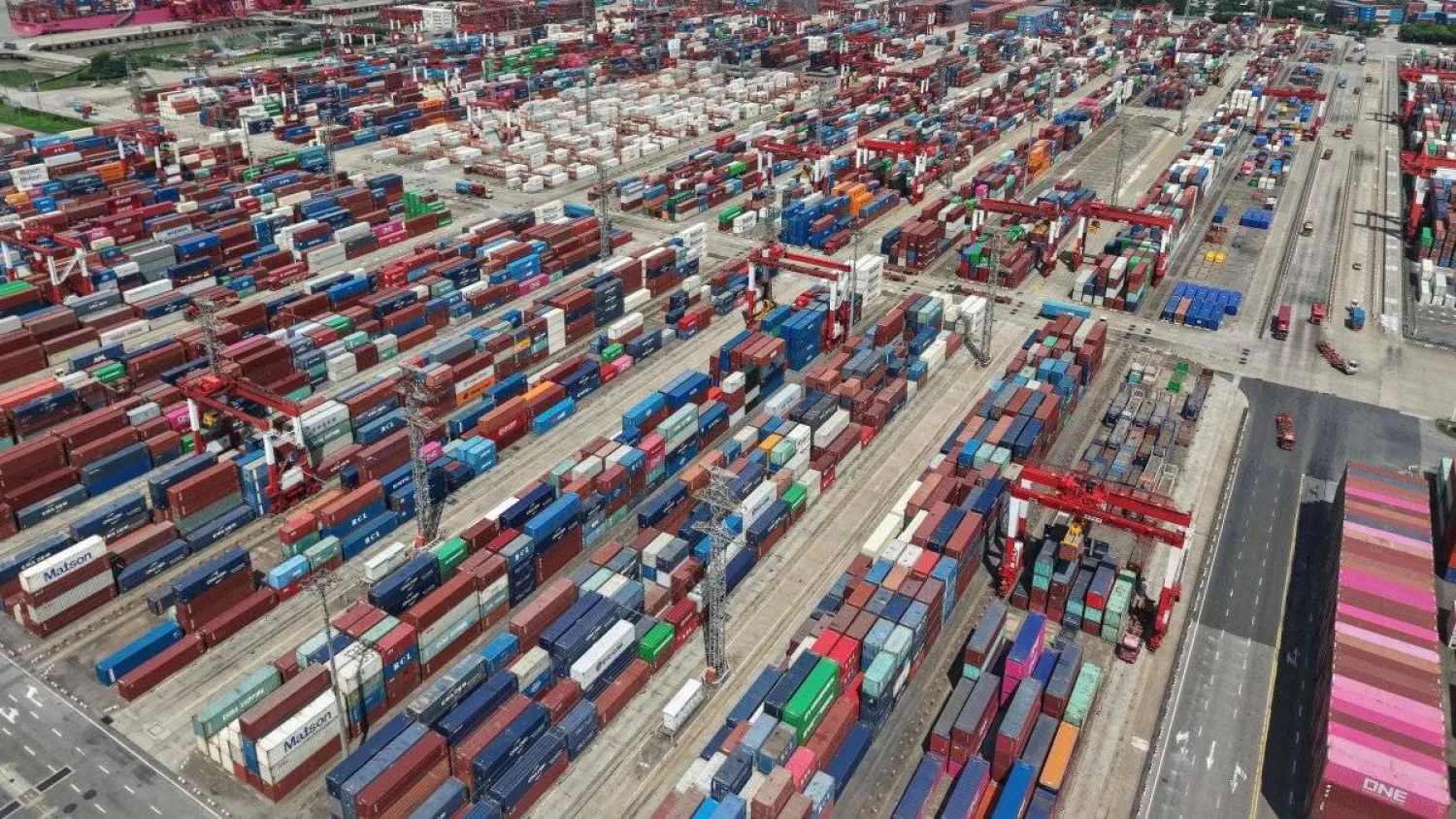
Containers are seen at the port in Shanghai, China, Oct. 13, 2025. (AFP)
TT

China Passes Revised Foreign Trade Law to Bolster Trade War Capabilities

Containers are seen at the port in Shanghai, China, Oct. 13, 2025. (AFP)

China on Saturday passed revisions to a key piece of legislation aimed at strengthening Beijing's ability to wage trade war, curb outbound shipments from strategic minerals, and further open its $19 trillion economy.

The latest revision to the Foreign Trade Law, approved by China's top legislative body, will take effect on March 1, 2026, state news agency Xinhua reported on Saturday.

The world's second-largest economy is overhauling its trade-related legal frameworks partly to convince members of a major trans-Pacific trade bloc created to counter China's growing influence that the manufacturing powerhouse ‌deserves a seat at ‌the table, as Beijing seeks to reduce ‌its ⁠reliance on the US.

Adopted ‌in 1994 and revised three times since China joined the World Trade Organization in 2001, most recently in 2022, the Foreign Trade Law empowers policymakers to hit back against trading partners that seek to curb its exports and to adopt mechanisms such as "negative lists" to open restricted sectors to foreign firms.

The revision also adds a provision that foreign trade should "serve national economic and social development" and help build China ⁠into a "strong trading nation", Xinhua said.

It further "expands and improves" the legal toolkit for countering external challenges, according ‌to the report.

The revision focuses on areas such ‍as digital and green trade, along ‍with intellectual property provisions, key improvements China needs to make to meet the ‍standards of the Comprehensive and Progressive Agreement for Trans-Pacific Partnership, rather than the trade defense tools the 2020 revamp honed in on following four years of tariff war with the first Trump administration.

Beijing is also sharpening the wording of its powers in anticipation of potential lawsuits from private firms, which are becoming increasingly prominent in China, according to trade diplomats.

"Ministries have become more concerned about private sector criticism," ⁠said one Western trade diplomat with decades' of experience working with China. "China is a rule-of-law country, so the government can stop a company's shipment, but it needs a reason."

"It's not totally lawless here. Better to have everything written out in black and white," they added, requesting anonymity, as they were not authorized to speak with media.

China's private exporting firms attracted global attention in November after the French government moved to suspend the Chinese e-commerce platform Shein.

The Chinese government increasingly could also find itself at odds with private enterprise when seeking to carry out sweeping bans, ‌such as Beijing's prohibition of all Japanese seafood imports, as Asia's top two economies continue to feud over Taiwan, trade diplomats say.



Gold Set for Weekly Drop as Oil Price Surge Weighs on Rate-cut Hopes

FILE PHOTO: A goldsmith weighs gold jewelry inside a showroom in Ahmedabad, India, July 31, 2025. REUTERS/Amit Dave/File Photo
TT

Gold Set for Weekly Drop as Oil Price Surge Weighs on Rate-cut Hopes

FILE PHOTO: A goldsmith weighs gold jewelry inside a showroom in Ahmedabad, India, July 31, 2025. REUTERS/Amit Dave/File Photo

Gold prices were on track for a second consecutive weekly drop, despite edging up on Friday, as surging energy prices due to the Middle East war dimmed prospects for near-term US interest rate cuts.

Spot gold was up 0.3% at $5,095.55 per ounce, as of 0633 GMT on Friday. US gold futures for April delivery fell 0.1% to $5,100.20.

The US 10-year Treasury yields eased, increasing the appeal of the non-yielding bullion. Bullion, however, has ‌lost more ‌than 1% so far this week. Since the war ‌started ⁠on February 28, ⁠it has dropped over 3% so far.

Fears of inflation and questions about the Federal Reserve's ability to cut interest rates if high oil prices persist are somewhat counteracting gold's appeal, said Tim Waterer, KCM Trade chief market analyst.

"Given the ongoing uncertainty about the duration and scope of the conflict in the Middle East, I expect gold to remain on the ⁠radar for investors as a safety play." Heightening geopolitical ‌tensions, Iran's Supreme Leader Mojtaba Khamenei said ‌on Thursday that Tehran will keep the strategic Strait of Hormuz closed as ‌leverage against the US and Israel, which has stoked concerns about ‌global energy supply and risk assets.

Oil prices rose above $100 a barrel, as attacks on oil tankers in the Gulf and warnings from Iran shattered prospects of quick de-escalation in the Middle East conflict. As oil prices surged, US President Donald ‌Trump again demanded Fed Chair Jerome Powell cut interest rates.

Traders, however, expect the Fed to keep rates ⁠steady in the current ⁠3.5%-3.75% range at the end of its two-day meeting on March 18, according to CME Group's FedWatch tool. While recent inflation data suggest price growth is under control, the war and the resulting spike in crude prices have yet to filter through the data.

Investors are awaiting the release of the delayed January Personal Consumption Expenditures Index, expected on Friday. Gold discounts in India widened this week to their deepest point in nearly a decade as demand stayed subdued and some traders steered clear of paying import duties, while the escalating Middle East war boosted safe-haven demand in China.

Spot silver was down 1% at $82.91 per ounce. Spot platinum lost 1% to $2,111.45 and palladium fell 1% to $1,603.


Iran War and Rising Fuel Costs Could Boost Panama Canal Traffic, Administrator Says

A cargo ship sails under Las Americas bridge through the Panama Canal, in Panama City, Thursday, March 12, 2026. (AP)
TT

Iran War and Rising Fuel Costs Could Boost Panama Canal Traffic, Administrator Says

A cargo ship sails under Las Americas bridge through the Panama Canal, in Panama City, Thursday, March 12, 2026. (AP)

Panama Canal Administrator Ricaurte Vásquez said Thursday that the conflict in the Middle East and rising fuel costs could ultimately benefit the interoceanic waterway as global shippers adjust routes.

In an interview with The Associated Press, Vásquez said that higher energy, fuel and navigation costs could make the Panama Canal a more attractive option for commercial traffic.

“When costs increase, in general when the price of marine fuel rises, the Panama Canal becomes a more attractive route,” Vásquez said.

Oil prices have risen amid the war in the Middle East, which has led to the temporary closure of the Strait of Hormuz by Iran in response to US and Israeli attacks. About one-fifth of the world’s oil passes through the waterway at the mouth of the Gulf.

If higher energy costs persist, routing cargo through Panama can cut voyages by between three and 15 days, depending on the route, while reducing fuel consumption, he said.

Vásquez said higher fuel costs are expected to affect container ships, bulk carriers and tankers transporting liquefied natural gas. If Middle Eastern supplies are disrupted, shipments may be replaced by other sources, including the United States, which could redirect some LNG cargo from Europe to Asia via Panama.

Gerardo Bósquez, an executive with the Panama Maritime Chamber, said a prolonged conflict could reshape global trade routes, with gas transport among the segments likely to benefit.

Vásquez cautioned that any changes will not be immediate and will depend on how long cargo operators expect the conflict and instability in the Gulf last.


ONS Data: UK Economy Lost Steam Unexpectedly at Start of 2026

FILE PHOTO: A direction sign is seen near the Bank of England building in London, Britain, February 3, 2025.  REUTERS/Toby Melville//File Photo
FILE PHOTO: A direction sign is seen near the Bank of England building in London, Britain, February 3, 2025. REUTERS/Toby Melville//File Photo
TT

ONS Data: UK Economy Lost Steam Unexpectedly at Start of 2026

FILE PHOTO: A direction sign is seen near the Bank of England building in London, Britain, February 3, 2025.  REUTERS/Toby Melville//File Photo
FILE PHOTO: A direction sign is seen near the Bank of England building in London, Britain, February 3, 2025. REUTERS/Toby Melville//File Photo

Britain's economy stagnated unexpectedly in January and expanded weakly in preceding months, according to official data on Friday that showed only tepid growth during the lead-up to the US-Israeli war in Iran.

The figures mean British gross domestic product has been essentially flat since June, ending January at the same level as six months earlier.

GDP rose during the three months to January by 0.2%, the Office for National Statistics ⁠said, against expectations ⁠in a Reuters poll of economists for a 0.3% increase.

The flat reading for January alone also dashed the median prediction for a 0.2% month-on-month increase.

Sterling slipped against the US dollar on the back of the figures, which showed no ⁠growth in the dominant services sector in January, against modest upticks in manufacturing and construction output.

Last month, the Bank of England said it expected the economy to grow 0.3% in the first quarter as a whole and 0.9% over 2026 as a whole - although that was before the conflict in Iran kicked off, prompting a surge in oil prices.

Earlier this week, finance minister Rachel Reeves ⁠said ⁠it was too soon to say how soaring energy prices would affect Britain's economy.

But investors see it as more exposed than other Western European economies due to its weak public finances, reliance on natural gas for electricity generation, and already high rates of inflation.

Financial markets no longer believe the Bank of England is likely to cut interest rates this year, and investors will be watching the central bank's communications carefully at next Thursday's interest rate announcement.