




At a time when geopolitical and economic changes are accelerating, and global competition for critical minerals are intensifying, supply chains are undergoing a profound reshaping of their traditional rules.
This transformation is driven by an unprecedented surge in demand, coupled with mounting constraints on supply.
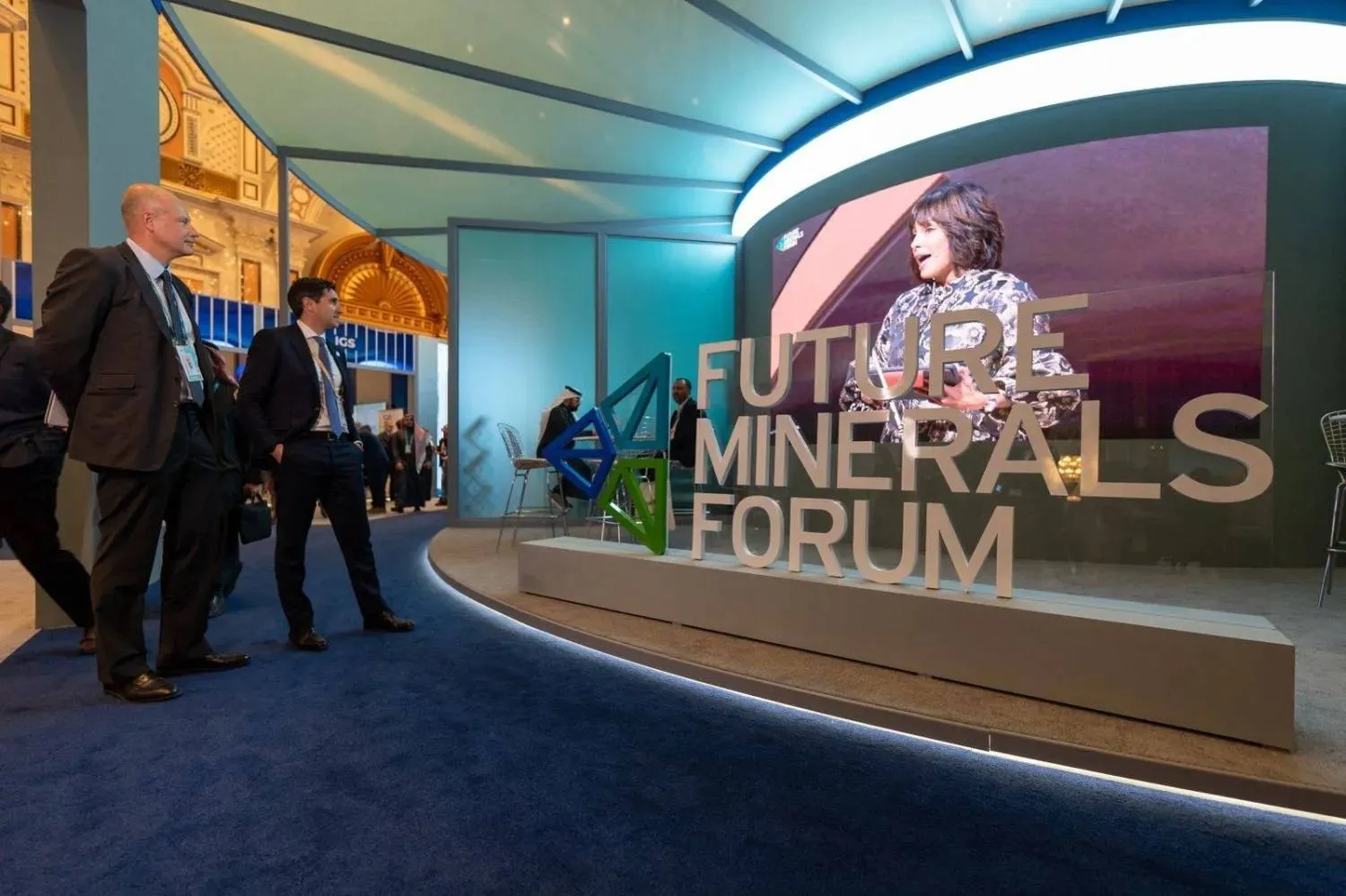
Asharq Al-Awsat held an interview on the sidelines of the International Mining Conference - currently under way in Riyadh under the patronage of Custodian of the Two Holy Mosques, King Salman bin Abdulaziz- with Nikolaus Lang, Managing Director and Senior Partner at Boston Consulting Group, Global Leader of the BCG Henderson Institute, and the Global Vice Chair for the firm’s Global Advantage Practice, along with Marcin Lech Managing Director and Partner at the firm.
The two figures offered an in-depth assessment of the global critical minerals landscape. They also addressed the role of artificial intelligence, Saudi Arabia’s position within these supply chains, and the key risks and opportunities shaping the sector’s outlook.
Supply Chains
Nikolaus Lang said that global minerals supply chains are being redrawn because demand is rising sharply at the same time as supply is becoming more constrained, concentrated, and politicized. Demand for critical minerals linked to energy transition, electrification, and advanced manufacturing is expected to grow 2–3× by 2040, with markets such as EVs and batteries alone driving multiples of today’s lithium, nickel, cobalt, copper, and rare earth demand.
Yet supply remains structurally tight: in several key minerals, 20–30% of future supply required by 2035 has not yet been identified or financed, while processing is heavily concentrated—often in a single country.
He added that the concentration is now translating directly into geopolitical risk. Recent years have seen export restrictions by China on gallium, germanium, and rare earth-related technologies, Indonesia’s nickel export bans, and rising resource nationalism in parts of Latin America.
For investors, this has changed the mindset fundamentally. Critical minerals are no longer viewed as cyclical commodities, but as strategic assets exposed to policy, trade, and security risk, with higher price volatility and longer development timelines challenging traditional project economics.
Artificial Intelligence
Lang stated that artificial intelligence is becoming one of the most important enablers in the race for critical minerals, precisely because the industry faces three simultaneous pressures: the need to expand the project pipeline, shorten development cycles, and improve success rates while controlling costs and risks. Traditional mining models simply cannot deliver the scale and speed required for the energy transition without fundamentally higher productivity.
In exploration, AI is already changing the odds. Machine-learning models can now analyze geological, geophysical, satellite, and historical drilling data simultaneously, identifying targets that would take human teams years to assess. Leading miners report that AI-supported targeting can increase discovery success rates by 2–3× and materially reduce exploration costs. This matters when global exploration pipelines have declined by nearly 40% since 2012, even as demand accelerates.
AI is also becoming critical in risk management—arguably the most underestimated lever. Advanced analytics can integrate commodity prices, supply-chain bottlenecks, permitting timelines, water and energy availability, and geopolitical signals to stress-test projects before capital is committed. In a world of volatile prices and policy-driven shocks, this ability to anticipate risk earlier is increasingly central to investment decisions.
That said, adoption is not without challenges. Many mining companies still struggle with fragmented data, legacy systems, and skills gaps, while regulatory uncertainty and concerns around explainability and ESG compliance slow deployment. AI only works when it is trained on high-quality, interoperable data—and much of the sector is still catching up on basic digital foundations.
Saudi Wealth
On the position of Saudi Arabia in the global critical minerals supply chain, Marcin Lech said that the Kingdom today sits at an inflection point in the global critical minerals supply chain. While it is not yet a dominant upstream producer across most critical minerals, it is rapidly emerging as a credible mining and processing ecosystem builder, with a strategy that spans domestic exploration, competitive processing, downstream demand, and international partnerships.
On the fundamentals, the Kingdom already has scale, he stated. Saudi Arabia is a top-five global producer of phosphate rock and among the top ten globally by phosphate reserves, while bauxite is another established pillar. More importantly, the exploration story is accelerating: recent work has highlighted new rare earth potential, alongside new gold and copper discoveries.
Lech added that what sets Saudi Arabia apart is the ecosystem it has deliberately put in place. The Mining Investment Law materially improved transparency, licensing timelines, and investor protections. That shift is reflected externally: in the Fraser Institute’s Annual Survey of Mining Companies, Saudi Arabia has been cited as one of the most improved jurisdictions globally over recent years, with a Policy Perception Index ranking now in the mid-20s globally, ahead of many longer-established mining regions. This is a meaningful signal for international investors.
Economically, Saudi Arabia brings competitive advantages few peers can match – with meaningful processing cost advantage versus major demand centers, driven by low-cost energy, industrial infrastructure, and scale.
Strategically, the Kingdom’s ambition is to become a critical minerals hub, not just a mining jurisdiction—connecting feedstock from Africa and Central Asia with processing, financing, and downstream demand. Saudi Arabia’s geopolitical neutrality and ability to work with both Eastern and Western partners is a real differentiator, particularly as supply chains fragment and investors seek diversification away from single-country dependence.
Risks and Chances
Marcin Lech said that looking ahead to 2025, the biggest risk for the global minerals sector is not demand — demand is clearly there — but whether supply can be mobilized fast enough in an increasingly fragmented world. We are entering a period where export controls, localization requirements, carbon border measures, and resource nationalism are becoming more common.
While many of these policies are understandable from a national security perspective, their cumulative effect risks undermining project economics, increasing volatility, and discouraging long-term investment at exactly the moment when the world needs more capital, not less.


