

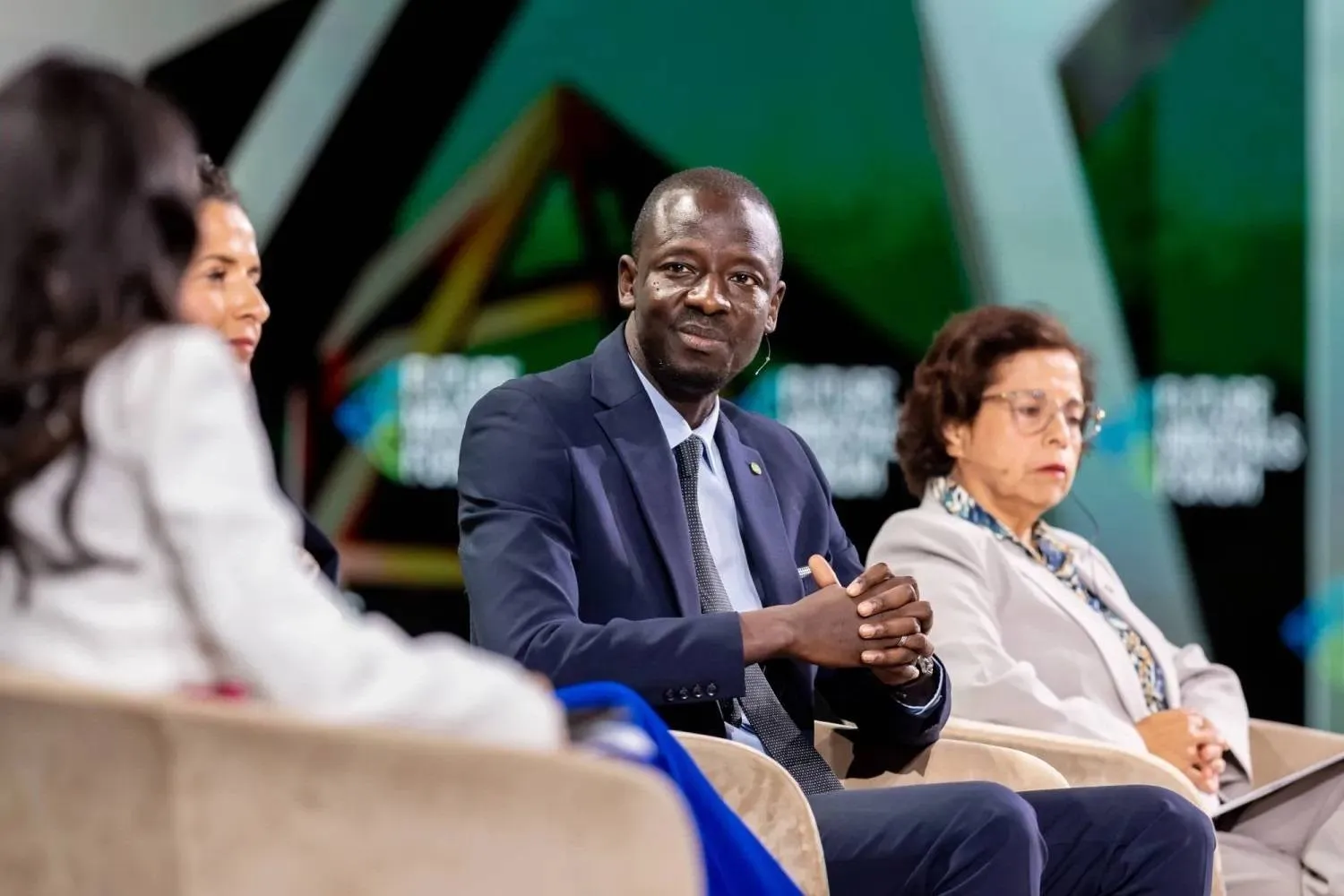

Mauritania to Saudi Investors: We Are Your Atlantic Gateway to Securing Minerals of the Future

Mauritania’s Minister of Mines and Industry, Thiam Tijani (Asharq Al-Awsat) 
TT

Mauritania to Saudi Investors: We Are Your Atlantic Gateway to Securing Minerals of the Future

Mauritania’s Minister of Mines and Industry, Thiam Tijani (Asharq Al-Awsat) 

Mauritania is positioning its mining weight and strategic Atlantic Ocean location as an “African mining gateway” for Saudi investments, extending a clear invitation to move immediately into partnerships that go beyond traditional extraction and open new horizons in downstream and value-added industries.

This message was conveyed by Mauritania’s Minister of Mines and Industry, Thiam Tijani, in an interview with Asharq Al-Awsat on the sidelines of the International Mining Conference held in Riyadh.

He stressed that the message was not merely an economic call, but a reaffirmation that Saudi investment in Mauritania is an “investment in the future” and a “unique development partnership in which the Saudi investor is not viewed as a stranger, but as a genuine partner welcomed through the open doors of Nouakchott to translate historical ties into major projects that benefit both brotherly countries.”

Today, Mauritania’s mining sector represents the backbone of the national economy, contributing more than 24 percent of GDP. The sector is undergoing a profound transformation aimed at moving it from a purely extractive activity into a comprehensive development sector.

While Mauritania has historically relied on iron ore and gold, recent discoveries and the country’s push toward green hydrogen are placing it on the threshold of an unprecedented industrial transformation on the African continent.

The minister said Mauritania is redrawing its mining map to make it broader and richer, setting ambitious targets for the next five years. Nouakchott aims to raise iron ore production to more than 20 million tons annually and increase gold output to over 1.5 million ounces per year.

He emphasized that the next phase will prioritize not only production volumes, but also the sector’s ability to generate local added value that supports sustainable economic growth.

Saudi Arabia... The Strategic Partner and the Awaited Expertise

Addressing bilateral relations, Tijani described Saudi Arabia as a “strategic partner,” noting that these ties are grounded in the forward-looking vision of the two countries’ leaderships. He praised the historic role of the Saudi Fund for Development, as well as investments by Saudi companies such as SABIC.

He expressed Mauritania’s aspiration for broader participation by major industrial players, including Maaden, stressing that the country is aligning its laws and regulations to be attractive to Saudi investors, whom he described as “partners in development, not strangers to the home,” particularly in downstream industries where the Kingdom has long-standing expertise.

Leadership in Hydrogen and the Production of “Green Steel”

On the energy front, Tijani revealed Mauritania’s ambition to become Africa’s “capital of green hydrogen,” capitalizing on its abundant wind and solar resources. The strategic plan, he said, is to use clean energy to process iron ore locally into “green steel,” a project he believes has the potential to “change the rules of the game globally.”

He extended an open invitation to leading Saudi companies in renewable energy and heavy industries to take part in this transformation, ensuring that Mauritanian mining products become among the most in demand in global markets in the future.

Fuel of Technology... Lithium and Rare Minerals

Turning to the minerals of the future, Tijani said recent geological surveys have revealed promising potential for lithium, cobalt, nickel, and chromium. Describing these minerals as the “fuel of the technological revolution” and electric vehicles, he noted that Mauritania has designated new concession areas and prepared technical files to present to Saudi partners.

He stressed that Saudi Arabia has a valuable opportunity to secure its supply chains for these strategic materials through direct investment in Mauritanian mines.

To ensure smooth investment flows, Tijani announced a major leap in facilitating procedures through the digitization of the mining land registry and making it available online, ensuring full transparency and allowing investors in Riyadh to access maps and data remotely. He added that a dedicated one-stop shop has been established to reduce bureaucracy and accelerate the processing of applications.

He concluded with a message of reassurance to leaders in Saudi Arabia’s mining sector, emphasizing that “Mauritania is the safest and most viable destination, thanks to its political and security stability and a legal framework that protects rights,” inviting them to invest in “the future” through Mauritania’s Atlantic gateway.


Hapag-Lloyd Says One Ship Has Crossed Strait of Hormuz

Hapag-Lloyd employees monitor the status of cargo ships in the Strait of Hormuz on a screen, in Hamburg, Germany, Wednesday, April 15, 2026. (AP Photo/Ebrahim Noroozi)
TT

Hapag-Lloyd Says One Ship Has Crossed Strait of Hormuz

Hapag-Lloyd employees monitor the status of cargo ships in the Strait of Hormuz on a screen, in Hamburg, Germany, Wednesday, April 15, 2026. (AP Photo/Ebrahim Noroozi)

Container shipping group Hapag-Lloyd said on Friday that one of its ships has crossed the Strait of Hormuz but did not have any information on the circumstances or timing.

Four out of initially six ships remain in the Gulf, after one ship's charter agreement expired, meaning it no longer belongs to the Hapag-Lloyd fleet, a spokesperson added.

The four ⁠Hapag ships remaining ⁠in the Gulf are staffed with 100 crew, who are well-supplied with food and water, Reuters quoted him as saying.

Scores of tankers and other vessels remain stuck in the Gulf as the United States is ⁠struggling to keep control of the Strait of Hormuz, one of the world's busiest shipping corridors.

The Iran war, launched by the US and Israel on February 28, has been paused since a ceasefire on April 8.

The US and Iran met in Pakistan in an attempt to end hostilities, but talks ended without agreement and ⁠a ⁠second round has yet to take place.

Tehran says it will not consider opening the strait until the US lifts its blockade of Iran's shipping, which Washington imposed during the ceasefire and Tehran calls a violation of that truce.

This week, Iran flaunted its grip over the strait with a video of commandos in a speedboat storming a huge cargo ship.


TotalEnergies to Invest in $1.2 Billion Power Project in Kazakhstan

FILE PHOTO: The logo of French oil and gas company TotalEnergies is seen at a petrol station in Paris, France, March 25, 2026. REUTERS/Abdul Saboor/File Photo
TT

TotalEnergies to Invest in $1.2 Billion Power Project in Kazakhstan

FILE PHOTO: The logo of French oil and gas company TotalEnergies is seen at a petrol station in Paris, France, March 25, 2026. REUTERS/Abdul Saboor/File Photo

French energy major TotalEnergies on Friday said it would invest in a Kazakhstan-based onshore wind and energy storage project, valued at $1.2 billion, and plans to sell the produced electricity to the country's government under a 25-year agreement signed in 2023.

The Mirny project, which is scheduled to reach full capacity in 2029, ⁠combines one gigawatt ⁠of wind capacity with 600 megawatt hours of battery energy storage, enough to supply about 1 million people in Kazakhstan, Reuters quoted the company as saying.

The launch of the project would ⁠contribute to Kazakhstan's target of increasing the share of renewables in electricity generation to 15% by 2030, Olivier Jouny, senior vice president for renewables at TotalEnergies, said in a statement.

Roughly 75% of the investment is financed externally through an agreement with an international consortium made of eight banks and entities, including the ⁠European ⁠Bank for Reconstruction and Development, Société Générale and China Construction Bank, TotalEnergies said.

TotalEnergies, jointly with partners Samruk Energy and KazMunayGas, controls a 60% stake in the project.

At the beginning of 2026, TotalEnergies had more than 34 GW of gross renewable power generation capacity, and it aims to achieve more than 100 terawatt hours of net electricity production by 2030.


Oil Rises on Concern Over Escalating Middle East Tensions

HUNTINGTON BEACH, CALIFORNIA - APRIL 23: A pumpjack stands idle in the Huntington Beach oil field on April 23, 2026 in Huntington Beach, California. Mario Tama/Getty Images/AFP
TT

Oil Rises on Concern Over Escalating Middle East Tensions

HUNTINGTON BEACH, CALIFORNIA - APRIL 23: A pumpjack stands idle in the Huntington Beach oil field on April 23, 2026 in Huntington Beach, California. Mario Tama/Getty Images/AFP

Oil rose on Friday on concerns of a renewed military escalation in the Middle East after Iran released footage of commandos boarding a cargo ship in the Strait of Hormuz, and a lack of progress in re-opening the key waterway.

Navigation through the strait, which before the war carried about a fifth of global oil output, remains effectively blocked. Iran's capture of two cargo ships highlighted Washington's difficulties in trying to control the passage.

Brent crude futures were up $1.93, ⁠or 1.8%, to $107 a ⁠barrel at 0805 GMT, while US West Texas Intermediate futures were up 76 cents, or 0.8%, at $96.61, Reuters reported.

For the week, Brent is up 18% and WTI 15%, the second-largest weekly gains since the war began.

Both contracts settled more than 3% higher on Thursday after reports that air defenses were engaging targets over Tehran and of a ⁠power struggle between Iran's hardliners and moderates.

"There is no de-escalation in sight," said Tamas Varga of oil broker PVM.

US President Donald Trump said Iran may have loaded up its weaponry "a little bit" during a two-week ceasefire, but added that the US military could eliminate it in a single day. On Wednesday, he said he would indefinitely extend the ceasefire to allow for further peace talks.

The ceasefire is increasingly looking like a preparatory phase for more war, Haitong Futures said in a report. If peace talks fail to make ⁠progress by ⁠the end of April and fighting resumes, oil prices could climb to new highs for the year, it added.

"There's set to be fresh financial pain ahead as key shipments from the region remain blocked," said Susannah Streeter, chief investment strategist at UK investment service Wealth Club. "That is set to keep costs elevated for a vast array of commodities."

As investors and governments around the world look for a lasting peace, Trump said he would not set a "timetable" for ending the conflict and that he wanted to make "a great deal."

"Don't rush me," he said when asked how long he was willing to wait for a long-term deal.
