

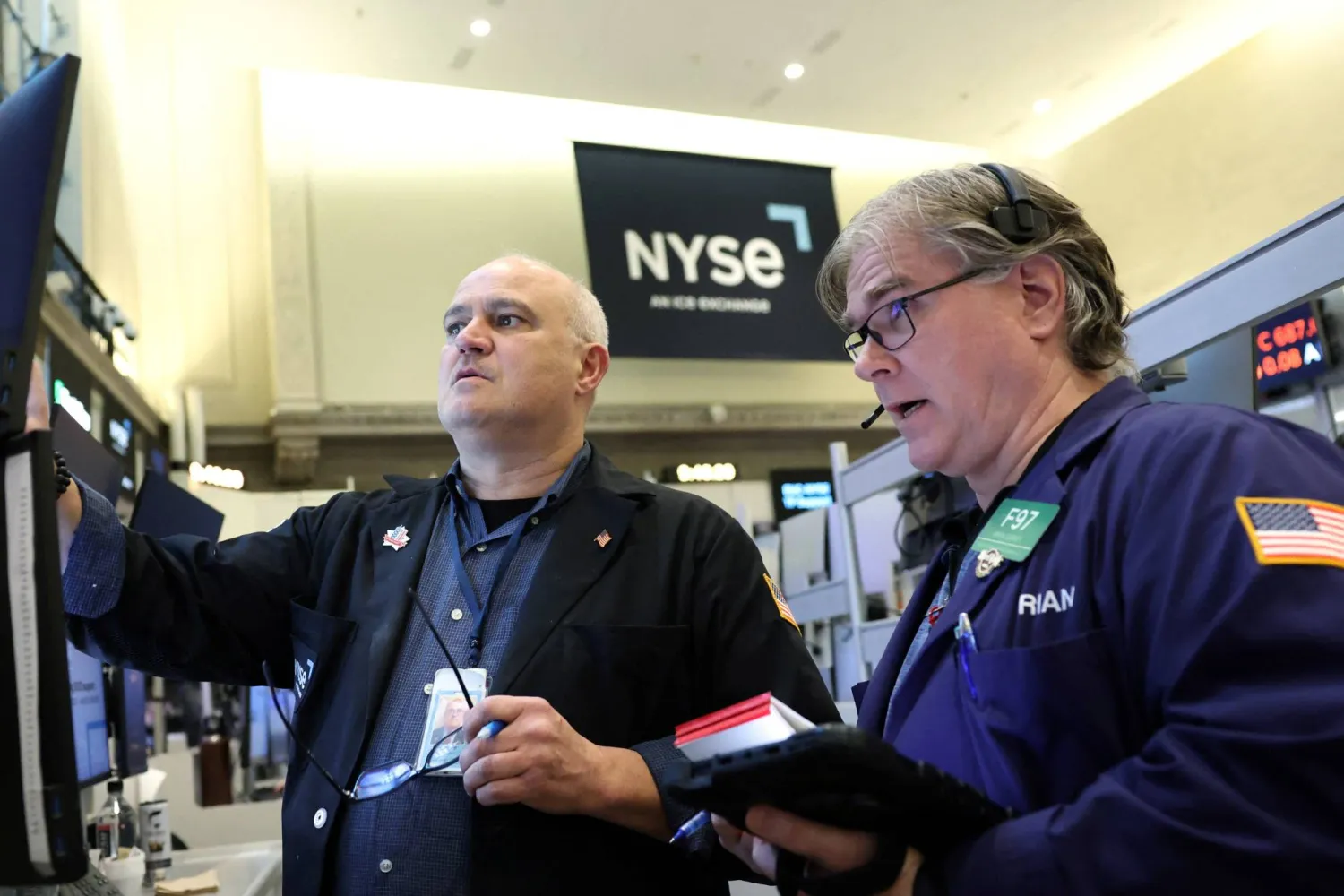

Wall Street Intends to Stay Open around the Clock

Futures-options traders work on the floor at the New York Stock Exchange's NYSE American (AMEX) in New York City, US, January 21, 2026. REUTERS/Brendan McDermid
TT

Wall Street Intends to Stay Open around the Clock

Futures-options traders work on the floor at the New York Stock Exchange's NYSE American (AMEX) in New York City, US, January 21, 2026. REUTERS/Brendan McDermid

The closing and opening bells of the New York Stock Exchange (NYSE) may become a ringing ritual of yesteryear, as the market moves toward nonstop trading.

This week, the Intercontinental Exchange announced it is developing a platform for 24/7 operations that offers "instant settlement."

The around-the-clock operations would rely on digital tokens mirroring the shares of listed companies, the NYSE's parent company said in a statement.

NASDAQ, another New York-based trading exchange, could follow suit as early as this year, said AFP.

The move is pending approval by federal regulators at the US Securities and Exchange Commission (SEC), and would amount to a minor revolution for the way money moves in US stock markets.

- 'Waste of time' -

In the early days of the exchange, investors had to be physically present in markets on Wall Street to "stand and yell at each other and wave pieces of paper, and then they would have to write down what everybody bought and sold," Sam Burns, chief strategist at Mill Street Research, told AFP.

That meant "having trading go on all day every day would sort of be impossible to keep up with," Burns said.

Digitized transactions can change all that.

Off-hours trading has already been on the rise since 2019, exploding since 2024 when the daily average topped $61 billion, according to a NYSE report in early 2025.

But the appeal remains limited, according to Steve Hanke, a professor of applied economics at Johns Hopkins University.

"Historically, there is little evidence that supports the idea that the benefits of 24-hour trading outweigh the costs," he said, adding that there "are few market-moving events that occur outside of normal business hours in New York City."

"Night trading proved to be a waste of time," he said.

Hanke said the real advantage in the NYSE's announcement lies in the time needed to finalize a trade -- a process that usually occurs the next day in most stock markets.

"Narrowing the settlement window may prove to be a significant competitive advantage," Hanke said.

- Attracting the young and foreigners -

As host to immense market caps, the US market remains the largest in the world, but competition is growing.

Last year, many European indexes generated returns that outpaced their US counterparts.

With extended hours, Wall Street may be able to attract smaller investors and those outside the Americas.

Nearly 18 percent of US shares belonged to non-US holders in 2024, according to the US Treasury's most recent available figures.

And fans of cryptocurrency trading may jump into stocks, said Burns, the Mill Street Research strategist.

"A lot of retail investors nowadays, particularly younger ones, seem to like the idea of being able to trade stocks all the time the way they do cryptocurrencies and other digital assets, whether it's nights or weekends," Burns said.

It is unlikely that the change would move traditional investors from banker's hours because the impacts of any change are likely to be limited," Burns added.

"Most institutional investors that trade the real money aren't really interested in working or trading on the weekends, and the fact (is) that banks are mostly still closed on the weekends," Burns said.



EU Opposes Removing Oil Sanctions on Russia to Cool Energy Prices

Pumpjacks operated by Aera Energy work the wells at the Midway-Sunset field near Taft in Kern County, California, on March 8, 2026. (Photo by Frederic J. BROWN / AFP)
TT

EU Opposes Removing Oil Sanctions on Russia to Cool Energy Prices

Pumpjacks operated by Aera Energy work the wells at the Midway-Sunset field near Taft in Kern County, California, on March 8, 2026. (Photo by Frederic J. BROWN / AFP)

EU economy chief Valdis Dombrovskis said Tuesday the European Union did not support removing sanctions on Russian oil despite soaring energy prices, AFP reported.

"We must continue to exert maximum pressure on Russia," he said when asked about US President Donald Trump's announcement he will waive some sanctions on oil, warning easing restrictions would "reinforce Russia's capacity to wage war, undermining Ukraine".


Airlines Hike Ticket Prices as Iran War Propels Fuel Costs

A Qantas logo is visible on the tail of an airplane at an airport in Sydney, Australia, September 18, 2025. (Reuters)
TT

Airlines Hike Ticket Prices as Iran War Propels Fuel Costs

A Qantas logo is visible on the tail of an airplane at an airport in Sydney, Australia, September 18, 2025. (Reuters)

Australia's Qantas Airways , Scandinavia's SAS and Air New Zealand announced airfare hikes on Tuesday, blaming an abrupt spike in the cost of fuel caused by the Middle East conflict.

Jet fuel prices, which were around $85 to $90 per barrel before US-Israeli strikes on Iran, have soared to between $150 and $200 per barrel in recent days, New Zealand's flag carrier said as it suspended its financial outlook for 2026 due to uncertainty over the conflict.

The war, which disrupted shipping via the world's most vital oil export route, has sent oil prices surging, upending global travel, pushing airline tickets on some routes sky-high, and sparking fears of a deep travel slump that could lead to widespread grounding of planes.

"Increases of this magnitude make it necessary to react in order to maintain stable and reliable operations," an SAS spokesperson said in a statement to Reuters, adding it had implemented a "temporary price adjustment".

The largest Scandinavian airline said last ‌year it had temporarily ‌adjusted its fuel hedging policy due to uncertain market conditions and that it had no ‌fuel ⁠consumption hedged for the ⁠following 12 months.

While several Asian and European airlines, including Lufthansa and Ryanair, have oil hedging in place, securing a part of their fuel supplies at fixed prices, Finnair warned that even the availability of fuel could be at risk if the conflict dragged on.

"A prolonged crisis could affect not only the price of fuel but also its availability, at least temporarily," a Finnair spokesperson said, adding that it had not seen this happening yet. It had hedged over 80% of its first-quarter fuel purchases.

AIRSPACE CHAOS IN THE MIDDLE EAST

Highlighting the airspace chaos in the Middle East, planes arriving in Dubai were briefly placed in a ⁠holding pattern on Tuesday due to a potential missile attack, flight tracking service Flightradar24 said on X. ‌The planes eventually landed.

Qantas said in addition to increasing international fares, it was exploring ‌options to redeploy capacity to Europe as airlines and passengers seek to evade disruptions in the Middle East, where drone and missile fire have ‌curtailed flights.

Airfares have soared on Asia-Europe routes due to airspace closures and capacity constraints, and Hong Kong's Cathay Pacific Airways said on ‌Tuesday it was adding extra flights to London and Zurich in March.

Air New Zealand said it had raised one-way economy fares by NZ$10 ($6) on domestic routes, NZ$20 on short-haul international services and NZ$90 on long-haul, with more adjustments to prices and schedules possible if jet fuel costs remain elevated.

Hong Kong Airlines said on its website it would raise its fuel surcharges by up to 35.2% from Thursday, with the sharpest increase on flights between ‌Hong Kong and the Maldives, Bangladesh and Nepal.

AIRLINE SHARES STABILISE AFTER SELLOFF

Some airline stocks rose and oil prices fell to around $90 a barrel on Tuesday from a high of $119 on Monday ⁠after US President Donald Trump said ⁠on Monday the war could be over soon. When markets opened in Europe, airline shares were up between 4% and 7%.

In Asia, airline shares showed signs of stabilising, with Qantas closing up 0.5%, Korean Air Lines rising 3% and Cathay Pacific up 3.6%. All had recorded sharp declines on Monday.

Fuel is the second-largest expense for air carriers after labor, typically accounting for a fifth to a quarter of operating expenses.

CONFLICTS SHRINKING AVAILABLE AIRSPACE

In addition to high fuel costs, tightening airspace also threatens to derail the global travel industry, as pilots reroute to avoid the Middle East conflict and capacity on popular routes fills up.

Emirates, Qatar Airways and Etihad typically jointly account for about one-third of the passenger traffic between Europe and Asia and fly more than half of all passengers from Europe to Australia, New Zealand and nearby Pacific Islands, according to Cirium.

European airlines have already struggled with the shortage of available airspace created by the war in Ukraine, with many avoiding Russian airspace and flying longer international routes. Now, with even less available airspace, they say their business has become even more challenging.


Aramco Sees ‘Catastrophic Consequences’ for Oil Markets if Hormuz Strait Remains Blocked

President and CEO of Saudi's Aramco, Amin Nasser, speaks during the Future Investment Initiative (FII) in Riyadh, Saudi Arabia October 29, 2024. (Reuters)
TT

Aramco Sees ‘Catastrophic Consequences’ for Oil Markets if Hormuz Strait Remains Blocked

President and CEO of Saudi's Aramco, Amin Nasser, speaks during the Future Investment Initiative (FII) in Riyadh, Saudi Arabia October 29, 2024. (Reuters)

Saudi Arabia's Aramco , the world's top oil exporter, said on Tuesday there would be "catastrophic consequences" for the world's oil markets if the Iran war continues to disrupt shipping in the Strait of Hormuz.

Oil shipments have been largely blocked from using the shipping artery, where normally roughly 20% of the world's oil would pass through daily. Iran's Revolutionary Guards said on Tuesday they would not allow "one liter of oil" to be shipped from the Middle East if US and Israeli attacks continue.

"There would be catastrophic consequences for the world's oil markets and the longer the disruption goes on ... the more drastic the consequences for the global economy," Aramco CEO Amin Nasser told reporters on an earnings call.

"While we have faced disruptions in the past, this one by far is the biggest crisis the region's oil and gas industry has faced."

WIDE RANGE OF SECTORS MAY BE HIT

The crisis has not only ‌upended the shipping ‌and insurance sectors, but it also promises to have drastic domino effects on aviation, agriculture, automotive ‌and ⁠other industries, he added.

Global ⁠crude benchmark Brent, which rocketed to a more than three-year high of nearly $120 a barrel on Monday, was trading around $92 on Tuesday following comments by US President Donald Trump predicting the war could end soon.

Trump, however, warned that the US would hit Iran much harder if it blocked exports from the vital energy-producing region.

He has also said the US Navy could escort ships in the Gulf to guarantee safe passage. But the Navy's capacity to do that is unclear, with some vessels already engaged in strikes against Iran and shooting down its missiles.

Asked about US Navy escorts and whether they were possible on the scale required, Nasser said there are sizable volumes involved, ⁠adding that Aramco's customers assume the risk of delivery.

"Of course, we would support any actions ‌or measures that would help to deliver our products to our customers, to ‌the global market," he said.

NO EXPORTS FROM THE GULF

Nasser noted global inventories of oil ‌were at a five-year low and said the crisis will lead to drawdowns at a faster rate, adding that it was critical that shipping in the strait resumed.

"Unfortunately, for global markets, most of the spare capacity is in this region," Nasser told analysts on a call, noting that incremental demand throughout the year will keep the market tightly balanced.

At present, Aramco is not exporting oil from the Gulf as ships cannot load ‌cargoes there. But the company, which does not disclose its exact crude output, is meeting the majority of its customers' needs, he said, partly by tapping into global inventories.

"Now, that ⁠cannot be used - that inventory - ⁠for an extended period of time, but for the time being, we are capitalizing on it," he said.

The East-West pipeline is, meanwhile, being used to transport mostly Arab Light and some Arab Extra Light crude grades to the Red Sea port of Yanbu. The pipeline, which has more than doubled its initial capacity, is expected to reach its full capacity of 7 million barrels per day in the next couple of days as customers re-route, Nasser said.

"Even with our ability to export through the western region, you're talking about close to 350 million barrels of disruptions that will come off the market," he said.

In addition to the pipeline, Aramco is also able to direct crude towards domestic demand, he noted. Close to 2 million bpd of the pipeline's 7 million bpd capacity is going to western domestic refineries, which are net exporters of products, Nasser added.

A small fire from an attack last week on Aramco's Ras Tanura refinery, its largest domestically, was quickly extinguished and brought under control, Nasser said, adding that the refinery was in the process of being restarted.