Oil Set for First Weekly Decline in Seven Weeks ahead of US-Iran Talks

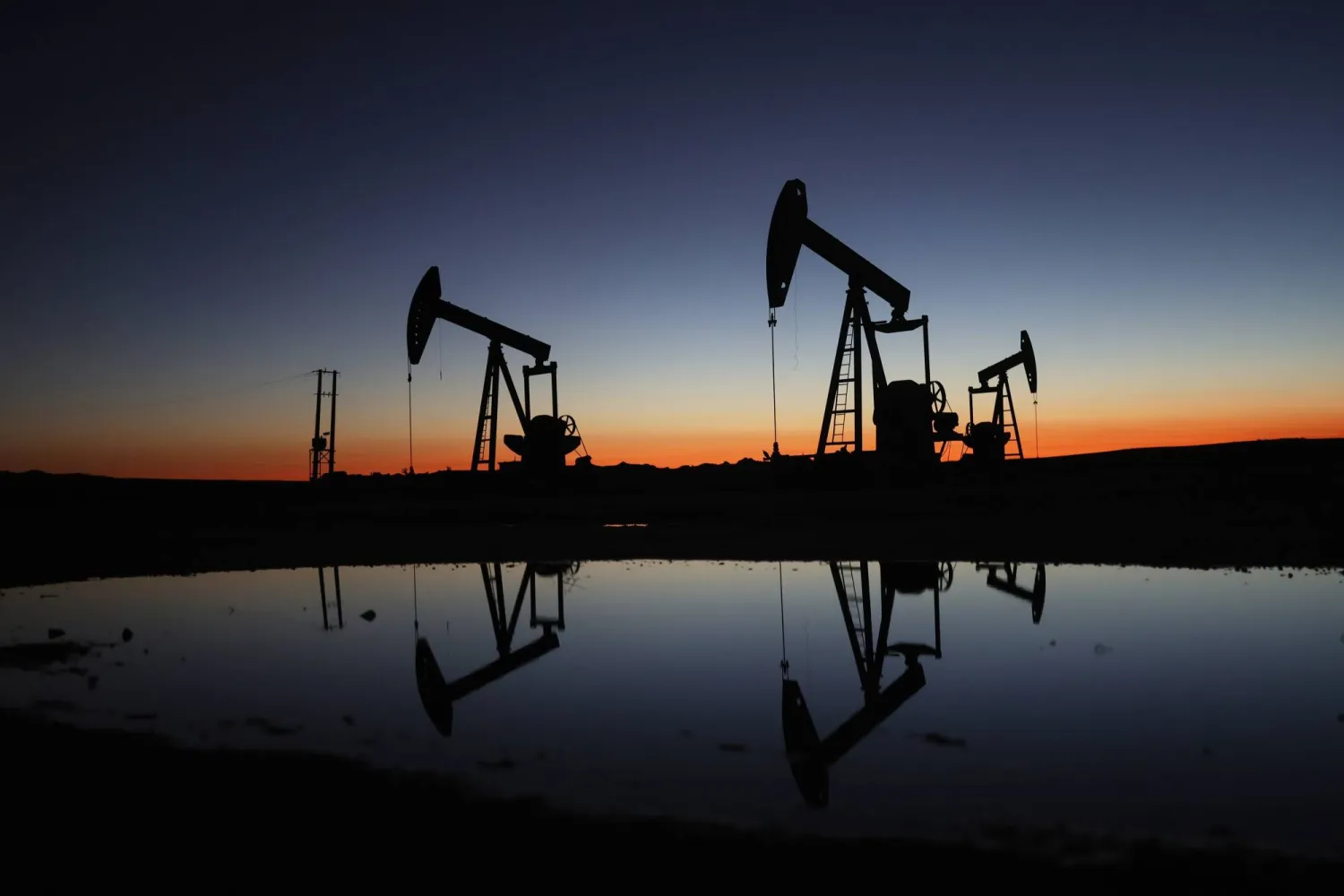
The sun rises behind the Tishrin oil field in the eastern Hasakah countryside, northeastern Syria (AP)
TT

Oil Set for First Weekly Decline in Seven Weeks ahead of US-Iran Talks

The sun rises behind the Tishrin oil field in the eastern Hasakah countryside, northeastern Syria (AP)

US crude futures rose slightly on Friday but were on track for their first weekly drop in seven weeks as supply concerns eased, and investors focused on the outcome of US-Iran nuclear talks in Oman later in the day.

Brent crude futures rose 25 cents, or 0.4%, to $67.80 a barrel at 0353 GMT, ‌while the US ‌West Texas Intermediate crude was also ‌up ⁠25 cents, ‌or 0.4%, at $63.54 a barrel.

The benchmarks are down more than 3% from near six-month highs reached in late January when US President Donald Trump threatened to strike Iran, with the two sides set to hold talks in Oman on Friday.

However, Tehran and Washington have not agreed on the agenda for the ⁠meeting. Iran wants to discuss only nuclear issues, while the US is ‌pressing to include Iran's ballistic missiles, support ‍for armed groups around ‍the region and the treatment of its people.

"The two ‍sides remain well apart, leaving tensions elevated. This should see the geopolitical risk premium remain in place," Daniel Hynes, an analyst at ANZ, said in a note on Friday.

Any escalation of tensions between the US and Iran could disrupt oil flows, as about a fifth of the world's ⁠total oil consumption passes through the Strait of Hormuz between Oman and Iran.

Saudi Arabia, the United Arab Emirates, Kuwait and Iraq export most of their crude via the strait, as does their fellow OPEC member Iran.

If the US-Iran talks ease the prospect of conflict in the region, oil prices could decline further.

"We think that geopolitical fears will give way to weak fundamentals," Capital Economics analysts said in a note, pointing to a recovery in Kazakhstan's oil output which will help push ‌oil prices lower, towards $50 per barrel by end-2026.


Cash-strapped Lebanon Finds Itself Sitting on a Gold Mine, as Precious Metal Prices Surge

Meanwhile, many Lebanese are crowding marketplaces to buy gold and silver in hopes of recovering some of their losses. (AP)
TT

Cash-strapped Lebanon Finds Itself Sitting on a Gold Mine, as Precious Metal Prices Surge

Meanwhile, many Lebanese are crowding marketplaces to buy gold and silver in hopes of recovering some of their losses. (AP)

Tiny Lebanon sits on one of the largest gold reserves in the Middle East and its government is weighing whether it can use that stockpile to restore a crippled economy while its citizens are looking at gold as a way to protect their battered assets.

Lebanon’s economy hobbled into 2026 with ongoing inflation and state decay and no reforms to combat corruption in sight. Its banks collapsed in late 2019 in a crippling fiscal crisis that evaporated depositors’ savings and plunged about half its population of 6.5 million into poverty, after decades of rampant corruption, waste, and mismanagement. The country suffered some $70 billion in losses in its financial sector, further compounded by about $11 billion in the 2024 war between Israel and the Hezbollah militant group.

The price of gold recently soared to an all-time high of $5,354, before dropping back below $5,000, sparked by geopolitical instability and questions surrounding US President Donald Trump’s desire to lower interest rates that would ultimately devalue the dollar. Global central banks have been among the most avid buyers. Silver prices meanwhile have also surged due to industrial demand and the attractiveness of a much cheaper price than gold.

The central bank in Beirut has maintained a reserve of 286 tons of gold - some nine million ounces - since the 1960s. Only Saudi Arabia’s central bank holds more in the region.

The government is considering using some of its gold reserves to bail out the banks and pay back depositors who got wiped out. But doing so would not only go against historical precedent, but also violate a 1980s-era law. Meanwhile, those depositors would like to make up some of their losses by buying gold and silver, hoping that prices will bounce back from the downturn of recent days and hit new highs.

Lebanon’s untouchable asset

At one point the value of Lebanon’s gold reserves reached $50 billion — over double Lebanon’s own GDP. After years of economic crisis, and pushback against meaningful reforms to make the country viable again, some are again raising a sensitive question: Is it finally time to dig into this goldmine?

A senior banking official told The Associated Press that some banks are proposing to dig into the gold reserves to help pay back depositors whose money was lost during the country’s currency crisis, essentially partially bailing out the banks with the country’s only viable public asset. The officials spoke on condition of anonymity in line with regulations.

Lebanon banned the sale of its gold in 1986 in the middle of the country's civil war to protect state assets during a time of extreme instability. The gold reserves have never been touched -- not after 15-year civil war in 1990, and not after multiple wars with Israel.

Some economists have proposed using a small percentage of the gold, in tandem with wholesale reforms, to fix Lebanon’s ailing electricity sector or to breathe life back into the country’s devastated education and healthcare system for the public good.

Parliament would have to vote to allow the use of the gold reserves in any capacity. It’s a largely unpopular move that is not expected to be made anytime soon, especially months before general elections. When gold was brought up in a session last week, Speaker Nabih Berri quickly interjected to shut down the conversation. “Not feasible,” he said sternly.

A draft fiscal gap law that offers a framework of returning some depositors’ losses is languishing in parliament amid a debate over who would absorb the losses: Lebanon’s battered banks, largely reluctant to hold themselves accountable, or an indebted and wasteful state.

Most Lebanese distrust the authorities, who for years have dodged implementing meaningful reforms to fight corruption, reduce waste, and improve public services. Given that track record, many say the gold should remain untouched for future generations.

Softening the financial blow

While authorities debate the future of the country’s gold, many Lebanese depositors who lost most of their savings in the banks are now turning to gold and silver to own something more tangible while hoping it might even make up for some of their losses.

Crowds of people were lined up outside of Lebanon’s key metals trader on the northern outskirts of Beirut on a recent day, desperate to get inside and buy gold and silver coins, medallions, and bars.

They no longer trust the banks and are trying to get by in the middle of a messy cash economy beset with uncontrollable inflation and no meaningful reforms on the horizon.

“For those making up for losses, gold is not a safe haven — it’s the only haven,” said Chris Boghos, the managing director of Boghos SAL Precious Metals. Business is booming, as customers are now paying in advance to get their metal months later due to high demand.

Lebanon has had a troubled history in a volatile region, with numerous conflicts and economic shocks, and little trust that the structural issues will change.

“There has always been this propensity for the Lebanese people to go buy up gold in order to hedge against possible inflation, because this is a country that has seen multiple episodes of hyperinflation during its history,” said Sami Zoughaib, an economist at Beirut-based think tank The Policy Initiative.

Zoughaib says it’s an easy shift as well, given the long-tradition in the region of a groom or his family giving gold jewelry to the bride ahead of marriage as her own wealth, even among lower-income families. That tradition still largely continues even as many women have entered the workforce.

Outside one of Beirut’s gold markets Alia Shehade strolls along some of the storefronts. She says as a woman, her gold jewelry collection has made her feel safe in the middle of the financial crisis, referring to an Arabic saying that translates to “an adornment and treasure.”

“If a woman is in a tough situation ... she can sell her gold. And when gold prices go up, then she’s the winner,” she said. But she refuses to sell any of hers.

When looking at the reluctancy to sell gold among both the citizens and the authorities, Zoughaib said, “I think this just tells us just how important that gold is in the psychology of people."

"They are not even able to imagine a use case for it beyond being a hedge,” he said.


Critical Minerals: Saudi Arabia’s Rise in Global Mining

A worker collects samples at a mine in Brazil (Reuters)
TT

Critical Minerals: Saudi Arabia’s Rise in Global Mining

A worker collects samples at a mine in Brazil (Reuters)

Critical minerals are no longer treated as simple raw materials traded on global exchanges. Amid increasing geopolitical competition, they have become a core element of national sovereignty, nearly as strategic as oil and gas.

The reality is increasingly clear: countries that secure access to these minerals are better positioned to protect their industrial and technological future.

As nations race to safeguard supply chains, the Future Minerals Indicators report points to a decisive shift in the sector. Highly globalized models are giving way to more regional and resilient systems designed to reduce risk and enhance security.

Within this evolving landscape, Saudi Arabia has emerged as a strategic force. By translating its geological potential into a credible investment environment, the Kingdom has entered the world’s top quartile for mining attractiveness, combining rich resources with far-reaching regulatory reform.

Released during the Future Minerals Forum in Riyadh, the report noted that demand for several critical minerals is rising faster than expected. This surge is driven by the energy transition, rapid digitalization, and the industries supporting them. The report also highlighted a restructuring of supply chains toward more regional models, shaped by geopolitical tensions and concerns over supply security.

Production Gains and Regulatory Reform

Jeffrey Lorsch, a partner at McKinsey & Company, said Saudi Arabia’s mining outlook is constructive and forward-looking.

In an interview with Asharq Al-Awsat, he stressed that the sector has undergone major changes in both production and regulation over the past decade.

Saudi Arabia has tripled its gold output while expanding steel and phosphate production. Lorsch said these gains were accompanied by regulatory reforms that fundamentally reshaped investor perceptions of the Saudi market.

The impact goes beyond headline figures. He noted that the Kingdom has moved into the global top quartile for mining investment appeal, reflecting improved governance, clearer regulations, and a stronger business environment.

Lorsch added that growth opportunities are concentrated in areas where Saudi Arabia holds clear competitive advantages, particularly phosphates. The Kingdom ranks among the world’s top quartile in phosphate competitiveness and cost efficiency, with additional room for expansion.

Titanium and Specialized Minerals

Lorsch also pointed to the potential to double steel production over the next 10 to 15 years, alongside promising prospects in specialized minerals such as titanium. Saudi Arabia has become one of the world’s leading exporters of titanium sponge, in addition to aluminum and other commodities.

Titanium plays a critical role in aerospace and advanced medical industries, valued for its rare combination of strength and light weight.

Globally, the report highlighted accelerating demand for minerals tied to advanced technologies. Lorsch said demand for gallium and germanium—key inputs in electronics—is growing faster than anticipated, tightening global supply-demand balances.

By contrast, some commodities, notably nickel, have seen rapid capacity expansion. Indonesia’s aggressive entry into the market through international partnerships has added substantial volumes to global supply in a short period.

Structural Challenges

Despite positive momentum, the report identified structural constraints that could limit growth. Lorsch described the shortage of skilled labor as one of the sector’s biggest challenges, particularly the difficulty of attracting qualified workers to remote sites or deep underground mines.

Infrastructure gaps remain a major hurdle, especially in regions such as South Africa, where transport and logistics networks struggle to support large-scale mining output. These shortcomings often prevent resources from being converted into sustained production.

Financing the Resource Gap

The Future Minerals Indicators report also examined the disconnect between abundant mineral resources and the capital needed to develop them. Lorsch attributed this gap partly to the traditional structure of exploration financing, long dominated by small firms raising funds in markets such as London, Toronto, and Australia.

While more exploration companies from the Global South have emerged in recent years, regulatory quality and infrastructure readiness still play a decisive role in determining whether resources evolve into viable projects.

More broadly, the report argued that change in mining extends beyond demand to the architecture of supply chains themselves, which are increasingly exposed to geopolitical risk and concentration. Governments are playing a more active role through industrial policy, investment support, and the localization of processing and refining, aiming to strengthen supply security and reduce dependence on single regions. This reflects a broader shift in how minerals are viewed—from tradable commodities to strategic assets with economic and sovereign value.

Artificial Intelligence and the Mining Cycle

On digital transformation, Lorsch remarked that artificial intelligence is reshaping the sector on two fronts. On the demand side, it is driving higher consumption of essential materials, especially copper, as electrification and digital infrastructure expand.

On the supply side, digital tools are improving efficiency and recovery rates, particularly in gold and copper mining. These technologies allow higher output, reduced capital requirements, and enhanced the value of mining-related jobs.

The report concluded that mining is entering a period of structural realignment, marked by rising demand, a stronger government role, and reconfigured supply chains. While challenges in financing, infrastructure, and human capital persist, the shift is opening strategic opportunities for countries that have strengthened regulation and improved investment appeal, at a time when a new balance between markets and states is taking shape in a sector expected to remain central to the global economy for decades.


ECB Holds Rates Steady, Offers No Clues on Next Move

The European Central Bank building in Frankfurt (Reuters)
TT

ECB Holds Rates Steady, Offers No Clues on Next Move

The European Central Bank building in Frankfurt (Reuters)

The European Central Bank warned Thursday a stronger euro could push inflation down too far after recent gains in the single currency, but sought to downplay any immediate threat to the eurozone economy.

As expected, the central bank for the 21-nation single-currency area kept its benchmark interest rate on hold at two percent, where it has been since June last year.

ECB President Christine Lagarde stressed the eurozone economy, which has been picking up speed recently, remained "resilient" and officials were confident inflation would settle around the central bank's two-percent target.

But much attention at her press conference focused on the recent gains of the euro, which jumped above the $1.20 threshold last week as the dollar weakened on renewed worries about US economic policy under President Donald Trump.

Combined with news that inflation had dropped below the ECB's target in January, speculation had mounted that the central bank might start mulling if and when to cut rates.

Lagarde made a nod to these concerns, warning that "a stronger euro could bring inflation down beyond current expectations", and noted the issue had been discussed by ECB officials at Thursday's meeting.

A stronger currency makes imports cheaper, which tends to push inflation down -- potentially leading consumers to delay purchases, with negative ripple effects across the economy.

A strong euro can also weigh on the eurozone's crucial exporters, particularly Germany, as it makes the cost of companies' goods pricier overseas.

But despite the gains last week, Lagarde pointed out that the euro had been steadily strengthening against the dollar since shortly after Trump took power last year.

And the current exchange rate was "very much in line with the overall average" since the euro was introduced, she stressed.

According to AFP, she also reiterated that the ECB feels it is in a "good place" -- phrasing which has been taken to mean the central bank is happy with the current level of rates.

The euro was barely changed against the dollar after Thursday's meeting at $1.18.

However, Frederik Ducrozet, an economist at Pictet Wealth Management, said some of the central bank's language appeared to signal "the ECB's growing discomfort with regard to the stronger euro".

Lagarde's comments indicate "that further currency appreciation would bring us closer to a pain threshold", he added.

As usual, the ECB chief gave no signal about the central bank's next move on rates.

But, given the movements in currencies and inflation, some analysts are now raising their bets on rate cuts in the second half of the year.

The Bank of England also left its benchmark interest rate unchanged Thursday, at 3.75 percent, while cutting its forecasts for UK growth this year and next.

Lagarde also said the global environment remained "challenging".

"The outlook is still uncertain, owing particularly to ongoing global trade policy uncertainty and geopolitical tensions," she said.

Trump's volatile trade policies in particular have unnerved Europe.

There was another flare-up last month when Trump threatened to hit eight European countries with new tariffs over their opposition to his desire to annex Greenland, but he later climbed down.

Central bankers around the world have been especially worried by Trump's targeting of US Federal Reserve chair Jerome Powell, whom he has criticized for not cutting rates faster.

On Thursday however Lagarde welcomed Trump's nomination of Kevin Warsh, a former Fed official, to be the next chief of the US central bank, a move that has broadly reassured markets.

"We go back a long way and I very much welcome (the) announcement of his appointment," said Lagarde.