


Oil Surges, Stocks Slide as Conflict Grips Middle East

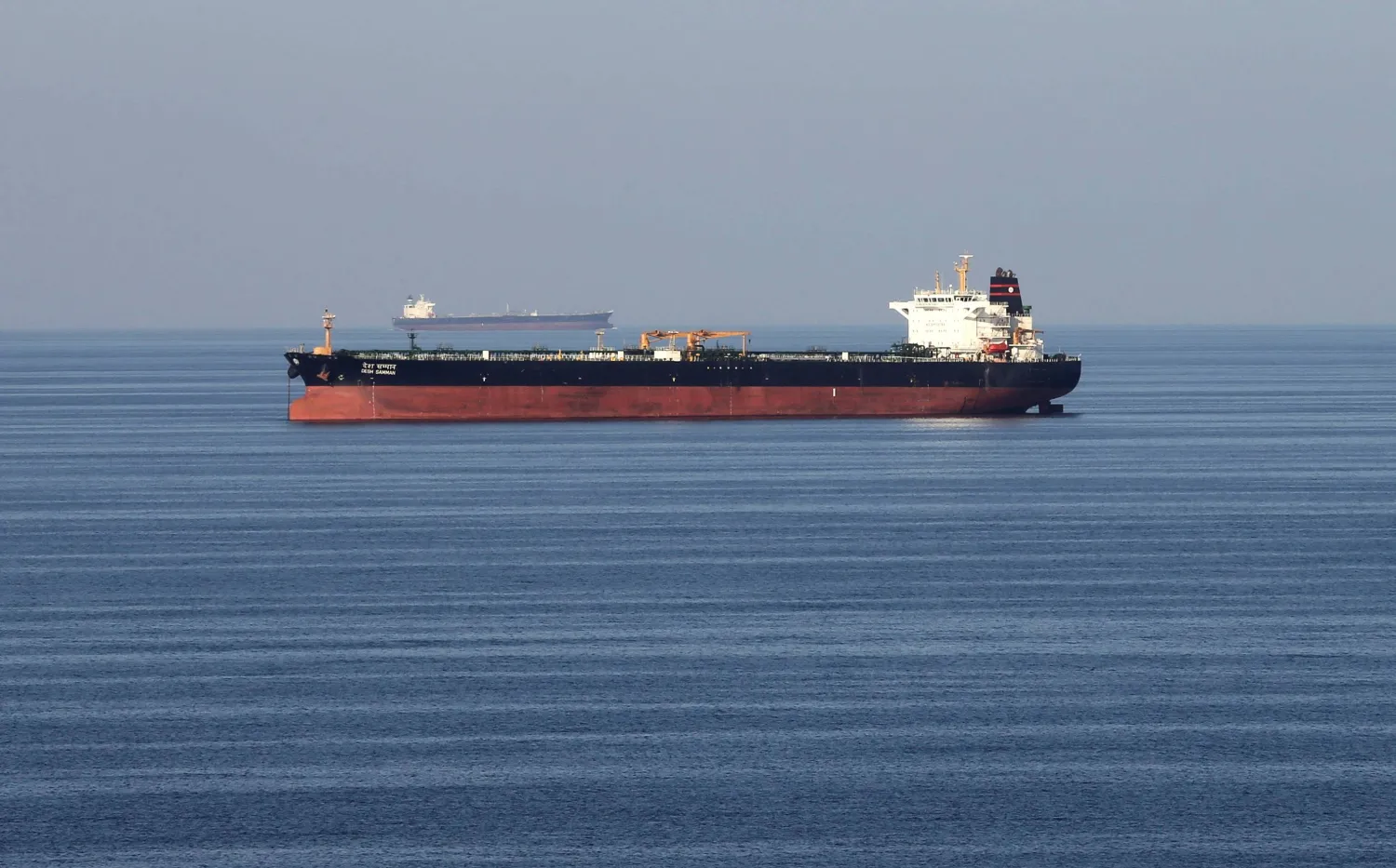
FILE PHOTO: Oil tankers pass through the Strait of Hormuz, December 21, 2018. REUTERS/Hamad I Mohammed/File Photo
TT

Oil Surges, Stocks Slide as Conflict Grips Middle East

FILE PHOTO: Oil tankers pass through the Strait of Hormuz, December 21, 2018. REUTERS/Hamad I Mohammed/File Photo

Oil prices surged on Monday and shares slid as military conflict in the Middle East looked set to last weeks, threatening to upend a global economic recovery and perhaps reignite inflation.

Brent jumped 6.4% to $77.57 a barrel, though it had briefly topped $82.00 at one stage, while US crude climbed 6.2% to $71.17 per barrel. Safe-haven gold rose 1.6% to $5,360 an ounce.

Military strikes by the United States and Israel on Iran showed no sign of lessening, while Iran responded with missile barrages across the region, risking dragging its neighbors into the conflict, reported Reuters.

President Donald Trump suggested to the Daily Mail the conflict could last for four more weeks, while posting that attacks would continue until US objectives were met.

All eyes were on the Strait of Hormuz where around a fifth of the world's seaborne oil trade flows and 20% of its ‌liquefied natural gas. While ‌the vital waterway has not yet been blocked, marine tracking sites showed tankers piling ‌up ⁠on either side ⁠of the strait wary of attack or maybe unable to get insurance for the voyage.

"The most immediate and tangible development affecting oil markets is the effective halt of traffic through the Strait of Hormuz, preventing 15 million barrels per day (bpd) of crude oil from reaching markets," said Jorge Leon, head of geopolitical analysis at Rystad Energy.

"Unless de-escalation signals emerge swiftly, we expect a significant upward repricing of oil."

A prolonged spike in oil prices would risk reigniting inflationary pressures globally, while also acting as a tax on business and consumers that could dampen demand.

OPEC+ did agree a modest oil output boost of 206,000 barrels per day for April on Sunday, ⁠but a lot of that product still has to get out of the Middle ‌East by tanker.

"The nearest historical analogue in our view is the Middle East ‌oil embargo of the 1970s, which increased oil prices by 300% to around $12/bbl in 1974," said Alan Gelder, SVP of refining, chemicals ‌and oil markets at Wood Mackenzie.

"That is only US$90/bbl in 2026 terms. Eclipsing this in today's market concerned about ‌significant losses of supply seems very achievable."

That would be expensive for Japan, which imports all its oil, sending the Nikkei down 1.3%, with airlines among the hardest hit.

Chinese blue-chips were off just 0.1%, though the country does get much of its seaborne oil imports from the Middle East. MSCI's broadest index of Asia-Pacific shares outside Japan fell 1.2%.

AND IT'S A BIG US DATA WEEK

In the Middle East, the ‌UAE and Kuwait temporarily closed their stock markets citing "exceptional circumstances".

For Europe, EUROSTOXX 50 futures shed 1.3% and DAX futures slid 1.4%. FTSE futures fell 0.6%.

On Wall Street, S&P 500 ⁠futures and Nasdaq futures both ⁠lost 0.8%.

The oil shock rippled through currency markets with the dollar a main beneficiary. The US is a net energy exporter and Treasuries are still considered a liquid haven in times of stress, shoving the euro down 0.2% to $1.1787.

While the Japanese yen is often a safe harbor, the country imports all of its oil making the flows more two-way. The dollar added 0.3% to 156.44 yen. 

In bond markets, 10-year Treasury yields steadied at 3.970%, having briefly touched an 11-month low of 3.926%. 

Bonds had gained a bid on Friday when UK mortgage lender MFS was placed into administration following allegations of financial irregularities. Its collapse stoked wider credit fears, with well-known big banks among its lenders. MFS had borrowed 2 billion pounds ($2.69 billion). 

The news slugged banking stocks and combined with jitters over AI-related stocks to hit Wall Street more broadly. 

Investors also have to weather a squall of US economic data this week, including the ISM survey of manufacturing, retail sales and the always vital payrolls report. 

Any weakness could shake confidence in the economy after a disappointing fourth quarter, but would also likely narrow the odds on rate cuts from the Federal Reserve. 

Markets currently imply a 50% chance of an easing in June and about 58 basis points of cuts this year. 


Iran Conflict Disrupts Fuel Assessements from Reporting Agency Platts

A map showing the Strait of Hormuz and Iran is seen behind a 3D printed oil pipeline (Reuters)
TT

Iran Conflict Disrupts Fuel Assessements from Reporting Agency Platts

A map showing the Strait of Hormuz and Iran is seen behind a 3D printed oil pipeline (Reuters)

Oil price reporting agency S&P Global Platts is suspending bids and offers for price assessments of Middle East refined products that transit the Strait of Hormuz because of shipping disruptions from the US-Iran conflict, the company said in a note to subscribers sent out on Monday and reviewed by Reuters.

S&P Global Platts, one of the larger providers of price and transaction information on the oil and fuel markets for the industry, is also reviewing its Middle East ‌crude pricing mechanism, the ‌company said.

From March 2 until further ‌notice, ⁠Platts has suspended ⁠the publication of bids and offers in the Middle East refined products Market on Close assessment process where they reflect loading at ports within the Arabian Gulf that require transit through the Strait of Hormuz, the company said in the note to subscribers.

Platts declined to comment on the suspension of the ⁠bids and offers for some of its Middle ‌Eastern oil product assessments.

The ‌Strait of Hormuz is a narrow waterway between Iran and Oman that ‌connects the Gulf to the Arabian Sea. On ‌a typical day, ships carrying oil equal to about one-fifth of global demand from Saudi Arabia, the UAE, Iraq, Iran, and Kuwait sail through the waterway along with tankers hauling diesel and jet fuel ‌and gasoline and other products from their refineries.

Platts also said in a note sent ⁠to subscribers ⁠that it is reviewing the deliverability of Middle East crude from ports within the Gulf and will announce its decision at 2 p.m. (0600 GMT).

"This review has been initiated because market participants have notified Platts that major shipping companies have halted transit through the Strait of Hormuz amid heightened safety concerns after Israel and the US launched air strikes on Iran," Platts said.

Platts' daily Dubai crude oil price assessment is a physical benchmark used by traders and oil companies to set the prices of millions of barrels of transactions of Middle Eastern crude and their derivatives.


Ship Insurers Cancel War Risk Cover Due to Iran Conflict

A navy vessel is seen sailing in the Strait of Hormuz, a vital waterway through which much of the world's oil and gas passes on March 1, 2026. (Photo by Sahar AL ATTAR / AFP)
TT

Ship Insurers Cancel War Risk Cover Due to Iran Conflict

A navy vessel is seen sailing in the Strait of Hormuz, a vital waterway through which much of the world's oil and gas passes on March 1, 2026. (Photo by Sahar AL ATTAR / AFP)

Several marine insurers said they are cancelling war risk cover for ships due to the conflict in Iran and the Gulf.

Insurers including Gard, Skuld, NorthStandard, the London P&I Club and the American Club said their cancellations will take effect from March 5, according to notices dated March 1 on their websites.

War risk cover will be excluded in Iranian ‌waters, as ‌well as the Gulf and adjacent waters, ‌according ⁠to the notices.

Skuld ⁠added in its notice that it was working on a buy-back option to reinstate cover.

Japan's MS&AD Insurance Group told Reuters it had suspended underwriting of a range of insurance policies covering war risks in the waters around Iran and Israel and ⁠neighboring countries.

Tensions in the Middle East have ‌escalated sharply after the US ‌and Israeli forces launched strikes on Iran over the weekend, ‌prompting Tehran to say it had closed ‌navigation through the Strait of Hormuz, a key chokepoint for global oil and gas flows.

Several tanker owners, oil majors and trading houses have since suspended crude, fuel and liquefied ‌natural gas shipments through the narrow waterway, and satellite data has shown vessels accumulating ⁠near key ⁠United Arab Emirates ports such as Fujairah.

Ship-tracking data on Sunday showed the disruption growing, with at least 150 tankers - including crude and LNG carriers - anchored in open Gulf waters beyond the Strait of Hormuz and dozens more stationary on the other side of the chokepoint.

The risks intensified further after at least three tankers were damaged off the Gulf coast and one seafarer was killed.


Gold Climbs as US-Israel Strikes on Iran Spark Safe-haven Demand

A goldsmith displays gold ornaments at the Hua Seng Heng gold shop in Bangkok, Thailand, 01 March 2026. EPA/NARONG SANGNAK
TT

Gold Climbs as US-Israel Strikes on Iran Spark Safe-haven Demand

A goldsmith displays gold ornaments at the Hua Seng Heng gold shop in Bangkok, Thailand, 01 March 2026. EPA/NARONG SANGNAK

Gold prices rose on Monday after the US and Israel launched major strikes on Iran, killing Supreme Leader Ali Khamenei, escalating geopolitical tensions and deepening global economic uncertainty.

Spot gold was up 1.37% at $5,349.44 an ounce, as of 0439 GMT, after hitting its highest point in more than four weeks. Earlier in the session, bullion prices climbed as much as 2%.

US gold futures rose 2.21% to $5,362.60 per ounce.

Israel launched a new wave of strikes on Tehran on Sunday and Iran responded with ‌more missile barrages, ‌a day after the killing of Khamenei ‌pitched ⁠the Middle East ⁠and the global economy into deepening uncertainty, Reuters said.

"Unlike previous escalations in this conflict, there is fairly strong incentive here for both sides to continue to escalate potentially - and that runs the risk of leading to a pretty chaotic, uncertain and therefore volatile environment for more than just a few days ... the dynamic for gold is pretty positive" ⁠said Kyle Rodda, senior financial market analyst at Capital.com.

However, ‌the US dollar index rose ‌0.27%, making gold more expensive for overseas buyers and capping the metal's ‌gains.

Bullion, a traditional safe-haven asset, has hit successive record highs ‌already this year due to heightened global political and economic uncertainty.

The latest rally builds on a 64% surge in 2025, driven by strong central bank buying, robust inflows into exchange-traded funds and expectations of US monetary ‌policy easing.

"Gold is perhaps the finest barometer to reflect global uncertainty and, to mix metaphors, the ⁠mercury is ⁠rising. We should expect gold to be repriced higher to fresh records as we enter a whole new era of geopolitical uncertainty," said independent analyst Ross Norman.

Meanwhile, data on Friday showed that US producer prices rose more than expected in January, suggesting inflation could pick up in coming months.

Investors will also watch a series of US labor market readings this week, including the ADP employment report, weekly jobless claims and the non-farm payrolls report.

Spot silver shed 0.3% to $93.54 per ounce, after registering a monthly gain in February.

Spot platinum was roughly steady at $2,363.26 per ounce, while palladium advanced 0.86% to $1,801.50.
