


Hormuz Strait Puts Global Economy in ‘Intensive Care’

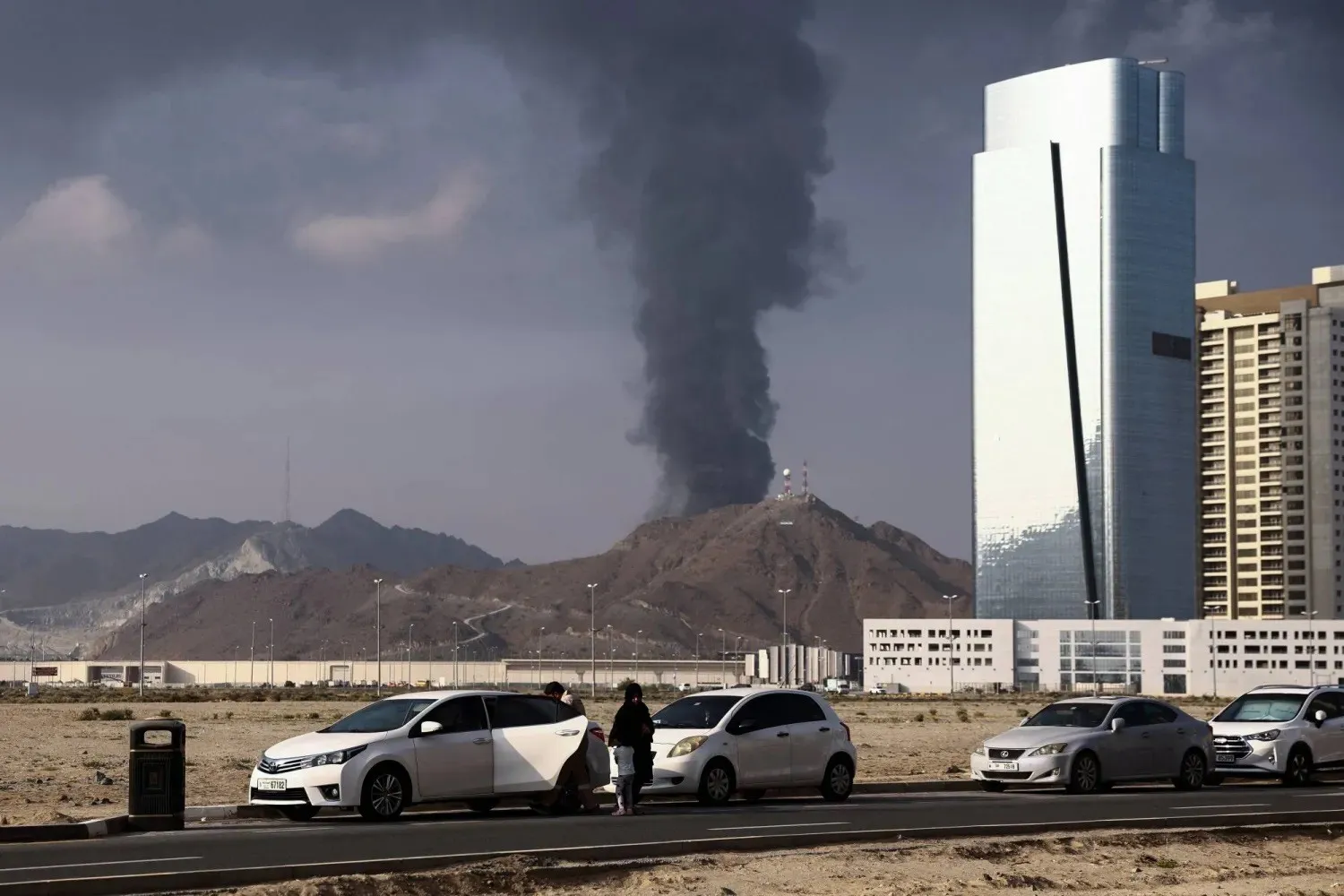
Smoke rises over the oil industry area in Fujairah after a fire caused by debris following the interception of a drone by air defenses. (Reuters)
TT

Hormuz Strait Puts Global Economy in ‘Intensive Care’

Smoke rises over the oil industry area in Fujairah after a fire caused by debris following the interception of a drone by air defenses. (Reuters)

The Strait of Hormuz is no longer merely an international waterway. In a decisive moment, it has turned into a tightly sealed bottleneck choking the global economy. As plumes of smoke rise from critical energy facilities following military confrontations between Iran on one side and Israel and the United States on the other, the world finds itself in the grip of a severe supply shock.

Attacks on tankers and energy infrastructure have disrupted oil and gas flows that power global industry, transforming once-secure shipping lanes into open conflict zones. Markets from Tokyo to London are already feeling the strain.

Brent crude prices reacted immediately, surging above $85 a barrel, with serious warnings that a prolonged maritime blockade could push prices toward the $100 mark.

Europe’s gas markets under pressure

In Europe, the crisis has escalated sharply. Gas prices recorded a staggering 70% cumulative jump within just two days.

The benchmark Dutch TTF (Title Transfer Facility) gas contract climbed 29.5%, reaching €57.50 per megawatt-hour, its highest level in more than a year. Analysts at ANZ warned the situation represents the “largest threat to global gas markets since Russia’s invasion of Ukraine in 2022.”

The spike places Europe - already struggling with low gas inventories - under intense pressure to compete with Asian buyers for limited spot cargoes. At the same time, US supplies are unlikely to fully replace the long-term gap left by disrupted Qatari shipments.

Saudi oil rerouted

In an effort to ease the pressure, Reuters reported that Saudi Aramco has launched a high-risk logistical maneuver to redirect crude exports away from the Strait of Hormuz.

According to sources, the company has informed some buyers of its Arab Light crude that their cargoes must be loaded from Yanbu Port on the Red Sea instead of Gulf terminals. The rerouting relies on Saudi Arabia’s massive East-West Pipeline (Petroline).

Gas shock from Qatar

Across the Gulf, military strikes targeting the Ras Laffan Industrial City complex in Qatar have caused a structural disruption to downstream production, not merely a pause in liquefied natural gas exports.

The complex is not just a gas extraction and liquefaction hub; it also serves as a supply center feeding major industrial plants with feedstock and energy required for smelting and chemical conversion.

The shutdown has broken logistical and operational links with facilities producing urea, polymers, methanol, and aluminum.

For Qatalum, the joint venture between QatarEnergy and Norsk Hydro, the disruption goes beyond an energy shortage. Aluminum smelting cells require an uninterrupted supply of electricity and natural gas.

With an annual production capacity of 648,000 tons, the company now faces a technical dilemma that extends beyond halted production to the risk of “frozen furnaces.”

Such a scenario would require enormous costs and extended time to restart operations if the energy disruption continues.

The industrial exposure has triggered supply panic across global markets. Aluminum prices on the London Metal Exchange jumped 3.8% to $3,250 per ton, reflecting a growing risk premium driven by fears of supply shortages.

At the same time, worsening logistical disruptions at major ports such as Fujairah Port in the UAE and Duqm Port in Oman have compounded the crisis.

Manufacturers are now facing not only raw-material shortages, but also shipping bottlenecks caused by tanker scarcity and the closure of the Strait of Hormuz.

Shipping industry in crisis

The maritime shipping sector has entered an unprecedented crisis. Rates for very large crude carriers (VLCCs) in the Middle East have soared to historic levels, exceeding $423,000 per day for shipments from the Gulf to China.

Iranian threats to open fire on any vessel attempting to transit the Strait of Hormuz have effectively halted many shipping operations. Daily charter rates for liquefied natural gas (LNG) carriers have also jumped by more than 40%.

Analysts at Wood Mackenzie expect spot rates to surpass $100,000 per day this week, driven by the scarcity of available vessels.

The logistical turmoil, combined with disruptions to fuel supplies at the Fujairah bunkering hub, has pushed global shipping companies such as Hyundai Glovis to activate emergency plans to secure alternative routes. The situation reflects growing logistical panic that could isolate global supply chains.

Global markets slide

The fallout has not been limited to commodity markets. Financial markets worldwide have also been shaken as investors retreat from risk.

The MSCI Asia Pacific Index (ex-Japan) fell 2.9%, extending losses for a second straight day. South Korea’s benchmark index plunged 7.2% after markets reopened following a holiday, the largest single-day drop since August 2024.

Japan’s Nikkei 225 dropped 3.1%, while S&P 500 electronic futures slipped 0.9%, according to Reuters.



UAE Bourses Slide as Markets Reopen after 2-day Halt

People walk near screens displaying stock information at the Dubai Financial Market, in Dubai, United Arab Emirates, December 30, 2025. REUTERS/Amr Alfiky
TT

UAE Bourses Slide as Markets Reopen after 2-day Halt

People walk near screens displaying stock information at the Dubai Financial Market, in Dubai, United Arab Emirates, December 30, 2025. REUTERS/Amr Alfiky

Dubai and Abu Dhabi stocks tumbled on Wednesday as they reopened after a two-day halt following Iran's unprecedented wave of missile and drone attacks on the Gulf nation on Sunday.

The closure froze trading in billions of dollars' worth of listed assets as investors awaited clarity on the scale of damage from the ⁠weekend strikes, which ⁠hit airports, ports and residential areas across both emirates.

Dubai's main share index slid 4.7%, its biggest intraday drop since May 2022, in broad-based declines led ⁠by blue-chip developer Emaar Properties 4.9%, while budget airliner Air Arabia retreated 5%.

In Abu Dhabi, the index fell 3.6%, also the steepest decline since May 2022, with the country's biggest lender First Abu Dhabi Bank losing 5%.

Both exchanges said they will temporarily set the lower price limit ⁠for ⁠securities at -5%.

In a separate statement, the Dubai Financial Services Authority (DFSA) said that Nasdaq Dubai would also resume trading on the day.

The Abu Dhabi Securities Exchange has instructed all listed companies to immediately assess their financial and operational exposure and promptly disclose any material information that could influence investor decisions.


Pakistan Seeks Saudi Oil Supplies Via Yanbu Port

Pakistani Petroleum Minister Ali Pervaiz Malik met with Saudi Arabia’s ambassador to Pakistan, Nawaf bin Said Al-Malki. Photo: Pakistani Ministry of Energy on X
TT

Pakistan Seeks Saudi Oil Supplies Via Yanbu Port

Pakistani Petroleum Minister Ali Pervaiz Malik met with Saudi Arabia’s ambassador to Pakistan, Nawaf bin Said Al-Malki. Photo: Pakistani Ministry of Energy on X

Pakistan has asked Saudi Arabia to route oil supplies through the Red Sea port of Yanbu after the closure of the Strait of Hormuz disrupted shipping, the petroleum ministry said in a press release on Wednesday.

The request comes as war in the Middle East has disrupted shipping through the Strait of Hormuz, a critical global chokepoint through which a large share of the ⁠world's oil and most ⁠of Pakistan's fuel imports pass, raising concerns about supply security for import-dependent economies.

"He further highlighted that Saudi Arabian sources had assured security of supplies through the Port of Yanbu on the Red Sea, which can ⁠help meet energy requirements," read the release, adding that one vessel has been arranged to sail to Yanbu to lift crude for Pakistan.

Riyadh reaffirmed it would support Pakistan in meeting its emergency energy needs, it added.

Petroleum Minister Ali Pervaiz Malik raised the issue in a meeting with Saudi Arabia’s ambassador to Pakistan, Nawaf bin Said Al-Malki, according to a ministry ⁠statement.

The ⁠minister said most of Pakistan's energy imports transit through the Strait of Hormuz and the government was monitoring the situation closely to ensure the continuity of supplies.


Gold Climbs Over 1% as Expanding War Fuels Safe haven Demand

A worker displays a one-kilogram gold bar at a refinery in Sydney (AFP)
TT

Gold Climbs Over 1% as Expanding War Fuels Safe haven Demand

A worker displays a one-kilogram gold bar at a refinery in Sydney (AFP)

Gold prices rose over 1% on Wednesday, rebounding from a more than one-week low hit in the previous session, as a widening Middle East conflict sent global markets tumbling and supported safe-haven demand.

Spot gold gained 1.5% to $5,164.42 per ounce by 0701 GMT. US gold futures for April delivery added 1% to $5,174.30, Reuters reported.

On Tuesday, bullion fell more than 4% to its ⁠lowest since February 20, ⁠weighed by a firmer dollar and dimming rate-cut prospects as inflation concerns were intensified by fears of a prolonged war.

Gold could shrug off the previous session's selloff over the coming days as the metal has swayed to its own narrative and has been resilient despite whatever the ⁠dollar and yields have been doing since the beginning of last year, said Ilya Spivak, head of global macro at Tastylive.

Oil and gas prices surged as the US-Israeli war on Iran halted energy exports from the Middle East, with Tehran attacking ships and energy facilities, closing navigation in the Gulf and forcing production stoppages from Qatar to Iraq.

"Higher oil prices as a result of escalating geopolitical tensions in Iran added to inflationary concerns and complicated the outlook ⁠for monetary ⁠easing," said Christopher Wong, a strategist at OCBC.

"The underlying fundamentals (for gold) have not materially shifted. Structural drivers such as geopolitical uncertainty, policy unpredictability and portfolio diversification needs remain intact," Wong added.

Investors expect the US Federal Reserve to hold rates at the end of its next two-day meeting on March 18, according to the CME Group's FedWatch tool.

Spot silver advanced 3.4% to $84.86 per ounce on Wednesday, after falling more than 8% in the last session. Spot platinum added 2.9% to $2,143.45 per ounce, while palladium gained 2.8% to $1,692.69.