

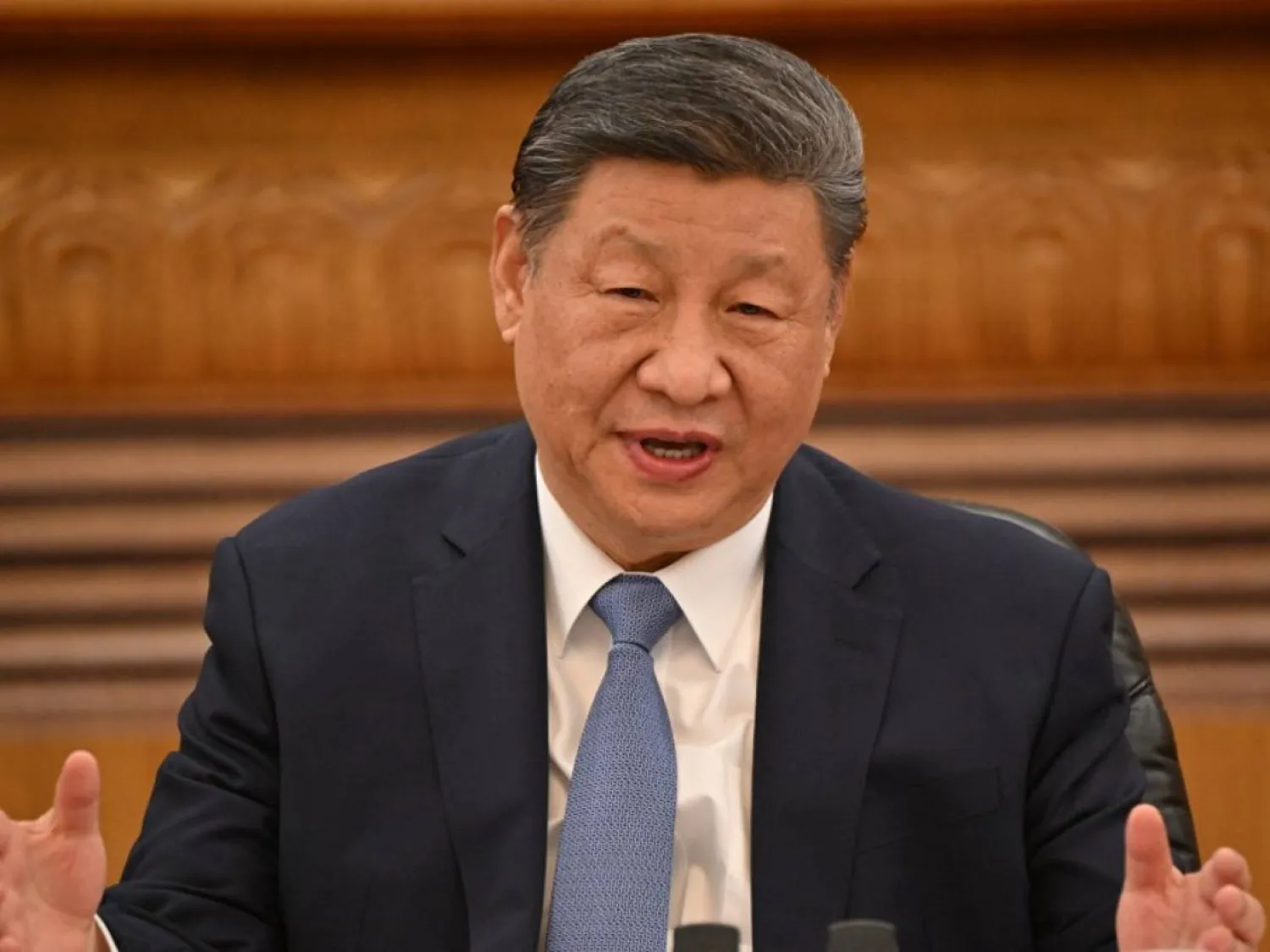

China’s Xi Urges Faster Development of New Energy System as Middle East War Continues

Chinese President Xi Jinping. (AFP file)
TT

China’s Xi Urges Faster Development of New Energy System as Middle East War Continues

Chinese President Xi Jinping. (AFP file)

Chinese President Xi Jinping has called for accelerated planning and construction of a new energy system to safeguard the country's energy security, weeks into the Iran war that has triggered global energy shocks.

The leader of the world's second-largest economy also emphasized hydropower development and ecological protection, while urging the safe and orderly expansion of nuclear power, according to state broadcaster CCTV on Monday.

"The Party Central Committee has gained a profound ‌grasp of global energy ‌development trends and made major decisions by advancing the ‌new ⁠energy security strategy ⁠in depth," he said, referring to the ruling Communist Party's center of authority.

Xi did not directly mention the war in his remarks cited by CCTV. The United States and Iran have been weighing a Pakistani-brokered plan that could end their five-week-old conflict, even as Tehran pushed back against pressure to swiftly reopen the Strait of Hormuz.

Analysts have pointed out that ⁠China is relatively better-positioned to absorb the higher oil prices. ‌Coal accounts for more than half of ‌its energy mix, while it has ample oil stockpiles and imports via the Strait ‌of Hormuz represent only around 5% of total energy consumption.

"The path we ‌took in being the first to develop wind and solar power has now proven to be forward-looking. At the same time, coal-fired power remains the foundation of our energy system and must continue to play its supporting role," Xi said.

China operates ‌more than half of the world's coal-fired power capacity, making it the top carbon emitter, which Western-led climate initiatives ⁠have long contended ⁠with. The country continues to position coal power as a reliability backbone and flexible backup system, even as it accelerates renewables.

Although he underscored the role of coal in China's energy mix, the president said the country—the world's largest consumer of coal—must stay committed to clean, low-carbon development.

"A greener, more diversified and resilient new energy system will provide a strong guarantee for China's energy security and economic development," CCTV said. Last July, China began construction of what will be the world's largest hydropower dam on the eastern rim of the Tibetan Plateau.

Construction on a solar thermal power plant by China General Nuclear Power Group at an altitude of 4,550 meters in Tibet has also begun on Monday, according to state Xinhua News Agency.



Trump Says He’ll Place 25% Tariff on Autos from EU, Accusing Bloc of Not Complying with Trade Deal

Cargo containers line a ship at the Port of Oakland on Wednesday, Aug. 6, 2025, in Oakland, Calif. (AP)
TT

Trump Says He’ll Place 25% Tariff on Autos from EU, Accusing Bloc of Not Complying with Trade Deal

Cargo containers line a ship at the Port of Oakland on Wednesday, Aug. 6, 2025, in Oakland, Calif. (AP)

President Donald Trump said Friday that he will increase the tariffs charged on cars and trucks from the European Union next week to 25%, a move that could jolt the world economy at a fragile moment.

Trump said in the post that the EU “is not complying with our fully agreed to Trade Deal,” though he did not flesh out his objections in the post.

Trump and European Commission President Ursula von der Leyen had agreed to the trade deal last July. It set a 15% tariff on most goods.

Both the US and the EU had previously confirmed their commitment to preserving the trade framework, known as the Turnberry Agreement, which was named after Trump’s golf course in Scotland.

But the status of the 2025 deal was first cast into doubt after the Supreme Court this year ruled that the Republican president lacked the legal authority to declare an economic emergency and charge tariffs on EU goods.

The initial agreement had been a tariff ceiling of 15% on goods from the EU, but the Supreme Court ruling reduced that to 10% as the Trump administration launched a new set of import taxes based on other laws.

The Trump administration is in the middle of investigations on trade imbalances and national security risks to impose a new tariff regime, which could ultimately put the agreement with the EU in risk of violation.

The EU had said it expected the bilateral deal would save European automakers about 500 million to 600 million euros ($585 million to $700 million) a month.

The value of EU-US trade in goods and services amounted to 1.7 trillion euros ($2 trillion) in 2024, or an average of 4.6 billion euros a day, according to EU statistics agency Eurostat.

“A deal is a deal,” the European Commission said in February after the Supreme Court ruling. “As the United States’ largest trading partner, the EU expects the US to honor its commitments set out in the Joint Statement — just as the EU stands by its commitments. EU products must continue to benefit from the most competitive treatment, with no increases in tariffs beyond the clear and all-inclusive ceiling previously agreed.”


Chevron's Upstream Strength Lifts First-quarter Earnings Past Estimate

3D-printed oil pump jacks and the Chevron logo appear in this illustration taken March 2, 2026. REUTERS/Dado Ruvic/Illustration
TT

Chevron's Upstream Strength Lifts First-quarter Earnings Past Estimate

3D-printed oil pump jacks and the Chevron logo appear in this illustration taken March 2, 2026. REUTERS/Dado Ruvic/Illustration

Chevron exceeded Wall Street estimates for its first-quarter earnings on Friday, as elevated oil prices linked to the US-Israeli war on Iran helped boost results from its upstream business.

The company reported adjusted earnings of $1.41 per share, well above the consensus estimate of 95 cents, according to data compiled by LSEG. Despite the strong beat, overall profit marked its lowest level in five years, partly due to unfavorable timing effects tied to financial derivatives.

Chevron's upstream segment, its largest business unit, generated $3.9 billion in earnings, up 4% year-on-year as higher oil prices led to increased revenue.

"Despite heightened geopolitical volatility and related supply disruptions, Chevron delivered solid first-quarter performance, underscoring the resilience of our portfolio and the value of disciplined execution," CEO Mike Wirth said in a statement.

The conflict with Iran, which began on February 28, significantly disrupted global energy markets. Shipping through the Strait of Hormuz was nearly halted, tightening supply and pushing oil prices up as much as 50% during the reported quarter.

Net income for the January-March period totaled $2.2 billion, down from $3.5 billion a year earlier. However, Chevron's exposure to the Middle East turmoil remains limited, accounting for less than 5% of its total production.

DOWNSTREAM RESULTS IN THE RED

In contrast, downstream operations swung to a loss of $817 million, from a profit of $325 million last year. This decline was largely due to accounting mismatches from derivative-related timing effects, which are expected to start reversing in the next quarter.

Larger rival Exxon also disclosed a similar hit from timing effects.

Chevron anticipates that paper positions worth about $1 billion will close and result in profit in the second quarter, Chief Financial Officer Eimear Bonner said in an interview.

Excluding timing effects that are typical in a volatile environment, she said Chevron's underlying business was strong.

"We can see cash flow growing, we can see earnings growing, and all our plans are on track."

The company said it could see additional timing effects if oil prices continue to rise and further "unwinds" when prices fall.

LIMITED MIDDLE EAST EXPOSURE

Chevron has lower production exposure to the Middle East compared with its peers. Production in the US remained robust, exceeding 2 million barrels per day for the third consecutive quarter, the company said.

First-quarter volumes declined slightly to 3.86 million barrels of oil equivalent per day compared with the previous three months due to downtime at the Tengiz field in Kazakhstan after a fire.

Free cash flow also swung to a negative $1.5 billion due to lower operating cash flow. On an adjusted basis excluding impacts to working capital, the metric was still down from the year-ago quarter.

Bonner reaffirmed the company's target of achieving at least 10% annual growth in adjusted free cash flow through 2030. During the quarter, Chevron paid $3.5 billion in dividends and repurchased $2.5 billion worth of shares. The buyback figure was lower than the previous quarter, though Bonner said the company continues to target full-year buybacks between $10 billion and $20 billion.

Chevron's results were strong, though some investors may be disappointed by the lack of buyback increases, said Biraj Borkhataria, an analyst with RBC Capital Markets, in a research note. He added that stronger cash generation this year could help lift repurchases in the second quarter.

The company said that capital expenditure in the first three months of 2026 was higher than last year, partly due to investments tied to its Hess acquisition, although this was offset by reduced spending in the Permian Basin.

Chevron shares were up less than 1% in pre-market trading.


Gold Heads for Weekly Loss as High Oil Prices Feed inflation worries

A jeweller holds gold bars in Cairo, Egypt, March 9, 2026. (Reuters)
TT

Gold Heads for Weekly Loss as High Oil Prices Feed inflation worries

A jeweller holds gold bars in Cairo, Egypt, March 9, 2026. (Reuters)

Gold prices fell more than 1% on Friday and were headed for a weekly loss of a similar magnitude, as elevated oil prices continued to fan inflation concerns that would discourage central banks from cutting interest rates.

Spot gold was down 1.1% at $4,573.33 per ounce at 1149 GMT, and on track for a weekly loss of 2.8%. US gold futures for June delivery fell 1% to $4,585.20.

"Gold remains negatively correlated to oil in the short term, as it impacts interest rate expectations," said UBS analyst Giovanni Staunovo.

Iran said on Thursday it would respond with "long and painful strikes" on US positions if Washington renewed attacks, reiterating its claim to the Strait of Hormuz, Reuters reported.

Brent crude prices have touched double the levels seen at the start of the year, raising concerns about a global economic slowdown and higher inflation as fuel prices surge.

US inflation accelerated in March as the war raised gasoline prices, reinforcing expectations that the Federal Reserve could keep interest rates on hold well into next year.

The European Central Bank and the Bank of England left interest rates unchanged on Thursday, following similar decisions this week by the Fed and the Bank of Japan.

Gold, traditionally seen as a hedge against geopolitical uncertainty and inflation, can come under pressure in a high interest rate environment as it loses its appeal to yield-bearing assets like US Treasuries.

However, Staunovo said UBS retained a constructive outlook over the next six to 12 months.

"Uncertainty surrounding upcoming (US) midterm elections, expectations of a weaker US dollar over time, and declining real interest rates (as the Fed cuts) will likely support investment demand alongside continued central bank demand," he said.

He added that these factors could drive prices towards $5,900/oz by late 2026.

Spot silver prices fell 0.3% to $73.53 per ounce, platinum was down 0.5% at $1,975.65, and palladium lost 0.1% to $1,522.18.