
Iraq Could Restore Oil Exports to Pre-War Level within a Week if Hormuz Reopens, Basra Oil Chief Says

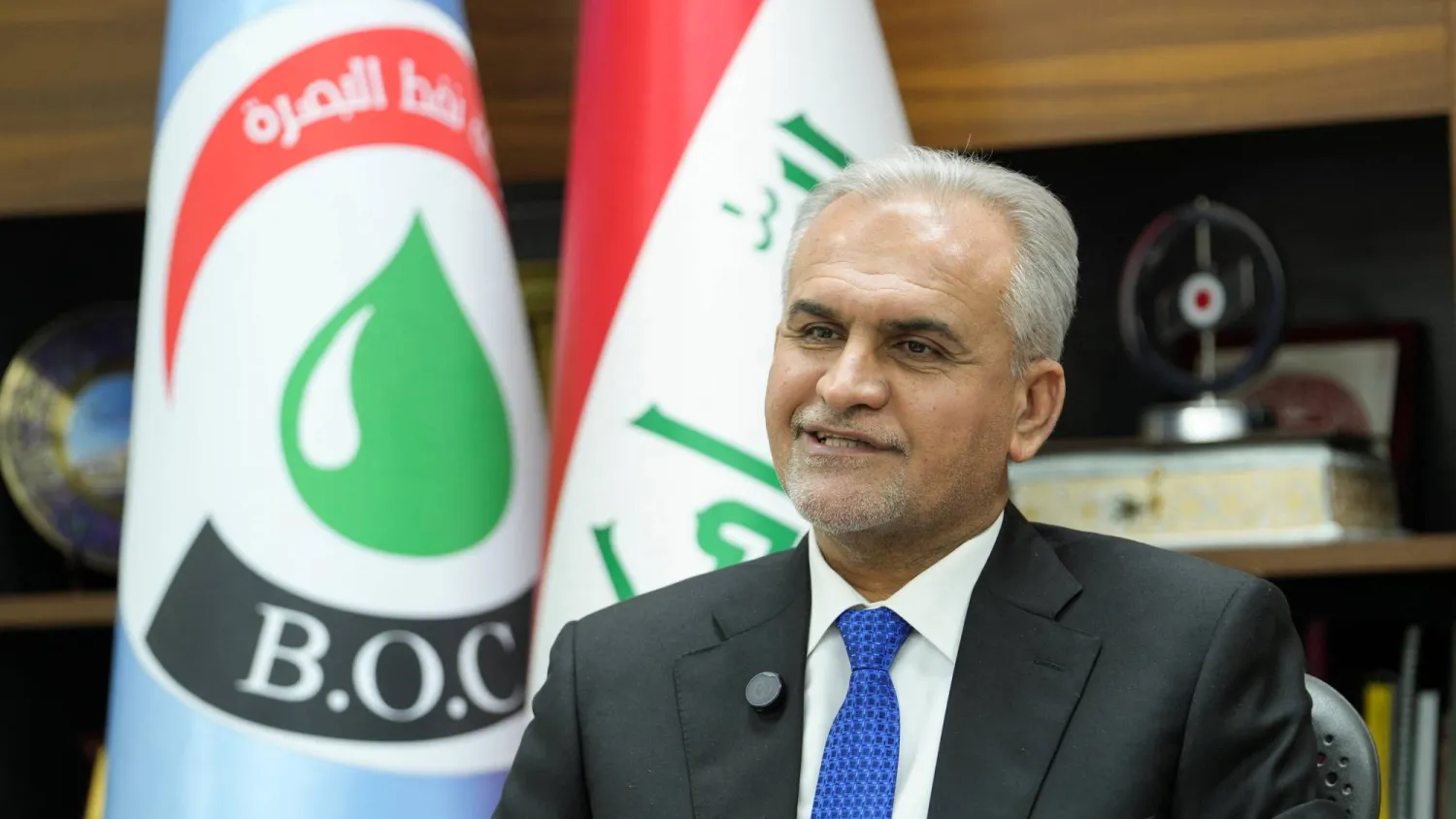
 Bassem Abdul Karim, director general of the state-run Basra Oil Company (BOC), speaks during an interview with Reuters, in Basra, Iraq, April 6, 2026. (Reuters)
Bassem Abdul Karim, director general of the state-run Basra Oil Company (BOC), speaks during an interview with Reuters, in Basra, Iraq, April 6, 2026. (Reuters)
TT

Iraq Could Restore Oil Exports to Pre-War Level within a Week if Hormuz Reopens, Basra Oil Chief Says

 Bassem Abdul Karim, director general of the state-run Basra Oil Company (BOC), speaks during an interview with Reuters, in Basra, Iraq, April 6, 2026. (Reuters)
Bassem Abdul Karim, director general of the state-run Basra Oil Company (BOC), speaks during an interview with Reuters, in Basra, Iraq, April 6, 2026. (Reuters)

Iraq could restore crude oil exports to around 3.4 million barrels per day within a week provided the Iran war ends and the Strait of Hormuz reopens, the head of the country’s state-run Basra Oil Company said.

Among Gulf oil producers, Iraq has suffered the biggest drop in oil revenue as a result of the effective closure of the Strait, a Reuters analysis has found, because it lacks alternative shipment routes.

But the country, the second biggest producer in the Organization of the Petroleum Exporting Countries, can quickly restore output to levels before US-Israeli attacks on Iran at the end of February led to the effective closure of the waterway. The Strait typically is the route for about a fifth of global oil and LNG flows.

SO FAR IRAN HAS MADE ONLY VERBAL PROMISES

Bassem Abdul Karim said Iran has ‌so far provided ‌only verbal guarantees that would allow Iraqi tankers permission to transit the Strait.

“We have not ‌received ⁠any formal documents ⁠regarding permission for Iraqi tankers to pass,” he said in an interview with Reuters.

He said production from Iraq's southern oilfields was around 900,000 barrels per day, but if the war ends and safe passage through the Strait is guaranteed exports could reach 3.4 million bpd within a week.

US President Donald Trump has threatened to rain "hell" on Tehran unless it makes a deal by the end of Tuesday that would allow traffic to move through the Strait of Hormuz.

STEEP DROP IN IRAQI OIL OUTPUT

Last month, Iraq’s oil production dropped by about 80% to around 800,000 barrels per day, Iraqi energy officials told Reuters last month as the war meant Iraq could not ⁠export and storage tanks filled.

With limited outlets for Iraqi oil, production from the Rumaila field fell ‌to around 400,000 bpd, down from about 1.35 million bpd before the conflict, ‌and at the Zubair field the level was about 300,000 bpd, down 340,000 bpd before the war, Abdul Karim said.

Several smaller fields are ‌being operated at limited levels to ensure continued production of associated gas, used in domestic power generation, while shutdowns at ‌other sites have been used as an opportunity to carry out maintenance work, he added.

Production from Iraq's fields was around 4.3 million bpd before the war, which should leave enough leeway to export 3.4 million bpd even allowing for war-related damage.

Storage has filled up as the closure of the Strait of Hormuz blocked exports, but Iraq produces more crude than it consumes domestically, allowing it to boost shipments quickly by tapping inventories ‌without immediately affecting domestic supply, two Iraqi energy sources said.

Local refineries are primarily fed from ongoing production rather than export tanks, according to the sources, who have direct knowledge of ⁠downstream operations.

Gas output from ⁠fields in Basra has dropped to around 700 million standard cubic feet per day, compared with about 1.1 billion standard cubic feet mscf per day before the war, largely because of the reduced oil production, Abdul Karim said.

MEETING REFINERY DEMAND

To supply domestic demand, BOC is sending around 400,000 bpd of crude to northern Iraq. That includes about 150,000 bpd by truck and roughly 250,000 bpd via a domestic pipeline, to supply refineries that have demand of around 500,000 bpd.

Production from the northern Kirkuk fields is roughly 380,000 barrels per day, Abdul Karim said.

Asked about the impact of drone attacks, Abdul Karim said strikes on oil facilities had caused “major losses to the continuity of production and oil operations,” adding that both foreign and Iraqi service companies had been targeted.

A two-drone attack that targeted the Rumaila oilfield on Saturday wounded three Iraqi workers, security and energy sources told Reuters.

Abdul Karim said the attack on the northern part of the Rumaila field hit sites used by US oilfield services companies Schlumberger and Baker Hughes, causing a fire that was later brought under control.

A Baker Hughes spokesperson said the company’s priority was personnel safety and that its employees were safe and accounted for across the region.

Schlumberger did not immediately respond to a request for comment.


India Turns to Latin American, African Oil After Hormuz Disruption

 A worker holds a nozzle to pump fuel in a vehicle at a petrol pump in New Delhi, India, May 19, 2026. (Reuters)
A worker holds a nozzle to pump fuel in a vehicle at a petrol pump in New Delhi, India, May 19, 2026. (Reuters)
TT

India Turns to Latin American, African Oil After Hormuz Disruption

 A worker holds a nozzle to pump fuel in a vehicle at a petrol pump in New Delhi, India, May 19, 2026. (Reuters)
A worker holds a nozzle to pump fuel in a vehicle at a petrol pump in New Delhi, India, May 19, 2026. (Reuters)

Indian refiners turned to imports from Latin America and Africa after supplies from the Middle East were disrupted as the Israeli-US war on Iran restricted shipping in the Strait of Hormuz, data provided by trade sources show.

Refiners in the world's third-largest oil importer and consumer bought most of their crude from the nearby Middle East until the war broke out at the end of February.

In April and May, Indian refiners raised imports ‌from Venezuela, Brazil, Angola ‌and Nigeria to make up the shortfall, as well ‌as ⁠continuing to buy ⁠Russian oil, preliminary data from Kpler show.

Last month, India skipped purchases from Iraq as exports were halted, while it received Iranian oil after a gap of seven years following a temporary waiver granted by Washington to help stabilize global oil prices.

New Delhi reduced imports from Russia by about 29.4% from March to 1.6 million barrels per day as Nayara Energy shut its 400,000-bpd ⁠refinery for maintenance, the data showed.

However, in May, ‌India is due to get about ‌1.9 million bpd of Russian oil and about 41,000 bpd of Iraqi oil, preliminary data ‌from Kpler showed.

Overall, India imported 4.57 million bpd oil in ‌April, unchanged from March, but down 15.5% from a year earlier, the data showed.

Imports from the United Arab Emirates rebounded in April to 669,700 bpd from 230,600 bpd in March while intake of Saudi Arabian oil stayed at about 619,500 bpd, ‌the data showed.

The UAE and Saudi Arabia are the only Gulf producers with pipelines that export crude bypassing ⁠the Strait ⁠of Hormuz, while Kuwait, Iraq, Qatar, and Bahrain rely on the waterway for shipments.

The share of the Organization of the Petroleum Exporting Countries, including the UAE as its member during the month, in India's imports rose to 45.2% in April from about 30% in March, the data showed. The UAE exited OPEC in May.

Higher imports from the UAE helped arrest a decline in the Middle East's share of India's imports, while the share of Russian oil declined to about 35% from nearly 50%.

Russia remained India's top oil supplier, followed by the UAE and Saudi Arabia. Brazil was the fourth-largest supplier, while Venezuela ranked fifth. Venezuela is on course to become the fourth-largest supplier in May, Kpler data showed.


Asian Shares Mostly Gain and Oil Prices Fall After Trump Says Peace Talks on Iran War Are Proceeding

 People walk in front of an electronic stock board showing Japan's Nikkei index at a securities firm Monday, May 25, 2026, in Tokyo. (AP)
People walk in front of an electronic stock board showing Japan's Nikkei index at a securities firm Monday, May 25, 2026, in Tokyo. (AP)
TT

Asian Shares Mostly Gain and Oil Prices Fall After Trump Says Peace Talks on Iran War Are Proceeding

 People walk in front of an electronic stock board showing Japan's Nikkei index at a securities firm Monday, May 25, 2026, in Tokyo. (AP)
People walk in front of an electronic stock board showing Japan's Nikkei index at a securities firm Monday, May 25, 2026, in Tokyo. (AP)

Asian shares mostly rose Monday and oil prices plunged after US President Donald Trump said talks on ending the war with Iran are progressing.

Japan's benchmark Nikkei 225 surged 2.8% to 65,130.03. Australia's S&P/ASX 200 added 0.4% to 8,692.00. The Shanghai Composite gained 0.8% to 4,143.97.

Trading was closed in South Korea and Hong Kong for local holidays. Markets will be closed in the US on Monday for Memorial Day.

Trump said negotiations with Iran were “proceeding in an orderly and constructive manner.” Meanwhile, regional officials told The Associated Press on Sunday that the United States is close to reaching a deal with Iran that would end the war, reopen the Strait of Hormuz and see Iran give up its stockpile of highly enriched uranium,

Reopening the Strait of Hormuz will help decide the direction of oil prices. The closure has prevented oil tankers from exiting the Gulf and delivering crude to customers worldwide. Japan, for instance, imports almost all its oil, most of it through the strait.

“Markets are rapidly transitioning from pricing geopolitical fear toward pricing a potential peace dividend as Hormuz reopening expectations pressure oil and the dollar lower,” analyst Stephen Innes said in a commentary.

Early Monday, benchmark US crude was down $5.52 at $91.08 a barrel. Brent crude, the international standard, sank $5.56 to $97.08 a barrel.

In currency trading, the US dollar declined to 158.91 Japanese yen from 159.16 yen. The euro cost $1.1639, up from $1.1605.

Friday on Wall Street, stocks finished their eighth straight winning week, the best such streak since 2023. That’s even though a survey showed US consumers are feeling even worse about the economy than before.

The S&P 500 added 0.4% and pulled closer to its all-time high set in the middle of last week. The Dow Jones Industrial Average rose 0.6%, and the Nasdaq composite gained 0.2%.

Recent earnings reports from US companies that topped analysts’ expectations also helped markets. But worries about inflation have pushed bond yields higher worldwide.

The yield on the 10-year Treasury edged down to 4.56% Friday from 4.57% late Thursday, but it remains well above its 3.97% level from before the war.


Vessels Carrying Middle East Oil, LNG Exit Hormuz, Head for Pakistan, China

Vessels in the Strait of Hormuz, Iran, May 22, 2026. Majid Asgaripour/WANA (West Asia News Agency) via Reuters
TT

Vessels Carrying Middle East Oil, LNG Exit Hormuz, Head for Pakistan, China

Vessels in the Strait of Hormuz, Iran, May 22, 2026. Majid Asgaripour/WANA (West Asia News Agency) via Reuters

Two liquefied natural gas tankers are exiting the Strait of Hormuz on Monday, heading to ‌Pakistan and China, while a supertanker with Iraqi crude for China left the Gulf on Saturday after being stranded for nearly three months, shipping data showed.

The US-Israeli war on Iran that began on February 28 has severely curtailed shipping through the Strait of Hormuz, through which around one-fifth of the world's supply of oil and LNG normally flows.

The vessels are among a handful of supertankers exiting the Gulf this month via a transit route ⁠that Iran has ordered ships to use. Last week, three Very Large Crude Carriers (VLCCs) made their way to China and South Korea with 6 million barrels of crude, according to Reuters.

LNG tanker Fuwairit is crossing the Strait of Hormuz on Monday and is expected to discharge its cargo in Pakistan on Tuesday, shipping data on LSEG and Kpler showed. The vessel, sailing under the Bahamas flag, loaded LNG at Qatar's Ras Laffan port around March 28.

Separately, the VLCC Eagle Verona, which exited the strait on Saturday, is expected to reach Ningbo port in eastern China on June 12 to discharge its cargo, ⁠shipping data on LSEG and Kpler showed.

The Singaporean-flagged vessel chartered by Unipec, the trading arm of Asia's largest refiner, Sinopec, loaded nearly 2 million barrels of Basrah crude around February 26, according to the data.

The Eagle Verona was among seven ships Malaysia had sought ⁠permission from Iran to transit, two sources earlier told Reuters. Five of the ships have since exited the waterway, while two more remain in the Gulf.

Before the war began, shipping traffic through the strait averaged 125 to 140 daily passages. Some 20,000 seafarers remain stranded inside the Gulf on board hundreds of ships.