


Euro Zone Growth Slows on Surging Energy Costs

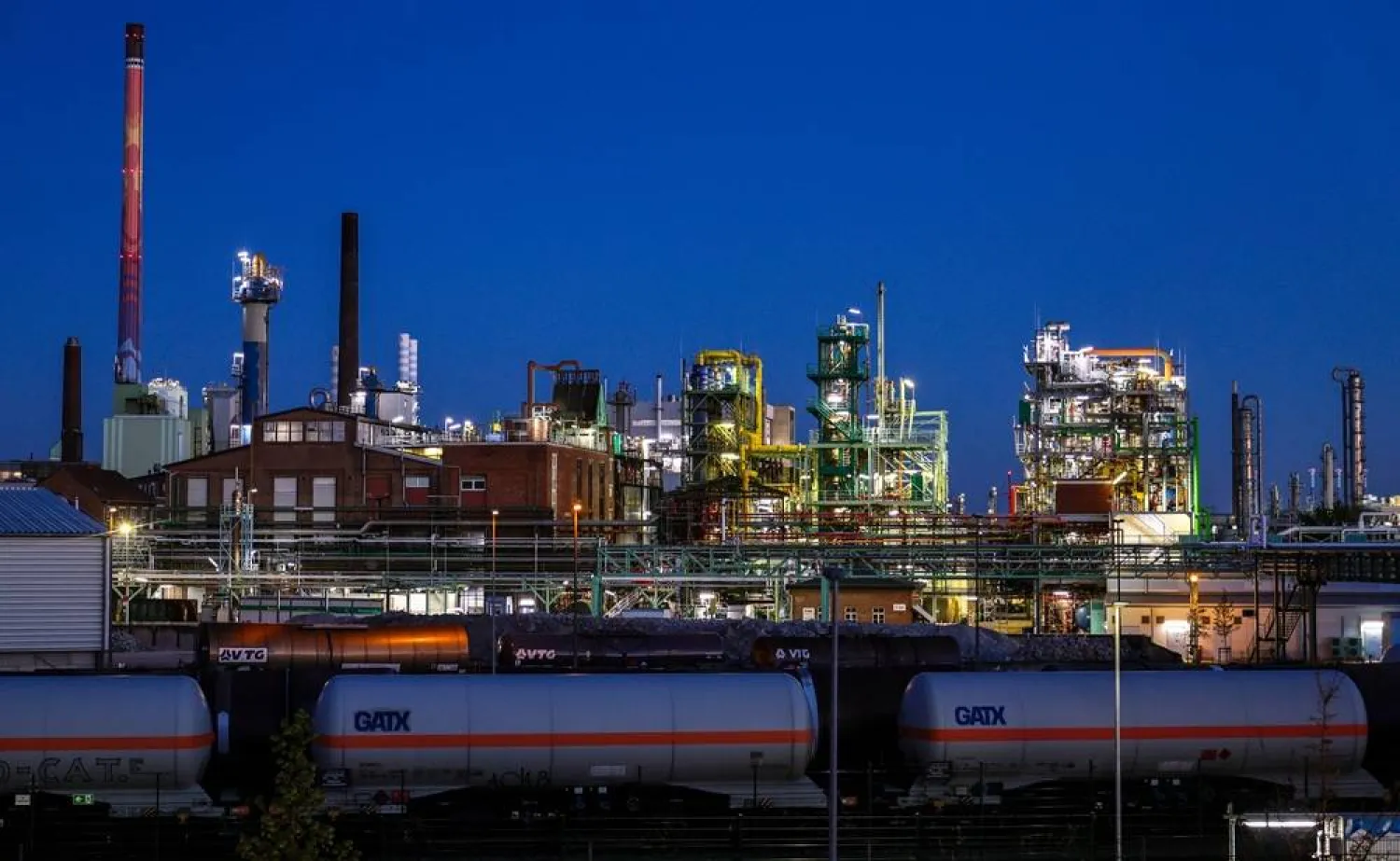
 Industrial facilities and infrastructure at the Hoechst Industrial Park, near Frankfurt, Germany, 07 April 2026. (EPA)
Industrial facilities and infrastructure at the Hoechst Industrial Park, near Frankfurt, Germany, 07 April 2026. (EPA)
TT

Euro Zone Growth Slows on Surging Energy Costs

 Industrial facilities and infrastructure at the Hoechst Industrial Park, near Frankfurt, Germany, 07 April 2026. (EPA)
Industrial facilities and infrastructure at the Hoechst Industrial Park, near Frankfurt, Germany, 07 April 2026. (EPA)

The euro zone's private sector expansion weakened sharply in March as the Middle East war drove up energy costs and disrupted supply chains, with overall demand - a key gauge for economic health - falling for the first time in ‌eight months, a survey showed on Tuesday.

The S&P Global euro zone Composite Purchasing Managers' Index fell to 50.7 in March from 51.9 in February, but was slightly higher than a preliminary estimate of 50.5. PMI readings above 50.0 indicate growth in activity, according to Reuters.

“March's PMI indicates that the euro zone economy has already been hit hard by the war ⁠in the Middle East,” said Chris Williamson, chief business economist at S&P Global Market Intelligence.

New business declined in March after improving steadily since July, dragged down by weaker demand for services. Overall export orders also fell again, with international services demand recording its steepest drop in six months.

The encouraging signs of growth seen earlier in the year have been eradicated thanks to surging energy prices, choked supply chains, financial market volatility and a renewed downturn in demand, Williamson added.

Services activity barely rose, with the business activity index sliding to 50.2 from ‌51.9 ⁠in February - its weakest reading in 10 months.

Manufacturing output growth remained solid.

Spain led the growth among the major economies, while France and Italy contracted. Germany's expansion slowed to its weakest pace so far this year.

Employment declined while business confidence dropped, raising concerns about future hiring and investment.

Input cost inflation ⁠surged to its highest in slightly more than three years, with manufacturing seeing a record one-month jump. Firms raised prices charged to customers at the fastest pace since February 2024, though the increase was ⁠more modest than the spike in their own costs.

Headline inflation in the bloc jumped above the European Central Bank’s 2% target last month, hitting 2.5% from 1.9% as soaring oil and ⁠gas prices intensified the dilemma between safeguarding growth and curbing inflation.

The survey's signal for first-quarter gross domestic product growth was 0.2%, with a risk of contraction this quarter unless the Middle East conflict is resolved swiftly.

German service sector growth slows

Meanwhile, business activity growth in Germany's service sector abruptly lost momentum in March as demand weakened amid fallout from the war in the Middle East, the survey also ‌showed on Tuesday.

PMI for Germany fell to 50.9 in March from 53.5 in February, marking its lowest reading since September and slightly below a preliminary reading of 51.2.

Phil Smith, economics associate director at S&P Global Market Intelligence, cited higher prices at the petrol pumps and heightened uncertainty as leading to the slowdown.

Despite the sharply rising costs, however, service providers have not been able to pass on greater price increases to customers due to the weaker demand environment, he added.

“Inflows of new business have fallen for the ‌first ⁠time since last September in a clear sign of the Middle East war's immediate impact on demand, whilst a notable drop in business expectations underlines how higher energy prices, supply chain disruption and generally ⁠elevated levels of uncertainty are set to stifle growth in the year ahead,” said Smith.

Business expectations dropped to a three-month low in March, ⁠to 53.4, and slipped below the long-run average of 56.7.

The final S&P Global composite PMI, which includes manufacturing and services, ⁠ticked down to 51.9 in March from 53.2 the previous month, a three-month low driven entirely by the downturn in the service sector.

France's services sector contracts

Also, France's services sector contracted further in March as client spending weakened due to the war in the Middle East and caution among ‌businesses in the run-up to last month's local elections, a business survey showed on Tuesday.

S&P Global said the final services PMI for March fell to 48.8 points from 49.6 points in February, marking ⁠a slight improvement from the flash March services figure of 48.3 points.

The final March composite PMI - which includes both the services and manufacturing sectors - also came in at 48.8, down from 49.9 in February. S&P Global said this marked the ‌quickest ⁠drop in private sector business activity since October.

S&P Global added that the US-Israeli war on Iran was impacting French businesses both in terms of inflation and customers postponing ⁠orders or delaying investments.

“Much uncertainty lies ahead, a condition which French businesses have become rather accustomed to in recent years ⁠given the domestic political environment. Uncertainty is bad for growth, and the inflation impulse stemming from the ⁠war raises the risk of stagflation in France,” said Joe Hayes, principal economist at S&P Global Market Intelligence.


Hapag-Lloyd: Resuming Normal Shipping to Take 6-8 Weeks if Mideast Stabilizes

This aerial picture shows stacks of shipping containers at Tanjung Priok Port, Jakarta, March 31, 2026. (Photo by BAY ISMOYO / AFP)
TT

Hapag-Lloyd: Resuming Normal Shipping to Take 6-8 Weeks if Mideast Stabilizes

This aerial picture shows stacks of shipping containers at Tanjung Priok Port, Jakarta, March 31, 2026. (Photo by BAY ISMOYO / AFP)

Hapag-Lloyd voiced cautious optimism on Wednesday on the prospect of resuming shipping through the Strait of Hormuz after a two-week ceasefire agreed between the US and Iran, but said that resuming normal traffic throughout its network would take at least 6-8 weeks.

Speaking in a call to customers, CEO Rolf Habben Jansen echoed guarded remarks ⁠by peer container ⁠shipping group Maersk, saying that more security assurances were needed.

“Even if a ceasefire has now been agreed overnight, I would say that it's fair to ⁠say that the conflict in the Middle East is still severely disrupting shipping, but also supply chains," the Hapag CEO said, adding that the situation was "fluid".

According to Reuters, he estimated additional costs from the Middle East crisis at $50 million to $60 million a week and warned that the German company ⁠would ⁠have to pass on some of that to its customers. That was up from $40-$50 million stated previously.

He added that about 1,000 ships were still stuck in the region, six of which from his company with a combined capacity of about 25,000 standard containers.


Turkish Shares Rise After Iran Ceasefire Deal, Lira Set for Rare Daily Gain

10 July 2020, Türkiye, Istanbul: People stand behind a Turkish national flag in front of Hagia Sophia in Istanbul. (dpa)
TT

Turkish Shares Rise After Iran Ceasefire Deal, Lira Set for Rare Daily Gain

10 July 2020, Türkiye, Istanbul: People stand behind a Turkish national flag in front of Hagia Sophia in Istanbul. (dpa)

Banking and ‌airline stocks led a more than 4% rise in Turkish shares and the lira was on track for a rare daily gain on Wednesday, as the two-week Middle East ceasefire sparked a relief rally across global markets.

At 0823 GMT, Türkiye's blue-chip BIST 100 index was up 4.3%, while the banking index rose 8.8%. Shares in airline ‌carriers Turkish ‌Airlines and Pegasus climbed more than ‌6% ⁠each.

The United States ⁠and Iran have agreed to a two-week ceasefire and Pakistan Prime Minister Shehbaz Sharif said in a post on X that he had invited Iranian and US delegations to meet in Islamabad on Friday.

The ⁠lira traded at 44.5400 against ‌the dollar, strengthening from ‌Tuesday's close of 44.6065.

The currency had lost about ‌1.5% in value since the US-Israeli strikes ‌on Iran began at the end of February. With a year-to-date loss of 3.6% and inflation reaching to 10% in the first three ‌months of the year, the lira has gained in real terms.

Before the ⁠two-week ⁠ceasefire agreement, economists had been expecting the central bank to reflect a cumulative 300 basis points of tightening delivered via liquidity measures in the main policy rate, which stands at 37%.

Markets are now watching whether the two-week ceasefire evolves into a more permanent arrangement, which could reshape expectations for policy tightening at the central bank's next monetary policy committee meeting on April 22.


Gulf Markets Jump on US-Iran Ceasefire Agreement

A man follows the stock market at the Dubai Financial Market in Dubai (EPA)
TT

Gulf Markets Jump on US-Iran Ceasefire Agreement

A man follows the stock market at the Dubai Financial Market in Dubai (EPA)

Stock markets in the Gulf region jumped on Wednesday in line with global equities after US President Donald Trump agreed to a two-week ceasefire with Iran on Tuesday.

Trump said the last-minute deal was subject to Iran's agreement to pause its blockade of oil and gas supplies through the Strait of Hormuz, which before the war typically handled about one-fifth of global oil and liquefied natural gas shipments.

Iranian Foreign Minister Abbas Araqchi said Tehran would cease counter-attacks and provide safe passage through the waterway if attacks against it stopped.

Pakistani Prime Minister Shehbaz Sharif ⁠said he had ⁠invited Iranian and US delegations to meet in Islamabad on Friday.

Saudi Arabia's benchmark index opened 1.4% higher, lifted by gains in banking and energy stocks.

Oil giant Saudi Aramco gained 2.1%, while largest lender Al Rajhi Bank added 2.4%.

Dubai's main market spiked as much as 8.5%, its highest intraday gain in more than 11 years, with the heavyweight real estate and financial sectors outperforming.

At 0730 GMT the Dubai index was trading 6.4% higher, led by a 9.8% jump in blue-chip developer Emaar Properties and an 11.3% rise in top lender Emirates NBD ⁠Bank.

Abu Dhabi's benchmark index climbed as much as 4.9% in early trade, its biggest jump in six years, boosted by gains in the financial, real estate, logistics and energy sectors.

At 0730 GMT the Abu Dhabi index was up 3.2% with the largest lender, First Abu Dhabi Bank, rising 8.3% and real estate giant Aldar Properties jumping 8.8%.

Energy firm Adnoc Gas gained 3.8%, while Abu Dhabi Ports Company advanced 9.8%.

In Qatar, the index jumped 3.4%, as all its constituents advanced, led by energy shares.

Petrochemical maker Industries Qatar jumped 6.2% and Qatar Gas Transport surged 8%, the top gainer.

The Gulf's biggest lender, Qatar National Bank, climbed 3.7%.
