


St. Petersburg Forum Brings Together Energy Leaders to Discuss Hormuz Security, Future of Global Markets

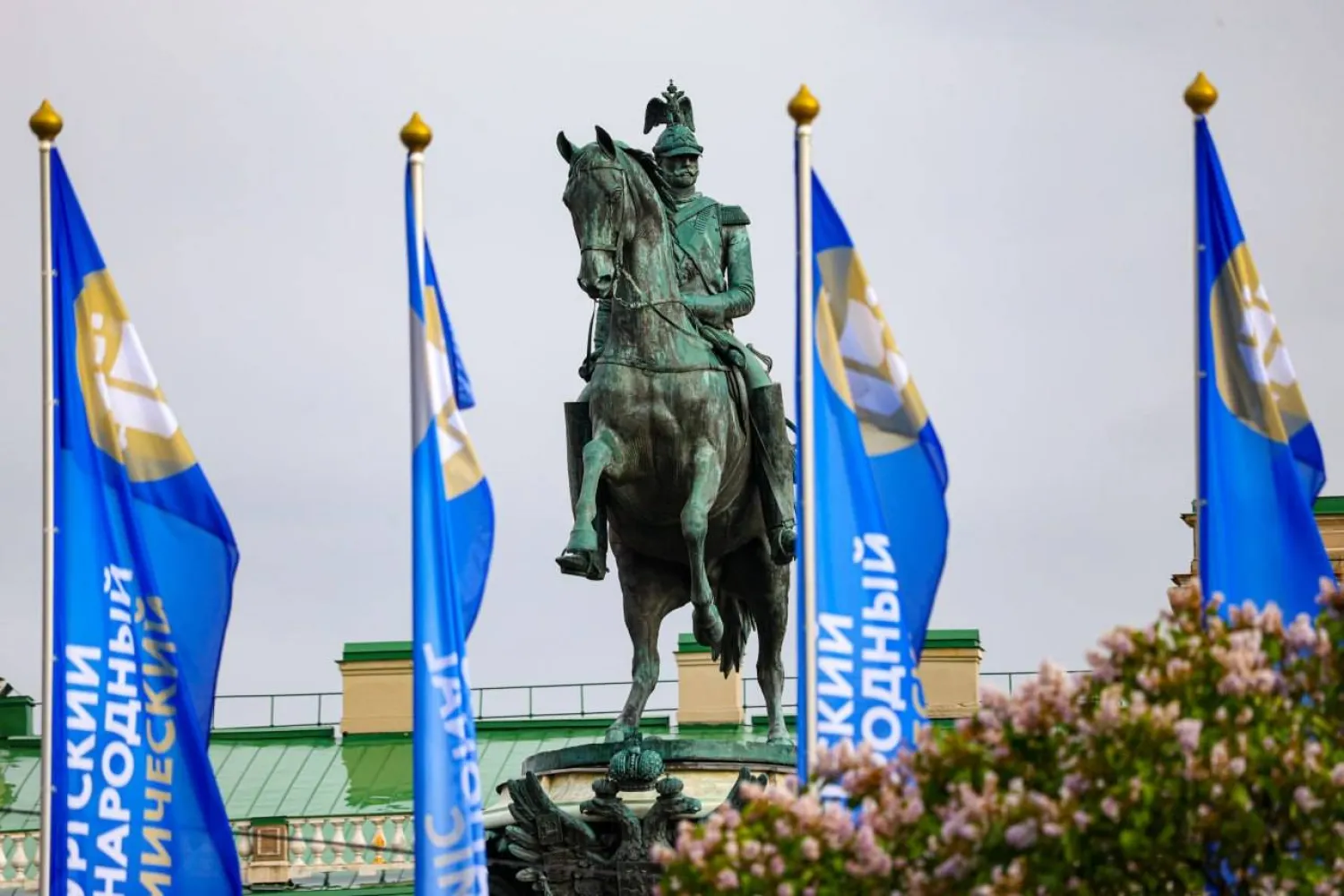
Venue of the St. Petersburg International Economic Forum (the Forum)
TT

St. Petersburg Forum Brings Together Energy Leaders to Discuss Hormuz Security, Future of Global Markets

Venue of the St. Petersburg International Economic Forum (the Forum)

Global energy markets will turn their attention on Friday to the St. Petersburg International Economic Forum, where a high-level panel discussion titled “Global Energy Systems: How Is the World’s Energy Sector Responding to Challenges and Risks?” will take place.

The 29th edition of the forum, being held this year under the theme “Shared Values: The Foundation of Growth in a Multipolar World,” opened on Wednesday. Saudi Arabia is participating as the forum’s principal guest of honor as the two countries mark 100 years of diplomatic relations.

Saudi government entities, national institutions and leading companies are taking part in the forum, including the ministries of energy, industry, transport, environment and investment, with the aim of strengthening cooperation and showcasing the goals and achievements of Vision 2030 in economic diversification and attracting high-quality investment.

The St. Petersburg International Economic Forum, established in 1997, is Russia’s leading economic conference and attracts more than 10,000 participants annually.

The energy session carries exceptional significance given its timing, coming after five months of escalating disruptions to supply routes and rising oil prices. It also falls within the main theme of the forum’s 2026 edition, “The Global Economy: Between Confrontation and Cooperation.”

The session will bring together senior decision-makers from across the global energy industry, led by Saudi Energy Minister Prince Abdulaziz bin Salman, Secretary General of the Organization of the Petroleum Exporting Countries (OPEC) Haitham Al Ghais, Russian Deputy Prime Minister Alexander Novak, and Chief Executive Officer of the Russian Direct Investment Fund Kirill Dmitriev. Also participating are Egyptian Petroleum Minister Karim Badawi, Serbian Energy Minister Dubravka Djedovic, and Secretary General of the Gas Exporting Countries Forum Philip Mshelbila.

According to the session agenda, discussions will focus on a series of strategic questions arising from the new reality facing global energy markets. Foremost among them is the impact of the current Middle East conflict on global oil and gas markets, and what current and future measures could reduce reliance on transporting energy resources through the Strait of Hormuz amid security tensions that have caused tangible shifts in traditional maritime shipping routes.

The session will also examine the strategy that major oil and gas producers should adopt under these circumstances and how the economic impact of OPEC+ measures should be assessed.

Participants will discuss the strategies that major oil and gas producers should pursue amid a complex environment shaped by six years of overlapping crises, beginning with the COVID-19 pandemic, continuing through Western sanctions imposed on Moscow, and extending to current military conflicts and their direct impact on international trade and the global economy. Discussions will also include an assessment of the economic impact of OPEC+ decisions and consideration of the alliance’s future plans.

The strategic dialogue comes ahead of a crucial oil-policy marathon on Sunday, when a series of meetings will begin with the OPEC’s conference, followed by the 66th meeting of the Joint Ministerial Monitoring Committee, which oversees compliance levels, coordination and current compensation plans for countries that previously exceeded their production quotas. The 41st ministerial meeting of OPEC and OPEC+ will also be held.

Sources familiar with the oil sector said OPEC+ is likely to approve an additional gradual increase in its production targets for July, in a move aimed at demonstrating the group’s ability to return to a “normal production path.”

The alliance has already increased production quotas by about 600,000 barrels per day between April and June.


Stocks Rise as Oil Prices Tumble after Trump Hails 'Energy Ceasefire'

A financial data screen in the dealing room of Hana Bank shows the benchmark Korea Composite Stock Price Index (KOSPI) having fallen 0.69 percent from the previous session to an intraday low of 6,580.01 in early trading in Seoul, South Korea, 12 October 2026. EPA/YONHAP SOUTH KOREA OUT
TT

Stocks Rise as Oil Prices Tumble after Trump Hails 'Energy Ceasefire'

A financial data screen in the dealing room of Hana Bank shows the benchmark Korea Composite Stock Price Index (KOSPI) having fallen 0.69 percent from the previous session to an intraday low of 6,580.01 in early trading in Seoul, South Korea, 12 October 2026. EPA/YONHAP SOUTH KOREA OUT

Most stock markets rose Monday as oil prices tumbled after Donald Trump announced an "energy ceasefire" between Russia and Ukraine.

Both main crude contracts sank more than one percent following the US president's declaration, even as it sparked astonishment in Kyiv, which also said Moscow had struck multiple power plants in the country.

"Effective immediately, there is an ENERGY CEASEFIRE in the War between Russia and Ukraine," Trump said early Sunday on Truth Social. "Both parties have agreed. Do not break it!"

His post came after he called on Ukrainian President Volodymyr Zelensky to halt attacks on Russian refineries and said it was "time for Ukraine to get a new president" who would finally settle the war.

Zelensky appeared to express surprise at the announcement, saying he was seeking further details, but added that "Ukraine supports the ceasefire, and it is important that Russia support it as well".

Russia has yet to confirm its agreement.

While the announcement was welcomed by Ukraine's allies, Trump had come under fire after declaring a temporary easing of US sanctions on Russian diesel, which European leaders and Kyiv said would only embolden Russian President Vladimir Putin.

"The market is no longer paying full geopolitical premium on every headline, and that is probably the most useful signal in the morning price action," wrote SPI Asset Management's Stephen Innes.

"A strike matters if it threatens real barrels, shipping lanes, refining capacity or insurance costs; otherwise, the market is getting increasingly reluctant to pay up simply because the geopolitical ticker flashes red.

"The physical market remains tight enough to keep Brent above $100, but futures are refusing to treat every new escalation as the start of another straight-line inflation shock."

The drop in oil prices provided support to most Asian markets, with Hong Kong, Sydney, Singapore, Wellington and Manila all up.

But Seoul and Taipei were dragged by losses in chipmakers SK hynix, Samsung and TSMC. Tokyo was closed for a holiday.

US futures were sharply higher.

Investors are also gearing up for the release of key US inflation and retail sales data, which could play a big role in the Federal Reserve's decision-making regarding interest rates. The bank is due to meet at the end of October.

Also in view is the beginning of earnings season this week, with banking giants JP Morgan, Goldman Sachs and Bank of America due to report.

Tech giants will follow later in the month and November, with traders keen to get an idea on the outlook for the AI sector in light of the vast sums of cash pumped into it in recent years.


Saudi Minister of Energy Signs Energy Cooperation MoUs with Kuwait, Qatar and Egypt

Saudi Minister of Energy and Minister of Industry and Mineral Resources Prince Abdulaziz bin Salman bin Abdulaziz and Kuwait’s Minister of Electricity, Water and Renewable Energy Dr. Subaih Abdulaziz Abdulmohsen Al-Mukhizim. (SPA)
TT

Saudi Minister of Energy Signs Energy Cooperation MoUs with Kuwait, Qatar and Egypt

Saudi Minister of Energy and Minister of Industry and Mineral Resources Prince Abdulaziz bin Salman bin Abdulaziz and Kuwait’s Minister of Electricity, Water and Renewable Energy Dr. Subaih Abdulaziz Abdulmohsen Al-Mukhizim. (SPA)

Saudi Minister of Energy and Minister of Industry and Mineral Resources Prince Abdulaziz bin Salman bin Abdulaziz signed on Sunday three memoranda of understanding with ministers from Kuwait, Qatar and Egypt, expanding cooperation across a broad range of energy fields.

Prince Abdulaziz signed an MoU on electricity and renewable energy cooperation with Kuwait’s Minister of Electricity, Water and Renewable Energy Dr. Subaih Abdulaziz Abdulmohsen Al-Mukhizim.

The MoU establishes a framework for cooperation between Saudi Arabia and Kuwait in electricity, renewable energy, power grid interconnection and electricity exports, as well as energy efficiency, energy storage and smart grids. It also covers related areas including digital transformation, innovation, cybersecurity and artificial intelligence.

The two countries will also work to develop strategic partnerships between their institutions, localize energy-related materials, products and services, and strengthen cooperation between companies operating in these fields.

The MoU further provides for cooperation on technologies and solutions related to climate change mitigation, including Circular Carbon Economy technologies and solutions.

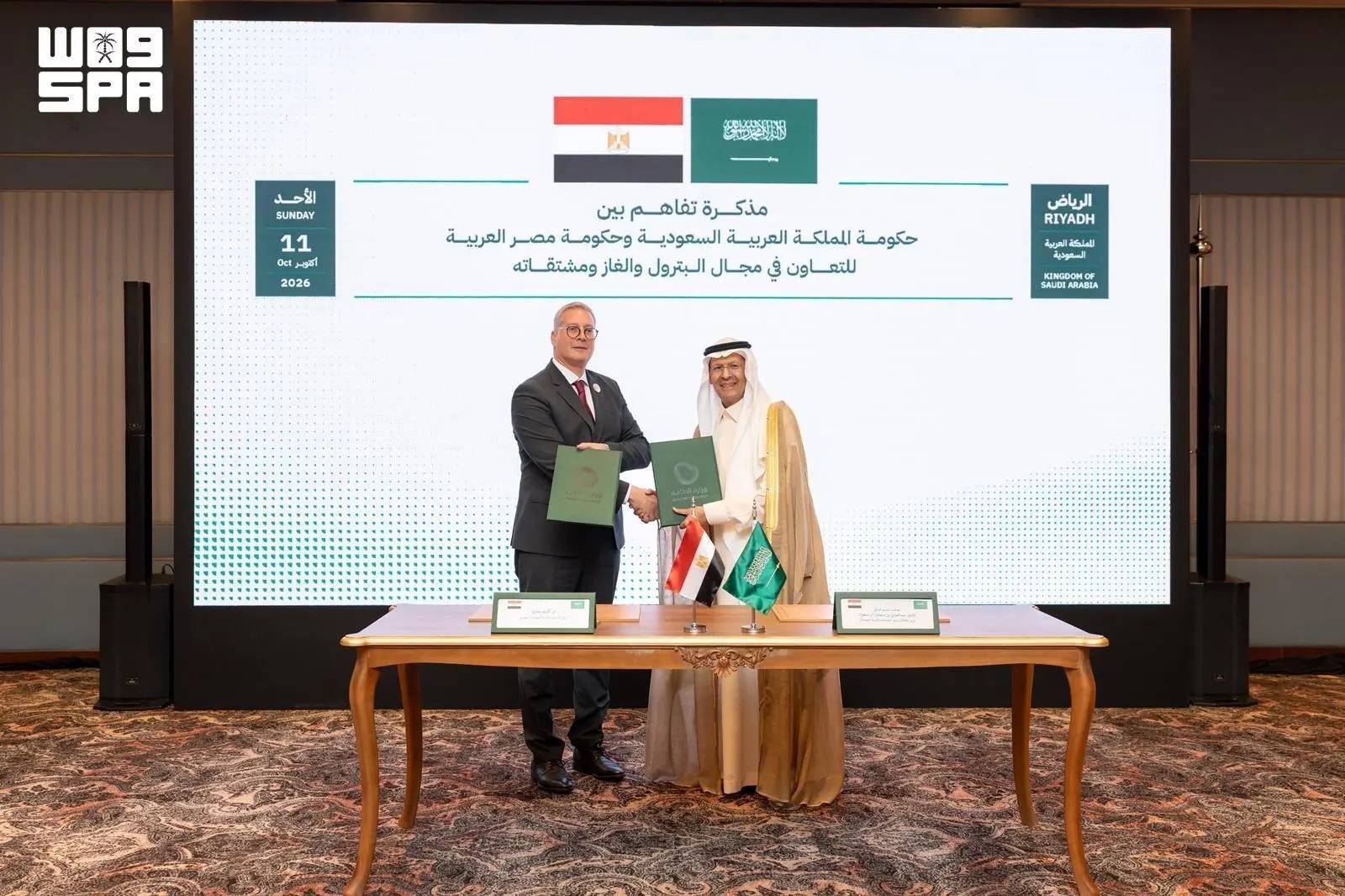
Saudi Minister of Energy and Minister of Industry and Mineral Resources Prince Abdulaziz bin Salman bin Abdulaziz and Egypt’s Minister of Petroleum and Mineral Resources Eng. Karim Badawi. (SPA)

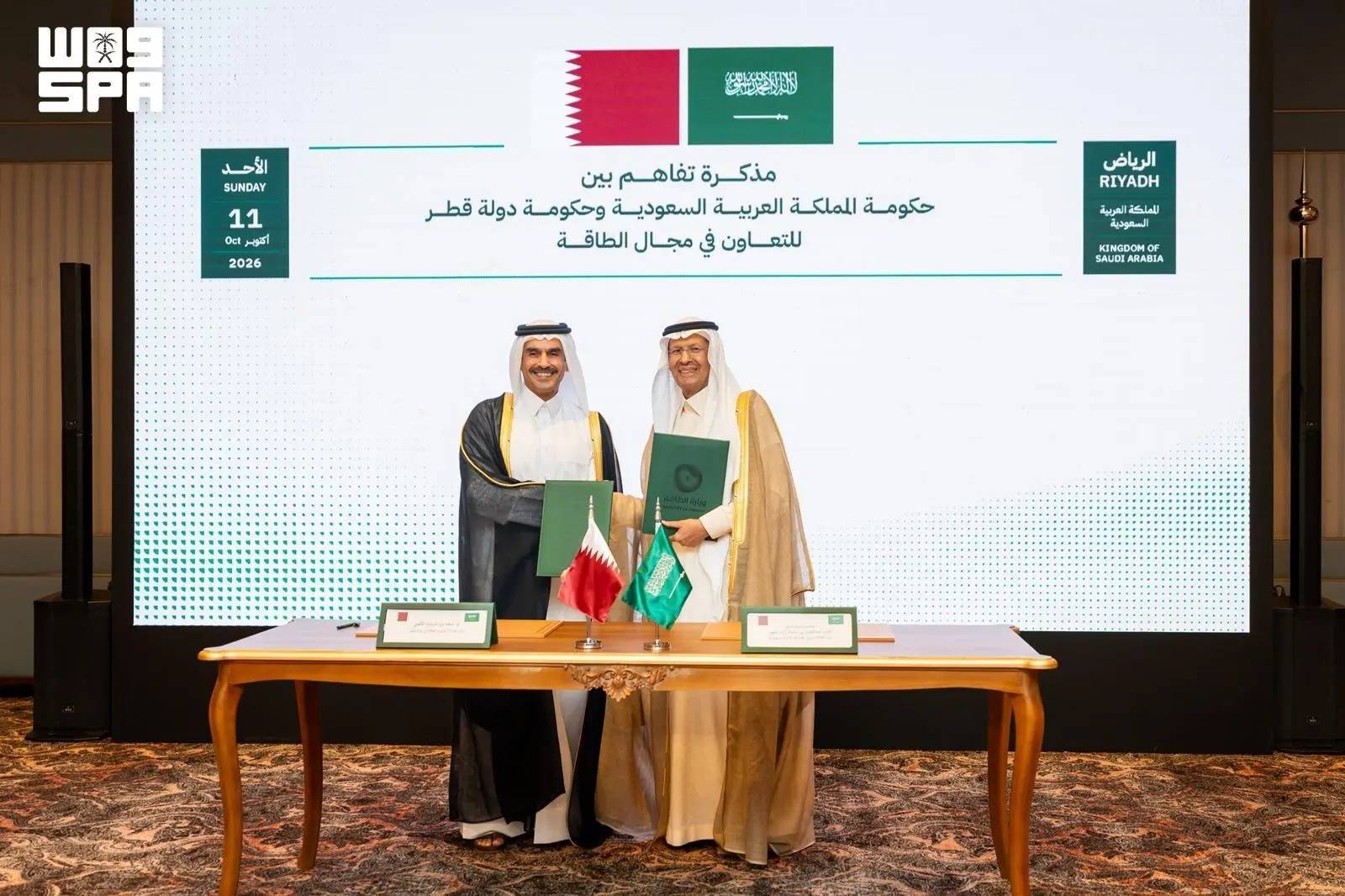
Prince Abdulaziz signed an MoU on energy cooperation with Qatar’s Minister of State for Energy Affairs Eng. Saad bin Sherida Al-Kaabi.

The MoU establishes a framework for cooperation between Saudi Arabia and Qatar across oil and petroleum products, gas and its derivatives, refining, petrochemicals, electricity, clean hydrogen and its derivatives, renewable energy, energy efficiency and energy storage.

It provides for the two countries to explore opportunities for joint projects involving pipelines for the transportation and export of oil and gas; the development and use of sustainable petrochemical materials in construction and other sectors; and cooperation on infrastructure to support access to energy.

The MoU covers cooperation in international negotiations, forums and organizations addressing energy transitions and climate change, including the United Nations Framework Convention on Climate Change, the Paris Agreement and the Intergovernmental Negotiating Committee tasked with developing an international legally binding instrument on plastic pollution, among others.

Prince Abdulaziz also signed an MoU with Egypt’s Minister of Petroleum and Mineral Resources Eng. Karim Badawi on cooperation in oil, gas and their derivatives.

Saudi Minister of Energy and Minister of Industry and Mineral Resources Prince Abdulaziz bin Salman bin Abdulaziz and Qatar’s Minister of State for Energy Affairs Eng. Saad bin Sherida Al-Kaabi. (SPA)

The MoU establishes a framework for Saudi-Egyptian cooperation in crude oil, petroleum products and natural gas, including their trade, handling, transportation, storage and distribution, as well as the development of related infrastructure and logistics.

The cooperation will strengthen energy market integration and supply chain resilience and reliability, enhance energy security, and help meet demand across domestic, regional and international markets. Activities will be carried out in accordance with the laws and regulations of both countries and on commercial terms that advance their mutual interests.

The agreement also covers the exchange of Saudi expertise in fuel station and service center qualification, operation and maintenance, as well as the Kingdom’s experience in opening the liquefied petroleum gas sector to competition. It expands cooperation in petrochemicals and investment in ongoing and planned projects.


Abdulaziz bin Salman: Riyadh is the Capital of Energy Security

Saudi Energy Minister Prince Abdulaziz bin Salman speaks at the opening of the ministerial meeting of the International Energy Forum (IEF) in Riyadh (Turki Al-Agili)
TT

Abdulaziz bin Salman: Riyadh is the Capital of Energy Security

Saudi Energy Minister Prince Abdulaziz bin Salman speaks at the opening of the ministerial meeting of the International Energy Forum (IEF) in Riyadh (Turki Al-Agili)

Saudi Energy Minister Prince Abdulaziz bin Salman stressed on Sunday that Riyadh represents the capital of energy security, noting that this status reflects the Kingdom's efforts, as well as those of the men and women working in the energy sector, to ensure reliable energy supplies and fulfill Saudi Arabia’s commitments to the world.

Achieving energy security requires cooperation among all countries, he said.

Speaking at the opening of the ministerial meeting of the International Energy Forum (IEF) in Riyadh, at the start of Riyadh Energy Week, the minister expressed hope that the gathering would help direct attention toward the most important issues that energy stakeholders should focus on.

He noted that the current period makes dialogue on energy security more important than ever and that in-person meetings enable participants to exchange assessments directly, discuss concerns, and build the understanding necessary for practical cooperation among nations.

He emphasized that Saudi Arabia will continue implementing its plans, meeting its domestic needs, and honoring its commitments to the world regardless of circumstances, stressing the Kingdom’s resilience and ability to continue advancing toward its objectives.

Prince Abdulaziz said that Saudi Arabia’s commitment to energy security is one of its defining characteristics and expressed hope that the event would help more participants understand the depth of that commitment.

“I am proud to say that this country, and the city of Riyadh, is the capital of energy security,” he said, attributing this standing to the efforts of the women and men working in the energy sector and to the work they undertake to ensure the continuity of supplies and the fulfillment of the Kingdom’s obligations.

He pointed to the significant amount of work Saudi Arabia has accomplished over the past eight months, stressing that the Kingdom continues to reassure its partners that it will meet its commitments to the world and will not fail to do so.

Abdulaziz bin Salman also noted that Saudi Arabia has demonstrated its ability to support the reliability of energy supplies under challenging circumstances through investment, preparedness, and decisive action.

He cited the East-West Pipeline as a clear example, explaining that it connects production centers in the Eastern Province with export facilities in Yanbu on the Red Sea, providing an alternative route for oil to reach international markets.

He further spoke about ongoing work on additional pipeline routes, expressing hope that the Kingdom’s commitments in this area would become clearer soon, ensuring the continuation of its efforts and strengthening its role in global energy markets.
