


Ukraine Ally Britain Eases Sanctions on Russian Oil as Fuel Prices Surge Over Iran Conflict

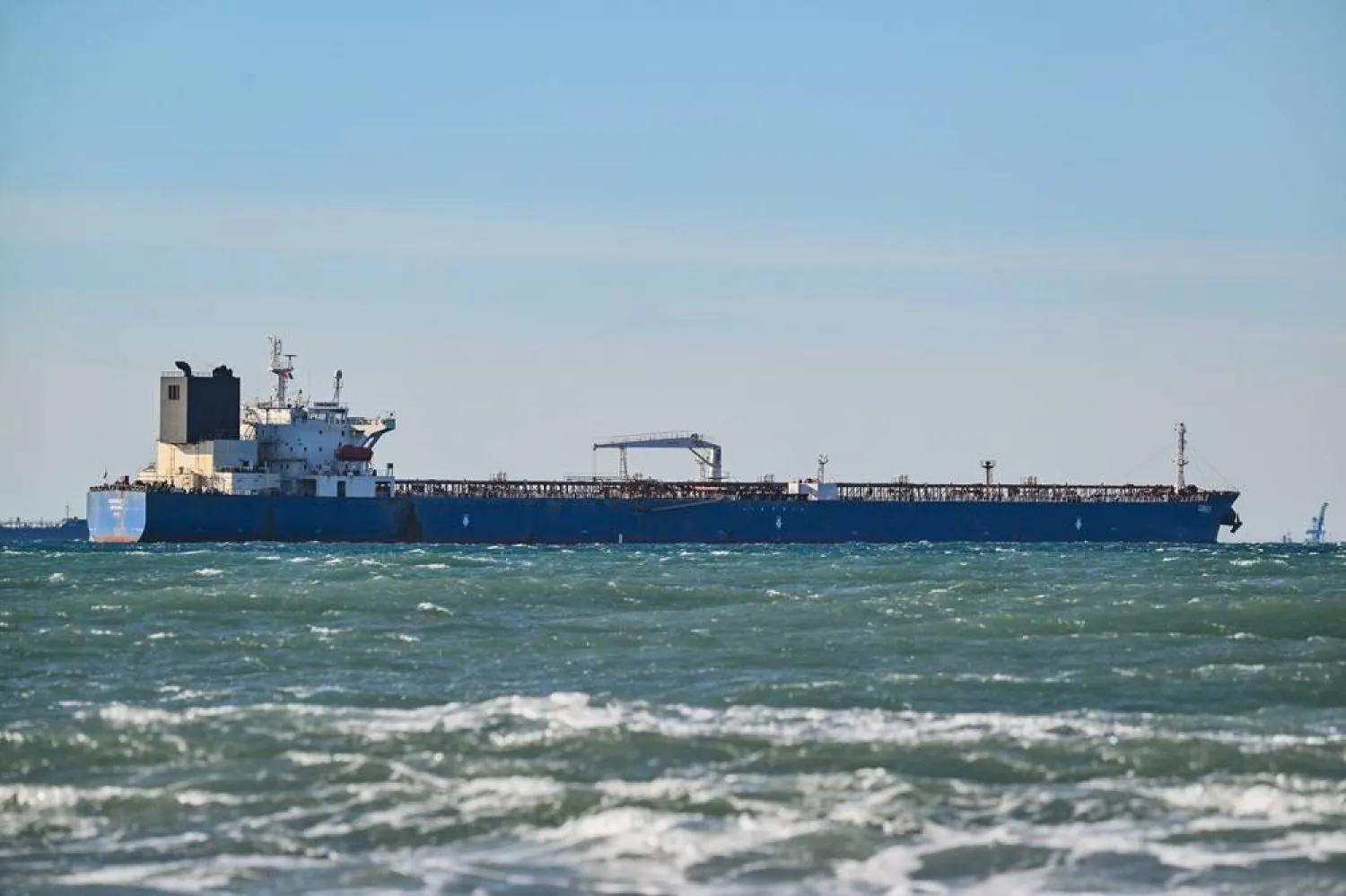
A seized suspected Russian oil taker by the French navy is photographed in the Mediterranean Sea in Fos-sur-Mer, southern France, on Jan. 26, 2026. (AP)
TT

Ukraine Ally Britain Eases Sanctions on Russian Oil as Fuel Prices Surge Over Iran Conflict

A seized suspected Russian oil taker by the French navy is photographed in the Mediterranean Sea in Fos-sur-Mer, southern France, on Jan. 26, 2026. (AP)

The UK government has quietly watered down sanctions on Russian oil in an effort to shelter Britons from the cost-of-living squeeze triggered by the closure of the Strait of Hormuz.

A trade license that came into effect Wednesday permits the import of Russian oil that has been refined into jet fuel and diesel in third countries, such as India and Türkiye.

The US-Israeli war on Iran and Iran's closure of the strait, through which about a fifth of the world's oil usually passes, has sent fuel prices soaring around the world and sparked concerns about a shortage of jet fuel.

UK Treasury minister Dan Tomlinson said the changes are “for a time limited period and on a very specific issue.”

Britain has been one of Ukraine's strongest allies since Russia's full-scale invasion in 2022, and the government insist its sanctions against Russia remain among the toughest in the world.

But lawmaker Emily Thornberry, who chairs Parliament’s Foreign Affairs Committee, said Ukrainians would “feel very let down” by the move. She said Ukraine’s allies should keep squeezing Russia’s oil industry, because it “is absolutely crippling their economy.”

The US has also eased Russian sanctions. Earlier this week, Treasury Secretary Scott Bessent extended a 30-day sanctions waiver allowing the purchase of Russian oil shipments already at sea.

On Tuesday, finance ministers from the US, Britain and the other Group of Seven wealthy nations issued a joint statement reaffirming “our unwavering commitment to continue to impose severe costs on Russia in response to its continued aggression against Ukraine.”


GCC, Britain Announce Historic Trade Deal

From the signing ceremony of the joint statement concluding the free trade agreement negotiations (GCC)
TT

GCC, Britain Announce Historic Trade Deal

From the signing ceremony of the joint statement concluding the free trade agreement negotiations (GCC)

The Gulf Cooperation Council and Britain have announced a trade deal worth $5 billion a year in the long run, deepening economic ties between the two sides and making Britain the first G7 nation to sign such an agreement with the Gulf bloc.

The agreement was first discussed in 2017 following Britain's vote to leave the European Union, with formal negotiations commencing in June 2022.

The British government said Wednesday that the deal would be worth £3.7 billion ($4.96 billion) each year in the long term.

The deal will remove 93% of GCC tariffs on British goods, equivalent to the removal of £580 million worth of tariffs by the deal's tenth year, with ⁠two-thirds of the tariffs being removed as soon as the deal comes into force.

In return, Britain has lowered tariffs to the GCC, though the countries' main exports to Britain, oil and gas, are already tariff-free.

GCC Secretary-General Jasem Mohamed Albudaiwi said following the signing that the agreement had a framework designed to achieve "tangible and measurable" economic benefits for businesses, investors ⁠and citizens of ⁠the seven signatory countries, according to a statement by the GCC.

He said the agreement spans trade in goods and services, financial services, digital trade, investment protection, telecommunications and others.


Saudi Arabia Leads Efforts to Stabilize Global Energy Supplies amid Warnings of Prolonged Conflict

The Saudi capital, Riyadh (SPA)
TT

Saudi Arabia Leads Efforts to Stabilize Global Energy Supplies amid Warnings of Prolonged Conflict

The Saudi capital, Riyadh (SPA)

Saudi Arabia is spearheading international efforts to stabilize global oil markets and contain the fallout from a supply crisis triggered by the Iran war and the halt to navigation through the Strait of Hormuz.

Using strategic logistics infrastructure, Riyadh has secured energy flows to consumers and helped prevent prices from soaring, as academic and industry warnings mount that the conflict’s structural impact on oil facilities and refineries could last for years, even if the war ends militarily and the strait reopens.

Dr. Ibrahim Al-Mohanna, adviser to the Saudi energy minister, told Asharq Al-Awsat that the Kingdom’s role was “very important” and had spared the global oil market a serious crisis.

He said the East to West pipeline transported about 7 million barrels of oil to the Red Sea, bypassing the Strait of Hormuz, and supplied international markets with crude and refined products, helping prevent prices from rising “insanely,” as he put it.

Al-Mohanna made the remarks after a seminar hosted by King Saud University titled "Media Narratives: The US-Israeli-Iranian War."

He said that when the Iran war began on Feb. 28, “the pace of events was very fast, and oil prices were highly volatile, even within a single day, amid blurred information and unclear facts.”

That, he said, led to “weak and scattered media coverage of oil issues and a lack of wise oil analysis,” which deepened price volatility. “There was even a major and unprecedented disconnect between the futures market and the spot market, with the gap sometimes reaching $50 a barrel,” he added.

Al-Mohanna said the Gulf states, particularly Saudi Arabia, the UAE, Kuwait and Qatar, along with Iran and Iraq, form the world’s most important oil region, not only because they produce about 20% of global oil needs, but also because of their refining capacity and production and export of liquefied gas, which is vital to many industries.

“The world lost about 13 million barrels per day because of the war, a very large amount by all standards,” he said.

“It represents the biggest crisis facing the global oil market.” He added that the conflict had major economic repercussions, while the closure of the Strait of Hormuz further complicated the situation and triggered another price spike.

Asked how long the war’s impact on the market could last, Al-Mohanna said the answer depended directly on the duration of the conflict, the closure of the Strait of Hormuz, and the shutdown of fields and production in countries where wells and facilities suffered severe damage.

He said uncertainty remained over when the war would end and when flows of crude and petroleum products would return to normal. Questions also persisted, he said, over the scale of structural damage to fields and facilities, which could take a very long time to rehabilitate.

Al-Mohanna warned that the war’s impact on the energy sector would last for years, not months, even if the conflict ends militarily and politically and the Strait of Hormuz reopens.

He said production, and export disruptions that have built up since the start of the war would take time to correct. The longer the strait remains closed, he added, the harder and more complex it becomes to restore production to previous levels.

He stressed that the Kingdom, the Gulf states, and OPEC more broadly are working continuously to limit these negative effects and protect global consumers by focusing on two main pillars: balancing supply and demand and stabilizing prices.

Al-Mohanna also underlined the strong, consistent link between oil prices and the media, especially in major producing and consuming regions. During economic, political and military crises, he said, media outlets move beyond reporting news to become a real gauge for markets and investors and a force shaping the direction of global prices.

Dr. Abdulaziz bin Salamah, a former Saudi deputy minister of information, described the American and Israeli war on Iran as “unprecedented in several respects,” saying it was “the first war waged by Israel and America together without prior consultation with NATO allies.”

Speaking at the seminar, Bin Salamah said European media coverage rested on two main concerns: military security and the economy.

He pointed to “a growing sense of disappointment and shaken confidence among Europeans toward the United States during President Donald Trump’s term,” as well as European fears that Iranian ballistic missiles could reach deep into the continent.

Dr.Ibrahim Al-Beayeyz, former head of the university’s media department, said US media initially relied on “the official government narrative,” presenting the war as “a preemptive act to curb Iran’s nuclear ambitions.”

But over time, he said, “signs of breaking away from the official narrative began to appear, along with rising voices opposing the war.”

Dr. Mutlaq Al-Mutairi, a professor of media at the university, said: “What Israel is doing cannot be understood only within its traditional military framework, but within its broader framework linked to managing perception and producing meaning in contemporary conflicts.”

He said the Israeli narrative operates on three main levels: redefining the threat, legitimizing military action through a preventive logic, and cementing Israel’s status as a key security ally of the West.

The public, he said, was facing “a model of how media and narratives are employed in contemporary conflict, where politics overlaps with security, and media with perception, in shaping the balance of power.”

Meshel Alweil, a faculty member in the department, said Tehran relied on two different narratives in its media approach.

The first was directed at the Iranian domestic audience and focused on mobilizing local public opinion, while the second targeted external media through political and media messages aimed at international and Arab audiences.


Foreign Investors Consolidate their Bets on Saudi Arabia as Economic Reforms Gather Pace

The King Abdullah Financial District in Riyadh. (SPA)
TT

Foreign Investors Consolidate their Bets on Saudi Arabia as Economic Reforms Gather Pace

The King Abdullah Financial District in Riyadh. (SPA)

Saudi Arabia is no longer just an oil-price bet for global investors. It is becoming a core emerging-market play. That is the view of Emmanuel Laurina, head of Middle East, Africa, and official institutions at State Street, one of the world’s major financial services and asset management firms.

Speaking to Asharq Al-Awsat, Laurina said a structural shift is reshaping how global institutions view the Kingdom, and why State Street is placing a major bet on its market.

Laurina explained that Saudi Arabia has moved from an oil-linked allocation to a central component of emerging-market portfolios.

The shift is being driven by a broader range of investable sectors, particularly finance, energy, and raw materials, giving investors real diversification in a world where many emerging markets are dominated by technology, he stressed.

Saudi Arabia’s inclusion in major global equity and bond indexes has helped anchor foreign inflows and strengthen the market’s role in international allocations, he said. Vision 2030 reforms have also widened opportunities beyond oil.

What is drawing investors now?

Laurina said market liberalization and the opening of share trading to foreign investors through the development of the Saudi Exchange, Tadawul, have helped attract liquidity and deepen international participation.

He also pointed to Saudi Arabia’s push into artificial intelligence and digital infrastructure as the Kingdom seeks strategic partnerships with major global technology companies.

In fixed income, Laurina said Saudi government bonds carry a strong A+ credit rating and offer a positive yield spread over US Treasuries, making them attractive for investors seeking dollar-denominated diversification.

Access has also improved sharply, he said. The abolition of the qualified foreign investor regime and the shift toward direct ownership of listed securities mark a major step forward.

Still, some structural limits remain. These include foreign ownership caps at individual and aggregate levels, and the need to trade through local brokers. Laurina said the listing of foreign exchange-traded funds in the Kingdom remains only partly developed because Saudi Arabia’s domestic market-making ecosystem is still limited.

New fund targets Saudi equities

Laurina said State Street recently launched an exchange-traded fund in partnership with the Saudi Public Investment Fund, giving international investors access to Saudi equities through a systematic active strategy that seeks to beat the benchmark across full market cycles.

The launch reflects rising client demand and a clear shift in the Saudi market’s composition, away from oil stocks and toward sectors such as healthcare, utilities and technology, he went to say.

ETFs, he said, are only one part of a wider ecosystem that includes institutional mandates, strategic partnerships, index-driven flows and growing activity in private markets, especially in Vision 2030 priority sectors.

Laurina said the Middle East and Africa are central to State Street’s future growth strategy.

The strategy rests on three pillars: building institutional asset classes in the Middle East and North Africa, internationalizing Sharia-compliant portfolios, and meeting growing demand for regionally focused investment solutions.

Riyadh became State Street’s 11th global investment center in 2024, he said, as the company continues to expand its local investment and research team.

Laurina said Saudi Arabia is now a pivotal market and a key growth engine in State Street’s Middle East and Africa strategy.
