


Asian Equities ahead, Oil Rises as Uncertainty Surrounds US-Iran Talks

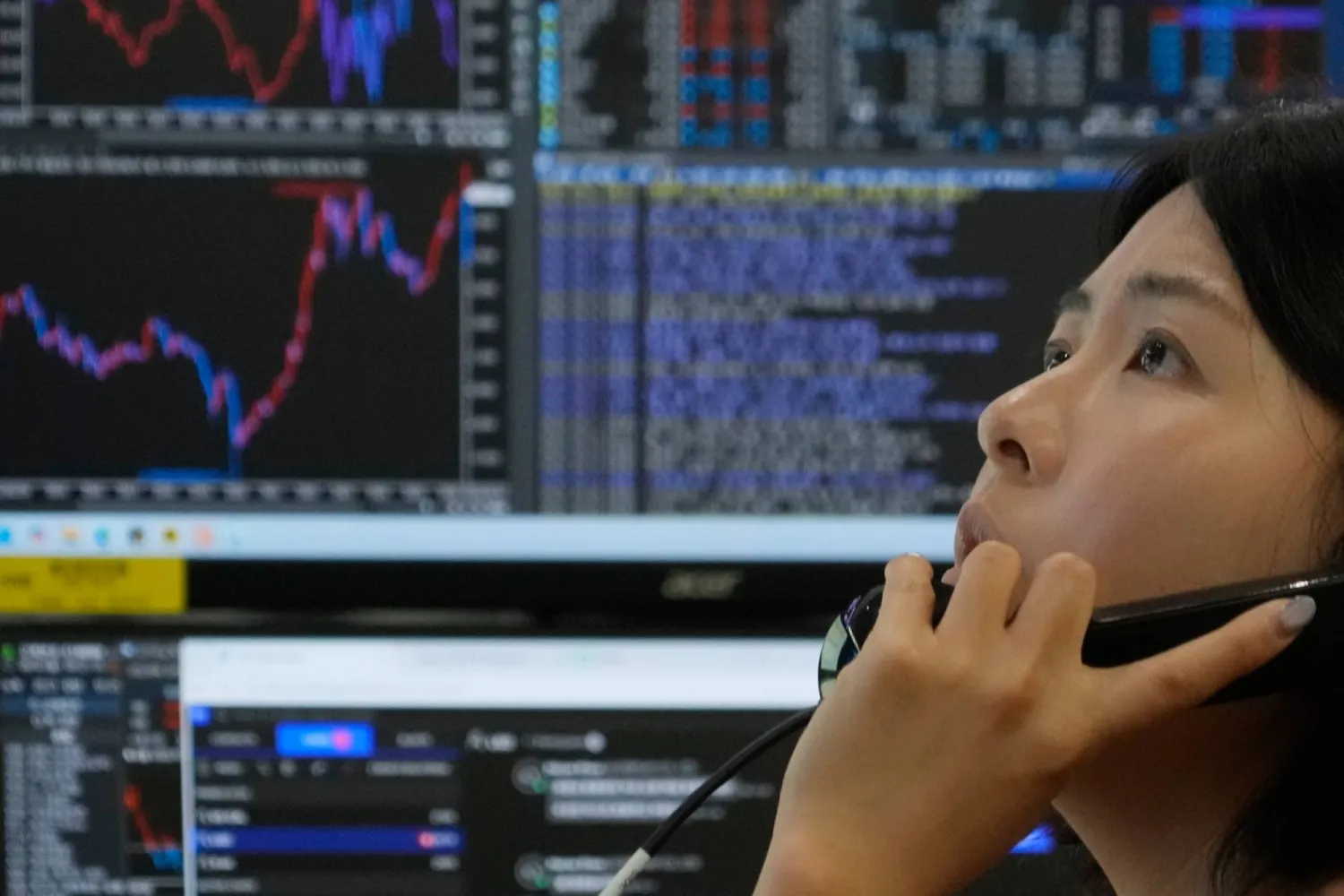
A currency trader talks on the phone at the foreign exchange dealing room of the Hana Bank headquarters in Seoul, South Korea, Monday, June 1, 2026. (AP Photo/Ahn Young-joon)
TT

Asian Equities ahead, Oil Rises as Uncertainty Surrounds US-Iran Talks

A currency trader talks on the phone at the foreign exchange dealing room of the Hana Bank headquarters in Seoul, South Korea, Monday, June 1, 2026. (AP Photo/Ahn Young-joon)

Oil rose while Asian equities firmed Monday as a surge in artificial intelligence-linked stocks helped offset uncertainty over US-Iran talks.

Gains in tech-heavy markets drove investor optimism, despite uncertainty driven by US-Iran negotiations to end the war that has roiled global energy markets since February, said AFP.

Iran's chief negotiator warned Sunday that Tehran would not trust Washington or agree to any deal unless its rights were fully secured, underlining the gap between the two sides as talks drag on.

Reports that US President Donald Trump had sent back a tougher proposal have further complicated negotiations, raising the risk of delays to any agreement to formally end the war and reopen the crucial Strait of Hormuz, through which about a fifth of global crude transits in peacetime.

While both sides continue to exchange proposals, key sticking points remain, including Iran's nuclear program, demands for sanctions relief and the future of shipping through the vital waterway.

The stifled progress has left markets sensitive to developments, with oil prices edging higher as uncertainty around supply flows continue.

Brent crude, the international benchmark, rose by 2.4 percent, while West Texas Intermediate, was up 2.8 percent.

Across Asia, Seoul led the rally jumping by more than 4.0 percent, boosted by continued demand for chipmakers and AI-related firms.

Memory chip giant Samsung Electronics rose by more than 9.0 percent, while rival SK hynix rose by over 2.0 percent.

Taipei, Tokyo, Manila, Wellington and Singapore also advanced.

Hong Kong rose in early trade though mainland Chinese markets lagged, with Shanghai dipping, as caution over the domestic outlook could have tempered buying.

May factory activity for China was flat at 50.0 after two months of expansion, according to official data released on Sunday.

Sydney and Kuala Lumpur were down.

Analysts said the resilience of equities despite geopolitical uncertainty demonstrated how dominant the AI-driven investment cycle remained.

"Investors continue to embrace the AI boom while assigning a higher probability to an eventual agreement between Washington and Tehran," Stephen Innes of SPI Asset Management wrote in a commentary.

"The reason is simple. Artificial intelligence remains the dominant engine of market psychology, and as long as Washington and Tehran continue to exchange draft proposals rather than missiles, investors appear willing to give diplomacy the benefit of the doubt," he added.

Attention remains on incoming US data and central bank signals this week.

Investors would also be looking to Nvidia CEO Jensen Huang's keynote speech at Taipei's Computex chip summit.

Huang "will set the tone today, with a typical upbeat and highly positive outlook set to go down", Chris Weston of Pepperstone said.

"Traders will closely scrutinize any updates relating to demand, product innovations, supply chains and infrastructure buildouts impacting what is already a super-hot space," he added.



Saudi Arabia's Mutlaq Al-Ghowairi Contracting Sets IPO Price Range at $2.9-$3.3 per Share

Photo showing one of Mutlaq Al-Ghowairi Contracting Co.'s projects. (Company website)
TT

Saudi Arabia's Mutlaq Al-Ghowairi Contracting Sets IPO Price Range at $2.9-$3.3 per Share

Photo showing one of Mutlaq Al-Ghowairi Contracting Co.'s projects. (Company website)

Saudi Arabia's Mutlaq Al-Ghowairi Contracting Co. has set the price range for its initial public offering (IPO) at between 11 riyals ($2.9) and 12.5 riyals ($3.3) per share, and began the institutional book-building period ahead of a planned offering of 30 percent of its shares on the Saudi Exchange.

Al Rajhi Capital, acting as lead manager, financial adviser, bookrunner and underwriter, alongside Morgan Stanley Saudi Arabia as financial adviser, bookrunner and underwriter, said the offering consists of 240 million ordinary shares in Mutlaq Al-Ghowairi Contracting Co., representing 30 percent of the company's share capital.

According to a filing on the Saudi Exchange (Tadawul), the book-building period for participating institutions began on Sunday, May 31, 2026, and will continue until 3:00 p.m. Saudi time on Thursday, June 4, 2026.

The minimum subscription size for participating institutions is 25,000 shares, while the maximum is 39.99 million shares. Participation in the book-building process is limited to eligible investors in accordance with the Capital Market Authority's rules governing institutional book-building and share allocation in initial public offerings.

The final offer price will be determined after the completion of the book-building process, to be followed by the retail subscription period. The company has initially allocated all 240 million offered shares to participating institutions, representing 100 percent of the total offering.

The filing added that if there is sufficient demand from retail investors, the institutional bookrunners, in coordination with the company, may reduce the allocation to participating institutions to a minimum of 168 million shares, representing 70 percent of the total shares on offer.


Saudi Market Closes Up 0.5%, Kingdom Holding Shares Jump 10%

A man monitors stock movements on the Saudi stock market. (AFP)
TT

Saudi Market Closes Up 0.5%, Kingdom Holding Shares Jump 10%

A man monitors stock movements on the Saudi stock market. (AFP)

Saudi Arabia's benchmark stock index (TASI) ended its first trading session following the Eid al-Adha holiday up 0.5 percent at 11,078 points, with total turnover reaching about 4 billion riyals.

The index touched a session high of 11,080 points and a low of 11,032 points.

Shares of Kingdom Holding led the gainers, surging 10 percent to 13.58 riyals. The stock has gained about 27 percent over the past three sessions, marking its highest closing level since 2016.

The company recently disclosed its combined stake with the Private Office of Prince Alwaleed bin Talal in SpaceX, amounting to 0.63 percent. Based on the company's expected valuation at a potential public offering, the stake is estimated to be worth between $8.32 billion and $10.55 billion.

Al Rajhi Bank shares rose 1 percent to 67.25 riyals.

Shares of Ma'aden, ACWA Power, Riyad Bank, Dr. Sulaiman Al Habib Medical Services Group, Elm, Masar, and Saudi Awwal Bank (SAB) closed higher, posting gains ranging from 1 percent to 4 percent.

Meanwhile, shares of Al Shamel Masar, Saudi Industrial Development Co. (SIDC), Electrical Industries Co., and Dar Al Arkan advanced between 6 percent and 10 percent.


Saudi National Housing Company... From an 'Executive Arm' to the Largest Real Estate Developer in the Region

 NHC Chief Executive Mohammed Albuty speaks during a panel discussion (company website)
NHC Chief Executive Mohammed Albuty speaks during a panel discussion (company website)
TT

Saudi National Housing Company... From an 'Executive Arm' to the Largest Real Estate Developer in the Region

 NHC Chief Executive Mohammed Albuty speaks during a panel discussion (company website)
NHC Chief Executive Mohammed Albuty speaks during a panel discussion (company website)

Saudi Arabia’s National Housing Company (NHC) has emerged as a central force in reshaping the Kingdom’s housing market, evolving from a state-backed developer into a key engine of Crown Prince Mohammed bin Salman’s economic reform agenda under Vision 2030.

Far from being a conventional real estate company, NHC today manages residential suburbs and assets accounting for around 20 percent of total real estate product sales in Saudi Arabia, underscoring its growing influence in one of the region’s largest property markets.

Since its launch in 2016, the company has positioned itself at the center of the Kingdom’s housing transformation, helping drive the Housing Program, one of Vision 2030’s flagship initiatives aimed at raising Saudi homeownership to 70 percent by the end of the decade.

NHC Chief Executive Mohammed Albuty said the company had played a pivotal role in restructuring the sector to ensure long-term sustainability beyond direct state financing. He pointed to the 2025 Vision 2030 annual report, which showed Saudi homeownership rising to 66.24 percent, surpassing the government’s interim target of 65 percent for 2025.

NHC was established by royal decree in 2016 as the investment and development arm of what is now the Ministry of Municipalities and Housing. Its creation marked the beginning of a new “national developer” model designed to manage housing assets and projects with greater efficiency and flexibility.

A major turning point came in 2020, when another royal order transferred the company’s ownership to the state, elevating it from a supporting entity to a market leader. The move enabled NHC to launch some of the region’s largest residential suburbs, shifting from managing limited housing complexes to developing integrated cities covering more than 160 million square meters.

The company has also sought to curb construction costs through its digital procurement platform, Supply Pro, which links developers directly with manufacturers and suppliers. The platform currently offers more than 1,500 products from 129 factories and 45 suppliers, helping reduce development costs by around 20 percent.

Speaking at the Real Estate Supply Chain Forum, Albuty said NHC had boosted local content in its projects through supply chain localization agreements and industrial partnerships worth more than SAR 21 billion ($5.6 billion). The deals included SAR 8 billion in supply chain service agreements, SAR 5 billion in industrial localization initiatives and 15 supply contracts worth more than SAR 8 billion.

Maan Alothimeen, NHC’s general manager for supply chains and business support, said Supply Pro had handled transactions exceeding SAR 2 billion over the past two years, with Saudi factories and small- and medium-sized enterprises accounting for 95 percent of the activity.

NHC has also become a platform for local developers, helping transform smaller firms into major players capable of managing billion-riyal projects. By offering investment opportunities in residential and commercial real estate, as well as in the operation of health, education and leisure facilities, the company has encouraged broader private-sector participation.

The strategy has contributed to the delivery of more than 300,000 housing units. The financial stability provided by NHC has also enabled emerging Saudi developers to grow into large companies managing projects valued at more than SAR 263 billion ($70 billion), strengthening the competitiveness of the Saudi property market.

As part of efforts to deepen local industrial participation, NHC signed a memorandum of understanding with the Local Content and Government Procurement Authority to turn its suburban developments into permanent showcases for Saudi-made products, a move expected to generate thousands of jobs in manufacturing and logistics.

Saudi Minister of Municipalities and Housing Majed Al-Hogail said mortgage financing had become a cornerstone of the Kingdom’s real estate expansion. He noted that the value of Saudi mortgage financing had surged from around SAR 200 billion ($53.3 billion) to more than SAR 900 billion ($240 billion) by the end of 2025, representing 27 percent of total Saudi banking portfolios.

Al-Hogail added that the Saudi Real Estate Refinance Co. (SRC) had issued sukuk in the London market to strengthen liquidity links between domestic and international financial markets and secure sustainable funding flows for the housing sector.

In remarks to Asharq Al-Awsat, Khaled Al-Mobid, chief executive of Menassat Real Estate Co., said NHC had become a key implementation arm of Saudi housing policy by increasing the supply of planned residential units, helping stabilize prices in the market.

He noted that the company’s most significant shift had been its evolution from a traditional developer into an “enabler” for private firms. Through the provision of serviced land and infrastructure, NHC allowed smaller developers to participate in large-scale projects and gain operational expertise, contributing to a more mature and professional real estate industry.

Al-Mobid added that NHC’s role extended beyond construction to balancing the housing market itself. By increasing organized housing supply and lowering development costs through economies of scale, the company was helping ease pressure on citizens and improve affordability.

He also said NHC’s partnership-driven model reduced reliance on direct government spending while encouraging private capital inflows and spreading investment risk, supporting the creation of a more financially sustainable housing sector.

As Saudi Arabia moves closer to achieving its Vision 2030 housing targets, NHC’s significance now goes beyond building homes. The company has become a model for a more diversified real estate economy led by private-sector investment and local industry, positioning housing as a driver of broader economic stability and growth.