


China Rides AI Wave as Exports Surge Past Forecast

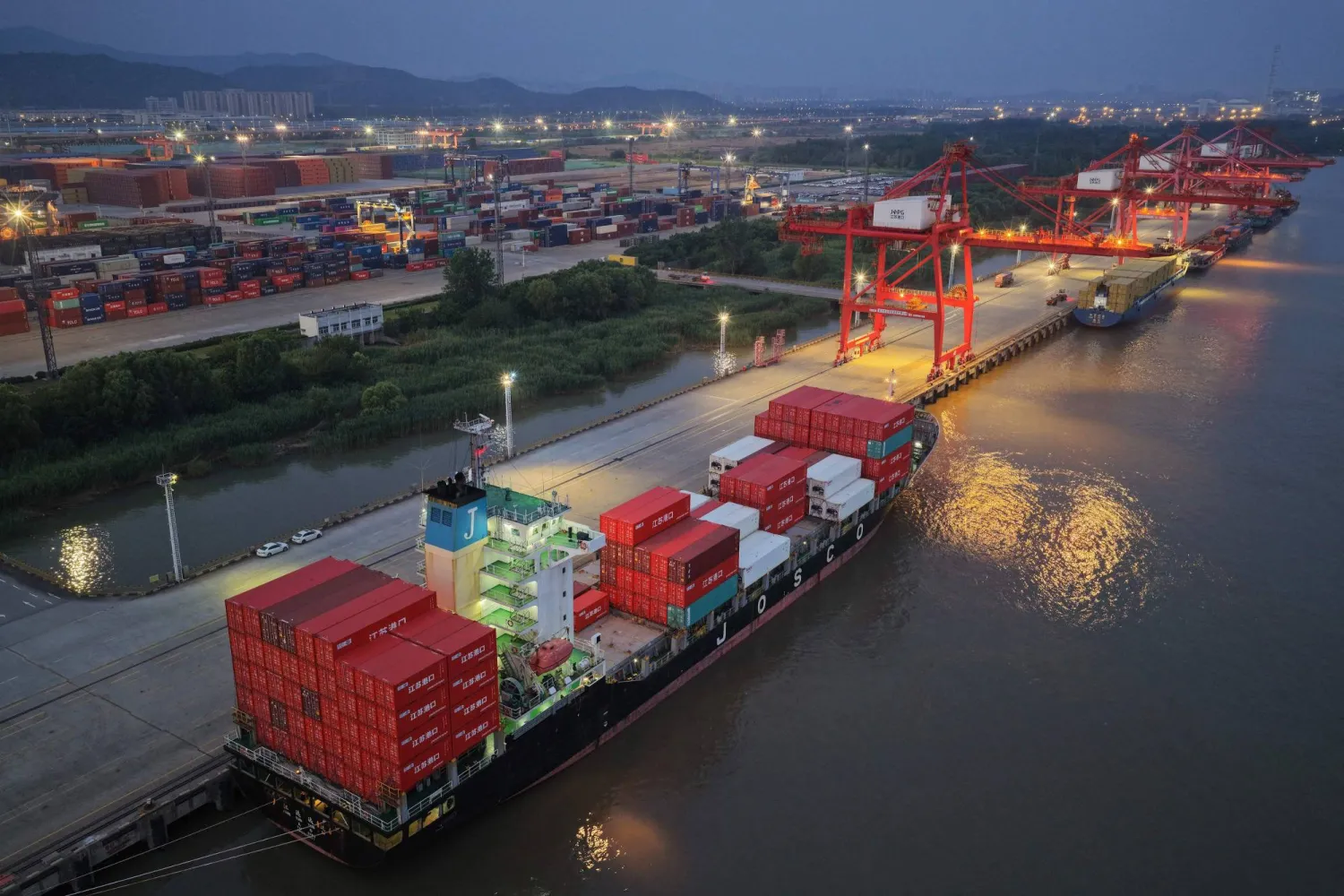
Containers and ships are seen at the port in Nanjing, in China's eastern Jingsu province early on June 9, 2026. (AFP)
TT

China Rides AI Wave as Exports Surge Past Forecast

Containers and ships are seen at the port in Nanjing, in China's eastern Jingsu province early on June 9, 2026. (AFP)

China's export growth accelerated in May, buoyed by robust demand for chips, autos and other high-tech goods fueling the global AI boom, providing policymakers some relief as energy price shocks from the Iran conflict weigh on broader demand.

A surge in global AI investment has helped the world's top manufacturer offset the export hit many had expected from the Middle East turmoil. But signs are emerging that stockpiling linked to higher energy costs is fading, with prices rising and overseas buyers starting to run down inventories as they hold out for a ceasefire.

Exports expanded 19.4% from a year earlier in US dollar value terms, customs data showed on Tuesday, outpacing the 14.1% gain in April and a 15% rise tipped by economists.

Imports notched another strong month, climbing 27.4% versus a rise of 25.3% a month prior. Economists had forecast growth of 25%.

"Chip price increases continue to support exports, with memory prices rising 20% month-on-month, pushing integrated circuit export growth to ‌111% for the month," ‌said Xing Zhaopeng, ANZ's senior China strategist.

China's exports of automated data processing equipment soared 66.1% in ‌value ⁠terms year-on-year, high-tech ⁠products rose 50.9% and shipments of cars jumped 39%, the data showed.

"Looking ahead, the AI story is far from over -- chips are rewriting China's trade landscape," Xing added.

The AI boom has driven strong demand for semiconductors powering data centers and advanced electronics, playing to China's manufacturing strengths.

But beyond AI, there are signs of strain in other sectors that suggest momentum may be starting to fade. Furniture exports, for example, rose just 1.9% year-on-year in May, while toy shipments fell 7% and footwear exports dropped 10.4%.

Separate factory activity data also showed a steep drop in new export orders last month from April's two-year peak, when warehouse managers reported "booming" business amid a scramble by foreign factories to lock in supplies.

Strong exports powered ⁠China's $20 trillion economy past forecasts in the first quarter, but pockets of weakness in the export ‌engine have reinforced concerns that fragile domestic demand leaves it exposed to weaker global ‌conditions and increases the likelihood of further policy support.

CHINA'S EXCESS CAPACITY STOKES TRADE FRICTION

Beijing is under growing international pressure to strengthen domestic consumption, as critics ‌warn its heavy reliance on imported inputs and re-exports is distorting trade and squeezing other emerging economies out of higher-value manufacturing.

"Close attention ‌must be paid to the risk of escalation between China and major trading partners such as Europe," said Zhiwei Zhang, chief economist at Pinpoint Asset Management.

The Organization for Economic Cooperation and Development amplified that concern last week, noting in a report that nearly 60% of Chinese firms' "market share gains can be explained by subsidies received."

A new US Federal Reserve paper found that China's trade surplus - measured against global GDP - has topped 1%, well above the peaks ‌Japan and Germany hit in the late 20th century, and shows little sign of narrowing.

China's trade surplus, which topped $1 trillion last year, came in at $105.43 billion in May, up from $84.8 billion ⁠a month prior and from a ⁠forecast of $92.1 billion.

The latest trade figures suggest Chinese industrial overcapacity probably accounts for at least some of the shipments.

Exports to Europe rose 7.6% year-on-year in May, while those to the United States climbed 35.4% and to Southeast Asia increased 24.3%.

Purchases from South Korea surged 83.6%. China is Korea's biggest chips market.

RARE EARTHS FLASHPOINT

China's economic heft is also rippling through oil markets, with the world's top energy buyer surprising traders by holding back purchases. Crude imports in May plunged 29% to their lowest level in eight years, helping temper global prices and partially cushion the energy shock triggered by US President Donald Trump's war in Iran.

A closely watched meeting last month between Trump and Chinese leader Xi Jinping helped cool tensions between the two superpowers but produced no meaningful breakthroughs, whether on tariff disputes or cooperation over ending the Iran conflict.

That said, China's rare earth exports climbed to a four-month high, with the world's top producer shipping 5,490 metric tons of the 17-element group essential for electric vehicles, wind turbines and defense technologies - another flashpoint in Beijing's trade tensions with the West.

China's relative advantages in scale, deep supply chains and industrial capacity leave it well positioned to absorb trade frictions with the West, including proposed US tariff hikes, said Sheana Yue, senior economist at Oxford Economics.

"We still expect exports to be China's primary growth driver in 2026, anchored by continued high-tech and clean-tech products despite war-related headwinds to global demand."



Iraq's SOMO Offers Big Discounts for Term Basrah Oil in July

FILE PHOTO: A gas flare burns in the distance at the Rumaila oil field, amid nationwide output cuts following the closure of the Strait of Hormuz, in Basra, Iraq, March 4, 2026. REUTERS/Essam Al-Sudani/File Photo
TT

Iraq's SOMO Offers Big Discounts for Term Basrah Oil in July

FILE PHOTO: A gas flare burns in the distance at the Rumaila oil field, amid nationwide output cuts following the closure of the Strait of Hormuz, in Basra, Iraq, March 4, 2026. REUTERS/Essam Al-Sudani/File Photo

Iraq's SOMO has offered wide discounts to its official selling prices to encourage term buyers to lift Basrah crude from its terminal inside the Middle East Gulf in July, according to trade sources and a document reviewed by Reuters.

The discounts for Basrah Medium crude ranged from $14 to $16 a barrel while those for Basrah Heavy crude were between $16.80 and $18.80 a barrel, depending on the loading period. Discounts are wider for cargoes ⁠loading between July 1 ⁠and 5 and they become narrower for cargoes loading July 6-10 and July 11-31.

Buyers are requested to submit their nominations for quantity within a day from receiving the letter, Reuters quoted SOMO as saying.

The discounts are meant as compensation for buyers who have to pay high chartering ⁠costs for ships to enter the Strait of Hormuz to fetch the oil, a trade source said.

The daily time charter rate for a Very Large Crude Carrier to load 2 million barrels of crude from the Middle East to China has climbed to about $300,000 from about $220,000 on February 27, before the US and Israel launched strikes on Iran, but has dropped from a peak of about $600,000 in March, LSEG data shows.

The wide discounts for ⁠Basrah ⁠crude may entice buyers, but the question remains if the Strait of Hormuz is passable, two other people said.

Last week, SOMO issued a tender to sell July-loading crude but it failed to attract buying interest as traders had difficulties in booking tankers to enter the Gulf, another source said.

Other Middle East producers are pushing ahead with oil loadings, but shipping in the strait has slowed following fresh ship attacks and renewed strikes between the US and Iran in recent days.


IMF Reaches Staff-level Deal with Egypt that Could Unlock $1.6 Billion

FILE PHOTO: A general view of buildings and the Great Pyramids in Cairo, Egypt, March 25, 2026. REUTERS/Mohamed Abd El Ghany/File Photo
TT

IMF Reaches Staff-level Deal with Egypt that Could Unlock $1.6 Billion

FILE PHOTO: A general view of buildings and the Great Pyramids in Cairo, Egypt, March 25, 2026. REUTERS/Mohamed Abd El Ghany/File Photo

The International Monetary Fund said on Monday it had reached a staff-level agreement with Egypt on reviews of two financing arrangements, potentially unlocking about $1.6 billion pending approval by the fund's executive board.

The agreement would make available about $1.5 billion under Egypt's Extended Fund Facility and about $136 million under the Resilience and Sustainability Facility, bringing total disbursements under the arrangements to about $7.2 billion, Reuters quoted the IMF as saying.

The IMF said the impact of the war in the Middle East on Egypt's economy had remained "relatively contained,” helped by "timely and decisive" policy measures including fuel and electricity price adjustments, curbs on government energy consumption and spending reprioritization.

The IMF said real GDP growth reached 5% in the third quarter, bringing growth for the first three ⁠quarters of the fiscal year to 5.2%, while headline urban inflation remained elevated at 14.6% in May and was projected to rise to 15.8% by the end of the fiscal year.

It said Egypt should maintain tight monetary policy to contain renewed inflationary pressures and keep exchange rate flexibility as the "first line of defense" against external shocks, including spillovers from heightened geopolitical tensions.

The fund said Egypt's fiscal performance was strong, with primary balance and tax revenue targets exceeded by end-March, and projected the primary surplus to rise to 5% of GDP ⁠in the 2026/27 ⁠fiscal year from 4.8% in 2025/26.

The IMF said swift implementation of Egypt's State Ownership Policy, including faster divestment of state assets, would be critical to supporting private sector-led growth. Earlier in June, Egypt's cabinet said it had granted four state-owned companies preliminary listings as part of its privatization program.

Egypt agreed to a $3 billion loan with the IMF in December 2022. The program was expanded to $8 billion in March 2024, when the country was grappling with high inflation and foreign currency shortages.

Egypt's foreign reserves rose to $53.134 billion in May from $48.526 billion in May 2025, according to central bank data.


Saudi Arabia Introduces New Irrigation Code to Save 2 Billion Cubic Meters of Water Annually

Part of the meetings of Saudi Water Week
TT

Saudi Arabia Introduces New Irrigation Code to Save 2 Billion Cubic Meters of Water Annually

Part of the meetings of Saudi Water Week

Saudi Arabia is expanding the use of treated wastewater as a strategic resource to support industrial and urban growth, with industrial consumption projected to exceed 100 million cubic meters annually by 2030.

The push comes alongside the launch of a new national irrigation code designed to save about 2 billion cubic meters of water each year.

CEO of the Saudi Irrigation Organization (SIO) Mohammed bin Zaid Abu Haid told Asharq Al-Awsat that water has become a cornerstone of the Kingdom’s development agenda.

He said rapid economic growth and the rollout of megaprojects across Saudi Arabia are driving demand for treated water as a key component of project infrastructure.

The corporation manages and operates dams while overseeing the transport, distribution, and reuse of treated water for urban, industrial, and agricultural purposes, a sector that is expanding rapidly, he said.

Treated water use in industry has risen by about 50 percent over the past two years, increasing from roughly 20 million cubic meters to 30 million cubic meters by the end of 2025. Abu Haid expects consumption to surpass 100 million cubic meters by 2030.

Urban demand has also grown sharply. Consumption for parks, green spaces, and projects under the Saudi Green Initiative climbed from about 65,000 cubic meters to nearly 13 million cubic meters, with forecasts pointing to 150 million cubic meters annually by 2030.

Abu Haid identified the Saudi Green Initiative as one of the main drivers of demand for treated water, alongside development projects, nature reserves, and expanding urban applications.

He also announced the imminent launch of the Irrigation Practices Code, developed by the corporation in partnership with the Food and Agriculture Organization of the United Nations. The code is expected to raise irrigation efficiency in the Kingdom from about 55 percent to more than 70 percent.

Once fully implemented, the code is projected to save around 2 billion cubic meters of water annually. Field trials have shown higher farm productivity, increased farmer incomes, and more efficient water use.

The code also aims to reduce water consumption in grain cultivation from 9,750 cubic meters per hectare to about 6,500 cubic meters per hectare. Abu Haid said the project is in its final stages and will be officially launched during the World Water Forum.