


Baghdad Urges OPEC to Raise Iraq's Production Quota

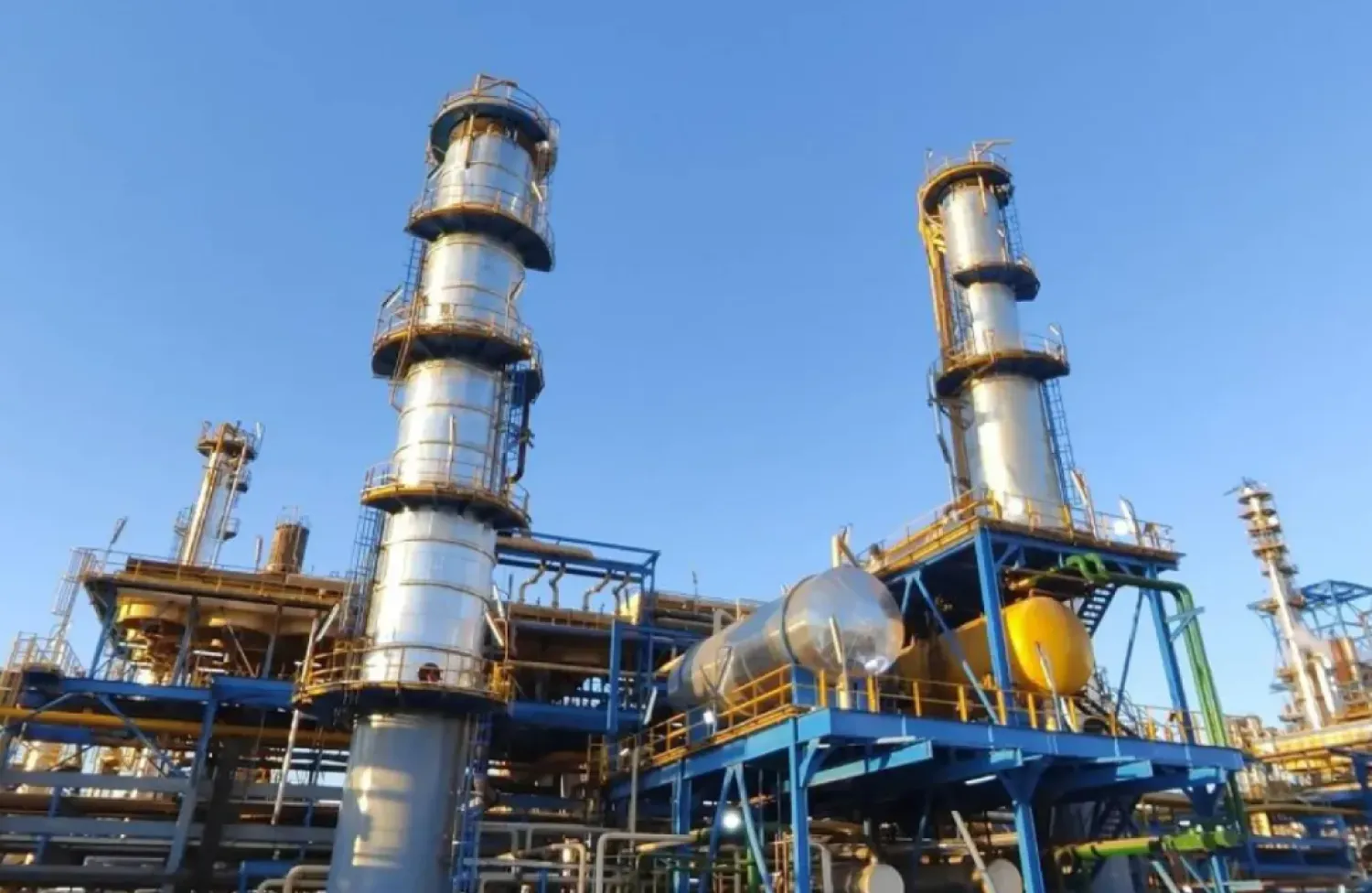
A handout picture released by Iraq's Prime Minister's Press Office on January 2, 2025, shows a partial view of the oil refinery of Baiji north of Baghdad, during the inauguration ceremony of the fourth and fifth units. (Iraq's Prime Minister's Press Office / AFP)
TT

Baghdad Urges OPEC to Raise Iraq's Production Quota

A handout picture released by Iraq's Prime Minister's Press Office on January 2, 2025, shows a partial view of the oil refinery of Baiji north of Baghdad, during the inauguration ceremony of the fourth and fifth units. (Iraq's Prime Minister's Press Office / AFP)

Baghdad has urged OPEC to increase Iraq's oil production quota, taking into account the damage done to its industry by its history of conflicts and the recent regional war, its oil ministry said Thursday.

Like other oil producers, Iraq, a founding member of OPEC, was greatly affected by the Middle East war, as it is hugely dependent on oil exports, which make up about 90 percent of its budget revenues.

Iraq's oil ministry said that reassessing production baselines was important "to ensure they are aligned with the sustainable production capacities of member countries", and with respect to "Iraq's unique security and economic circumstances".

OPEC has "responded by launching a process to reassess" its member states' capacities, the ministry said.

Following reports of a possible Iraqi exit from OPEC, oil ministry spokesperson Salim al-Rikabi told AFP that Iraq "has no intention of withdrawing from the organization and remains committed to its mechanisms".

But he added that the cartel "has to raise Iraq's production quota. Otherwise, a decision will have to be made about whether to stay or leave the organization".

Iraq has started increasing its production "in line with its capacities and needs", he said.

The ministry said that "reports suggesting that Iraq is considering ending its membership in OPEC do not reflect" the government's position.

Iraq's ministry said that any change would be decided within OPEC's existing framework, but noted there was a "high level of understanding" among members regarding Iraq's situation after decades of wars, sanctions, and recent attacks on the sector during the Middle East War.

All of these challenges will be considered to "ensure that Iraqi oil production reaches a fair level".

The Middle East war and Iran's blockade of the Strait of Hormuz choked off shipments and prompted production cuts in key oil-producing countries including Iraq, shaking world energy markets.

During the conflict, several Iraqi oil fields were struck by drones mostly launched by pro-Iran armed groups.

Before the war, Iraq produced around four million barrels per day (bpd), and exported an average of 3.5 million bpd, mostly via Hormuz.

After the recent deal between Washington and Tehran to end the fighting, Iraq now hopes to return within two months to its previous production levels.

A former oil ministry official, who requested anonymity, warned against Iraq's exit from OPEC.

A "withdrawal would not serve the interests of Iraq", which is exclusively dependent on the oil sector, he said.

"I don't think that Iraq has really the incentives to leave OPEC," said Jorge Leon, an analyst at Rystad Energy.

Instead, he added, Iraq might be trying to apply pressure to "the capacity review exercise that the group is currently doing", which will serve as the basis for the 2027 quota.



Egypt Overhauls Nitrogen Fertilizer Export Levy, Exempts High-grade Ammonium Nitrate

General view of part of Cairo (Reuters)
TT

Egypt Overhauls Nitrogen Fertilizer Export Levy, Exempts High-grade Ammonium Nitrate

General view of part of Cairo (Reuters)

Egypt has revamped its export tax regime for nitrogen fertilizers, replacing a fixed export tax with a 10% ad valorem duty on all nitrogenous fertilizer exports, while exempting high-purity ammonium nitrate, according to a decision published in the Official Gazette on Thursday.

The duty, calculated on the FOB invoice value, does not apply to pure ammonium nitrate with a nitrogen concentration exceeding 34.2%, or to shipments destined for productive enterprises in Egypt's free zones, Reuters reported.

The World Bank warned in its April Commodity Markets Outlook that global fertilizer prices could rise by more than 30% in 2026 due to conflict-related disruptions in the Middle East and logistical risks around the Strait of Hormuz.

The new decree replaces a flat $90-per-metric-ton tax introduced in May, tying the levy more directly to prevailing export prices, which have fallen since peaking in mid-April.
Egypt is the world's seventh-largest exporter of nitrogen fertilizers, according to LSEG data.


Gold Lingers Near 7-month Low as Fed Hike Bets Boost Dollar

A worker displays gold bullion bar at the ABC Refinery in Sydney - AFP
TT

Gold Lingers Near 7-month Low as Fed Hike Bets Boost Dollar

A worker displays gold bullion bar at the ABC Refinery in Sydney - AFP

Gold fell for a third straight session on Thursday, lingering near a more than seven-month low it had reached in the previous session, as expectations of US rate hikes lifted the dollar and weighed on the precious metal.

Spot gold fell 0.5% to $3,982.49 an ounce by 1054 GMT. US gold futures for August delivery edged 0.3% lower to $3,997.60 per oz.

The US dollar hit its strongest level in more than 13 months on Thursday, making greenback priced-metals more expensive for other currency holders. Markets currently see a 66% chance that the US Federal Reserve will hike rates in September, CME FedWatch data showed, Reuters reported.

"The Fed's hawkish shift, which has led to a repricing of rate hike expectations, remains the dominant driver of gold's weakness," said Nikos Tzabouras, senior market analyst at Jefferies-owned Tradu.com. ETF outflows and the rotation into equities driven by the AI boom are definitely factors weighing on the precious metal, said Tzabouras, noting that these forces tend to be cyclical and do not subtract from the broader structural case for gold.

Bullion has declined more than 6% since Fed's meeting last week and dipped below the $4,000 level on Wednesday for the first time since November 2025. Prices were down over 28% from its record high of $5,594.82 reached on January 29.

Investors now await the US Personal Consumption Expenditures data, the Fed's preferred inflation gauge, due at 1230 GMT, forI further cues on monetary policy.


Oil Falls to Pre-war Levels on Rising Middle East Supply

A drilling rig operates near a crude oil reserve in the Permian Basin oil field in Texas, USA (Reuters)
TT

Oil Falls to Pre-war Levels on Rising Middle East Supply

A drilling rig operates near a crude oil reserve in the Permian Basin oil field in Texas, USA (Reuters)

Oil prices fell on Thursday to levels last seen before the start of the Iran war as expectations of rising supply from the Middle East outweighed demand concerns.

Prompt-month Brent crude futures for August delivery were down 51 cents, or 0.7%, to $73.23 a barrel by 1201 GMT, while US West Texas Intermediate lost 53 cents, or 0.8%, to $69.81 a barrel.

Both contracts hit their lowest since February 27, Reuters reported.

August Brent was trading lower than September, which was priced at $73.50, signalling ample short-term supply.

US Energy Secretary Chris Wright told a forum that flows through the Strait of Hormuz were close to those before the start of the Iran war, with at least 20 million barrels having exited the strait in the last 24 hours.

A return to complete normalcy would take a few weeks, however, because the strait needs to be demined, he added.

"Most of the increase in flows from the Gulf is outbound —ships exiting the Strait," UBS analyst Giovanni Staunovo said.

However, a significant increase in inbound flows requires shipping confidence to return, including safety assurances and mine clearance to allow insurance premiums to normalise, Staunovo said.

Rising Middle Eastern supply, together with Iran set to boost sales after a temporary reprieve from US sanctions, drove down prices of physical crude oil cargoes around the world.

Goldman Sachs said it does not expect a large pick-up in Iranian production, even if sanctions relief extends beyond the August 21 expiry.

On the demand side, China is likely to remain the main buyer of Iranian crude, as EU and UK sanctions on Iranian oil and vessels remain in place, the bank added.

An accord agreed last week to end the US-Israeli war, which began on February 28, has allowed the resumption of traffic through the strait.

It set up a 60-day period of negotiations to tackle tougher issues, such as Iran's nuclear program. Wright said oil would continue to flow through the strait even if the deal did not hold, and that Iran would not be able to close it again.

UBS lowered its Brent price forecasts to $85 per barrel for end-September and end-December, and $80 per barrel for end-March and end-June 2027.