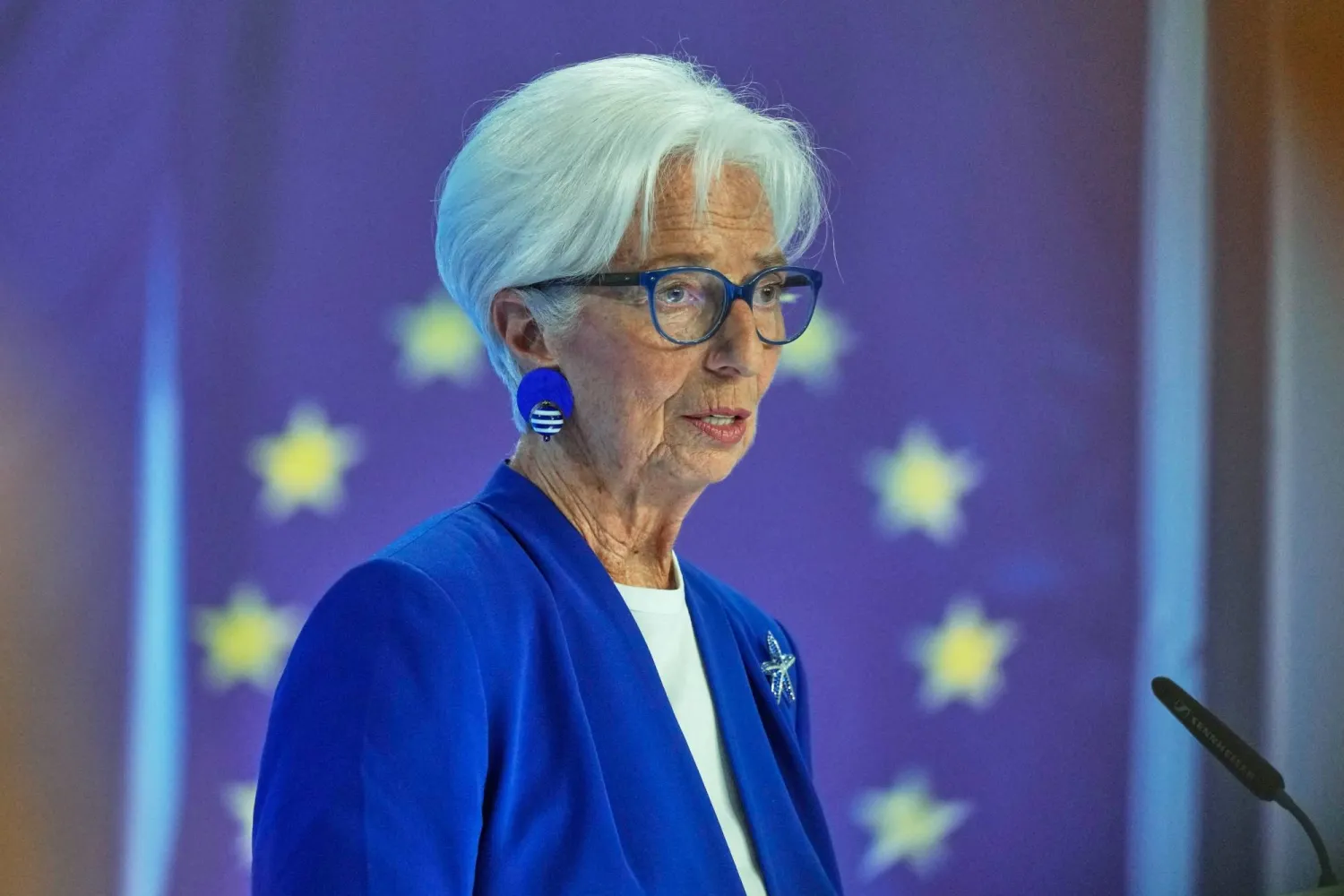
ECB's Lagarde Says She Can't Rule Out Early Departure

President of European Central Bank Christine Lagarde addresses the media during a press conference after an ECB's governing council meeting in Frankfurt, Germany, Thursday, June 11, 2026. (AP Photo/Michael Probst)
TT

ECB's Lagarde Says She Can't Rule Out Early Departure

President of European Central Bank Christine Lagarde addresses the media during a press conference after an ECB's governing council meeting in Frankfurt, Germany, Thursday, June 11, 2026. (AP Photo/Michael Probst)

European ‌Central Bank President Christine Lagarde said it was still possible she could leave before her term ends in late 2027 to weigh in on French politics in the run up to next year's presidential election, Reuters said.

Responding to a question from French newspaper Les Échos whether she would rule out leaving early, perhaps ‌to take ‌part in the French political ‌debate, ⁠she said: "It's possible. I believe ⁠that a European voice needs to be heard in the French presidential debate."

Lagarde has previously played down resignation rumors, saying a ship's captain would not leave during turbulent times, as inflation ⁠surged on an oil-price spike ‌triggered by the ‌Iran war. She said then that her baseline ‌was to remain in the job until ‌her term expires at the end of October 2027.

While she did not repeat this line, she appeared to rule out running ‌in the French election next spring, saying this was not on ⁠the ⁠agenda.

"I would speak with a French and a European voice, because I am profoundly both," Lagarde said on her possible role in the election.

"I would tell them that France must play a decisive role in the economic future of our continent. And that without this European environment and anchoring, our economic prospects would, at the very least, be unclear," she said.


Saudi Arabia Earmarks $371 Bn in Spending for 2027 Budget

The Saudi finance minister at the 2026 Budget Forum (File photo — Asharq Al-Awsat)
TT

Saudi Arabia Earmarks $371 Bn in Spending for 2027 Budget

The Saudi finance minister at the 2026 Budget Forum (File photo — Asharq Al-Awsat)

Saudi Arabia projects spending of 1.392 trillion riyals ($371.2 billion) in 2027 against revenue of 1.202 trillion riyals ($320.5 billion), leaving a budget deficit of about 3.6% of gross domestic product as it funds economic growth and development and strategic priorities.

The Finance Ministry released its preliminary budget statement for fiscal 2027 on Wednesday as the kingdom presses ahead with economic transformation programs and expands non-oil activity. Its fiscal policy seeks to support growth while maintaining fiscal sustainability.

The ministry forecasts revenue rising to about 1.351 trillion riyals ($360.3 billion) by 2029, with spending increasing to about 1.544 trillion riyals ($411.7 billion).

The projections point to sustained spending on development and strategic priorities and projects with economic and social returns, backed by long-term fiscal planning designed to maintain sustainability across economic cycles.

Diversification initiatives and economic reforms have lifted non-oil revenue from about 166 billion riyals ($44.3 billion) in 2015 to 505 billion riyals ($134.7 billion) in 2025, strengthening revenue stability and broadening its sources.

Non-oil growth cushions oil slump

Saudi Arabia’s real GDP is expected to contract by 3.6% in 2026 as oil activity falls by 21.8%, according to preliminary estimates reflecting the impact of economic and geopolitical developments.

Non-oil activity is forecast to grow by 3.2%, cushioning the decline in the broader economy.

In the first half of 2026, non-oil activity grew by 1.8%, lifting its share of real GDP to a record 57.3%, driven by strong domestic demand and private investment inflows.

Saudi unemployment falls to 6.5%

Unemployment among Saudi nationals fell to 6.5% in the second quarter of 2026.

Inflation is estimated at about 2.1% for the full year, amid sustained domestic demand and developments in non-oil economic activity.

Government plans domestic and international financing

The government plans to continue raising funds domestically and internationally in 2027 and over the medium term under its medium-term debt strategy, through bond and sukuk issuance and loans.

It also plans to expand alternative government financing.

These channels include project and infrastructure financing and financing through export credit agencies, providing additional funding for projects and development priorities.

Finance Minister Mohammed Al-Jadaan said the preliminary 2027 budget estimates come amid persistent global economic uncertainty and accelerating geopolitical developments.

The kingdom continues to manage public finances with a long-term view, he said, strengthening its ability to respond to changing conditions and sustain spending on development and strategic priorities while preserving fiscal sustainability and financial strength.

The government is monitoring economic and geopolitical developments and assessing their potential impact on the global economy, supply chains and energy markets, he added. Flexible, proactive policies aim to support the economy and keep it on course toward Saudi Vision 2030 targets.

Al-Jadaan said economic transformation plans would continue to support growth and broaden the economic base, lifting non-oil revenue and making revenue more sustainable and stable over the medium and long term.

Deficit fits long-term fiscal policy

The projected 2027 deficit of 3.6% of GDP is part of a fiscal policy aimed at preserving financial strength and improving fiscal sustainability while maintaining spending on priority projects.

The Finance Ministry said the approach allows the government to pursue balanced fiscal policies across economic cycles, support growth, adapt to changing conditions and manage crises and emergency needs while keeping public debt sustainable and maintaining substantial fiscal reserves.

The government plans to continue domestic and international financing in 2027 and over the medium term under its medium-term debt strategy, issuing bonds and sukuk and securing loans at a fair cost.

It also plans to expand alternative government financing, including project and infrastructure financing and financing through export credit agencies.


Digital Spending Is Reshaping Saudi Consumer Habits

A woman shops at a retail and grocery center in Saudi Arabia (SPA)
TT

Digital Spending Is Reshaping Saudi Consumer Habits

A woman shops at a retail and grocery center in Saudi Arabia (SPA)

Saudi consumers are rapidly reducing their reliance on cash as digital payments expand across everyday sectors, from grocery shopping to entertainment and electronic gaming. The shift is being driven by a young population, widespread smartphone adoption, and increasingly advanced payments infrastructure.

Grocery shopping is emerging as one of the sectors benefiting most from this transformation. Digital spending in the sector grew by 18 percent over the past year, while spending on electronic gaming has surpassed global averages, pointing to the expanding reach of the digital economy and changing consumption patterns in the Kingdom.

The total value of digital transactions across the Gulf countries is expected to grow at an annual rate of 8.7 percent between 2024 and 2028, reaching $178 billion, according to Oxford Business Group (OBG). This growth comes amid wider adoption of digital wallets, money-transfer applications, and cashless payment methods.

Against this backdrop, Mohamed Nana, Mastercard's Senior Vice President for Digital Partnerships in Eastern Europe, the Middle East and Africa, told Asharq Al-Awsat that this growth is being driven by the digital transformation visions adopted by countries across the region.

He also pointed to the launch of Buna, the Arab regional payments system, which is fully owned by the Arab Monetary Fund and supported by Arab central banks. The system aims to reshape cross-border payments and strengthen economic integration both regionally and globally.

Nana said Mastercard has made its Mastercard Move money-transfer solutions available through Buna, in what he described as the first collaboration of its kind between the public and private sectors. In Saudi Arabia, he said, the company is focused on supporting the growth of the digital economy through technology, secure payments infrastructure, and local partnerships.

Saudi Consumers Expand Their Digital Payment Use

Nana said the adoption of a broader range of digital payment methods is accelerating in Saudi Arabia. In addition to becoming familiar with solutions such as digital wallets, money-transfer applications, biometric identification, and installment-payment services, consumers are becoming increasingly comfortable using them in their everyday lives.

They are also turning to more diverse ways of shopping, including through voice assistants and social media platforms.

He said the continuing shift away from cash is being driven by a young, tech-savvy population and widespread smartphone penetration. Speed, security, convenience, and a seamless payment experience are among the main factors encouraging consumers to adopt digital payments.

Maintaining this momentum, he added, requires giving consumers confidence in new payment methods through secure technologies and an interconnected digital payments ecosystem.

Grocery shopping stands out among the Saudi sectors that have experienced notable growth in digital payment use. The sector recorded annual growth of 18 percent over the past year, driven by the expansion of digital platforms, promotional pricing, delivery services, and integration with mobile devices.

Nana said the fashion and electronics sectors have also recorded strong performance, while digital spending on electronic gaming exceeds global averages. This reflects the strength of Saudi Arabia's esports economy, which is valued at $1 billion and is being developed under the National Gaming and Esports Strategy.

Local Infrastructure for Electronic Payment Processing

Alongside growing demand for digital payments, Mastercard is developing local infrastructure for processing electronic transactions in Saudi Arabia. Nana said the company, under the auspices of the Saudi Central Bank, SAMA, has launched technology infrastructure inside the Kingdom, powered by Mastercard Gateway, allowing e-commerce transactions to be processed locally.

He added that Mastercard Gateway has become part of Mastercard Merchant Solutions, a payments platform that brings together the company's services to help businesses manage their commerce operations. He noted that Mastercard received certification last December allowing it to process electronic transactions through SAMA's new e-commerce payment interface.

Artificial Intelligence

Nana said artificial intelligence has been a core part of Mastercard's ecosystem for nearly two decades. It helps make every digital experience more secure, intelligent, and personalized for consumers and businesses, while improving efficiency for customers and partners.

In Saudi Arabia, AI is a key component of the company's strategic collaboration with Riyadh Air, which aims to redefine the travel experience across multiple customer touchpoints. It is also central to the work of Mastercard's Cyber Resilience Center in Riyadh, strengthening its ability to detect and respond to sophisticated cyber threats and fraud attempts.

Data to Help Attract Visitors

Last August, the Saudi Tourism Authority and Mastercard signed a memorandum of understanding to cooperate in supporting the growth of the Kingdom's tourism sector and strengthening Saudi Arabia's position as a global tourism destination. The partnership involves campaigns and initiatives aimed at attracting international visitors from target markets, supporting the Kingdom's goal of receiving 150 million visitors by 2030.

Nana said the partnership with the Saudi Tourism Authority uses Mastercard data and insights to segment visitor groups, analyze spending, monitor travel trends, measure the impact of events, and conduct predictive analytics. These capabilities help inform marketing strategies and policy development.

He added that the company's goal is to design global campaigns and initiatives to attract international travelers from target markets, in conjunction with the Priceless platform, which promotes unique cultural experiences across the Kingdom.



UK Economic Growth Revised Up to 0.5 Percent in Q2

The British capital, London (Reuters)
TT

UK Economic Growth Revised Up to 0.5 Percent in Q2

The British capital, London (Reuters)

Britain's economy grew more than initially estimated in the second quarter, revised data showed Wednesday, offering a boost to Prime Minister Andy Burnham ahead of next month's annual budget update, AFP said.

Gross domestic product increased 0.5 percent in the April-June period, up from a first estimate of 0.4 percent, the Office for National Statistics said.

The figure still marked a slowdown from the 0.6 percent expansion recorded in the first quarter.

"Stronger services growth in the latest quarter means the economy is now slightly larger than previously estimated," ONS director of economic statistics Liz McKeown said in a statement.

Burnham, who has made easing the cost of living a key focus for his Labor government, has set the stage for difficult decisions to be made in the October 28 budget presentation.

With inflation rising and government bond yields reaching multi-decade highs this month, Finance Minister John Healey, who will unveil the budget, has pledged to maintain strict fiscal discipline.

"Growth has come in marginally better than initially expected, but it remains difficult to come by as households and businesses contend with high borrowing costs, inflationary pressures and a cooling labor market," said Richard Carter, head of fixed interest research at Quilter Cheviot.

He noted that since the second quarter, "the outlook has become more uncertain" following a recent surge in energy prices and borrowing costs.