


Sources: New Syria-Iraq Crude Pipeline Still Years Away

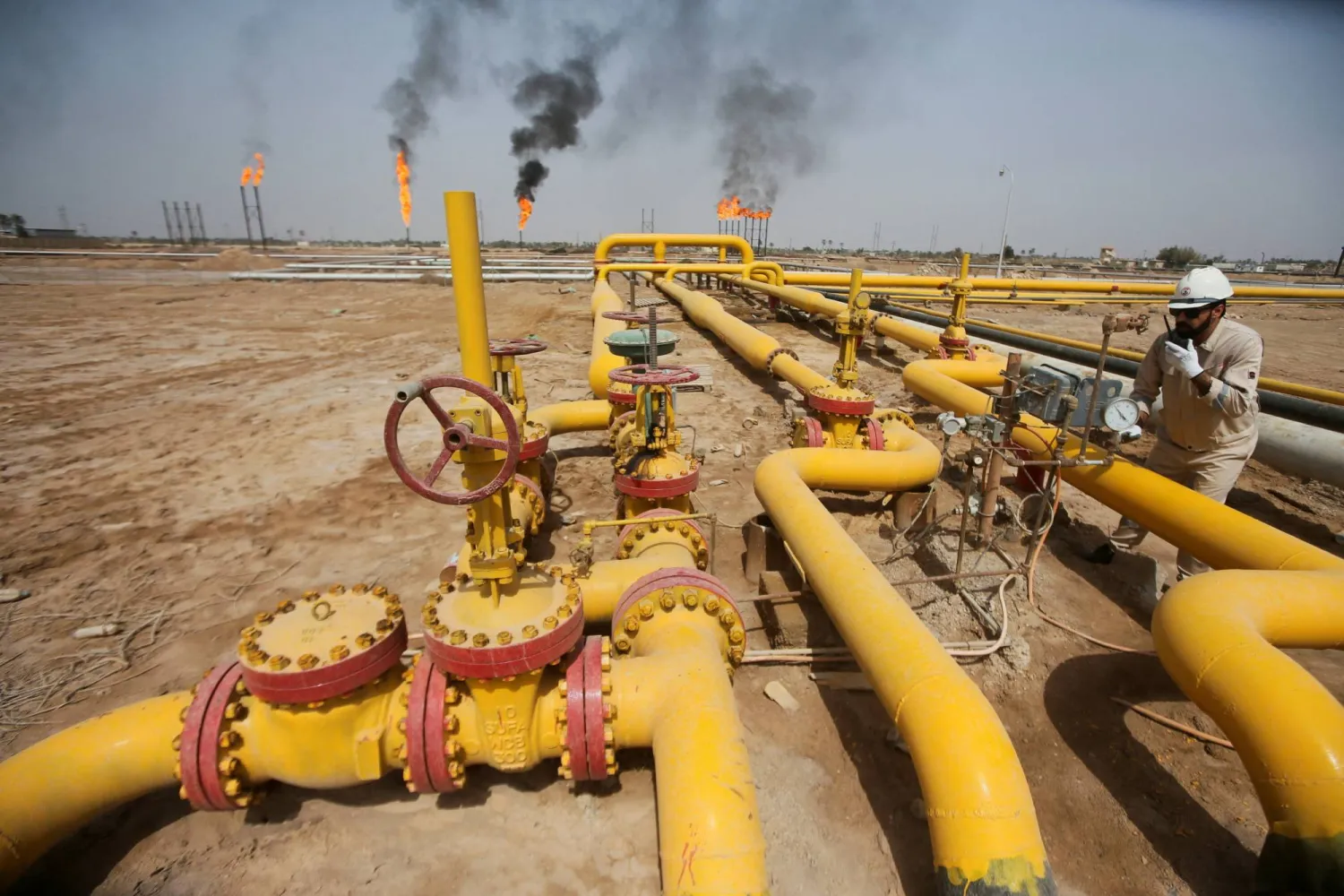
FILE PHOTO: A worker checks an oil pipeline at Nahr Bin Umar oil field, north of Basra, Iraq March 22, 2022. REUTERS/Essam Al-Sudani/File Photo
TT

Sources: New Syria-Iraq Crude Pipeline Still Years Away

FILE PHOTO: A worker checks an oil pipeline at Nahr Bin Umar oil field, north of Basra, Iraq March 22, 2022. REUTERS/Essam Al-Sudani/File Photo

Iraq's plans to export oil via a pipeline through Syria to avert future disruptions in the Strait of Hormuz will likely require four years of construction and cost at least $15 billion, sources with knowledge of the project told Reuters.

US officials and energy executives are billing the plan, which is receiving initial support for feasibility studies from a consortium including Chevron, as part of a strategy to reduce the industry's reliance on a waterway that has been largely shut by the Iran war.

"Over the next two years, the strait is going to become irrelevant. It is going to become just another body of water," US Treasury Secretary Scott Bessent said last week.

While a fifth of the world's oil and liquefied natural gas was shipped through Hormuz before the conflict, Bessent said "more than 50% or 70%" of those exports would instead be exported via underground pipelines.

But two sources directly involved in ‌the project told Reuters ‌the plans for the Iraq-Syria pipeline would take twice that long due to the need ‌for ⁠new infrastructure and ⁠could face other hurdles.

Both sources asked not to be named due to the sensitivity of the matter.

NEW INFRASTRUCTURE TO REPLACE EXISTING WAR-DAMAGED PIPELINE

Iraq has been among the countries most affected by the Hormuz shutdown.

It exported around 3.6 million barrels of oil per day before the war, mainly through Gulf terminals near Basra, but shipped just 35.5 million barrels in total via Hormuz in July, according to state-run oil firm SOMO.

A pipeline linking Iraq's northern Kirkuk region to Syria's Mediterranean port of Banias already exists but was badly damaged by wars in Iraq and Syria and has not been in regular use since the 1980s.

Both sources said the plan would require laying entirely ⁠new infrastructure rather than rehabilitating the existing pipeline and cost at least $15 billion.

While part of the ‌new pipeline would run largely along the same Kirkuk-Banias route, intact sections of ‌that pipeline are not compatible with newly developed specifications and would be unusable, one of the sources said.

The second source said the project ‌would include developing an entirely new integrated crude oil pipeline system that would link Iraq's southern and northern fields to a ‌central hub in Haditha in western Iraq, then onwards to Banias.

The US has welcomed the "rehabilitation and reconstruction" of the pipeline, saying it will have initial transport capacity of 2 million bpd of crude oil.

That would imply a major expansion of the old pipeline's capacity of about 300,000 bpd, which is less than a tenth of the oil volume Iraq exported through the Strait of Hormuz before the Iran war. Iraq has also ‌restarted oil exports from its Kirkuk fields via pipeline to Türkiye’s Ceyhan port with targeted capacity of around 250,000 bpd.

Both sources said work on the Iraq-Syria pipeline would take around ⁠four years, though one added ⁠that the timeline may also need to accommodate clearing old infrastructure and acquiring fresh land use rights from Syria's new administration.

ANOTHER POSSIBLE 'ACCESS TO MARKET' BUT STUDIES STILL NEEDED

Syria and Iraq have both signed separate memorandums of understanding with a consortium comprised of US major Chevron, TI Capital and Qatar's UCC Holding to carry out technical and financial studies in preparation for the project.

Iraq's oil ministry and state-owned Syrian Petroleum Company did not respond to Reuters requests for comment on the project and the sources' timeline and cost assessments. TI Capital and UCC Holding did not immediately respond to requests for comment. Chevron pointed to an earlier statement about the preliminary agreement and said it does not comment on details related to commercial matters.

During a press briefing last month, a Chevron executive said the project could offer "another access route to market" through the Mediterranean. The executive said any pipeline would also need to connect to Iraq's southern fields of West Qurna 2 and Nassiriya, which Chevron is in negotiations to enter.

Chevron still needs to complete technical studies to determine whether the existing Iraq-Syria pipeline would need refitting, expanding or rebuilding, the executive said.

The company has not yet given estimates of the project's future export capacity.

"Usually, as these pipelines go, it's not 100% capacity available on day one," the executive said.



Maersk, Hapag-Lloyd Resume Further Services Through Suez Canal

FILE PHOTO: Shipping containers sit on a Maersk vessel docked at the port of Los Angeles in Long Beach, California, US, March 10, 2026. REUTERS/Caroline Brehman/File Photo
TT

Maersk, Hapag-Lloyd Resume Further Services Through Suez Canal

FILE PHOTO: Shipping containers sit on a Maersk vessel docked at the port of Los Angeles in Long Beach, California, US, March 10, 2026. REUTERS/Caroline Brehman/File Photo

Shipping group Maersk said on Monday it will resume four further of its container services with Germany's Hapag-Lloyd through the Suez Canal, as they gradually ⁠return to using the ⁠shortcut between Asia and Europe.

The Asia-Europe trade corridor through the Suez Canal was abandoned ⁠by most shippers earlier this decade after attacks in the Red Sea by Yemen's Houthis, forcing ships to take the much longer trip around Africa's Cape of Good Hope.

The two ⁠companies ⁠in early July and later again in August announced that they would resume some services connecting Asia, the Mediterranean and Europe through the Suez Canal.


Goldman Sachs, JP Morgan Expect September Fed Hike as Inflation Lingers

Federal Reserve building in Washington (Reuters)
TT

Goldman Sachs, JP Morgan Expect September Fed Hike as Inflation Lingers

Federal Reserve building in Washington (Reuters)

Goldman Sachs and J.P. Morgan now expect the US Federal Reserve to raise interest rates this week after a string of stronger-than-expected inflation readings challenged hopes that price pressures would continue to ease without additional policy tightening.

The Wall Street banks joined a growing number of forecasters turning more hawkish after data last week showed ‌US consumer ‌and producer prices rose more than expected in August, ‌while ⁠oil prices climbed ⁠above $100 a barrel due to renewed hostilities in the Middle East, reported Reuters.

In a note on Friday, Goldman Sachs abandoned its previous call for rates to remain unchanged and now expects a 25-basis-point increase at the US Fed's September 15-16 meeting. J.P. Morgan, meanwhile, forecasts quarter-point hikes in both September and December.

The latest data have revived concerns that progress toward the Fed's ⁠2% inflation target could stall after months of moderation.

"We ‌think that the FOMC will be ‌reluctant to surprise," Goldman Sachs economist David Mericle said.

J.P. Morgan struck a similarly ‌hawkish tone following the inflation reports.

"The week that saw rising ‌bond yields and energy prices and a firm enough set of inflation readings to make a rate hike at next week's FOMC meeting more likely than not," J.P. Morgan economists led by Michael Feroli said in a note.

The outlook ‌for further Fed tightening will be in focus this week as policymakers conclude their meeting on Wednesday, ⁠while investors ⁠also watch the Bank of Japan for policy signals.

J.P. Morgan said the latest inflation data cast doubt on a sustained disinflation trend, leading it to forecast another Fed rate hike this year and raise its estimate of the long-run policy rate to 3.25%.

Markets are pricing in an 87% chance of a quarter-point Fed rate hike this month, up from about 70% before the latest inflation data, with another increase expected in December, according to CME's FedWatch Tool.

In a separate note on Sunday, Goldman Sachs said it still expects two Fed rate cuts in 2027, though later than previously forecast, as it sees this week's expected hike as driven more by market pricing than inflation fundamentals.


Saudi Arabia’s Dammam Airports Signs Design Contract to Develop King Fahd Int'l Airport

Dammam Airports CEO Eng. Mohammed Al-Hassany and President of WSP for the Middle East and Asia Dean McGrail seen at the signing of the agreement on Sunday. (X)
TT

Saudi Arabia’s Dammam Airports Signs Design Contract to Develop King Fahd Int'l Airport

Dammam Airports CEO Eng. Mohammed Al-Hassany and President of WSP for the Middle East and Asia Dean McGrail seen at the signing of the agreement on Sunday. (X)

Dammam Airports CEO Eng. Mohammed Al-Hassany and President of WSP for the Middle East and Asia Dean McGrail signed on Sunday a design contract to develop the King Fahd International Airport in accordance with the airport's approved master plan.

Al-Hassany said signing the contract marks a significant milestone in the development of King Fahd International Airport.

Dammam Airports is committed to upgrading airport facilities, increasing capacity, and delivering a seamless, high-quality travel experience through modern design solutions and smart technologies that meet travelers' needs and accommodate future growth in passenger and air cargo traffic, he stressed.

This will reinforce the airport's status as an international gateway connecting Eastern Region to the world, he added..

The project scope includes designing the expansion of passenger terminals, upgrading facilities, and improving airport entrances and access roads. It also includes developing baggage handling systems, digital services, and terminal wayfinding systems to streamline travel procedures and enhance passenger comfort.

The master plan aims to serve more than 19.3 million passengers annually by 2030, with capacity to be increased in phases to 32 million passengers per year to meet future travel demand.

It targets increasing air cargo capacity to more than 600,000 tons annually and aircraft operational capacity to 77 movements per hour, supported by comprehensive expansions of infrastructure, runways, and general aviation facilities.

The contract is part of Dammam Airports' ongoing efforts to develop the airport ecosystem, boost operational efficiency, and contribute to achieving the objectives of the Aviation Program and Saudi Vision 2030.