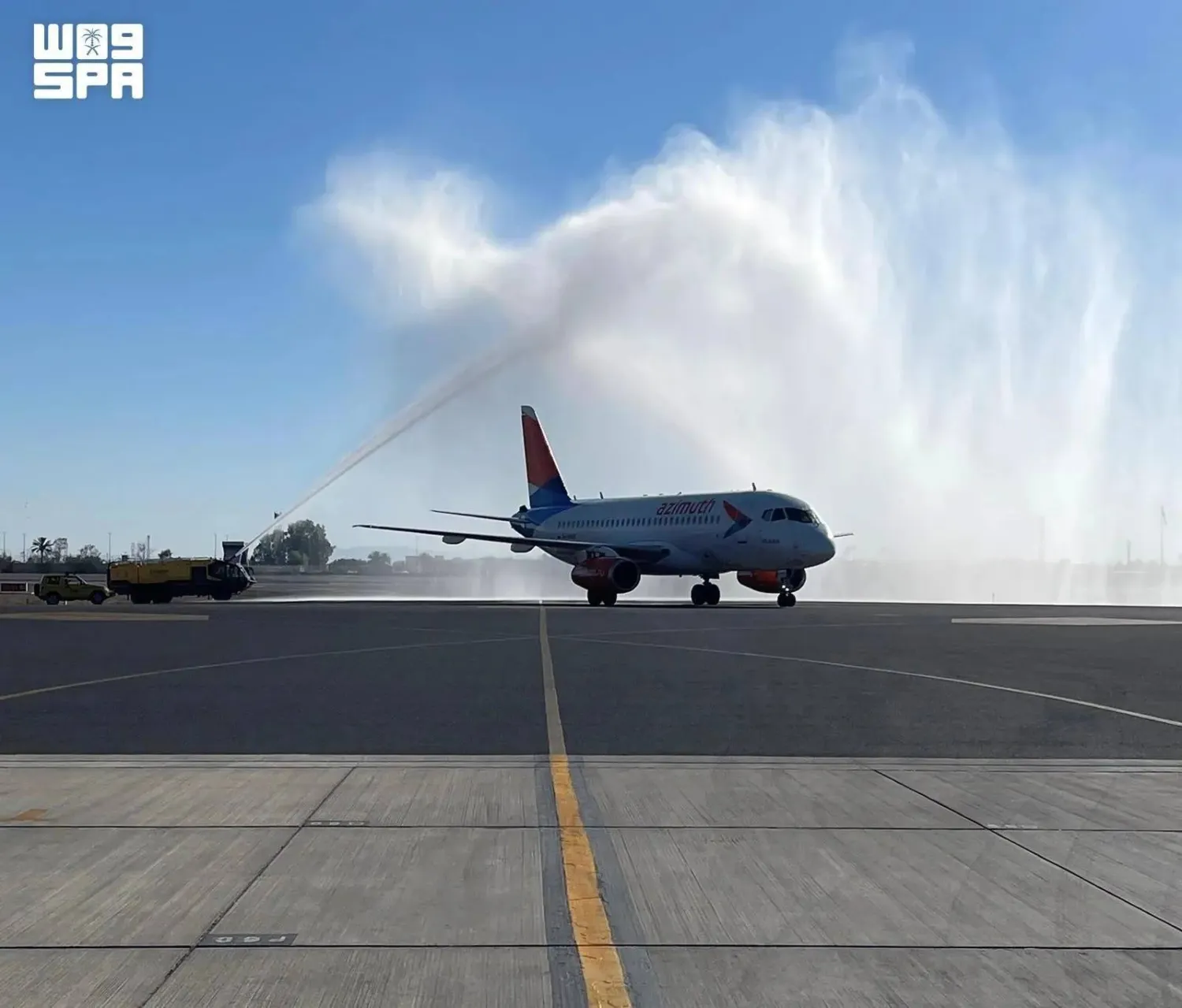
Prince Sultan bin Abdulaziz Int'l Airport Welcomes First Seasonal Direct Flight from Russia's Sochi

Prince Sultan bin Abdulaziz International Airport in Tabuk, operated by Cluster2 Airports, welcomed the first seasonal direct flight of 2026 from the Russian city of Sochi. (SPA)
TT

Prince Sultan bin Abdulaziz Int'l Airport Welcomes First Seasonal Direct Flight from Russia's Sochi

Prince Sultan bin Abdulaziz International Airport in Tabuk, operated by Cluster2 Airports, welcomed the first seasonal direct flight of 2026 from the Russian city of Sochi. (SPA)

Prince Sultan bin Abdulaziz International Airport in Tabuk, operated by Cluster2 Airports, welcomed the first seasonal direct flight of 2026 from the Russian city of Sochi, in cooperation with Azimuth Airlines, the Saudi Press Agency reported on Sunday.

The new seasonal route is part of Cluster2 Airports’ efforts to strengthen air connectivity and expand its network of destinations in collaboration with its partners. The initiative aims to meet growing travel demand while offering passengers greater choice through the introduction of new international destinations.

The direct Tabuk–Sochi service operates once a week.


Oil Drifts Down after OPEC+ Agrees to Raise Output Targets

FILE - Iraqi oil workers at an oil installation at Beiji in northern Iraq Tuesday, February 29, 2000. (AP Photo/Jassim Mohammed, File)
TT

Oil Drifts Down after OPEC+ Agrees to Raise Output Targets

FILE - Iraqi oil workers at an oil installation at Beiji in northern Iraq Tuesday, February 29, 2000. (AP Photo/Jassim Mohammed, File)

Oil prices inched lower on Monday after OPEC+ agreed to further increase its output targets from August while exports from key producers via the Strait of Hormuz are recovering, potentially adding to global supplies.

Brent crude futures fell 34 cents, or 0.47%, to $71.78 a barrel by 0408 GMT after settling 0.45% higher on Friday. US West Texas Intermediate crude was at $68.49 a barrel, down 20 cents, or 0.29%. There was no settlement for WTI on Friday as US markets were closed ahead of the Independence Day holiday on Saturday.

Both contracts were little changed last week, ⁠after mostly falling over ⁠the past few weeks, as investors kept a close eye on talks between the United States and Iran over the fate of shipping through the Strait of Hormuz while keeping tabs on the recovery in Gulf oil exports.

"Coming off the US long weekend, traders are sitting tight and waiting to see whether US-Iran relations will be cordial or volatile this week," said Tim Waterer, chief market analyst at ⁠KCM Trade.

The Organization of the Petroleum Exporting Countries and their allies including Russia agreed on Sunday to further increase output targets by 188,000 barrels per day from August, on top of similar increases for June and July.


Iraq Signs Deal with Oil Services Giant Halliburton

This picture shows the Nahr Bin Omar oil field and facility in Iraq's southern port city of Basra on June 14, 2024. (AFP)
TT

Iraq Signs Deal with Oil Services Giant Halliburton

This picture shows the Nahr Bin Omar oil field and facility in Iraq's southern port city of Basra on June 14, 2024. (AFP)

Iraq's government and US oil services giant Halliburton signed a deal Sunday to manage two oil fields in the country's south, as Baghdad looks to boost production.

The state-owned "Basra Oil Company has signed a joint management contract with the American company Halliburton for the Bin Omar and Sinbad oil fields" in Basra province, said the Iraqi oil ministry's media office.

Iraqi Oil Minister Bassem Khodeir said the deal with Halliburton aligns with the government's plans to "boost oil and gas production capacity".

He added that Iraq aims to boost oil output at the Bin Omar field by 150,000 barrels per day (bpd) within five years, along with 300 million cubic feet of associated gas.

Production at the Sinbad oil field should increase by 80,000 to 100,000 bpd.

Baghdad's new government led by Prime Minister Ali al-Zaidi has urged the OPEC oil cartel to increase Iraq's oil production quota, taking into account the damage done to its industry from past conflicts and the recent Middle East war.

Like other oil producers, Iraq, a founding member of OPEC, was greatly affected by the US-Iran conflict, as it is hugely dependent on oil exports, which make up about 90 percent of its budget revenues.

The new contract with Halliburton was signed prior to al-Zaidi's upcoming visit to Washington later this month.

Al-Zaidi, who only recently took office with the blessing of the United States, hopes to attract more US investment to Iraq, which urgently needs to revive its economy, especially after revenue losses caused by the halt of oil exports during the Middle East war.


OPEC+ Approves Further Oil Output Increase

The logo of the Organization of Petroleum Exporting Countries (OPEC) is seen at its headquarters in Vienna on June 3, 2023. (AFP)
TT

OPEC+ Approves Further Oil Output Increase

The logo of the Organization of Petroleum Exporting Countries (OPEC) is seen at its headquarters in Vienna on June 3, 2023. (AFP)

OPEC+ has agreed a further increase in output targets from August, the group said in a statement on Sunday, adding to global supply at a time when oil prices are falling due to the gradual reopening of the Strait of Hormuz for oil exports.

The oil-producing group agreed during an online meeting to increase quotas by 188,000 barrels per day from August, on top of similar increases for June and July.

The seven core members of OPEC+, which groups OPEC and allied producers including Russia, have hiked their output quotas from April through July by almost ‌800,000 bpd.

OPEC+ output fell to 33.13 million bpd in May, according to OPEC data, from 42.77 million bpd in February.

Despite persisting supply disruptions, oil prices have returned to pre-war levels, pressured by lower Chinese imports, higher exports from ⁠non-Middle East producers, and a record global strategic stock release coordinated by ‌the International Energy Agency.

"The group of seven kept unwinding their ‌production cuts as widely expected," UBS analyst Giovanni Staunovo said. "The near-term focus will remain on how many tankers will ‌manage to cross the Strait of Hormuz and how quickly demand and Chinese crude imports recover."

A ‌memorandum of understanding between Washington and Tehran to end the war has also helped convince traders that supply will ultimately return to normal levels.

Brent crude prices traded near $72 per barrel on Friday, down from recent peaks of more than $120 per barrel and back to levels traded just before the US ‌and Israel attacked Iran on February 28.

Those seven producers — Saudi Arabia, Russia, Iraq, Kuwait, Algeria, Kazakhstan and Oman — are boosting output as part of the phased rollback of a 1.65 million bpd supply cut agreed in 2023, when the group still included the UAE.