


US Hits Canadian Goods with 50% Tariffs After Trade Talks Fail

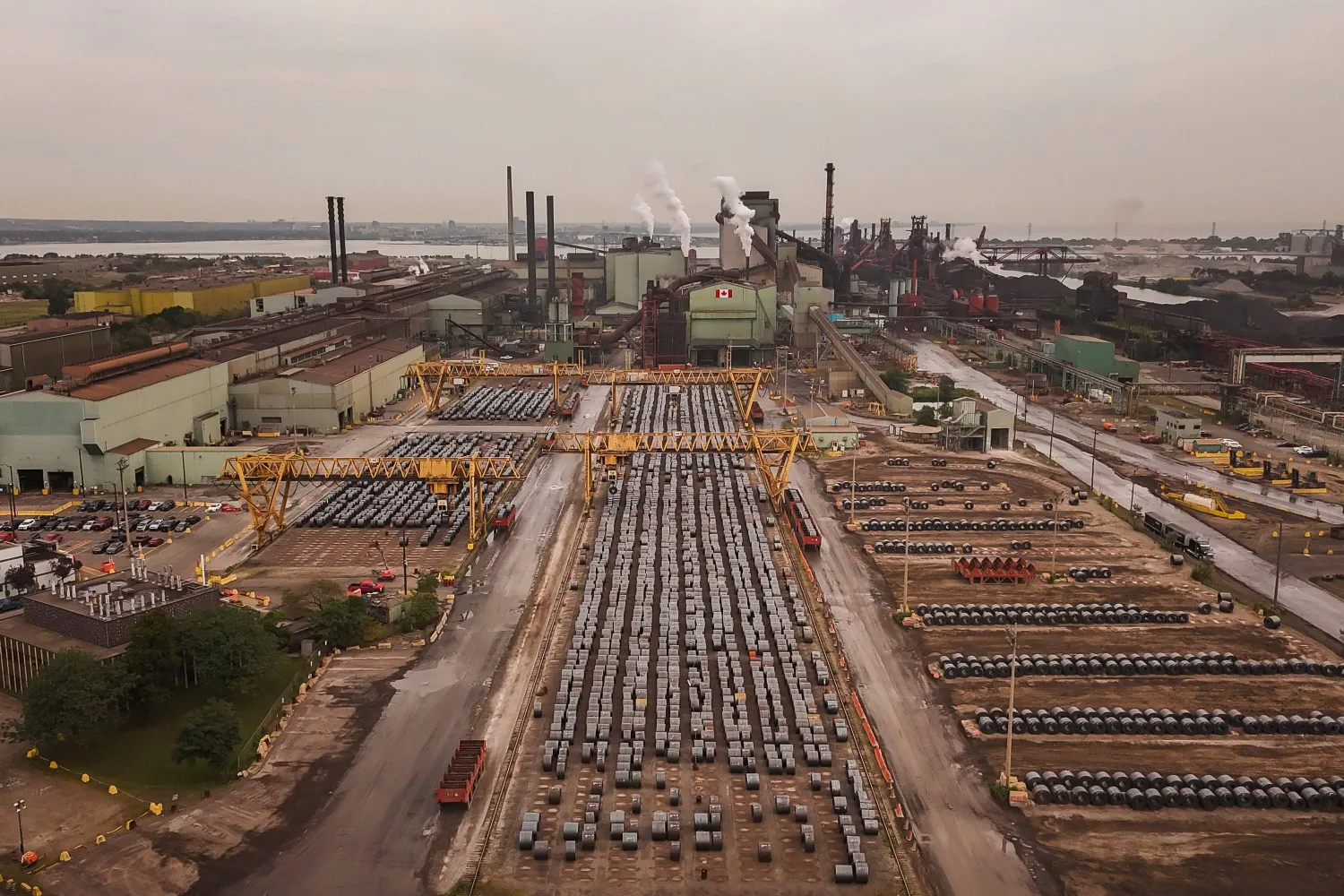
 Rolled coils of steel sit in the yard at the ArcelorMittal Dofasco steel plant in Hamilton, Ont. on Thursday, Aug. 20, 2026. (Nick Iwanyshyn /The Canadian Press via AP)
Rolled coils of steel sit in the yard at the ArcelorMittal Dofasco steel plant in Hamilton, Ont. on Thursday, Aug. 20, 2026. (Nick Iwanyshyn /The Canadian Press via AP)
TT

US Hits Canadian Goods with 50% Tariffs After Trade Talks Fail

 Rolled coils of steel sit in the yard at the ArcelorMittal Dofasco steel plant in Hamilton, Ont. on Thursday, Aug. 20, 2026. (Nick Iwanyshyn /The Canadian Press via AP)
Rolled coils of steel sit in the yard at the ArcelorMittal Dofasco steel plant in Hamilton, Ont. on Thursday, Aug. 20, 2026. (Nick Iwanyshyn /The Canadian Press via AP)

The US imposed 50% tariffs on some Canadian goods on Saturday after the two longstanding allies failed to reach a trade deal, with each side accusing the other of derailing days of talks.

The tariffs that came into effect just after midnight (0400 GMT) on some $20 billion of Canadian goods - things like wooden ice hockey sticks that are rarely used anymore - are far from an economic game-changer for the largest US trading partner after Mexico.

That represents just over 5% of Canada's exports to the US. But the new ‌tariffs mark an ‌increase in tensions between President Donald Trump and Prime Minister Mark ‌Carney, ⁠and will likely make broader ⁠talks to renew the US-Mexico-Canada free trade agreement more difficult.

Carney said he had suspended trade negotiations and Canada would retaliate "dollar for dollar" on the new tariffs.

"I have decided to suspend trade negotiations with the US and have directed Canada’s negotiators to return to Ottawa," Carney said in a statement.

"They (negotiators) have worked hard, in good faith, to defend the interests of Canadians throughout these negotiations up until the very last minute," he said. "However, last-minute changes in the US proposed terms were unfair, uneconomic, and called into question ⁠the reliability of any deal."

Carney, the only person to ever run ‌the central banks of two major economies, was elected last ‌year on promises to stand up to Trump and remains broadly popular. Polls show most Canadians oppose making ‌any concessions to Trump.

Hours earlier, the two sides had seemed close to an agreement that ‌sources said would have lowered tariffs on steel, aluminum and autos.

"Tonight, Canada declined to finalize the trade deal under the terms agreed earlier this week," US Trade Representative Jamieson Greer said during a White House briefing.

"This is a missed opportunity for Canada to partner with ‌the United States, which is the fastest-growing economy in the G7," Greer said.

A senior Trump administration official said the US offer would have put ⁠Canada in the best ⁠tariff position of any major exporter to the US, but that Canada had sought additional concessions, especially on steel, aluminum, autos and softwood lumber.

No additional talks are scheduled as the US implements the new duties, the official said.

Trump last month threatened to impose a raft of duties on a range of Canadian imports including furniture, dairy products, cement, clothing, fishing rods, hockey equipment.

The tariffs, which do not qualify for preferential treatment under the US-Mexico-Canada free-trade agreement, open up some already vulnerable sectors to potential severe damage that could lead to job losses and business closures, trade experts have said.

The decision by the US administration followed three days of talks in Washington between Canada's minister for trade with the US, Dominic LeBlanc, and Greer.

The new duties add to existing US tariffs on steel, lumber and autos which have taken major hit in the last 18 months, although the malaise has been largely contained within these sectors.



Brazil’s Lula Urges Tariffs Resolution in Call with Trump

Brazil's President Luiz Inacio Lula da Silva speaks during a campaign rally at Praca da Estacao in Belo Horizonte, Minas Gerais state, Brazil on August 21, 2026. (AFP)
TT

Brazil’s Lula Urges Tariffs Resolution in Call with Trump

Brazil's President Luiz Inacio Lula da Silva speaks during a campaign rally at Praca da Estacao in Belo Horizonte, Minas Gerais state, Brazil on August 21, 2026. (AFP)

Brazilian President Luiz Inacio Lula da Silva urged US counterpart Donald Trump in a phone call Friday to resolve their countries' trade dispute, saying US tariffs were imposed on "baseless" grounds.

Washington imposed two new sets of tariffs on the Latin American giant in July, a move that has become a key campaign issue ahead of Brazil's presidential election in October.

Lula -- seeking a fourth and final term -- told Trump that the tariffs "negatively affect both Brazil and the United States," according to a statement from his office.

"To remain at the negotiating table is the best option for both countries," he said.

Relations between Trump and the leftist Lula have blown hot and cold in recent months, but diplomatic tensions have flared as the election approaches.

Trump has backed several victorious right-wing candidates in recent Latin American elections. He is an ally of Brazil's jailed far-right former president Jair Bolsonaro, whose son Flavio is Lula's main election rival.

The Brazilian presidency statement said the conversation between Trump and Lula lasted an hour and 20 minutes and "took place in a friendly and cordial tone."

During a campaign event in the southeastern state of Minas Gerais, Lula said Trump asked Commerce Secretary Howard Lutnick to contact his Brazilian counterpart Marcio Elias Rosa "and they already scheduled a meeting."

He added that Trump acknowledged during their call that the tariffs on Brazil are "based on a lie."

Lula, who like Trump is 80, has made national sovereignty a key theme of his campaign.

In an interview last week, he warned Trump: "Don't meddle in Brazil's affairs, especially regarding the election. If you do meddle, you'll lose."

"I said, 'Hey Trump, if you want to fight organized crime, let's fight organized crime,'" Lula told the crowd in Minas Gerais. "We want to work together. What we don't want is interference in Brazil."

- 'Daily terror'-

The two leaders have often appeared to get on well one-on-one, with Trump last year hailing an "excellent chemistry" with Lula.

The US last year dropped punitive tariffs it imposed over the trial against Jair Bolsonaro, which Trump labelled a "witch hunt," after diplomatic efforts by Lula's government.

However, Lula then suffered a blow after a May visit to the White House by Flavio Bolsonaro.

Two days later, the US designated Brazil's two largest drug cartels as terrorist organizations, which Flavio has said was a personal request.

"These criminal groups inflict daily terror on the most vulnerable populations, but they are not the same as terrorist organizations," Lula told Trump.

Security is the main concern of Brazilians heading into this year's elections, polls have shown.

Flavio Bolsonaro is pushing for a tough-on-crime model like that of El Salvador's President Nayib Bukele, whose sweeping crackdown on gangs and mass detentions have drawn controversy.

- Deforestation and PIX -

The United States imposed a 25-percent tariff on a range of Brazilian goods over policies it argued harm US commerce, such as deforestation and a free electronic payments system known as PIX.

Brazilian data shows deforestation in the Amazon fell last year to its lowest point since 2016.

Brazil was also impacted under a separate global tariff regime against US trading partners accused of using forced labor.

Lula has repeatedly said he believes it was US Secretary of State Marco Rubio and not Trump who was behind the tariffs against Brazil.

"Trump is the best of the lot, and the one who talks most seriously with me," he said last week.


Arctic Shipping a Daunting Prospect in Hotly Contested Region

This handout photo taken and released on August 15, 2026 by the Ningbo Zhoushan Port Group shows the "Dubai Tower" container ship, operated by Chinese shipowner Sea Legend, setting sail from the port of Ningbo headed to the port of Felixstow, England. (Handout / Ningbo Zhoushan Port Group / AFP)
TT

Arctic Shipping a Daunting Prospect in Hotly Contested Region

This handout photo taken and released on August 15, 2026 by the Ningbo Zhoushan Port Group shows the "Dubai Tower" container ship, operated by Chinese shipowner Sea Legend, setting sail from the port of Ningbo headed to the port of Felixstow, England. (Handout / Ningbo Zhoushan Port Group / AFP)

With Middle East turmoil slashing Suez Canal traffic, shipping firms are tempted to try the Arctic for quicker trips between Europe and Asia -- but commercial prospects are unlikely to match countries' strategic ambitions for the North Pole.

Container ships from China and South Korea aim to transit the Northern Sea Route in Russian territorial waters in the coming weeks, testing its viability as climate change keeps the passage free of ice longer each year.

Industry experts remain skeptical, saying that even if more vessels start going through, the bulk of global shipping will remain along established lines for the foreseeable future.

- Shorter, cheaper, harder -

Houthi militants in Yemen have disrupted traffic through the Bab el-Mandeb Strait by attacking vessels heading to and from the Suez Canal.

Many operators now avoid the passage and send ships instead around South Africa's Cape of Good Hope, vastly prolonging the journey between Asia and Europe and driving up fuel costs and emissions.

By contrast, the Northern Sea Route (NSR) could cut the distance by 30 to 40 percent compared to using the Suez Canal, and by nearly half from going around the southern tip of Africa, the credit insurance group Coface said in April.

But what looks good on spreadsheets ignores daunting constraints.

"The Arctic link can only be seasonal, from August to October," said Paul Tourret, director of the Higher Institute of Maritime Economics (ISEMAR) in Saint-Nazaire, France.

"And you need ice-class ships, which cost more," he told AFP.

That rules out Supramax and other hulking container ships that make up a major share of global traffic, since they can offer hugely competitive rates.

By contrast, the capacity of the Chinese container ship "Dubai Tower" that embarked on the NSR from Ningbo to Europe this month, is one-tenth the size, said Jerome de Ricqles, a sea freight specialist at Upply, a French-based transport management firm.

- Real but limited potential -

Most container ships using the NSR need to be escorted by Russia's fleet of nuclear-powered icebreakers.

Last year, a record 23 vessels made the passage, up from 15 in 2024, according to a recent study by insurance group Allianz Commercial.

That's fewer than the number using the Suez Canal each day.

Even with conflicts in the Middle East, some 35 ships a day transited the Egyptian canal in the first half of this year, down from more than 50 a day before the Houthis started their attacks in 2023.

The northern route is "a temporary and minuscule solution with regards to the overall needs", De Ricqles said.

According to Coface, just 3.5 percent of the current traffic between East Asia, northern Europe and North America could actually shift to Arctic routes.

Looking out to 2030, viability "remains extremely limited and mainly only concerns raw materials", Eve Barre, an economist who piloted the Coface study, said in a statement.

Even so, the NSR could attract bulk liquid vessels carrying oil and liquefied natural gas, who could see their costs slashed by 45 to 50 percent in some cases, the study found.

Dry bulk ships might also start using it, especially if they can operate with icebreaker escorts.

But the prospect also carries environmental risks if increased traffic accelerates Arctic melting, with soot emissions that settle on the ice cap trapping heat from sunlight.

Fuel spills are also a concern, and several big Western shipping firms including France's CMA-CGM, Switzerland's MSC and Germany's Hapag-Lloyd have already pledged they will not use the Northern Sea Route.

All in all, the route "isn't likely to upend the major balances of global trade", Barre said, noting that the interest in Arctic shipping "is less commercial than political" at a time of tense rivalries between Russia, China and the United States.

Tourret at the French marine institute agreed, calling the trips by the Chinese and South Korean vessels a sideshow.

"One swallow does not a summer make, and one Chinese container ship doesn't create a Polar Silk Road," he said, referring to Beijing's Belt and Road Initiative aiming to knit together a trading network between Asia, Europe and Africa.


Trump Announces Temporary Tariff Relief on Ground Beef Imports

Beef cows gather at the Diamond J Angus Ranch, March 31, 2026 near Mandan, N.D. (AP)
TT

Trump Announces Temporary Tariff Relief on Ground Beef Imports

Beef cows gather at the Diamond J Angus Ranch, March 31, 2026 near Mandan, N.D. (AP)

President Donald Trump announced Friday that the United States would temporarily allow a greater volume of foreign beef imports, in his latest bid to lower costs for American consumers as midterm elections approach.

The US cattle herd has shrunk to its smallest size since the 1950s -- in part due to drought and international competition -- with the diminishing numbers pushing beef product prices higher.

"As we work to rebuild this herd and help our ranchers, for the next 90 days, the United States will allow up to 300,000 metric tons of product for ground beef to be imported with no out of quota tariff," Trump wrote on his Truth Social platform.

The US president did not say which countries would be exporting the beef but added there was a commitment to sell it at 25 percent below market prices.

Steeper beef prices have become a symbol of high living costs in the world's biggest economy, pressing the Trump administration to take steps to bring costs down.

Affordability will be a key issue in November's midterm elections, where Democrats are seeking to wrest control of both houses of Congress from Trump's Republicans.

- 'Disappointed' -

US cattle and rancher groups have been resistant to importing more beef. Responding to the move, Senator Deb Fischer of Nebraska, a major beef-producing state, said she was "extremely disappointed."

"We all want lower grocery prices, but as I've said for months, we cannot do it at the expense of American producers. Flooding the market with foreign beef hurts our livestock industry," said Fischer, a Republican.

The National Cattlemen's Beef Association, a trade group, was similarly downbeat.

"Flooding the market with government-subsidized, below-market beef is not the way to rebuild the American cattle herd," CEO Colin Woodall said. "Today's announcement and other market interventions throw cold water on the prospect of herd expansion and sacrifices long-term stability for short-term messaging."

Responding to the criticism later in the day, Trump offered no details on how the plan would work but insisted he would get beef prices down because "that's what the voters want, and that's what I want."

Last fall, Trump demanded ranchers slash their prices, and he later moved to expand imports of beef trimmings from Argentina to cool ground beef prices.

He has also launched an investigation into the meatpacking industry over the high prices of red meat.

His latest effort comes as American households struggle with stubborn inflation, fueled by an energy crisis linked to the war on Iran.

Trump launched the war alongside ally Israel in late February, with Tehran's retaliatory action virtually blocking the Strait of Hormuz, a vital energy and fertilizer supply route.

This has pushed up fuel, transportation and food costs.

Despite higher beef prices, US consumer demand for meat remains robust.

The US Department of Agriculture estimates total beef consumption this year will hit 29.4 billion pounds, an uptick from 2025.

The American Farm Bureau Federation warned in May, however, that Americans are consuming more beef than US farmers and ranchers can supply.

It added that ranchers need to rebuild the US cattle herd -- or demand would have to cool -- in order for beef prices to fall.

Yet "cattle producers still face substantial uncertainty that clouds herd rebuilding decisions," wrote Bernt Nelson, an economist at the federation.

These include threats to animal health, including the New World screwworm, a flesh-eating parasite.