


Real Estate Authority to Asharq Al-Awsat: Strong Interest from International Investors in Saudi Market

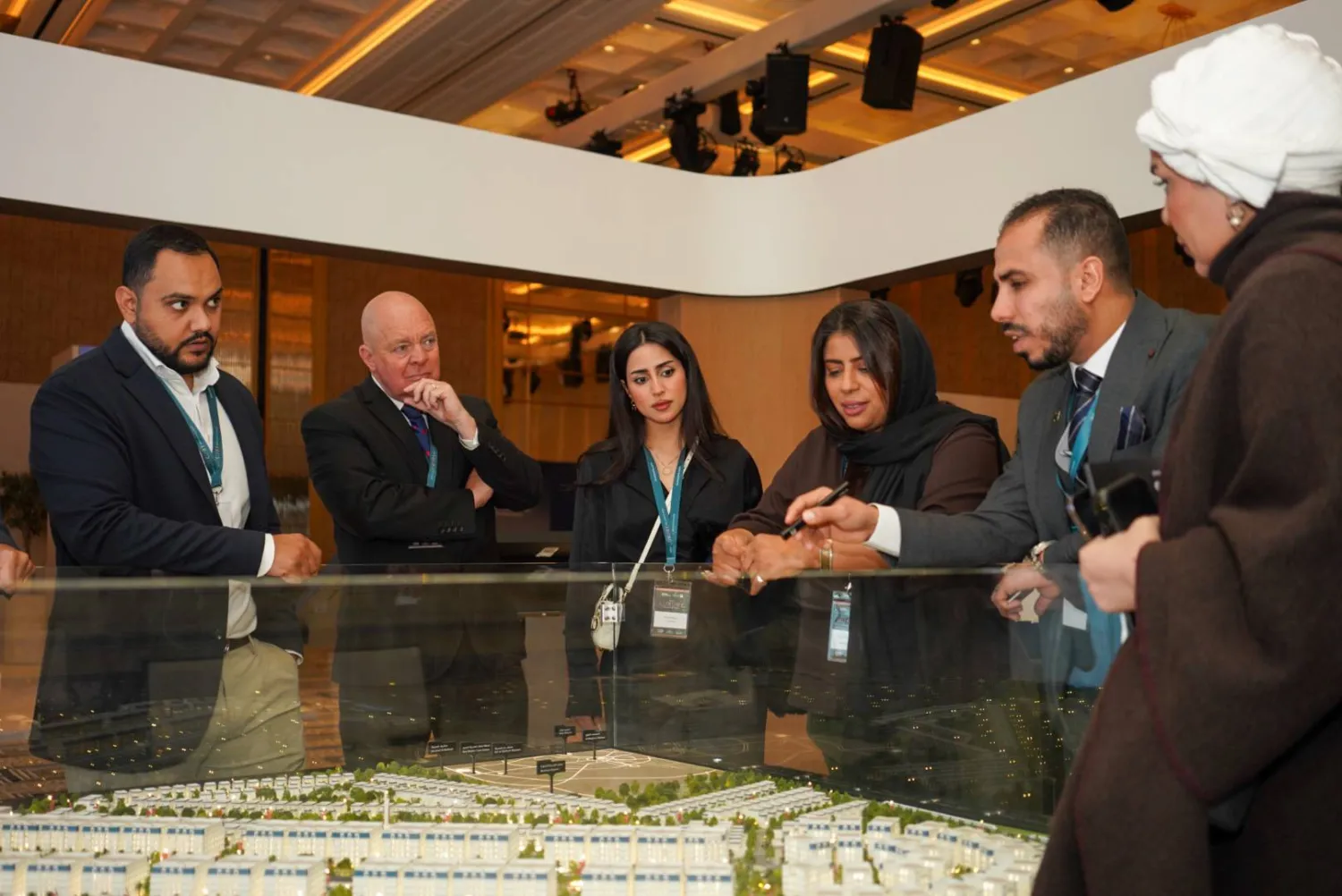
Participants at the Saudi Luxury Real Estate Exhibition in London listen to a presentation on one of the projects (Asharq Al-Awsat)
TT

Real Estate Authority to Asharq Al-Awsat: Strong Interest from International Investors in Saudi Market

Participants at the Saudi Luxury Real Estate Exhibition in London listen to a presentation on one of the projects (Asharq Al-Awsat)

Saudi Arabia's real estate market is entering a new phase of openness to international capital, driven by new regulations governing non-Saudi ownership of property and defining the geographic areas where such ownership is permitted. The move reinforces the Kingdom's efforts to establish itself as a global destination for real estate investment, amid growing interest from international investors and investment funds.

Government entities and a number of real estate development companies are seeking to attract investors to the Saudi market through participation in the inaugural Saudi Luxury Real Estate Exhibition, in strategic partnership with the General Real Estate Authority. The event brings together a number of Saudi real estate developers, along with investors, family offices and industry specialists from Britain and international markets.

Taiseer bin Mohammed Al-Mufarrej, official spokesman for the General Real Estate Authority, said the authority's participation in the Saudi Luxury Real Estate Exhibition reflects its role in raising awareness of the Kingdom's new real estate regulatory framework, particularly the recently approved system governing non-Saudi ownership of property, as well as informing investors about the geographic areas designated for ownership.

Al-Mufarrej told Asharq Al-Awsat that the authority's presence at the exhibition goes beyond explaining the new regulations to include direct engagement with investors, answering their questions and clarifying the process for beneficiaries, whether they are buyers, investors or real estate brokers, through to the completion of transactions related to non-Saudi ownership.

He noted that the Saudi Properties platform serves as a key channel for real estate transactions covered by the new system. The authority is using its participation to familiarize investors with the "customer journey" and the mechanisms for using the platform, providing a clearer picture for those seeking to enter the Saudi market and capitalize on the opportunities available.

International Funds Show Interest

The authority's participation was not limited to its exhibition booth. Alongside the event, it organized a series of workshops, panel sessions and roundtables aimed directly at investors, in cooperation with a number of Saudi government entities and private-sector institutions.

Al-Mufarrej revealed that a roundtable was held specifically for international investment funds, with participation from the Saudi-British Business Council. The initiative reflects growing interest in attracting institutional capital to Saudi Arabia's real estate sector, while broadening the investor base targeted by the new regulations.

He said the meetings provided an opportunity for direct dialogue with investors and for hearing their questions about ownership mechanisms, available opportunities and the nature of the market, at a time when the sector's regulatory environment is undergoing changes aimed at enhancing transparency and making the market more attractive to investors both inside and outside the Kingdom.

Riyadh and Jeddah... Makkah and Madinah

According to Al-Mufarrej, the authority's participation demonstrated a high level of interest in the system governing non-Saudi property ownership, from both investors and exhibition visitors seeking real estate in the Kingdom.

He noted that interest is not limited to Riyadh and Jeddah, but also extends to Makkah and Madinah, which are attracting particular attention because of their religious significance and the distinctive nature of real estate demand in the two cities.

"We have seen a very significant impact in raising awareness among investors, visitors and even those looking for property in the Kingdom," he said, noting that inquiries covered the country's major cities, foremost among them Riyadh and Jeddah, as well as Makkah and Madinah.

These developments take on added significance as Saudi Arabia seeks to increase the real estate sector's contribution to the economy and diversify investment channels, alongside major projects, urban expansion and the population and economic growth taking place across the Kingdom's cities.

A "Global Destination for Real Estate Investment"

Al-Mufarrej described attendance at the exhibition as strong, pointing to a notable presence of investors, media outlets and influencers. He viewed this as evidence of the changing perception of the Saudi real estate market among overseas investors.

He said the response to the exhibition "clearly demonstrates that the Kingdom of Saudi Arabia has become a destination for real estate investment in the world," pointing to strong demand among investors and prospective property buyers, whether for investment, ownership or residential purposes.

International interest in the sector comes as Saudi Arabia's real estate market undergoes a broad restructuring of its regulatory and investment framework. The focus is shifting from simply offering real estate opportunities to building a more transparent and accessible environment for investors, beginning with clarity over the areas where ownership is permitted and extending to the procedures and platforms through which investment transactions are conducted.

Al-Mufarrej said the timing of the exhibition coincided with these transformations, making it a platform for raising awareness of the new regulations and engaging directly with investors. He described the event as having come "at a very appropriate time" and contributing to greater awareness of the Kingdom's ownership system.

The growing presence of international investors reflects a broader shift in the Saudi market. Real estate opportunities are no longer driven solely by domestic demand. The Kingdom is increasingly positioning its property sector as a channel for attracting international investment, leveraging regulatory reforms, major projects and the transformation of Saudi cities under the objectives of Saudi Vision 2030.



Italian Official to Asharq Al-Awsat: We Will Work with Saudi Arabia to Enter Third Markets

Signing of a cooperation agreement between the Federation of Saudi Chambers and Italy's national promotional and development institution (X)
TT

Italian Official to Asharq Al-Awsat: We Will Work with Saudi Arabia to Enter Third Markets

Signing of a cooperation agreement between the Federation of Saudi Chambers and Italy's national promotional and development institution (X)

Riyadh and Rome are moving their economic relations toward a more practical track, with plans for joint cooperation in third markets, alongside expanding channels of cooperation between Saudi and Italian companies, particularly small and medium-sized enterprises.

The move comes as Italy's national promotional institution, Cassa Depositi e Prestiti (CDP), signed two agreements in Riyadh, one with Saudi Arabia's National Development Fund and another with the Federation of Saudi Chambers, aimed at expanding financing and investment cooperation and facilitating companies' access to opportunities in both countries.

A senior Italian official told Asharq Al-Awsat that cooperation between Riyadh and Rome is not limited to the Saudi and Italian markets, but also extends to working together in "third markets." He noted that Saudi Arabia's economic diversification offers broad opportunities for Italian companies, given Italy's diverse industrial base and expertise across multiple sectors.

On Wednesday, the Federation of Saudi Chambers and CDP signed an agreement in Riyadh aimed at activating the Saudi-Italian strategic partnership launched in AlUla, opening financing channels for joint projects, integrating small and medium-sized enterprises into cooperation between the two countries, and strengthening the federation's role as the institutional representative of the Saudi private sector in cooperation with its Italian counterpart.

The agreement provides a practical framework for strengthening partnerships between the business sectors of the two countries by supporting a business-matching platform that connects Saudi companies with their Italian counterparts, introducing projects and investment opportunities, and establishing communication channels to help Italian companies explore the Saudi market and facilitate their entry.

CDP is part of the Saudi-Italian strategic partnership launched in AlUla, while the agreement enables the Federation of Saudi Chambers and its Saudi-Italian Business Council to play a greater role in advancing private-sector cooperation between the two countries and turning partnership opportunities into joint projects and business ventures.

Joint Strategic Cooperation

Dario Scannapieco, President of CDP (Cassa Depositi e Prestiti), told Asharq Al-Awsat that cooperation between Italy and Saudi Arabia "is not limited to bringing the two countries closer together or working within the Saudi market, but also includes cooperation in other countries and third markets."

He explained that the Italian delegation's visit to Riyadh has several objectives, foremost among them meeting with investors and strengthening cooperation with Saudi institutions. He said the meeting with the National Development Fund was "very fruitful" and had paved the way for excellent cooperation with it in many fields.

He added that the agreement signed with the Federation of Saudi Chambers represents "a further step" toward moving from institutional cooperation to more operational cooperation, with the aim of helping Italian SMEs that want to explore the possibility of entering Saudi Arabia, providing them with direct contacts and facilitating their access to the market.

"We are launching and revamping a platform that will put Italian SMEs in contact with Saudi SMEs. So business opportunities may develop from this new opportunity. This is another signal that Italy and Saudi Arabia must cooperate more," Scannapieco said.

He noted that there are many opportunities for cooperation between Italy and Saudi Arabia through Cassa Depositi e Prestiti, Italy's national promotional institution, adding that CDP is working to foster this cooperation and expand its scope.

Regarding the agreement's details, Scannapieco said its first objective is to support and expand the business-matching platform, which will connect Saudi SMEs with Italian SMEs and help them identify potential partners.

"The second is the idea to work on selected projects here in Saudi Arabia and allow Italian companies to know about these projects. The Expo is one of this kind where clearly Italian projects may be involved," he said.

"The third is to create a contact point between these two organizations, so to iron out all the doubts and to clearly push developing this relationship." He explained that when an Italian company wants to enter the Saudi market, it needs support in obtaining authorizations and handling other requirements.

"So it's very concrete, goes in the direction to make easier the access to Saudi Arabia for Italian companies," he said.

On the extent to which the strategic relationship between the two countries can help address challenges that may arise in the region, Scannapieco said Italy has "a very diversified industrial base" and produces a wide range of products.

"We are the third most diversified industry after China and the United States," he said.

This diversity, he added, enables Italian companies to provide specialized technical expertise and become useful partners in efforts to diversify the Saudi economy. "We could be extremely valuable partners."

He said the next phase requires bringing the Italian business sector's presence in Saudi Arabia to a broader level. Many large companies are already present in the Kingdom, he noted, but "now is the time to also give the opportunity to SMEs to internationalize in this region," thereby expanding the base of economic cooperation between the two countries.

Saudi-Italian Partnership Moves Toward Implementation

Kamel Al-Munajjed, Chairman of the Saudi-Italian Business Council, told Asharq Al-Awsat that the agreement is a direct extension of the meeting held in AlUla in January 2025 between Crown Prince and Prime Minister Mohammed bin Salman and Italian Prime Minister Giorgia Meloni, which elevated relations between the two countries to the level of a strategic partnership and made economic relations one of its main pillars.

He added that the agreement signed Wednesday between CDP and the Federation of Saudi Chambers represents a practical step toward strengthening cooperation between the business sectors of the two countries and provides a new channel for turning existing relations into commercial and investment partnerships and projects.

Al-Munajjed said the agreement strengthens the partnerships built by the Saudi-Italian Business Council with Confindustria and CNA through delegations, forums, and direct business meetings. He noted that CDP's capabilities and the scope of the Federation of Saudi Chambers' work would help turn these links into more sustained business opportunities.

He said the agreement offers two main advantages. The first is CDP's business-matching platform, which allows Saudi and Italian companies to enter information about their capabilities and business interests and then identify potential partners whose needs match those capabilities.

The platform can shorten the path for companies seeking suitable partners. A Saudi industrial company looking for Italian technology, for example, can identify companies capable of meeting its needs, while an Italian company seeking to enter the Saudi market can search for a local partner. The federation and the business council will work to encourage companies to use the platform and follow up on cooperation opportunities that emerge through it.

The second advantage, Al-Munajjed said, is strengthening cooperation with SIMEST, a subsidiary of the CDP Group. Its presence in Riyadh and support for the international expansion of Italian companies could help more companies, particularly SMEs, establish and expand their businesses in Saudi Arabia.

He added that the joint channel provided by the agreement will enable Saudi companies seeking to trade, invest, or operate in Italy to reach suitable Italian partners and identify new opportunities. He called on the Saudi business community to take advantage of the partnership and work to turn it into sustainable projects and shared growth opportunities.

Al-Munajjed said Italian companies have specialized expertise in engineering, technology, and manufacturing, while Saudi companies provide knowledge of the local market and the ability to expand. Opportunities for cooperation extend to trade, infrastructure, telecommunications, industry, energy, tourism, and other sectors.

He added that Expo 2030 Riyadh represents an important opportunity to bring these capabilities together and open new areas for companies in both countries. He stressed that the priority now is to move to implementation by bringing companies onto the platform, identifying priority sectors, establishing clear points of contact, and following promising opportunities through to actual projects.


Oil Prices Rise 2% as China Suspends Fuel Exports

The Klesch oil refinery, formerly BP, produces petrol, diesel, and jet fuel in Gelsenkirchen, Germany, one day before the German government starts a fuel tax discount, Wednesday, Sept. 30, 2026. (AP Photo/Martin Meissner)
TT

Oil Prices Rise 2% as China Suspends Fuel Exports

The Klesch oil refinery, formerly BP, produces petrol, diesel, and jet fuel in Gelsenkirchen, Germany, one day before the German government starts a fuel tax discount, Wednesday, Sept. 30, 2026. (AP Photo/Martin Meissner)

Oil prices rose around 2% on Thursday after China suspended oil products exports, potentially tightening fuel markets already coping with supply shortages globally, while investors continued to assess renewed diplomatic efforts to end the US-Iran war.

The new front-month December Brent crude futures contract traded at $100.09 per barrel at 0829 GMT, up 2.1%, or $2.06, from Wednesday's close, Reuters reported.

The November contract expired on Wednesday, settling at $103.50 per barrel, marking a monthly gain of around 14% in September for the front-month contract.

US West Texas ⁠Intermediate crude was ⁠up $2.06, or 2.28%, to $92.48 a barrel.

Prices were volatile on Thursday, having slipped more than 1% in early trading, before rebounding.

Chinese refiners have suspended exports of oil products to regions beyond Hong Kong and Macau until further notice, four people briefed on the matter said on Thursday, a move that will further crimp war-constrained fuel markets.

"The Chinese export ban suggests concerns about domestic product availability," UBS analyst Giovanni Staunovo said, adding that it remains to ⁠be seen whether the measures will support higher crude imports after recent drawdowns in Chinese crude and fuel stocks.

Global diesel supplies have tightened as a result of falling refining capacity due to attacks linked to the Middle East and Ukraine wars, raising pressure on governments to intervene to shield consumers.

The Trump administration has told Germany and France to draw down emergency diesel inventories to help ease global fuel prices or face a potential US diesel export ban, three people close to the discussions said.

European diesel refinery profit margins were trading at around $80.05 per barrel at 0829 GMT, down around 4% from the previous session. The margin hit an all-time high of $95 per barrel on September 23.

Investors ⁠continued to watch ⁠diplomacy efforts and oil exports in the Middle East.

Saudi Arabia resumed oil tanker loadings from Yanbu, Reuters reported on Tuesday, after earlier restarting operations on its East-West Pipeline.

Iran said on Wednesday it had received a US response to its latest proposal to resurrect the collapsed ceasefire in the Gulf.

However, US President Donald Trump denied reports by Axios and CNN citing US officials as saying he was willing to give Iran sanctions relief and release frozen Iranian funds in return for "concrete" steps by Tehran on its nuclear program.


Trump Unveils $200 Billion South Korean Investment in US; Seoul Hedges on Alaska Pipeline

US President Donald Trump (L, sitting) makes an announcement in the Oval Office of the White House in Washington, DC, USA, 30 September 2026. EPA/YURI GRIPAS / POOL
TT

Trump Unveils $200 Billion South Korean Investment in US; Seoul Hedges on Alaska Pipeline

US President Donald Trump (L, sitting) makes an announcement in the Oval Office of the White House in Washington, DC, USA, 30 September 2026. EPA/YURI GRIPAS / POOL

US President Donald Trump unveiled plans on Wednesday for South Korea to invest some $200 billion in US projects, but Seoul quickly suggested one key element, a $54 billion pipeline for an LNG project in Alaska, was not yet set in stone.

The announcement from the White House amounted to the first set of major projects under a broader $350 billion strategic investment package South Korea made as part of a trade agreement with Washington last year. The package included $150 billion for shipbuilding and $200 billion for strategic investments.

"Thanks to the agreements my administration has secured with the Republic of Korea, they will invest up to $200 billion," Trump said from the Oval Office.

According to Reuters, he said the investment would include the construction of eight large-scale nuclear power plants, a natural gas pipeline and a 6-gigawatt power generation facility in Texas.

The announcement is the latest in a series of economic and investment deals Trump is highlighting ahead of November's midterm elections, as he seeks to reinforce his economic ⁠record amid voter concerns ⁠over the Iran war and high gasoline prices.

The pipeline project could carry political significance in Alaska, where Republican Senator Dan Sullivan faces a competitive reelection race against Democrat Mary Peltola. Sullivan attended Wednesday's announcement.

South Korea's government, however, said the pipeline project would only go forward if certain commercial and legal conditions are met. Seoul confirmed other elements of Trump's announcement, saying it would invest $22.3 billion in a Texas gas power project to power AI data centers, as well as $120 billion to build eight nuclear reactors.

South Korea will begin reviewing the Alaska LNG project to assess its commercial viability and compliance with legal procedures, Seoul's industry ministry said in a ⁠statement.

"No decision has been made on whether to invest or on the size of the investment," it said.

South Korean President Lee Jae Myung also said in a post on X that the commercial viability of both the LNG project and the nuclear reactors must be confirmed before they proceed.

Any differences between Seoul and Washington over details of the deal could lead to disputes between the allies over its implementation, analysts in Seoul said.

The Alaska LNG project, if it ultimately goes forward, includes an 807-mile pipeline carrying natural gas from the North Slope to a liquefaction facility on Alaska's southern coast, allowing the fuel to be shipped to Asian markets.

The project is designed to transport about 3.9 billion cubic feet of natural gas per day and produce up to 20 million metric tons of LNG annually, according to the White House.

Trump has repeatedly promoted the project as a way to expand US energy exports and strengthen ties with allies including South Korea and Japan.

But the project has faced years of ⁠uncertainty over its cost, financing ⁠and commercial viability.

South Korea's industry ministry said last week that a more than 6-gigawatt gas-fired power plant in Encinal, Texas, was the first project selected under the $200 billion strategic investment program.

Japan's two biggest LNG importers, JERA and Tokyo Gas, have signed preliminary agreements to buy a combined 2 million metric tons a year from Alaska LNG if it is built.

Glenfarne, the project's developer, welcomed Trump's investment announcement. It has lined up commitments for 13 million tons a year, but needs another 3 million tons to support a final investment decision and make commitments binding.

"Glenfarne will work with the US and Korean governments to finalize the investment structure and complete the remaining steps required to reach FID," it said in a statement.

The eight nuclear plants would form part of Trump's effort to expand US nuclear generation as electricity demand rises, including from data centers and manufacturing. South Korea has been discussing a potential investment in US nuclear projects as part of the broader package.

The Texas gas-fired power project is expected to supply electricity to energy-intensive facilities, including semiconductor plants and data centers. South Korean officials have said the project was selected after reviews of its commercial viability.