


Europe’s Central Bankers Fear More Turbulence in Testy US Relations

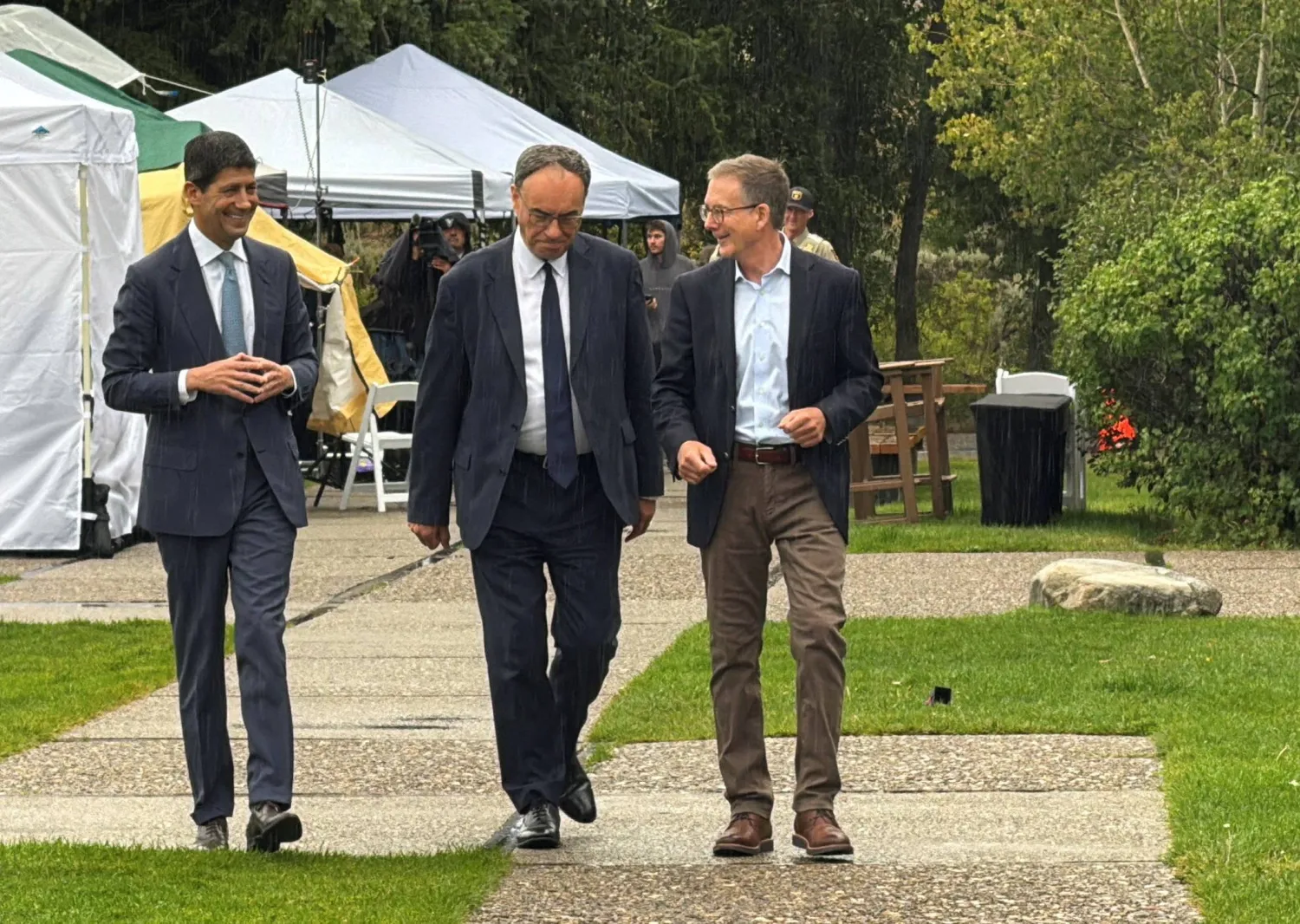
US Federal Reserve Chairman Kevin Warsh takes a break in the rain with Bank of Canada Governor Tiff Macklem and Bank of England Governor Andrew Bailey during the Kansas City Fed’s annual economic symposium, in Jackson Hole, Wyoming, US, August 28, 2026. (Reuters)
TT

Europe’s Central Bankers Fear More Turbulence in Testy US Relations

US Federal Reserve Chairman Kevin Warsh takes a break in the rain with Bank of Canada Governor Tiff Macklem and Bank of England Governor Andrew Bailey during the Kansas City Fed’s annual economic symposium, in Jackson Hole, Wyoming, US, August 28, 2026. (Reuters)

Europe's central bankers are leaving an annual getaway with their US counterparts far from reassured that long-standing norms in global cooperation remain intact and worried that more turmoil is ahead for an already testy relationship with Washington, sources familiar with the discussion said.

Federal Reserve policymakers went out of their way to ease their counterparts' concerns this week, promising to honor all of their commitments.

But, given the separation between the central bank and the administration, they could offer no guarantees against sudden policy shifts by President Donald Trump, more than half a dozen officials on the sidelines of the Kansas City Fed’s annual Jackson Hole Economic Symposium said.

Recent US Treasury interventions to prop up the Japanese yen and to lower longer-term US borrowing costs were particularly concerning as they foreshadowed more intervention and breaks with norms, the officials, who asked not to be named, said.

After the August 1 yen transaction, US Treasury Secretary Scott Bessent confirmed that the Treasury had sold euros for the Japanese currency and said he reassured central banks in the region that the move was "just a reallocation of resources." On Friday, he said that the foreign exchange assets to buy yen came from the Treasury's Exchange Stabilization Fund.

But European officials were especially annoyed the ‌US did not give them ‌a customary heads-up that euro sales were part of the transaction, the sources said.

"That was infuriating," one ‌of them ⁠said. "You always pick up ⁠the phone and give heads-up."

"The message to me is that the US does whatever it wants."

Others were more forgiving and said the transaction was so unusual that it may have been an honest oversight.

Spokespeople for the European Central Bank and the Federal Reserve declined to comment.

A US official said the US-Japan intervention was undertaken to counter disorderly movements in the yen and to support stability in global financial markets.

"It was not directed at anyone else," the official said. "Treasury maintains close and ongoing communication with our international counterparts, but we do not comment on the operational details of those discussions."

DEBT BUYBACK CONCERNS

The sources also said that Bessent’s plan to increase buybacks of longer-dated bonds -- transactions that may need to be financed by issuance of more shorter-term maturities -- was also a concern to European central bankers because, like the yen purchase, ⁠it indicates the administration was willing to take unusual measures to cap borrowing costs.

"These interventions normally offer just ‌temporary relief," a second source said. "But they are clearly worried. So what is next? Will they put ‌pressure on the Fed to start buying bonds on the market?"

While the Fed is the sole US monetary policymaking body, independent in that mission by design from the elected administration, ‌the sources said Trump has shown he is willing to go to extraordinary lengths to get his will across.

Their concern was that this ‌could then set off upheaval in markets that would go far beyond the US.

The US official responded by repeating earlier statements that the increased long-end bond buybacks were aimed at providing greater liquidity in longer-dated sectors where Treasury gets high-quality buyback offers.

"They are not monetary policy or an effort to impose a cap on interest rates," the official said.

On Thursday, however, a US Treasury official had told reporters the Treasury was "really focused on bringing those long-end yields lower" because they had risen above what the department viewed as "fair value."

SWAP ‌LINES AT RISK?

Another of the Europeans' worries was that political meddling could eventually involve the dollar liquidity backstops provided by the Fed to the world's biggest central banks, considered a cornerstone of global financial stability, some of the ⁠sources said.

These swap lines ensure that ⁠commercial banks around the world retain their access to US dollars, especially in moments of financial stress.

The Fed renews this facility year after year on the premise that it actually safeguards US interests and markets, since overseas banks in moments of global market upheaval could otherwise be forced to dump US bonds.

"But rationality doesn't always prevail with this administration," a third source said. "When they run retaliatory trade policies with their closest allies, Trump could just say, 'Hey, they're ripping us off' and the swap lines could be gone overnight."

The sources said there has not been even a hint that these backstops are in danger, and they still expected them to remain unchanged. The swap lines are authorized by the Federal Open Market Committee itself and operated exclusively by the Fed, not the administration.

"Decisions concerning Federal Reserve facilities and swap-line arrangements rest with the Federal Reserve," the Treasury official said. "Nothing Treasury has announced regarding either yen operations or debt buybacks suggests otherwise."

The official added that Bessent looked forward to discussing financial stability issues with G20 finance ministers and central bank governors in the coming days in Asheville, North Carolina, seeking to further press the administration's agenda on isolating Iran, fostering growth and reducing global imbalances.

Fed Chairman Kevin Warsh travelled to Europe just over a month into his job and went out of his way to foster good relations with officials there, leaving a predominantly positive impression, the sources said.

In his debut Jackson Hole conference as Fed leader, he also posed for a customary photo with Bank of Canada Governor Tiff Macklem, a small but still notable gesture since Trump is now engaged in an escalating and bitter trade war with Canada.



Oil Prices Retreat as Investors Weigh Supply Outlook, Middle East Tensions

FILE PHOTO: Oil storage tanks and facilities of a Sinopec plant in Shanghai, China, March 26, 2026.  REUTERS/Go Nakamura/File Photo
FILE PHOTO: Oil storage tanks and facilities of a Sinopec plant in Shanghai, China, March 26, 2026. REUTERS/Go Nakamura/File Photo
TT

Oil Prices Retreat as Investors Weigh Supply Outlook, Middle East Tensions

FILE PHOTO: Oil storage tanks and facilities of a Sinopec plant in Shanghai, China, March 26, 2026.  REUTERS/Go Nakamura/File Photo
FILE PHOTO: Oil storage tanks and facilities of a Sinopec plant in Shanghai, China, March 26, 2026. REUTERS/Go Nakamura/File Photo

Oil prices fell more than 1% on Thursday as investors weighed risks to supply from attacks on shipping through the Strait of Hormuz against US efforts to cut petroleum shipping costs by easing sanctions on vessels.

Brent crude futures fell $1.64, or 1.6%, to $104.42 a barrel by 0337 GMT, while US West Texas Intermediate crude futures were down 98 cents, or 1%, to $94.11, reversing gains from the previous session.

WTI rose to a three-week high in the prior session after Iran said it was deploying new tactics to target ships in the Strait ‌of Hormuz and ‌keep oil prices high.

A container ship and a dry bulk ‌carrier ⁠both sank near ⁠the strait in the past 24 hours after being hit by projectiles in separate incidents, maritime officials said on Wednesday.

Attacks around the waterway have surged over the past 10 days, with Iran saying it is stepping up strikes in response to the US blockade of its ports and tougher sanctions introduced last month.

With the Iran war having disrupted shipping and driven up freight costs to record highs, the Trump administration is considering easing sanctions on so-called shadow-fleet vessels that have ⁠transported oil and petroleum products from countries including Russia, Iran and ‌Venezuela to help ease prices, a US official said ‌on Wednesday.

The new talks center on the United States potentially allowing "legal oil" to flow on previously sanctioned ‌vessels, the US official said.

Increased output from Russia and the Middle East has kept ‌a lid on prices. Russia's crude oil production rose by 65,000 barrels per day in September to 8.43 million bpd but remained down 870,000 bpd year over year, the International Energy Agency said on Wednesday.

The IEA also said crude oil exports from Middle East Gulf producers rose by 4.4 million bpd ‌in September to around 75% of prewar levels.

"While there is little concrete evidence of a near-term peace deal, oil continues to find ⁠its way to ⁠buyers through alternative routes and logistical arrangements," said Phillip Nova's head of market insights, Priyanka Sachdeva, in a client note.

"These workarounds have helped prevent a more severe supply shock, although they come at a higher cost and leave global flows vulnerable to further disruption."

In the US, crude oil and distillate inventories fell, while gasoline stocks rose last week, market sources said on Wednesday, citing data from the American Petroleum Institute.

Crude stocks fell by 11.1 million barrels in the week ended October 9, sources said. That was a much bigger draw than analysts polled by Reuters expected.

"Despite the sharp inventory draw, oil prices barely reacted. The failure to rise on bullish news suggests investors are cautious about chasing prices higher at current levels," said Haitong Futures in a note on Thursday.

Official numbers from the US Energy Information Administration are due at 12 p.m. EDT (1600 GMT), delayed by a day following the Columbus Day holiday on Monday.


Saudi E-commerce Registrations Rise 25% in Q3 2026

The Saudi flag. Asharq Al-Awsat
TT

Saudi E-commerce Registrations Rise 25% in Q3 2026

The Saudi flag. Asharq Al-Awsat

Saudi Arabia’s active e-commerce commercial registrations increased by 25 percent year-on-year by the end of the third quarter of 2026, according to the Ministry of Commerce.

The Kingdom recorded 52,259 active e-commerce commercial registrations by the end of Q3 2026, an increase of 10,577 registrations compared with 41,682 during the same period in 2025.

The ministry also revealed the top five regions with the highest number of active e-commerce commercial registrations. Riyadh topped the list with 23,061 registrations, followed by Makkah with 13,177 and the Eastern Province with 7,792.

Madinah ranked fourth with 2,198 registrations, followed by Al-Qassim with 1,659.

The growth in commercial registrations in the e-commerce sector reflects the increasing prevalence of commercial activities conducted through digital channels across the Kingdom.


IMF Chief Urges US and Wealthy Nations to Rein in Debt to Ease Global Economic Pressure

International Monetary Fund (IMF) Managing Director Kristalina Georgieva speaks during a press briefing on the Global Policy Agenda during the 2026 Annual Meetings of the IMF and the World Bank Group in Bangkok, Thailand, 14 October 2026. (EPA)
TT

IMF Chief Urges US and Wealthy Nations to Rein in Debt to Ease Global Economic Pressure

International Monetary Fund (IMF) Managing Director Kristalina Georgieva speaks during a press briefing on the Global Policy Agenda during the 2026 Annual Meetings of the IMF and the World Bank Group in Bangkok, Thailand, 14 October 2026. (EPA)

The US and other wealthy nations need to urgently tackle mounting global debt levels that are weighing most heavily on low-income countries and straining the global financial system, the head of the International Monetary Fund said Wednesday.

IMF Managing Director Kristalina Georgieva said Treasury Secretary Scott Bessent and other US leaders recognize that the federal deficit and national debt are too high. But economic growth alone would not be enough to address the country’s more than $40 trillion in national debt, she said.

Meanwhile, rising bond yields, reflecting higher premiums demanded by investors for taking on greater risk, have been disrupting financial markets.

“We believe that growth, of course, helps, but it cannot deliver fast enough the necessary adjustments,” Georgieva said at the autumn meeting of the IMF and World Bank in Bangkok.

“There is no magic,” she said, adding that other measures would be needed. “You have to go in a direction of tightening, bringing it down, bringing the deficit down.”

‘Fiscal consolidation’ faces challenges

Rising debt levels and global inflation, partly resulting from high energy costs due to the Iran war, have pushed interest rates to multidecade highs, adding to the burdens of the world’s poorest nations.

Efforts to bring debt under control with what Georgieva and other experts call “fiscal consolidation” have suffered setbacks from heavy spending during the COVID-19 pandemic and since.

“Fiscal risks are rising, and a proper reaction is largely absent in many countries,” said Rodrigo Valdes, director of the IMF's Fiscal Affairs Department. “And in major advanced economies, the effect of fiscal indiscipline does not stop at the border. It travels to the rest of the world.”

“Among the world’s poorest countries, interest payments have reached historic highs relative to revenue, and declining amounts of aid are creating gaps that some countries have been unable to finance,” the IMF's latest Fiscal Monitor said.

That is forcing countries to make hard choices between supporting their most vulnerable people and meeting their debt repayment obligations.

“The Global South is paying the price for rising interest rates in wealthier countries,” UK Foreign Secretary Ed Miliband said at an event on the sidelines of the IMF meetings.

“We need a new deal on debt, a deal that supports countries to repay over longer time horizons and, crucially, refinancing with better rates to give developing countries precious fiscal space,” he said.

Nations need help with job creation and investment

The median developing country pays three times as much in interest as developed countries, said Alexander De Croo, former Belgian prime minister and administrator of the United Nations Development Program (UNDP).

On average, nearly 10% of government spending goes toward debt repayments. High fuel and fertilizer prices, the effects of the El Niño weather phenomenon and rising borrowing costs have left many low-income countries with little room to recover.

“I mean, we don’t see really a light at the end of the tunnel,” De Croo told The Associated Press.

Creating jobs is another top priority, particularly as the growing use of artificial intelligence threatens to make many traditional occupations obsolete. More than 1.2 billion young people are expected to enter the global workforce over the next decade or so, while forecasts suggest only 400 million net new jobs will be created.

The UNDP this week announced its “Jobs for Prosperity” initiative to bring together governments, development banks — such as the World Bank — and private businesses to encourage investment in sectors such as tourism, healthcare and food processing.

The initiative and related efforts will help countries attract investment by strengthening governance and policies and developing pipelines of “investible projects,” De Croo said.

“These are things that are feasible. It’s been proven that you can do it in many places of the world,” he added.

Separately, the IMF, Bank of Thailand and World Bank Group announced a “Bangkok Blueprint” on Wednesday to combat cybercrime, financial fraud and online scams.

The announcement came a day after cyberattacks caused refrigeration systems to overheat at hundreds of stores in France.