


Taiwan’s Foreign Minister Welcomes Partnership with Saudi Arabia to Support Vision 2030 and High-Tech Industries

Lin: Disruptions in the Strait of Hormuz Are Driving Us to Diversify Energy Sources and Strengthen Partnerships

Taiwanese Minister of Foreign Affairs Lin Chia-lung (X)
TT

Taiwan’s Foreign Minister Welcomes Partnership with Saudi Arabia to Support Vision 2030 and High-Tech Industries

Taiwanese Minister of Foreign Affairs Lin Chia-lung (X)

Taiwanese Minister of Foreign Affairs Lin Chia-lung emphasized that Taiwan attaches great importance to fostering strong economic and investment partnerships with Saudi Arabia and the broader Middle East.

He praised major regional development initiatives, led by Saudi Arabia's Vision 2030, and renewed Taiwan’s readiness to deploy its technological capabilities and resources to foster sustainable cooperation in advanced industries.

Lin made his remarks in response to questions posed by Asharq Al-Awsat newspaper, which covered prospects for economic and technological collaboration, investment opportunities under Vision 2030, Taiwan’s economic performance, as well as its position on regional geopolitical challenges and global energy security.

The Taiwanese Foreign Minister during the opening of a new Taiwan office in the city of Phoenix, Arizona (X)

Economic Cooperation with Saudi Arabia & Vision 2030

In response to a question regarding economic, industrial, and technological ties with the Kingdom, Lin highlighted the global transition from traditional oil-based economies toward digital technology, semiconductors, and artificial intelligence (AI).

"We are aware that Saudi Arabia is actively pushing forward with Vision 2030 and transitioning toward modern technologies. We believe Taiwan is the ideal partner for Middle Eastern nations in these sectors," Lin stated.

Addressing future investment plans, Lin noted: "We are currently looking for partner countries in the Middle East that are willing to engage in normal exchanges and interactions with us.”

“Whenever such engagement is established, we stand fully prepared to invest and allocate our resources—whether in Saudi Arabia, Oman, Qatar, or other friendly nations that maintain strong relations with our international allies,” he added.

Robust Economic Performance and Market Growth

Regarding Taiwan’s economic trajectory and challenges, Lin strong growth indicators, noting that Taiwan’s economy grew by 8.68% last year, with projections expected to exceed 11% this year, fueled by technological innovation and surging global demand for semiconductors and AI technology.

The minister further pointed out that Taiwan’s stock exchange has become the fourth largest in the world, outperforming major G7 economies such as France, the UK, and Italy.

In the semiconductor sector, he noted that major Taiwanese tech firms (such as TSMC) have secured orders stretching over the next five years, exceeding their current manufacturing capacity.
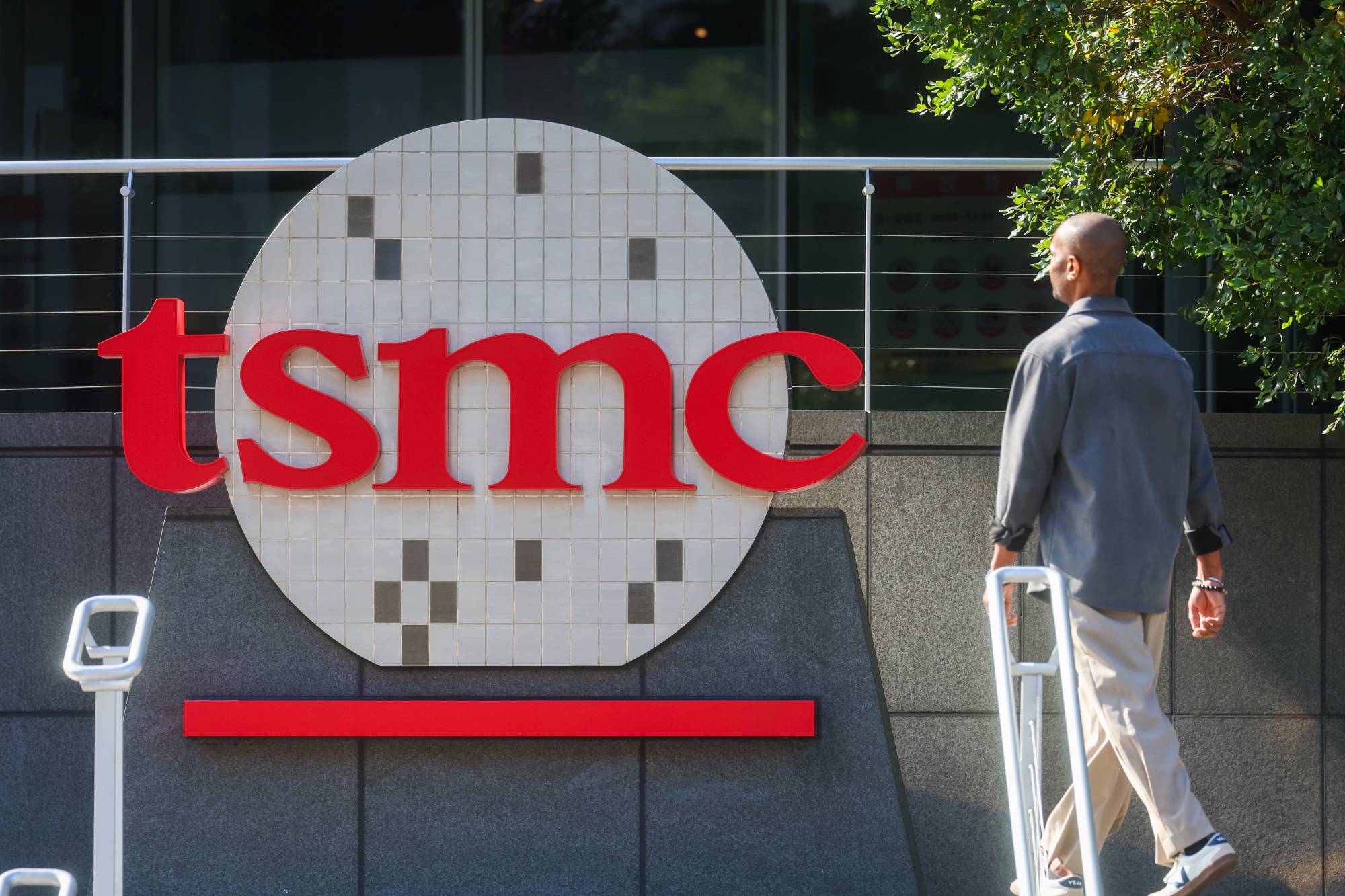
FILE - A worker walks past the logo of TSMC or Taiwan Semiconductor Manufacturing Corp., a Taiwanese multinational semiconductor contract manufacturing and design company, in Hsinchu, Taiwan, on Jan. 29, 2026. (AP Photo/Daniel Ceng, File)

Middle East Crises and Energy Security

Addressing questions regarding regional instability and energy supply routes through the Strait of Hormuz, Lin acknowledged that Middle Eastern conflicts affect Taiwan due to its reliance on imported energy.

However, he emphasized that Taiwan has taken proactive measures to diversify its energy sources by increasing purchases and investments from the United States and Australia, while expanding domestic investments in renewable energy to safeguard national energy security.

Lin reiterated that Taiwan has built significant resilience in risk management amidst geopolitical challenges, expressing the country’s eagerness to share these experiences and forge robust economic bonds with partners around the world.



Gold Pauses Decline after Two-month Low as Traders Weigh US Fed Move

A 1000-gram gold bar at a gold and silver refinery in Vienna (AFP)
TT

Gold Pauses Decline after Two-month Low as Traders Weigh US Fed Move

A 1000-gram gold bar at a gold and silver refinery in Vienna (AFP)

Gold prices steadied on Thursday after sliding to a two-month low in the previous session, as investors assessed the likelihood of another US Federal Reserve interest rate hike before year-end.

Spot gold was little changed at $4,116.67 per ounce by 0625 GMT. On Wednesday, bullion prices touched their lowest level since August 5 as a ‌firmer dollar and ‌higher US Treasury yields weighed on the ‌market.

US ⁠gold futures were ⁠flat at $4,140.70.

"The short-term investment case for gold remains challenged... We would need to see a break above $4,275 to become more constructive on the near-term upside," said Chris Weston, head of research, Pepperstone.

"If markets begin treating rising long-end yields as a reflection of sovereign credit and fiscal risk rather than stronger economic fundamentals, gold ⁠could start to diverge positively from bond yields ‌and the debasement trade could return ‌with greater force."

Fed policymakers were divided last month over the rationale for ‌raising interest rates, with "some participants" seeing a hike as needed ‌to keep the impact of energy and other price shocks at bay, but a more hawkish core viewing it as necessary to guard against emerging demand-driven inflation, minutes showed.

Traders see only a 19% chance ‌of a rate hike later this month, but are pricing in an 86% likelihood of ⁠an increase ⁠in December, according to CME's FedWatch tool.

Higher rates diminish the appeal of non-yielding gold.

The global economy is under threat from persistently high energy prices, record public debt and risks from the AI investment boom, International Monetary Fund Managing Director Kristalina Georgieva warned, urging governments to implement protective fiscal and monetary policy measures.

Among other metals, spot silver fell 1.9% at $59.01, platinum added 1.6% to $1,657.18 and palladium climbed 1.1% to $1,136.80.

"We see silver on a downward trajectory given the deteriorating chart patterns and expect a test of the 2026 lows in the mid to high $50s," Marex analyst Edward Meir said in a note.


Oil Rises as Middle East Supply Concerns Persist amid Shipping Attacks

Oil rigs operating in the Kern River field in California, USA (Reuters)
TT

Oil Rises as Middle East Supply Concerns Persist amid Shipping Attacks

Oil rigs operating in the Kern River field in California, USA (Reuters)

Oil prices rose on Thursday on persistent worries about supply from the key Middle East producing region amid an increase in attacks on shipping in the Gulf and the Strait of Hormuz, while the US cut output as a hurricane menaced offshore production.

Brent crude futures rose $2.28, or 2.28%, to $102.28 a barrel by 0427 GMT. US West Texas Intermediate (WTI) crude futures gained $1.66, or 1.88%, to $89.94.

Prices settled lower on Wednesday after the International Energy Agency agreed to accelerate the release of oil stocks and to prioritize diesel supplies under a plan launched in March, as governments seek to tackle record ‌fuel prices ‌and supply disruptions caused by the Iran war.

However, threats to oil shipping ‌in ⁠the Gulf and ⁠the Strait of Hormuz, which carried shipments equal to about 20% of global oil and fuel before the war, have increased in October as the US-Israeli conflict with Iran enters its eighth month, said Reuters.

Attacks on tankers sailing through the Strait of Hormuz hit their highest last week of any week since the Iran war began as Gulf producers increased exports. The expansion of attacks is occurring as more crude is flowing out of the Gulf but at higher costs and risk to cargoes and crew.

In the latest attack, a ⁠tanker north of Qatar was struck by multiple projectiles, causing casualties, the ‌United Kingdom Maritime Trade Operations agency said on Wednesday.

"The frequency ‌of Iranian attacks on ships is now at the highest point since the war began, and likely to ‌intensify further," said Saul Kavonic, MST Marquee head of energy.

He noted that "constrained product flows, extreme ‌logistics costs and high likelihood of Iranian escalation are keeping prices elevated".

ANZ analyst Daniel Hynes said in a note on Thursday the IEA's oil release would likely consist of barrels that were already part of the group's original 400-million-barrel release plan at the start of the Middle East conflict, meaning it does not appear to represent an additional ‌draw on strategic inventories.

"Ultimately, strategic stock releases can augment supply flows temporarily but do not create new production capacity," Hynes said.

HURRICANE CONCERNS

Prices are also gaining ⁠on supply curtailments as ⁠a hurricane moves toward offshore production areas in the US, the world's biggest oil producer, causing companies to shut their platforms.

Shell and Chevron said on Wednesday they were curtailing offshore operations in the Gulf as Hurricane Isaias approached.

Overall, US Gulf of Mexico oil and gas producers had shut in about 25.08% of current oil production and 16.37% of current natural gas production as of Wednesday because of the storm, according to the Marine Minerals Administration.

Inventory data from the US, also the world's biggest oil consumer, were supportive for prices as crude stockpiles fell by a higher-than-expected amount, while diesel inventories declined slightly.

Crude inventories fell by 3.2 million barrels to 424.1 million barrels in the week ended October 2, the Energy Information Administration said on Wednesday, compared with analysts' expectations in a Reuters poll for a 1.7 million-barrel decline.

Distillate fuel inventories, including diesel fuel and jet fuel, dropped by 42,000 barrels to 105.14 million barrels, well below their levels reported for this time of year in the past five years.


Stocks Fall Further as Oil Spike Fans Fresh Inflation Worries

Chart of German share price DAX (Deutscher Aktienindex) at the stock exchange in Frankfurt, Germany, October 6, 2026.  REUTERS/Staff
Chart of German share price DAX (Deutscher Aktienindex) at the stock exchange in Frankfurt, Germany, October 6, 2026. REUTERS/Staff
TT

Stocks Fall Further as Oil Spike Fans Fresh Inflation Worries

Chart of German share price DAX (Deutscher Aktienindex) at the stock exchange in Frankfurt, Germany, October 6, 2026.  REUTERS/Staff
Chart of German share price DAX (Deutscher Aktienindex) at the stock exchange in Frankfurt, Germany, October 6, 2026. REUTERS/Staff

Equities extended losses Thursday as inflation fears were stoked by a fresh jump in oil prices following a report that said Donald Trump was considering more Iran strikes ahead of next month's US midterm elections.

The selling tracked a retreat on Wall Street, where tech firms pulled back from recent gains, having weathered concerns over spiking borrowing costs and geopolitical uncertainty, said AFP.

Crude had started the week on the back foot thanks to signs that exports from the Middle East were heading back towards pre-war levels and that G7 nations had agreed to tap their stockpiles.

But anxiety returned as figures showed Tehran had increased strikes on tankers in the Strait of Hormuz, Houthis rebutted claims they had lost key territory and top oil officials warned that global reserves were running worryingly low.

And on Wednesday, The Atlantic reported that the White House had asked the Pentagon to draw up options to hit sites in Iran ahead of the midterms, with Trump's Republicans in danger of losing both houses of Congress.

The article said the size and targets were still being discussed, but added that a wider operation could be in the works after the polls on November 3.

It added that even its proponents did not think the attacks would bring Tehran to talks or see Hormuz reopened, but hoped they would show strength leading into the vote.

Both main crude contracts rose more than one percent Thursday, with supplies also hit by the loss of more than 500,000 barrels of Gulf of Mexico output owing to producers shutting up shop as Tropical Storm Isaias approaches.

News that International Energy Agency members were ready to tap more oil from reserves did little to assuage worried traders.

The spike in oil prices fanned inflation fears again and put fresh upward pressure on government bond yields to multi-year highs.

After all three main indexes on Wall Street dropped -- with the S&P 500 and Nasdaq off records -- Asia followed suit.

Tokyo, Hong Kong, Sydney, Singapore, Seoul, Wellington, Taipei and Manila were all well down, though Shanghai edged up as investors returned from a week-long break.

- Tech earnings -

US Federal Reserve officials expect to hike interest rates again before the end of the year, according to minutes of their September meeting, where everyone agreed to the first increase since July 2023.

"With regard to the outlook for monetary policy beyond the current meeting, most participants assessed that another increase in the target range for the federal funds rate would likely be appropriate by year end," the minutes said.

Several participants said they viewed the previous policy rate as not being adequately restrictive of economic activity, while they saw signs of renewed strength in the economy.

Investors are also gearing up for earnings season, with tech firms in the spotlight as questions over their profitability and elevated valuations swirl in light of the vast sums they have pumped into the AI sector.

"The headline earnings numbers may still be very strong. But with expectations elevated, valuations demanding and Treasury yields near multi-decade highs, the investment hurdle has become higher as well," warned Charu Chanana at Saxo Markets.

"This season should therefore be less about simply identifying who beat consensus by the largest amount," she said.

"The stronger businesses may be those that can deliver growth above expectations, convert that growth into cash, fund future investment from a strong balance sheet and still offer enough earnings upside to justify their valuation."

South Korean titan Samsung's shares fell as it forecast a more than 780 percent leap in third-quarter operating profit -- thanks to high memory chip prices -- but missed expectations.

It estimated July-September profit of 107.4 trillion won ($80.3 billion), up 782.5 percent on-year, but analysts on average had tipped 108.7 trillion won.

On currency markets, the euro remains wedged at lows last seen in June last year following another heavy fall amid worries about France's high debt levels, which have spooked bond markets.