


Spanish Tapestry Factory, Once Home to Goya, Is Still Weaving 300 Years after It Opened

A craftswoman works on a tapestry at the Royal Tapestry Factory in Madrid, Spain, Friday, Nov. 30, 2023. (AP)
TT

Spanish Tapestry Factory, Once Home to Goya, Is Still Weaving 300 Years after It Opened

A craftswoman works on a tapestry at the Royal Tapestry Factory in Madrid, Spain, Friday, Nov. 30, 2023. (AP)

Spain’s Royal Tapestry Factory has been decorating the walls and floors of palaces and institutions for more than 300 years.

Located on a quiet, leafy street in central Madrid, its artisans work with painstaking focus on tapestries, carpets and heraldic banners, combining the long wisdom of the craft with new techniques.

The factory was opened in 1721 by Spain’s King Felipe V. He brought in Catholic craftsmen from Flanders, which had been part of Spain’s empire, to get it started.

Threads and wool of all colors, bobbins, tools and spinning wheels are everywhere. Some of the original wooden machines are still in use.

The general director, Alejandro Klecker de Elizalde, is proud of the factory's sustainable nature.

“Here the only products we work with are silk, wool, jute, cotton, linen,” he said. “And these small leftovers that we create, the water from the dyes, or the small pieces of wool, everything is recycled, everything has a double, a second use.”

The factory also restores pieces that have suffered the ravages of time, and it boasts one of the most important textile archives and libraries in Europe.

Nowadays, 70% of customers are individuals from Latin America, Europe and the Middle East.

The factory recently received one of its biggest orders, 32 tapestries for the Palace of Dresden in Germany — worth more than 1 million euros and providing work for up to five years, according to Klecker de Elizalde.

Creating a tapestry is a delicate process that takes several weeks or months of work for each square meter.

A tapestry begins with “cartoons,” or drawings on sheets of paper or canvas that are later traced onto vertical thread systems called warps, which are then woven over.

One of the factory’s most illustrious cartoonists was master painter Francisco Goya, who began working there in 1780. Some of the tapestries he designed now hang in the nearby Prado Museum and Madrid’s Royal Collections Gallery.



Qassim Region Principality Illuminated in Green in Celebration of Founding Day

The Qassim Region Principality illuminated in green marking Founding Day - SPA
TT

Qassim Region Principality Illuminated in Green in Celebration of Founding Day

The Qassim Region Principality illuminated in green marking Founding Day - SPA

The Qassim Region Principality building was illuminated in green in celebration of Founding Day.

The scene reflected pride in the historical roots of the Saudi state and embodied feelings of belonging on this cherished national occasion, SPA reported.

The illumination affirms the deep historical significance of Founding Day, marking 299 years since the establishment of the First Saudi State by Imam Mohammed bin Saud.

It also reflects the enduring principles upon which it was founded, including unity, stability, and state-building. These foundations culminate in the security, stability, and prosperity that the Kingdom of Saudi Arabia enjoys today under its wise leadership.


Prince Mohammed bin Salman Project Restores Century-Old Uqlat Al-Suqur Mosque in Qassim

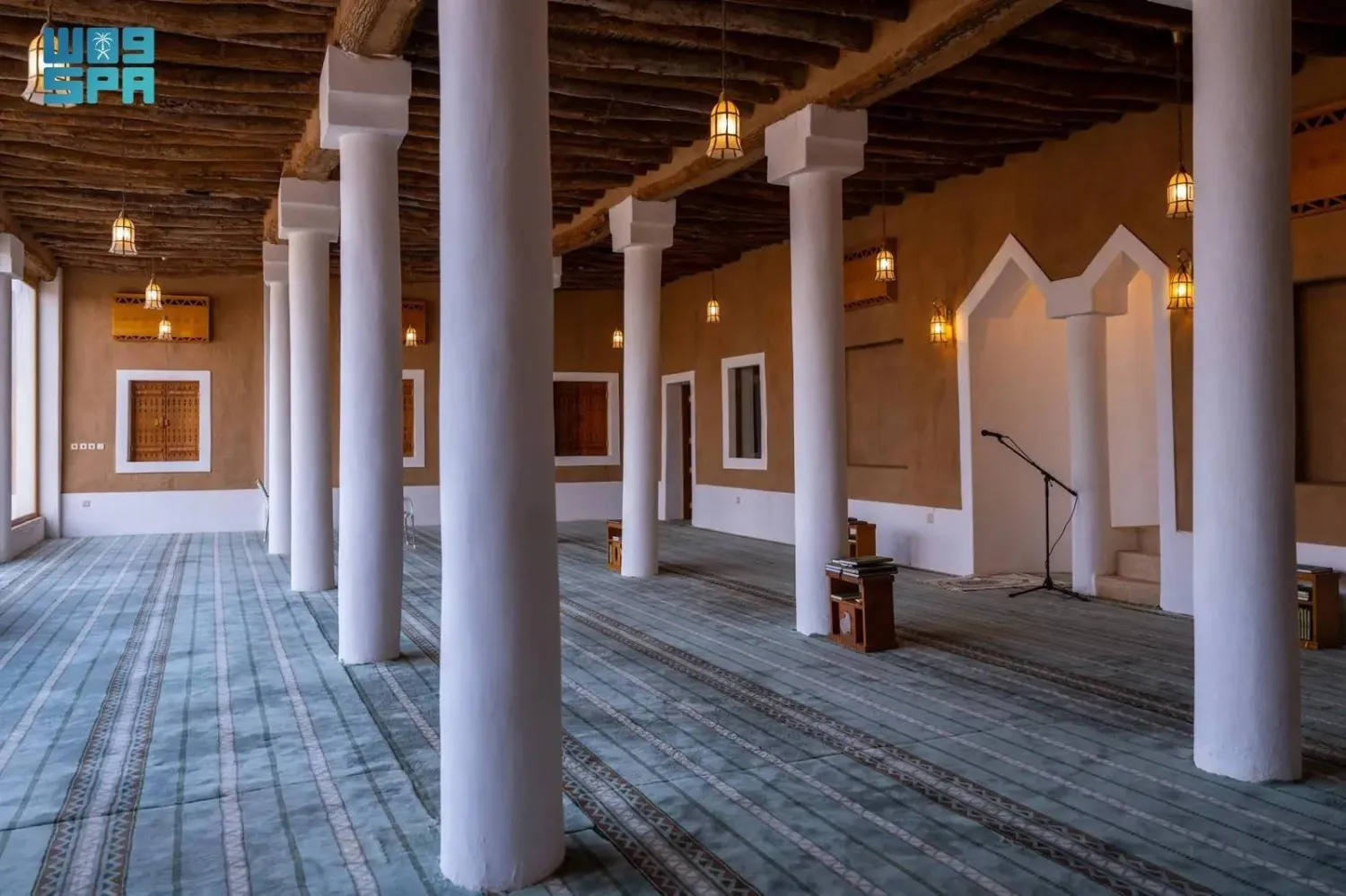
The renovation utilized traditional mud, stone, and wood to preserve the mosque's authentic Najdi architectural style. (SPA)
TT

Prince Mohammed bin Salman Project Restores Century-Old Uqlat Al-Suqur Mosque in Qassim

The renovation utilized traditional mud, stone, and wood to preserve the mosque's authentic Najdi architectural style. (SPA)

The Prince Mohammed bin Salman Project for the Development of Historical Mosques has completed the restoration of the Uqlat Al-Suqur Mosque in Qassim Region, revitalizing a heritage landmark dating back to 1922, reported the Saudi Press Agency on Saturday.

Originally the only mosque in the area, it served as a vital religious and social hub for education and community governance.

The renovation, executed by specialized Saudi firms, utilized traditional mud, stone, and wood to preserve its authentic Najdi architectural style.

The project increased the mosque's area to 544 square meters, expanding its capacity to 250 worshippers while maintaining its historical identity.

The initiative aligns with Vision 2030 to preserve the Kingdom's urban heritage and boost the cultural and religious significance of its historical mosques for future generations.


Tomb More Than 1,000 Years Old Found in Panama

This handout picture released by Panama’s Ministry of Culture shows an archaeologist working inside a pre-Hispanic tomb approximately 1,200 years old, discovered at the El Cano Archaeological Park in Cocle, Panama, on February 20, 2026. (Handout / Panama’s Ministry of Culture / AFP)
TT

Tomb More Than 1,000 Years Old Found in Panama

This handout picture released by Panama’s Ministry of Culture shows an archaeologist working inside a pre-Hispanic tomb approximately 1,200 years old, discovered at the El Cano Archaeological Park in Cocle, Panama, on February 20, 2026. (Handout / Panama’s Ministry of Culture / AFP)

Archaeologists have discovered a tomb more than a thousand years old in Panama containing human remains alongside gold and ceramic artifacts, the lead researcher told AFP on Friday.

The discovery was made at the El Cano site in the Nata district about 200 kilometers (124 miles) southwest of Panama City.

Scientists and archaeologists have already unearthed other remains of pre-Hispanic cultures in the region that has been excavated for two decades.

The skeletal remains were found surrounded by gold objects and pottery decorated with traditional motifs, pointing to these being "high-ranking" individuals, archaeologist Julia Mayo told AFP, adding that the tomb was built between 800 and 1000 AD.

"The individual with the gold was the one with the highest social status in the group," she said.

That body was found with two bracelets, two earrings, and pectoral jewelry that featured bats and crocodiles, she added.

The El Cano archaeological site is linked to the societies that inhabited the central provinces of Panama between the 8th and 11th centuries.

"This is where they buried their dead for 200 years," said Mayo.

Nine other tombs "similar" to the one found on Friday had already been found at the site, she added.

Panama's Ministry of Culture said the discovery was "of great importance for Panamanian archaeology and the study of pre-Hispanic societies of the Central American isthmus," referring to the land that connects North and South America.

According to experts, these excavations demonstrate that death did not represent an end for these societies, but a transition to another phase where social status remained important.