‘Suspense’ of Slowest Horse Race Wins New Fans in Japan 

This picture taken on December 9, 2023 shows a Banei Keiba horse race at the Obihiro racecourse in Obihiro, Hokkaido Prefecture. (AFP)
TT

‘Suspense’ of Slowest Horse Race Wins New Fans in Japan 

This picture taken on December 9, 2023 shows a Banei Keiba horse race at the Obihiro racecourse in Obihiro, Hokkaido Prefecture. (AFP)

Speed isn't everything at one racecourse in Japan, where the unpredictable stop-and-start drama of the world's slowest horse race has drawn new fans eager to bet on their sturdy favorite.

A fanfare plays, the gates flip open and they're off -- but at a plod rather than a gallop, pulling heavy sleighs in a tradition that harks back more than a century.

The Banei Keiba races are held in Obihiro, a city in northern Japan's Hokkaido, where spectators cheer on the muscular workhorses moving at the pace of a brisk human walk.

Eight equine competitors kicked up dust on a recent afternoon as they powered over the first of two mounds on the 200-meter (220-yard) track.

But they soon began to halt, taking the first of several breaks to catch their breath, which billowed in the winter air.

The slow progress "builds a little bit of suspense", 24-year-old Australian tourist Esther McCourt told AFP, marveling at the horses' size.

"No matter how good people or horses look in the beginning, the crucial part is the last 50 meters, so it can change at any time," she said.

The popularity of Banei Keiba had dwindled until renewed marketing efforts coincided with a surge of interest during the pandemic, when people began to watch the races.

'Dynamic' races

Banei Keiba developed when Japanese settlers migrated to Hokkaido, a sparsely populated island with long, bitter winters.

They relied on horses known as "banba" to clear fields, transport goods and operate mines, and would pit them against each other in tug-of-war games and other contests at local festivals.

Banba are twice as heavy as racing thoroughbreds, and the sleighs they tug weigh more than 600 kilograms (1,300 pounds).

Jockeys standing on the sleighs shout and whip the horses with long reins to keep them going.

Trainers like Yoshiyuki Hattori deny any accusations of cruelty, saying the strong creatures are treated with care and are not forced to pull loads above their capacity.

"If thoroughbreds were born to run, banba were bred to haul things," said Hattori, whose horses have won many race trophies.

"They worked in fields. They worked for us. We want to continue this history."

For Hattori, Banei races are "more dynamic" than the "visual experience" of regular horse racing.

"This moves you physically as you cheer," he said.

'Can't help but cheer'

Three other cities in the region used to host similar races, but they all stopped under mountains of debt in 2006.

The long-stagnant Japanese economy had hit Banei Keiba hard, and the regular punters who kept it going were getting older.

Obihiro Racecourse, now the tradition's sole custodian, made efforts to attract more young families and tourists by cleaning up the facility and making it smoke-free.

They set up a mini-zoo and launched marketing campaigns including tie-ups with popular smartphone games to rejuvenate the attraction.

Now there are around 750 horses taking part in the races, kept by 28 trainers, 150 caretakers and 21 jockeys.

One of the caretakers, 21-year-old Yuno Goto, was busy affixing pale pink and blue fluffy bows and ribbons on a banba's mane ahead of the race.

She said she dreams of becoming a jockey one day, and called the event "a great opportunity to expose people to this culture, and to provide a different experience from other horse races".

Spectator Taichi Yamada, 27, who moved to the region last year, also said knowing the race's origins adds to its appeal.

"This is a form of interaction between humans and animals. I hope it will continue as a piece of history," he told AFP.

"It must be tough for horses to pull this much weight. You can't help but cheer for them."


India’s Historic Haveli Homes Caught Between Revival and Ruin

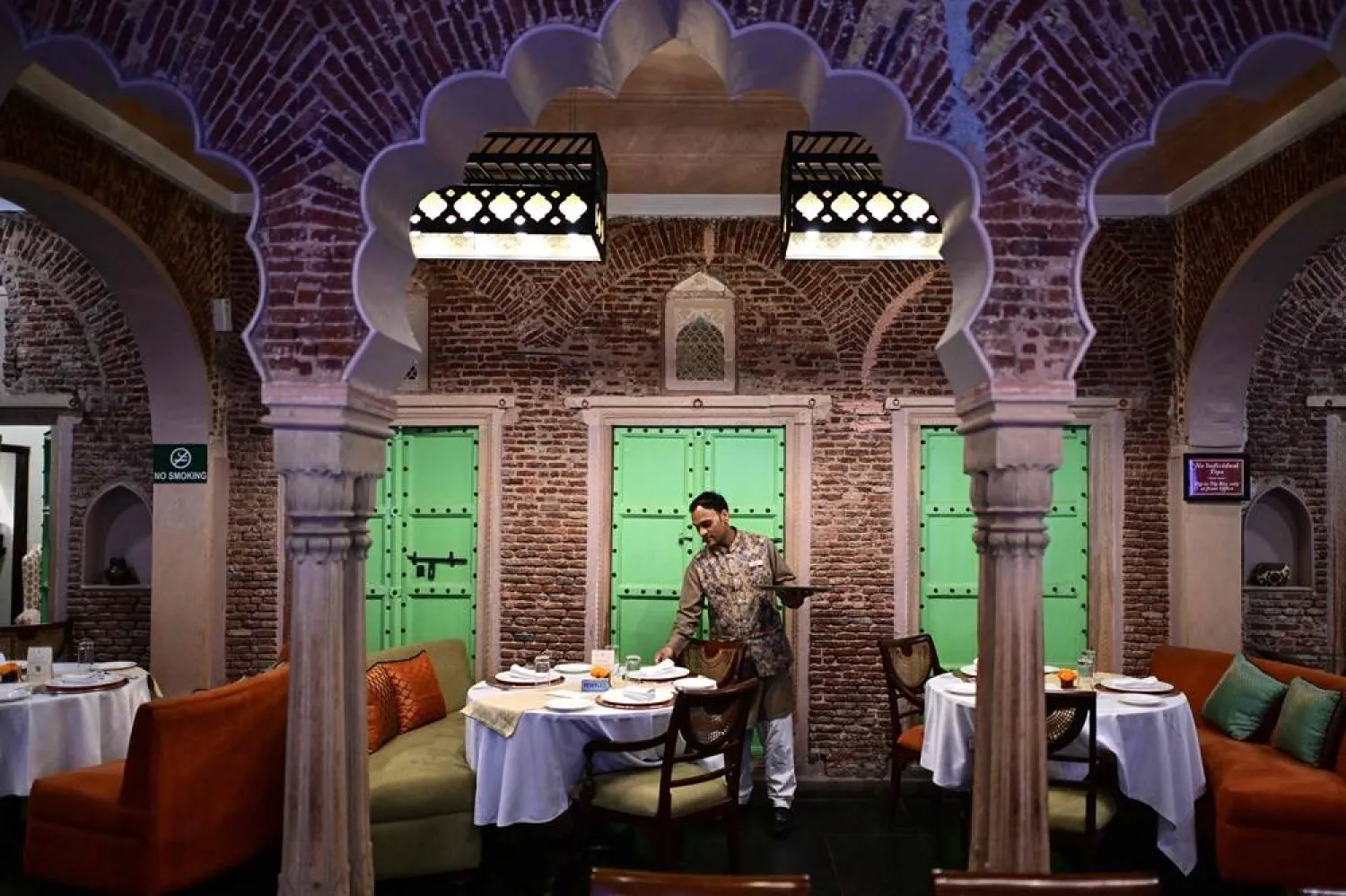
 This photograph taken on February 2, 2026 shows a hospitality staff arranging tableware at the Dharampura Haveli, an 18th-century haveli-turned-heritage hotel in the old quarters of Delhi. (AFP)
This photograph taken on February 2, 2026 shows a hospitality staff arranging tableware at the Dharampura Haveli, an 18th-century haveli-turned-heritage hotel in the old quarters of Delhi. (AFP)
TT

India’s Historic Haveli Homes Caught Between Revival and Ruin

 This photograph taken on February 2, 2026 shows a hospitality staff arranging tableware at the Dharampura Haveli, an 18th-century haveli-turned-heritage hotel in the old quarters of Delhi. (AFP)
This photograph taken on February 2, 2026 shows a hospitality staff arranging tableware at the Dharampura Haveli, an 18th-century haveli-turned-heritage hotel in the old quarters of Delhi. (AFP)

Once the grand residences of Mughal-era nobility, the Indian capital's haveli homes now stand at a fragile crossroads -- a handful lovingly restored but many more sliding quietly into ruin.

Across Old Delhi -- the 17th century walled city founded as the Mughal capital Shahjahanabad -- cracked facades, shuttered gateways and sagging balconies tell the story of a heritage under siege from neglect, inheritance battles and relentless urban pressure.

Only a few restored pockets provide a glimpse of what once was -- airy courtyards, carved sandstone pillars and homes built around a deeply social way of life.

Inside one restored mansion that now houses a cultural center, sunlight filters through stained glass onto carved sandstone arches, the air infused with freshly polished wood and rosewater.

Musicians tune their instruments in a frescoed courtyard, where nobles may once have entertained guests, offering a rare peek into Old Delhi's rich architectural past.

But outside in the narrow lanes of Old Delhi's Chandni Chowk district, the contrast is stark.

Many havelis are abandoned or on the verge of collapsing, their carved facades fading beneath peeling paint.

The contrast reflects two futures -- one of careful restoration and the other of gradual decay.

- 'Who will pay?' -

The Kathika Cultural Centre's founder Atul Khanna said his initiative hoped to create an immersive cultural space inside a restored structure.

But he admitted that conservation in Old Delhi remains a huge challenge.

Many havelis are split among multiple heirs, with no single stakeholder willing or able to invest in costly upkeep.

"When there are multiple ownerships, that becomes a challenge," he said.

"If the haveli is decaying, who is going to spend the money?"

Khanna also blamed bureaucratic hurdles for discouraging restoration.

"There should be some kind of a single window for anyone who is working with heritage," he said, arguing that easing red tape would be more effective than offering subsidies for restoration.

Another prominent restoration is the 18th century Haveli Dharampura, now converted into a heritage hotel.

"Restoration in Old Delhi is still isolated unless there is sustained support and awareness," said Vidyun Goel, whose family owns the property.

Residents say family disputes and the push to convert properties into shops or apartments have led to rapid decline.

In nearby Roshanpura, only a scattering of old homes still stand. Among them, the century-old Mathur ki Haveli is a rare example of a lived-in heritage home.

- Showpiece projects -

"We are in love with this house," said Ashok Mathur, a fourth-generation resident who continues to live in the ancestral property despite mounting challenges.

Wooden ceilings are deteriorating, floors are wearing thin and doors require constant repair, he said, walking through rooms that bear only traces of intricate craftsmanship.

Still, he said he has never considered leaving -- although he can only imagine the social world that once defined haveli life.

"There is no community left," Mathur, 56, said. "We are living in a cocoon."

Conservationist K. T. Ravindran said that while Old Delhi is economically vibrant, its havelis suffer from unclear titles and multiple claimants.

"Often buildings that look intact from outside conceal deeper damage," he said, noting that the condition was worse in the inner lanes hidden from public view.

Ravindran said revival was still possible, but only through neighborhood-level regeneration rather than isolated showpiece projects.

Oral historian Sohail Hashmi said each haveli once formed part of "a larger social ecosystem of neighborhoods, crafts and traditions", with architecture and community deeply intertwined.

As Khanna put it, the loss goes beyond architecture.

"When you lose a haveli, you are not only losing the structure," he said.

"Every element in it is a piece of art."


Charcoal Irons Illustrate Traditional Ironing Practices in Saudi Arabia’s Old Villages

Charcoal irons were once a common household tool in village homes over six decades ago - SPA
TT

Charcoal Irons Illustrate Traditional Ironing Practices in Saudi Arabia’s Old Villages

Charcoal irons were once a common household tool in village homes over six decades ago - SPA

Charcoal irons were once a common household tool in village homes over six decades ago, serving as the only way to iron clothes before they gradually fell out of use and now survive mainly as museum artifacts, SPA reported.

Several elders recalled that charcoal irons were widely used, with women relying on them for daily ironing.

Neighbors often lent or exchanged irons when needed, highlighting their importance and scarcity, and making them an integral part of village social life.

The charcoal iron worked similarly to a modern steam iron but required preparation where charcoal had to be burned to embers, placed inside the iron to heat the base, and water had to be manually sprayed to create steam for ironing.

SPA documented several charcoal irons preserved at a heritage museum in Rafha Governorate, Northern Borders Region. Licensed by the Heritage Commission, the museum illustrates the history of traditional household tools in the past.


Cultural and Heritage Events Launched at King Abdulaziz Palace in Qibah, Qassim

The activities will run through March 27 to revitalize the palace - SPA
TT

Cultural and Heritage Events Launched at King Abdulaziz Palace in Qibah, Qassim

The activities will run through March 27 to revitalize the palace - SPA

The Imam Turki bin Abdullah Royal Reserve Development Authority, in collaboration with the Heritage Commission, has launched a series of cultural and heritage events at the historic King Abdulaziz Palace in Qibah, Qassim Region.

The activities, running through March 27, 2026, aim to revitalize the palace as a vibrant cultural platform and strengthen the community’s connection to Saudi national identity.

The daily program, held from 3:00 pm to 10:00 pm, includes live folk art performances, such as the Saudi Ardah, along with interactive experiences for all age groups. Outdoor areas are designated for children, offering educational and recreational activities that help preserve cultural values across generations, SPA reported.

Visitors can also explore archaeological artifacts that reflect the region’s social and economic history. The event further provides a platform for families engaged in cottage industries and artisans to showcase traditional handicrafts, supporting local economic empowerment and highlighting the richness of regional heritage through a modern, interactive approach.

The authority confirmed that activating King Abdulaziz Palace in Qibah is part of its strategy to highlight historical sites within its geographical scope. It aims to transform them into active cultural and tourist destinations that promote cultural engagement and strengthen national identity, in coordination with relevant authorities.