


Tea-Loving Nepal Is Warming up to Coffee 

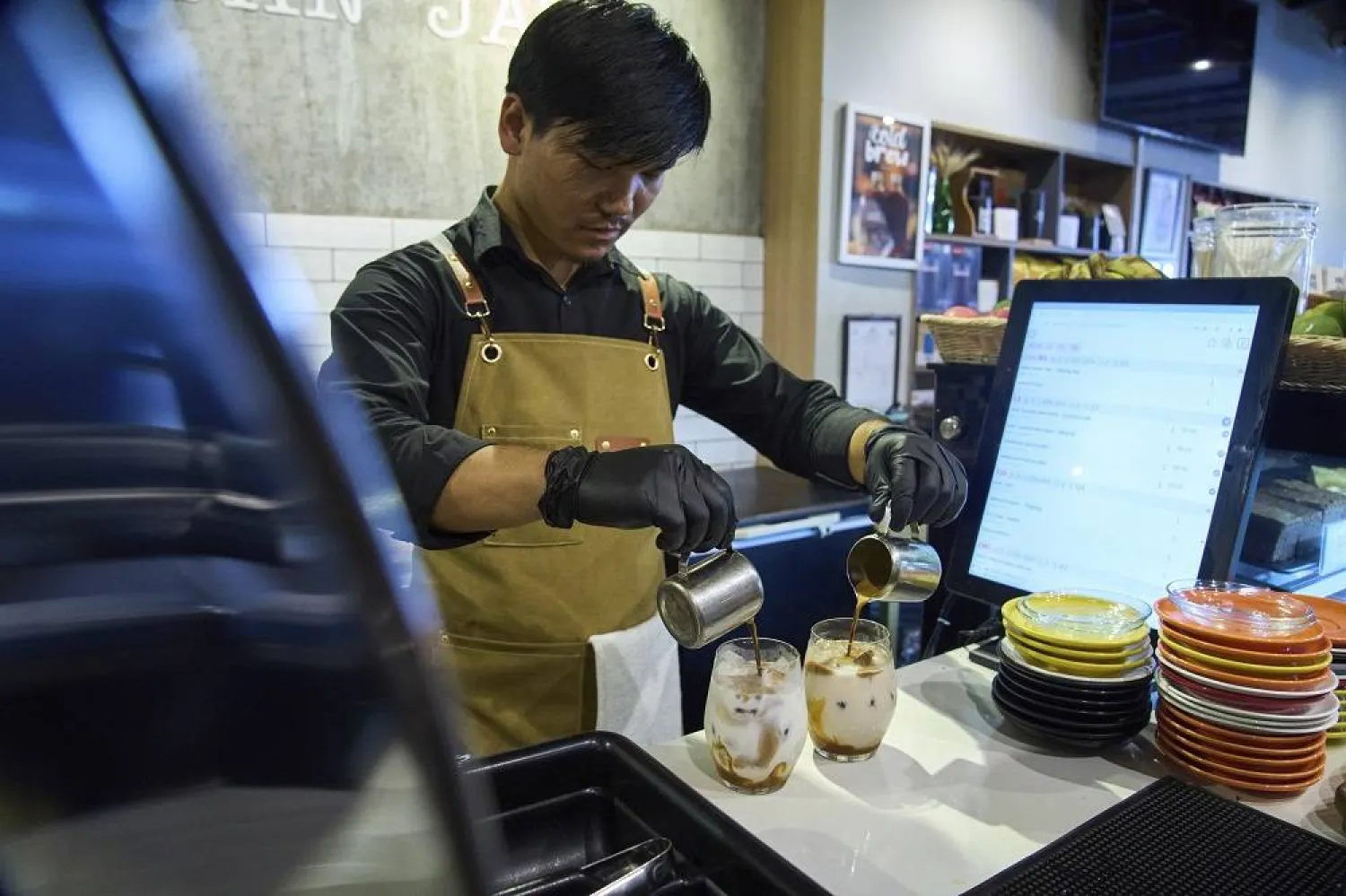
An employee prepares a coffee for a customer at Himalayan Java cafe at Boudhanath Stupa in Kathmandu, Nepal, Tuesday, June 10, 2025. (AP)
TT

Tea-Loving Nepal Is Warming up to Coffee 

An employee prepares a coffee for a customer at Himalayan Java cafe at Boudhanath Stupa in Kathmandu, Nepal, Tuesday, June 10, 2025. (AP)

Coffee hasn't always been an easy sell in Nepal.

The Himalayan country is a major tea producer, as well as a major consumer. When people greet each other in the morning, they don't ask “how are you.” They say “have you had your tea?”

Tea — usually served with as a sweet, milky beverage in a piping hot glass tumbler — is as much a part of Nepal's culture as rice, a constant presence at homes, meetings and social gatherings.

But a growing number of Nepalis are warming up to coffee, as trendy cafes spring up street corners in cities and towns across the country.

Nepalis started trying coffee in the 90s. One cafe in the capital, Kathmandu, is widely seen as the pioneer.

Gagan Pradhan began Himalayan Java as a single cafe in an alley, and it's grown to a chain with 84 locations in the country. Pradhan estimates there around 7,000 cafes across the country, although so far international brands like Starbucks aren't in Nepal.

“There are lot of tea shops throughout the nation, but the kind of set up they have is still kind of old fashioned,” Pradhan said. “I think with investors and people like us, when it comes to coffee shop we are more serious not only with machines, we are serious with everything like the lighting, the set up, the furnishings, the location.”

Pradhan said tea shops usually offer just black tea or tea with milk, whereas a typical coffee menu has 10-15 hot beverages and about 10-15 cold beverages, he said.

Pradhan said it’s an appealing business because the initial investment to open a cafe is very low, they’re clean and simple enough for a single family to run, and customers are willing to pay more for coffee.

Several of eastern Nepal’s tea plantations in the mountains of east Nepal, famous for the tea, are joined by coffee plantations now.

Coffee is expensive, but it's a lifestyle Nepal is part of a regional trend. Coffee consumption has soared across traditionally tea-drinking countries in Asia as members of growing middle classes seek out novel flavors and adopt international trends.

Coffee is a premium drink in Nepal: it costs about $2 at Himalayan Java, which is enough to buy a meal at a local cafe in Kathmandu, or five cups of tea. Still, cafes bustle with office workers on breaks and students looking for places to study.

“I think the idea of drinking coffee (in Nepal) was first triggered with people thinking it would elevate their standard of living, but then once they tasted coffee many people just liked it and continued to drink it,” said Deep Singh Bandari, a social worker who is a regular visitor to the coffee cafes.

Nepal is starting to produce coffee too. Most of the coffee drunk in Nepal is imported, but in the country's famous eastern tea-growing regions coffee plantations are springing up.

According to Nepal’s National Tea and Coffee Development Board, about 400 tons of coffee was produced in fiscal year 2021-22, the most recent for which data is available. That's a drop in the percolator compared to the 26,000 tons of tea produced the same year, but the board predicts rapid growth.

“Both young and old people in Nepal just love coffee, and the number of coffee drinkers is growing every day. This trend is just going to grow,” said Pradhan.



Italy Uncovers Basilica Designed by Vitruvius, the 'Father of Architecture'

A handout photo made available by Regione Marche press office shows the excavations in Piazza Andrea Costa from which large columns emerge, remains believed of the Basilica of Vitruvius, in Fano, Italy, 19 January 2026. (EPA/Regione Marche press office)
TT

Italy Uncovers Basilica Designed by Vitruvius, the 'Father of Architecture'

A handout photo made available by Regione Marche press office shows the excavations in Piazza Andrea Costa from which large columns emerge, remains believed of the Basilica of Vitruvius, in Fano, Italy, 19 January 2026. (EPA/Regione Marche press office)

Italian officials on Monday hailed the discovery of a more than 2,000-year-old public building attributed to Vitruvius, the ancient Roman architect and engineer known as the "father of architecture."

"It is a sensational finding ... something that our grandchildren will be talking about," Italian Culture Minister Alessandro Giuli told a press conference.

Vitruvius, who lived in the ‌1st century BC, ‌is celebrated for having written "De architectura," ‌or ⁠The Ten ‌Books on Architecture, the oldest surviving treatise on the subject.

His teachings on the classical proportions of buildings have inspired artists over centuries, including Leonardo da Vinci, whose famous drawing of the human body is known as the "Vitruvian Man."

Archaeologists believe they have found ⁠the remains of an ancient basilica, or public building, in the central ‌Italian city of Fano northeast of ‍Rome, that was created ‍by Vitruvius.

"I feel like this is the discovery ‍of the century, because scientists and researchers have been searching for this basilica for over 500 years," said the Mayor of Fano Luca Serfilippi.

"We have absolute match" between what was discovered and the descriptions given by Vitruvius in his books, regional archaeological superintendent Andrea Pessina told reporters.

The basilica had a rectangular layout, with 10 columns on the long side, and four on the short ones, Pessina said.

During excavation, when traces of four columns emerged, archaeologists used Vitruvius' descriptions to calculate where the top right column should be. When they started digging, they found it immediately, Pessina said.

"The are few certainties in archaeology ... but we were impressed by the precision" of the match, he added.

Further digging will determine whether more of the ‌basilica lies underground and if the site can be shown to the public, the superintendent said.


French TV Broadcasts Louvre Robbery Images

People wait for the Louvre museum to open as employees at the Louvre Museum vote to extend a strike that has disrupted operations at the world's most visited museum, Thursday, Dec. 18, 2025 in Paris. (AP)
TT

French TV Broadcasts Louvre Robbery Images

People wait for the Louvre museum to open as employees at the Louvre Museum vote to extend a strike that has disrupted operations at the world's most visited museum, Thursday, Dec. 18, 2025 in Paris. (AP)

Footage of the spectacular robbery at the Louvre Museum has been broadcast for the first time on French television, showing the brazen jewel thieves breaking into display cases.

The images, filmed by surveillance cameras, were shown by the TF1 and public France Televisions channels on Sunday evening, three months after the hugely embarrassing break-in in October.

They show the two burglars, one wearing a black balaclava and a yellow high-visibility jacket, the other dressed in black with a motorcycle helmet, as they force their way into the Apollo Gallery.

After breaking in through a reinforced window with a high-powered disk cutters, they begin slicing into display cases under the eyes of several staff members who do not intervene.

Managers at the Louvre have stressed that staff are not trained to confront thieves and are asked to prioritize the evacuation of visitors.

During the roughly four minutes that the two men were inside the gallery, one staff member can be seen holding a bollard used to orient visitor through the gallery, according to France Televisions.

The images form a key part of the ongoing criminal investigation into the October 19 heist.

Details of the footage have been reported in French newspapers, including Le Parisien.

Four suspects are in police custody, including the two suspected thieves, but the eight stolen items of French crown jewels worth an estimated $102 million have not been found.

The security failures highlighted by the break-in on a Sunday morning in broad daylight have lead to major pressure on director Laurence des Cars, who has apologized.

Metal bars have since been installed over the windows of the Apollo Gallery.


Cultural Development Fund Highlights Economic Value of Saudi Culture in Davos

The Cultural Development Fund (CDF) logo
TT

Cultural Development Fund Highlights Economic Value of Saudi Culture in Davos

The Cultural Development Fund (CDF) logo

The Cultural Development Fund (CDF) is participating in the Saudi House pavilion initiative, led by the Ministry of Economy and Planning, during the Annual Meeting of the World Economic Forum 2026, held in Davos, Switzerland, from January 19 to 23.

Through this participation, CDF aims to showcase the economic value of Saudi culture, highlight its role in diversifying the national economy and enhancing quality of life, attract international investment in the cultural sector, and spotlight Saudi cultural entrepreneurship.

According to a statement from the fund, the CDF’s participation includes a networking breakfast bringing together global economic leaders and investors from various countries, with the aim of raising awareness of Saudi culture as an economic force and a key pillar of Saudi Vision 2030.

The event will also provide a platform for exchanging perspectives and opportunities with international investors and financial institutions, while offering a closer look at the enablers of the Saudi cultural sector and its investment opportunities.

As part of the event, the CDF will host a panel discussion titled “Investing in Culture as an Economic Engine” that will feature CEO of the Cultural Development Fund Majed bin Abdulmohsen Al-Hugail, alongside Deputy Minister of Cultural Strategies and Policies at the Ministry of Culture Albara Al-Auhali.

The discussion will address the economic value of culture globally and locally, highlighting the CDF’s role in providing financial solutions that support cultural enterprises and enable their contribution to GDP growth and quality of life. The session will also explore cultural policies and their impact on strengthening the sector’s economic and investment potential.

Within the NextOn dialogue series organized by the Saudi House in Davos, the Cultural Development Fund will enable supported cultural projects to share their success stories and highlight their role in enhancing cultural production and increasing its economic value.

Participating entrepreneurs include Co-Founder of AlMashtal Creative Incubator Princess Noura bint Saud bin Naif, and CEO of Arabian Housing and Building company (AHB) Khalid Henaidy, who will speak about the role of entrepreneurship in shaping the future of the Kingdom’s cultural economy.

‏This participation underscores the CDF’s role as a center of excellence and financial enabler for the cultural sector in the Kingdom, and forms part of its efforts to strengthen the presence of Saudi cultural dynamism on the global stage. It aligns with the CDF’s objectives to maximize the cultural sector’s economic and social impact, increase its contribution to GDP, quality of life, and advance the goals of Saudi Vision 2030.