


Made in China? The Remarkable Tale of Venice's Iconic Winged Lion

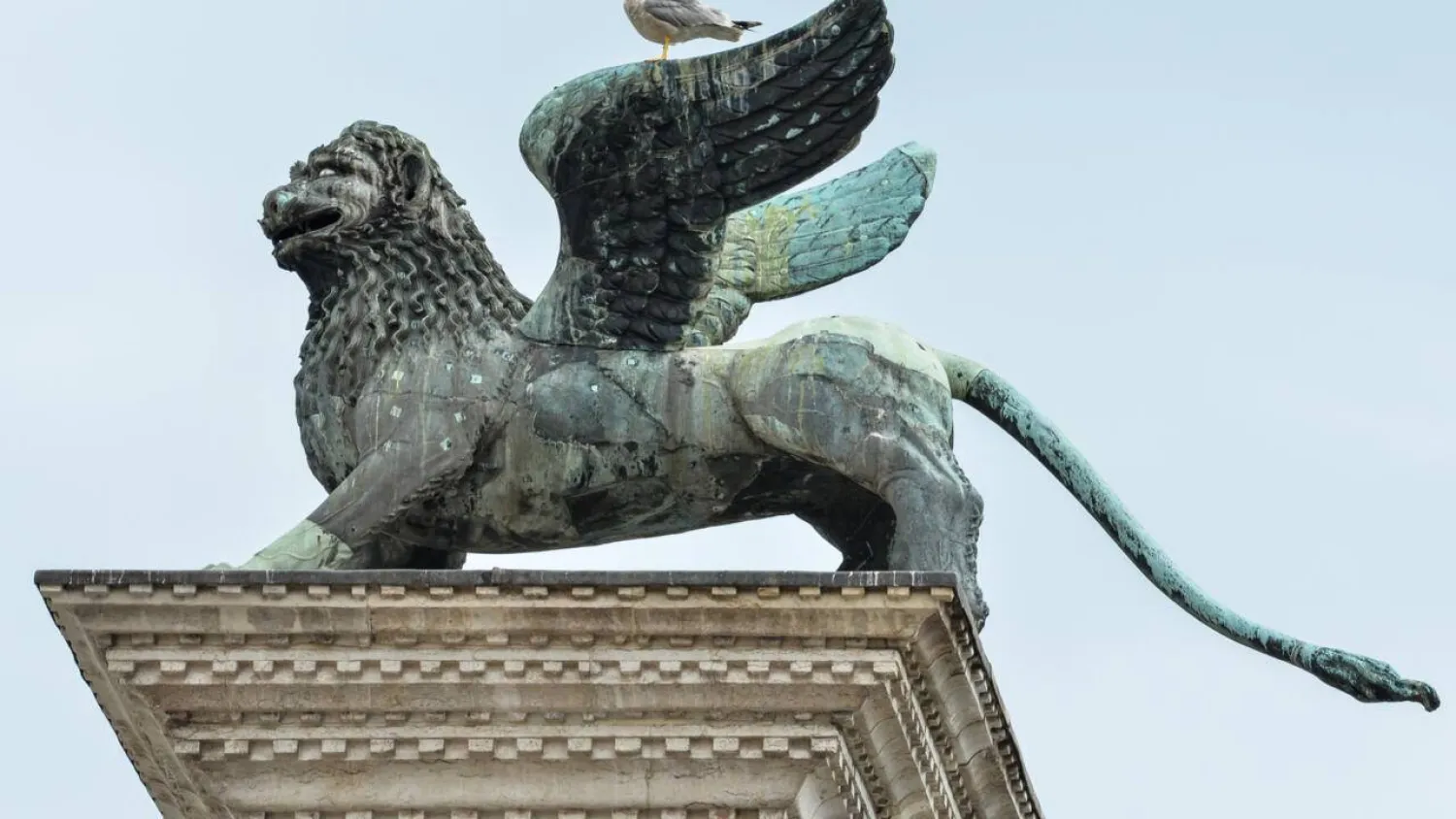
Made in China? The Lion of Venice sculpture sits on top of a column in Piazza San Marco.  ANDREAS SOLARO / AFP/File
Made in China? The Lion of Venice sculpture sits on top of a column in Piazza San Marco. ANDREAS SOLARO / AFP/File
TT

Made in China? The Remarkable Tale of Venice's Iconic Winged Lion

Made in China? The Lion of Venice sculpture sits on top of a column in Piazza San Marco.  ANDREAS SOLARO / AFP/File
Made in China? The Lion of Venice sculpture sits on top of a column in Piazza San Marco. ANDREAS SOLARO / AFP/File

A winged lion sculpture that symbolizes the Italian city of Venice was made in China and went on a remarkable journey that possibly involved explorer Marco Polo's father and the court of Mongol emperor Kublai Khan, researchers suggested Thursday.

Every year millions of people pass under the Lion of Venice, an ancient bronze sculpture which looks out on the Venetian Lagoon from the top of a column on the main square Piazza San Marco.

However much about this icon of the Venetian Republic remains shrouded in mystery.

It bears clear signs of having had a life before being installed near Saint Mark's Basilica and Doge's Palace.

Over the centuries its ears have been shortened, its wings have been changed -- the sculpture even once had horns that were shorn off at some point.

"We don't know when the sculpture arrived in Venice, where it was reworked, who did it, or when it was erected on the column where it is still visible today," Massimo Vidale, an archaeologist at the University of Padua and co-author of a new study, said in a statement.

The only historical document that mentions the sculpture dates back to 1293, when it was already damaged and in need of repair.

The violet granite of the sculpture's column -- which could have been looted from the sacking of the ancient city Constantinople, modern-day Istanbul -- likely arrived in Venice shortly before 1261, the study said.

Hoping to shed light on the winged lion's mysterious past, a team of Italian researchers analyzed lead isotopes in samples taken during a 1990 restoration.

The sculpture's copper ore was mined in the Yangtze River basin in China, the analysis revealed.

That is dramatically farther east than previous theories about where the sculpture came from, which include a 12th-century Venetian foundry, or somewhere in Anatolia or Syria during the Hellenistic period.

A 'somewhat brazen idea'

And it may not actually be a lion at all.

It more closely resembles tomb guardian sculptures called "zhenmushou" from China's Tang Dynasty (618–907 AD), the researchers said.

"These hybrid creatures share leonine muzzles, flaming manes, horns and raised wings attached to the shoulders, pointed upraised ears and, sometimes, partially humanized facial features," according to the study in the journal Antiquity.

Although made from different material, the zhenmushou sculptures that are still around look very similar to the Lion of Venice -- particularly its "bulbous nose", the study added.

So how did this tomb guardian make it all the way to Venice?

Perhaps in the luggage of Niccolo and Maffeo Polo, the father and uncle of the famed Venetian explorer Marco Polo, the researchers theorized.

Around 1265, the travelling merchants visited the court of the Mongol emperor Kublai Khan in Khanbalik -- modern-day Beijing.

They could have stumbled on the sculpture there, the researchers said.

Just years earlier the Republic of Venice had adopted the lion as its symbol, and "the Polos may have had the somewhat brazen idea of readapting the sculpture into a plausible (when viewed from afar) Winged Lion," the study said.

They could have then sent the sculpture to Venice along the trade route known as the Silk Road.

That was not the end of its travels. After French general Napoleon Bonaparte defeated the Venetian Republic in 1797, he moved the winged lion to Paris.

Broken into pieces, it did not return to Venice until 1815.


Desert X AlUla Unveils Acclaimed Lineup of Saudi and Global Artists in 2026 Edition

Running from January 16 to February 28, the exhibition will feature an exceptional selection of specially commissioned artworks. SPA
TT

Desert X AlUla Unveils Acclaimed Lineup of Saudi and Global Artists in 2026 Edition

Running from January 16 to February 28, the exhibition will feature an exceptional selection of specially commissioned artworks. SPA

Arts AlUla has announced the lineup of Saudi and international artists participating in the fourth edition of Desert X AlUla, the international open-air art exhibition held in collaboration with Desert X.

Running from January 16 to February 28, the exhibition will feature an exceptional selection of specially commissioned artworks, ranging from large-scale installations and sound pieces that stretch across and beneath the desert landscape, to kinetic works and immersive interactive experiences.

The showcase reflects a deep connection to AlUla’s unique environment, its dramatic natural landscapes, and rich cultural heritage.

Desert X AlUla, the region’s first public art biennial, will feature 11 artists presenting diverse perspectives, materials, and artistic traditions in their large-scale works in its 2026 edition.

The program offers a delightful mix of performances and interactive family activities, alongside dedicated programs that blend sound, movement, storytelling, and play.

Also, the visitor pavilion will host a live music program curated in collaboration with AlUla Music Hub, creating moments where art, nature, and community converge in a shared experience shaped by rhythm and a strong sense of place.

Arts AlUla confirmed that Desert X AlUla 2026 will be open to the public.


Saudi Heritage Commission Announces Discovery of 20 Rock Engravings in Soudah Peaks Project

The newly identified sites feature inscriptions and rock carvings estimated to be between 4,000 and 5,000 years old. (SPA)
TT

Saudi Heritage Commission Announces Discovery of 20 Rock Engravings in Soudah Peaks Project

The newly identified sites feature inscriptions and rock carvings estimated to be between 4,000 and 5,000 years old. (SPA)

Saudi Arabia’s Heritage Commission, in collaboration with Soudah Development, a Public Investment Fund company, announced on Tuesday the discovery of 20 ancient rock art sites within the Soudah Peaks area.

Spanning more than 636.5 square kilometers across Soudah and parts of Rijal Almaa, the project area is now recognized as home to some of the region’s oldest cultural landmarks. The newly identified sites feature inscriptions and rock carvings estimated to be between 4,000 and 5,000 years old, offering valuable insights into the region’s rich history.

The findings include Thamudic inscriptions, along with vivid depictions of ibex, hyenas, and ostriches, as well as scenes of hunters, dancers, palm trees, and weapons, reflecting the environmental and social practices of the ancient communities that once inhabited the area.

The survey forms part of a memorandum of understanding signed between the Heritage Commission and Soudah Development. Conducted in four scientific phases, the initiative began with data collection and site analysis, concluding with the documentation and classification of high-value archaeological sites in preparation for future development and preservation efforts.

Soudah Development remains committed to protecting and promoting the natural and cultural heritage of the project area. The company continues to work towards creating an integrated cultural and tourism experience that reflects the authenticity and historical richness of the region, in line with its vision to transform Soudah Peaks into a premier luxury mountain destination rooted in heritage.


Ancient Rome Meets Modern Technology as Tourists Visit Restored, Frescoed Home via Livestream Tours

 Colosseum Archeological Park guide Valentina uses a head-mounted device to livestream a guided tour for the press of the newly-restored underground House of Griffins, dated between the II and I century B.C., on the Palatine Hill next to the Colosseum, in Rome, Tuesday, Jan. 13, 2026. (AP)
Colosseum Archeological Park guide Valentina uses a head-mounted device to livestream a guided tour for the press of the newly-restored underground House of Griffins, dated between the II and I century B.C., on the Palatine Hill next to the Colosseum, in Rome, Tuesday, Jan. 13, 2026. (AP)
TT

Ancient Rome Meets Modern Technology as Tourists Visit Restored, Frescoed Home via Livestream Tours

 Colosseum Archeological Park guide Valentina uses a head-mounted device to livestream a guided tour for the press of the newly-restored underground House of Griffins, dated between the II and I century B.C., on the Palatine Hill next to the Colosseum, in Rome, Tuesday, Jan. 13, 2026. (AP)
Colosseum Archeological Park guide Valentina uses a head-mounted device to livestream a guided tour for the press of the newly-restored underground House of Griffins, dated between the II and I century B.C., on the Palatine Hill next to the Colosseum, in Rome, Tuesday, Jan. 13, 2026. (AP)

One of the best-preserved ancient Roman homes on the Palatine Hill is opening to the public for the first time, albeit via a livestreamed tour of its hard-to-reach underground frescoes and mosaics.

The House of the Griffins was first discovered during the excavations in the early 20th century of the Palatine Hill, the verdant hill that rises up from the Roman Forum and dominates views of central Rome today with its striking red brick ruins.

The hill, located just off the Colosseum, was the site of temples and homes of leading citizens during Rome’s Republican era, which is traditionally dated from 509 B.C. to 27 B.C. It became the aristocratic quarter during the Roman Empire that followed, when new palaces were built on top of the older homes.

The House of the Griffins is one of those earlier Republican-era homes, and was hidden to the world underground after the Emperor Domitian built his palace on top of it in the first century A.D.

Now for the first time, the general public can virtually visit the House of the Griffins and its newly restored frescoes, including the decoration that gives the home its name: An arched lunette fresco featuring two griffins — the half-eagle, half-lion mythological creatures.

Visitors won’t actually walk through the home’s intimate rooms, which are only accessible via a perilously steep staircase underground. Rather, visitors above ground will watch as a tour guide wearing a head-mounted smartphone descends into the domus and walks through its rooms, livestreaming the visit and narration.

The live, virtual tour serves multiple purposes: It allows visitors to “see” a domus that, because of its underground location, would otherwise be off-limits. And by limiting the number of people in its rooms, the livestreaming protects the delicate frescoes from too much humidity and carbon dioxide.

Project chief Federica Rinaldi said archaeologists don’t know much about the family who lived there, but said they were clearly well-off. The level of decoration recalls some of the elegant homes of the era in Pompeii: The frescoes feature richly colored faux marble designs, and floor mosaics of three-dimensional cubes.

“Its location at the highest point of the hill, its distribution over several levels that take advantage of the slopes of the Palatine Hill itself, and its preservation make it today an almost textbook reference," she said. “It was certainly a domus of the highest standard.”

Starting on March 3, the livestreamed tours will be held weekly, on Tuesdays, with one in Italian and one in English, though more are foreseen. Groups are limited to a dozen people and require reservations, as well as an additional ticket beyond the typical Colosseum-Palatine Hill entrance fee.

The restoration of the House of the Griffins is one of 10 projects funded by the European Union in the archaeological park and is part of an effort to spread tourists out beyond the must-see Colosseum and Forum, which often get overwhelmed with visitors.

“It’s a great occasion to value the full territory of the park,” said the head of the park, Simone Quilici.
