


Frida Kahlo Portrait Could Sell for $60 Million and Shatter Records at Sotheby’s

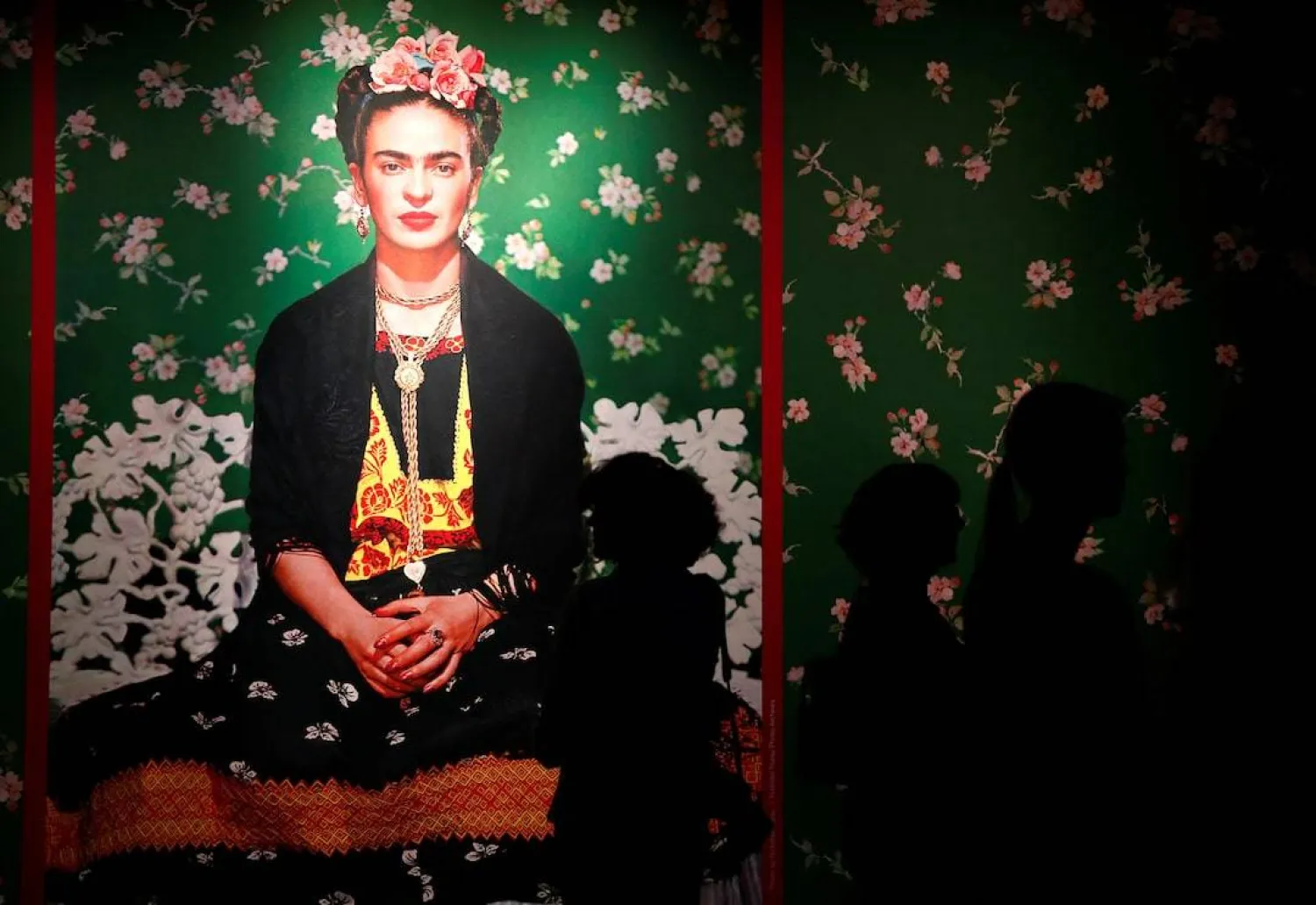
Visitors attend the "Frida Kahlo: Masterpieces from the Museo Dolores Olmedo, Mexico City" exhibition at the Hungarian National Gallery in Budapest, Hungary, August 2, 2018. Picture taken August 2, 2018. (Reuters)
TT

Frida Kahlo Portrait Could Sell for $60 Million and Shatter Records at Sotheby’s

Visitors attend the "Frida Kahlo: Masterpieces from the Museo Dolores Olmedo, Mexico City" exhibition at the Hungarian National Gallery in Budapest, Hungary, August 2, 2018. Picture taken August 2, 2018. (Reuters)

Frida Kahlo’s face is one of the best known in art, thanks to her bold and challenging self-portraits.

A lesser-seen self-depiction by the Mexican artist is going up for auction at Sotheby’s in what could be a record-setting sale.

With an estimated price of $40 million to $60 million, "El sueño (La cama)" – in English, "The Dream (The Bed)" — may surpass the top price for a work by any female artist when it goes under the hammer on Nov. 20. That record currently stands at $44.4 million, paid at Sotheby’s in 2014 for Georgia O’Keeffe’s "Jimson Weed/White Flower No. 1."

The highest price at auction for a Kahlo work is $34.9 million, paid in 2021 for "Diego and I," depicting the artist and her husband, muralist Diego Rivera. Her paintings are reported to have sold privately for even more.

"It's not just one of the more important works by Kahlo, but one of a few that exists outside of Mexico and not in a museum collection," said Julian Dawes, vice chairman and head of impressionist and modern art for Sotheby’s Americas. "So as both a work of art and as an opportunity in the market, it could not be more rare and special."

Kahlo vibrantly and unsparingly depicted herself and events from her life, which was upended by a bus accident at 18. She started to paint while bedridden, underwent a series of painful surgeries on her damaged spine and pelvis, then wore casts until her death in 1954 at age 47.

Painted in 1940, "El sueño (La cama)" shows the artist, wreathed in vines, lying in a four-poster bed floating in a pale blue sky. A skeleton wired with dynamite and clutching a bouquet of flowers lies atop the canopy.

The image is exploding with symbolism and feels like an allegory – but the artist really did have a papier-mâché skeleton on top of her bed.

Dawes said it's a psychological self-portrait by an artist at her peak.

"Her greatest works derive from this moment between the late 1930s and the early 1940s," he said. "She has had a variety of tribulations in her romantic life with Diego, in her own life with her health, but at the same time she’s really at the height of her powers."

Last exhibited publicly in the late 1990s, the painting is the star of a sale of more than 100 surrealist works by artists including Salvador Dalí, René Magritte, Max Ernst and Dorothea Tanning. They are from a private collection whose owner has not been disclosed.

A century after Andre Breton’s "Surrealist Manifesto" defined a revolutionary artistic movement characterized by unsettling juxtapositions and paradoxical statements, interest in – and prices for – surrealist art are booming. Surrealism’s share of the art market rose from 9.3% to 16.8% between 2018 and 2024, according to Sotheby’s. Magritte’s "L’empire des lumières" sold last year for $121.2 million, a record for a surrealist work.

Kahlo resisted being labeled a surrealist, but Dawes said her "fascination with the subconscious" and use of otherworldly imagery place her squarely in that tradition.

He said it’s no surprise the genre is undergoing a resurgence.

"There are so many interesting parallels between the 1920s and the 2020s," Dawes said. "Coming out of a crippling global pandemic, a world that has to confront war on a more graphic and intimate level that had ever been experienced before — and economic and political and social forces swirling in the background that are eerily similar."

The Kahlo painting is on show at Sotheby’s in London until Tuesday, and then tours to Abu Dhabi, Hong Kong and Paris before the sale in New York.



As Iran Diplomacy Picks Up, Rubio Tours Taj Mahal

United States Secretary of State Marco Rubio poses with his wife, Jeanette Rubio, during their visit to the Taj Mahal in Agra, India, Monday, May 25, 2026. Pool via Reuters
TT

As Iran Diplomacy Picks Up, Rubio Tours Taj Mahal

United States Secretary of State Marco Rubio poses with his wife, Jeanette Rubio, during their visit to the Taj Mahal in Agra, India, Monday, May 25, 2026. Pool via Reuters

As diplomacy intensifies on ending the Iran war, top US diplomat Marco Rubio was spending Monday not in negotiations but at India's world-famous monument to love, the Taj Mahal.

Rubio, on his first-ever visit to India, flew to Agra and spent 45 minutes at the Taj Mahal with his wife Jeanette, who usually shuns the spotlight.

"It's one of the wonders of the world," Rubio said of the Taj Mahal.

"I think it's important to show respect to the culture of the countries that you visit."

Under a blazing sun in 40C heat, Rubio removed the tie from his navy-blue suit, put his arm around Jeanette, who wore a flowing dress with elegant heels.

The couple posed for pictures on the bench from where Princess Diana was photographed alone in an iconic 1992 shot.

The US ambassador to India, Sergio Gor, a high-octane former aide to President Donald Trump, smiled and eagerly joined some of the couple's pictures.

The normally teeming street leading to the Taj Mahal were cleared for Rubio, with other tourists kept 100 meters away from him -- although it was only a partial shutdown unlike when Vice President JD Vance visited.

Rubio was not entirely away from Iranian influence at the Taj Mahal, whose domes and four-way charbagh gardens are heavily influenced by Persian architecture.

The Taj Mahal was built in the 17th century on orders of Mughal emperor Shah Jahan as a mausoleum for his beloved wife Mumtaz Mahal who died in childbirth.

The excursion is unusual for Rubio, who in nearly a year and a half on the job has preferred short, business-like trips and rarely done events outside of government meetings.

Rubio said he was taking advantage of a one-day break in his schedule before a meeting in New Delhi on Tuesday of the Quad -- Australia, India, Japan and the United States.

He will also visit the palace-filled city of Jaipur on Monday to tour the Amber Fort.

Rubio is visiting four cities over four days in India as he seeks to revive ties with a country successive US administrations saw as a like-minded partner in a world dominated by China's rise.

Trump has shaken up that approach since returning to office, temporarily imposing high tariffs, warming to both China and India's historic adversary Pakistan, curbing visas used by Indian professionals and reposting insulting language about Indian immigrants.

Trump, in remarks Sunday by speakerphone to a celebration in New Delhi for the 250th anniversary of US independence, insisted he was on board with the relationship, telling the crowd, "we've never been closer to India, and India can count on me 100 percent".


French Artist Begins Giant ‘Cave’ Art Inflation Over Paris’ Oldest Bridge

People walk along the Seine river next to "The Pont Neuf Cave," an inflated art installation by French street artist JR, on Paris' oldest bridge, the Pont Neuf, Thursday, May 21, 2026, which will be open to the public from June 6-28. (AP Photo/Michel Euler)
TT

French Artist Begins Giant ‘Cave’ Art Inflation Over Paris’ Oldest Bridge

People walk along the Seine river next to "The Pont Neuf Cave," an inflated art installation by French street artist JR, on Paris' oldest bridge, the Pont Neuf, Thursday, May 21, 2026, which will be open to the public from June 6-28. (AP Photo/Michel Euler)

The oldest bridge in Paris has begun to vanish this week, as the artist JR — who is known as the “French Banksy” — began inflating a giant “cave” over the Pont Neuf.

The monumental, rocky illusion is swallowing the 17th-century landmark, which has carried Parisians across the Seine for more than 400 years. By Thursday, it looked as if a prehistoric cliff had risen in the heart of the city.

The inflation process, which was carried out overnight — after being delayed by bad weather — is the most dramatic stage yet of a project more than a year in the making.

One of the most ambitious public artworks Paris has seen in decades, which has been funded by the sale of JR’s work and a handful of corporate partners, does not open to the public until June 6.

“We’re about to leave something pretty incredible in the middle of Paris,” JR told The Associated Press earlier this year at his studio in the city’s east, wearing his trademark hat and shades.

The transformation of the bridge has been documented by the AP since March with time-lapse cameras, including one fixed on a rooftop terrace high above the river, watching the bridge slowly disappear day by day.

From the outside, the installation looks like a rocky mass that “literally” breaks the landscape, said JR, who is famous for pasting enormous photographs on buildings, walls and rooftops around the world. This time he wanted Parisians to do something unusual on their busiest bridge: stop.

Visitors will be able to walk for free through a long, dark tunnel that lets in no daylight and where, according to JR, people “will lose track of time.”

The numbers are startling. The structure is 120 meters (393 feet) long and 18 meters (59 feet) tall — which is as high as a six-story building.

Yet it is built almost entirely from air — 80 fabric arches filled with 20,000 cubic meters of it — and weighs only about five tons. The fabric was hand stitched by 25 artisans in a village in Brittany.

Nothing digs into the historic stone.

Cut the air and the cliff would sink like a held breath — a collapse JR’s engineers spent weeks rehearsing in a hangar at Orly airport to be sure that if the power ever failed, the rock would come down gently.

The artwork, called La Caverne du Pont Neuf, is a tribute to a Parisian artistic legend.

In 1985, artist Christo and his wife, Jeanne-Claude, wrapped the same bridge in pale golden fabric — 13 kilometers of rope, a decade of arguing with city hall, three million visitors in two weeks. The act helped invent the idea of monumental art in modern cities.

A square beside the bridge now carries their names.

“It’s pretty hard to go after them,” JR said.

His idea, he said, is to bring “mineral and nature” back to the heart of the city. He is not covering the bridge but undressing it — sending the dressed stone back to the limestone quarries from which Paris itself was cut.

The cave is also a warning. JR built it as a nod to Plato’s allegory, in which prisoners mistake shadows on a wall for the real world.

“What are our caves today? Our phones,” he said. “Because we believe that our algorithm on social media is the reality.”

Then he walks straight into the contradiction: to enter his cave about screens, visitors raise their phones.

The tech company Snap has built an augmented-reality layer that shows what the eye cannot.
The sound is a low, mineral hum from Thomas Bangalter, formerly of Daft Punk — who was 10 the year Christo wrapped the bridge.

The cave will be open around the clock from June 6-28, closing the bridge to traffic and visible from the quays, from passing boats, even from the top of the Eiffel Tower.

It will coincide with Paris Fashion Week, World Music Day and the all-night Nuit Blanche arts festival.

When it comes down, the fabric will be reused or recycled. Air, JR likes to say, leaves no scar.
Then, like the golden wrapping 40 years before, the cave will be gone — and the Pont Neuf, older than the republic and older than the revolution, will reappear exactly as it was.


Winston Churchill's 'Playful' Paintings Go on Show in London

The 'Winston Churchill: The Painter' exhibition opens on Saturday at the Wallace Collection in London. Justin TALLIS / AFP
TT

Winston Churchill's 'Playful' Paintings Go on Show in London

The 'Winston Churchill: The Painter' exhibition opens on Saturday at the Wallace Collection in London. Justin TALLIS / AFP

As Britain's wartime leader, Winston Churchill was known for his stirring speeches, but a new London exhibition explores another side to his creativity -- as a passionate and prolific artist.

The exhibition opening Saturday at the Wallace Collection will be the most significant display of the statesman's paintings for more than 60 years, including over 50 canvases, many of them rarely seen in public.

Churchill first tried painting during World War I after he resigned from the government over the 1915 failed Dardanelles naval attack.

This was a "very difficult time in his life" when "he suddenly finds himself with all this unwanted leisure time", Lucy Davis, co-curator of the exhibition, told AFP.

"And he discovered painting as a way of releasing the stress, the anguish that the situation had caused him."

The museum presents a chronological survey starting with his first paintings, created with advice from renowned artist John Lavery, then canvases painted in the 1920s at Chartwell, the country house where Churchill lived with his family.

Largely self-taught while associating with well-known painters, Churchill quickly became interested in landscape painting and drew inspiration from holidays in the south of France to create brightly colored canvases dominated by blues and ochre.

- 'Loved the light' -

Churchill "saw painting as a spur to travel" and "just loved the light and warmth and atmosphere, which he captures so beautifully", said Davis.

A whole room is dedicated to canvases inspired by trips to Morocco, including "The Tower of the Koutoubia Mosque", the only painting that Churchill did during World War II. A gift to US President Franklin D. Roosevelt, the painting recently belonged to Hollywood star Angelina Jolie.

The exhibition ends with the postwar period when Churchill, defeated in a general election, began painting again and continued until his death in 1965, with some of his works going on display at the Royal Academy.

Churchill had previously shown paintings at various galleries, but always under an assumed name.

As a statesman, Churchill went down in history for his wartime leadership, but as an artist, he had little interest in depicting current world events, the curator stressed.

"He was a wartime leader. He was known for these very stirring wartime speeches. But in these paintings, you really see his joie de vivre, his witty side, his playful side."

One painting at the exhibition is an exception: "The Beach At Walmer", painted in 1938 as fears grew of imminent war.

It shows a sandy beach in southern England with bathers paddling. But in the foreground, a black cannon points at the sea, suggesting a looming threat.