Saudi Media Ministry Launches ‘Levant Culture’ Activities as Part of ‘Global Harmony 2’https://english.aawsat.com/culture/5210375-saudi-media-ministry-launches-%E2%80%98levant-culture%E2%80%99-activities-part-%E2%80%98global-harmony-2%E2%80%99
Saudi Media Ministry Launches ‘Levant Culture’ Activities as Part of ‘Global Harmony 2’
The initiative is part of the Quality of Life Program. SPA
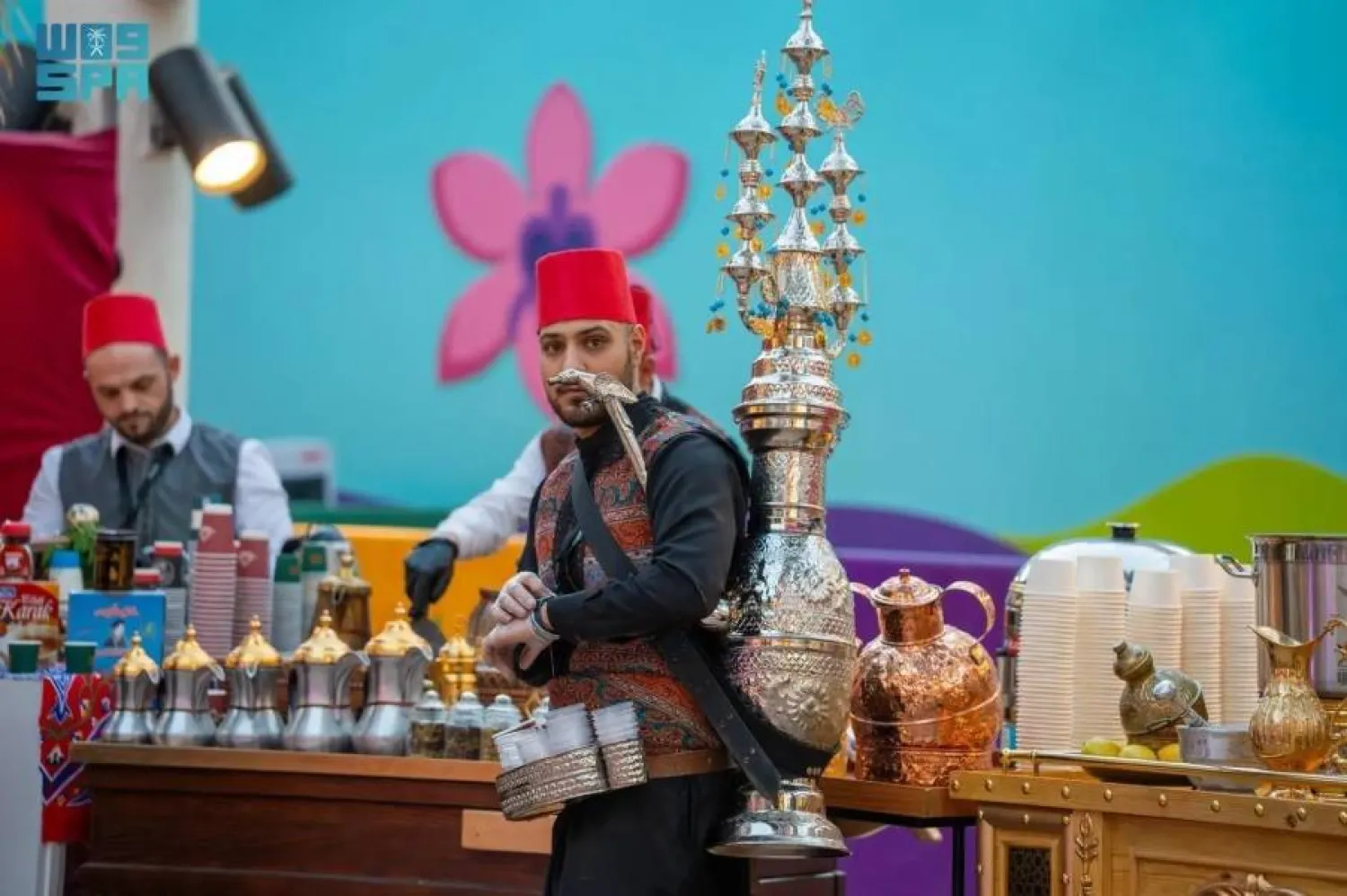
The Saudi Ministry of Media inaugurated the “Levant Culture” activities on Tuesday as part of the “Global Harmony 2” initiative, organized in cooperation with the General Entertainment Authority (GEA).
The initiative aims to enhance engagement with residents in the Kingdom and highlight the cultural diversity of Saudi Arabia through an interactive space that brings together different communities and cultures.
The initiative is part of the Quality of Life Program, one of Saudi Vision 2030 programs aimed at enhancing the quality of life and enriching the cultural landscape in the Kingdom. The Levant activities, which run for three days, highlight the cultures of Jordan, Syria, Palestine, and Lebanon.
The event features artistic performances and heritage booths showcasing aspects of Levantine culture, including traditional clothing and folk arts, alongside tasting experiences of popular Levantine dishes. Artists and creators present their performances on the event stage before a large audience.
The activities continue Wednesday with a series of artistic, entertainment, and folkloric performances showcasing a wide range of Levantine heritage and folk arts.
The “Global Harmony 2” activities attracted a large audience of citizens and residents from various nationalities, exceeding 800,000 visitors. Daily performances highlighted residents’ lives in the Kingdom across multiple aspects, their integration and harmony with Saudi society, as well as the efforts of government and private sectors to enhance the quality of life in Saudi cities.
Holy Quran Museum Showcases Rare 18th-Century Brass-Engraved Copy of the Quranhttps://english.aawsat.com/culture/5269098-holy-quran-museum-showcases-rare-18th-century-brass-engraved-copy-quran
Holy Quran Museum Showcases Rare 18th-Century Brass-Engraved Copy of the Quran
Among the museum’s distinctive exhibits is a copy of the Quran engraved on brass plates dating back to the 12th century AH - SPA
The Holy Quran Museum in the Hira Cultural District in Makkah offers a rich cultural and knowledge experience, enabling visitors to explore the history of the Holy Quran and its sciences, and view rare manuscripts and artifacts documenting the journey of its transcription through the ages, reflecting the care Muslims have given to the Holy Quran since the dawn of Islam to the present day, SPA reported.
Among the museum’s distinctive exhibits is a copy of the Quran engraved on brass plates dating back to the 12th century AH (18th century CE), showcasing the precision and mastery achieved in Islamic arts and the special attention given to Quranic transcription, combining beauty and scholarly accuracy.
This artwork embodies a continuation of deep-rooted traditions in Islamic calligraphy and decorative arts, utilizing various materials and techniques from parchment and paper to metals, highlighting Muslims’ profound connection to the Holy Quran and their commitment to preserving it in artistic forms that combine creativity and reverence.
Yemen Introduced the World to Coffee. Now, Its Coffeehouse Culture Is Booming in the UShttps://english.aawsat.com/culture/5268899-yemen-introduced-world-coffee-now-its-coffeehouse-culture-booming-us
Franchisee Ahmad Badr serves a drink and treat sampler at Arwa Yemeni Coffee on April 6, 2026, in Sunnyvale, Calif. (AP)
TT
TT
Yemen Introduced the World to Coffee. Now, Its Coffeehouse Culture Is Booming in the US
Franchisee Ahmad Badr serves a drink and treat sampler at Arwa Yemeni Coffee on April 6, 2026, in Sunnyvale, Calif. (AP)
Hundreds of years ago, Yemen helped introduce the world to coffee. Lately, the mountainous, war-ravaged country that borders Saudi Arabia and Oman is exporting something else: its coffee culture.
Yemeni coffeehouses are opening at a rapid pace across the US. The number of cafes run by six major chains that serve Yemeni-style drinks grew 50% last year to 136, according to Technomic, a restaurant industry consulting company. The count doesn’t include the many smaller chains and independent cafes serving coffees and teas imported from Yemen.
Yemeni coffeehouses are meeting the moment for several reasons. They stay open late — sometimes past 3 a.m., especially during Ramadan — and provide a place to socialize for the growing number of Americans who don’t drink alcohol. Last year, a Gallup poll found that just 54% US adults reported drinking alcohol, the lowest percentage in 90 years.
“Generally in the Middle East, our nightlife is coffee, right? People hang out at coffee shops, they play cards, they talk. We wanted to bring that here,” said Ahmad Badr, who owns an Arwa Yemeni Coffee franchise in Sunnyvale, California.
Another reason for the cafes’ popularity is the growing number of Americans of Arab descent. Between 2010 and 2024, the Arab American population in the US rose by 43%, compared to around 10% growth for the US population as a whole, according to the Arab American Institute.
While most Yemeni coffee shops are in places with high concentrations of Arab Americans, including Michigan, California and Texas, they’re also opening in locations as diverse as Alpharetta, Georgia; Overland Park, Kansas; and Portland, Maine.
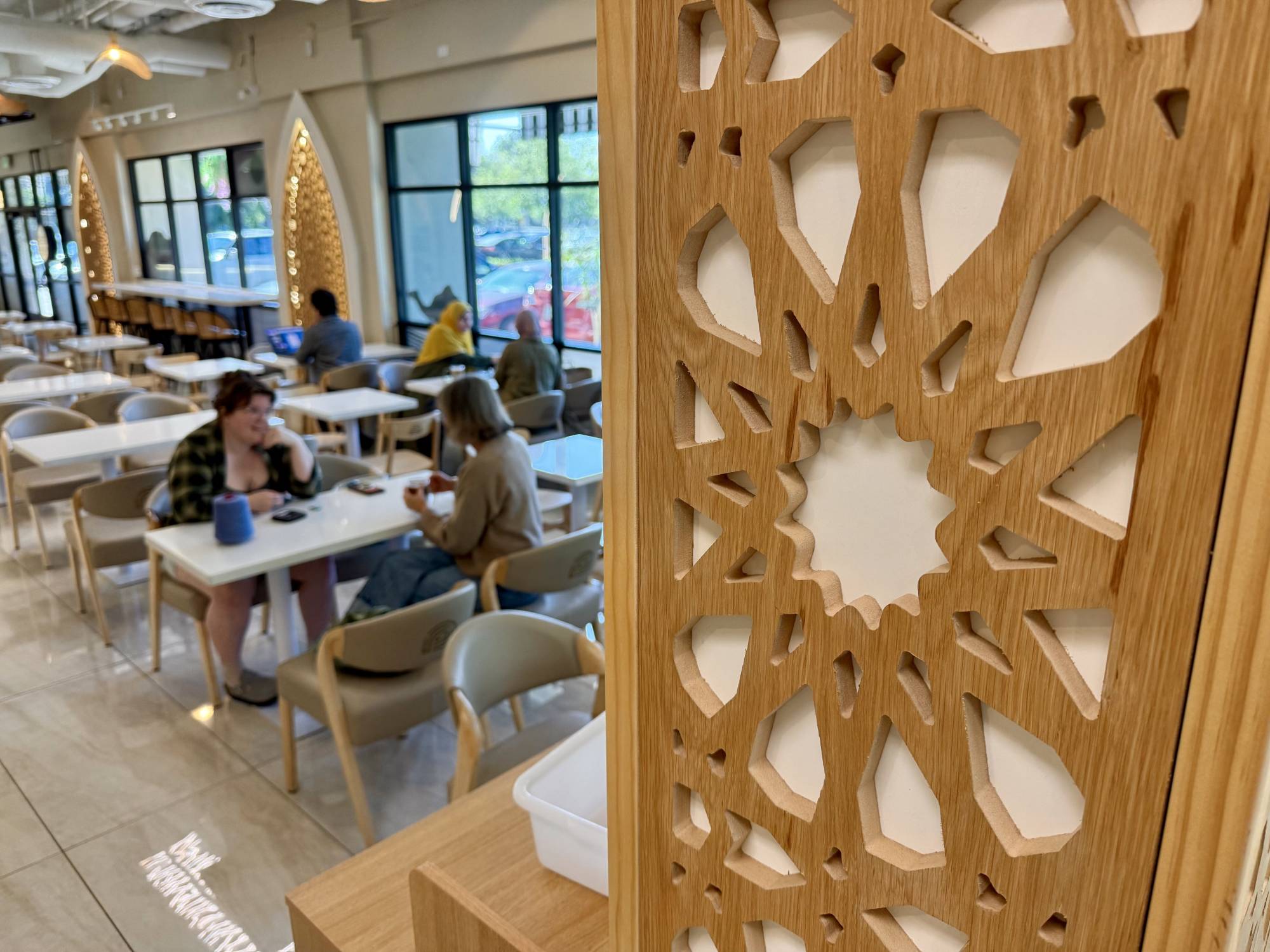
Customers are seen inside Arwa Yemeni Coffee on April 6, 2026, in Sunnyvale, Calif. (AP)
A taste of home
Faris Almatrahi is the co-founder and owner of Texas-based Arwa Yemeni Coffee, a chain with 11 cafes across the US and 30 more in development. He said an ongoing civil war in Yemen that began in 2014 has prevented Yemeni Americans like himself from visiting their homeland, so he has tried to evoke Yemen in his cafes.
Arwa locations are painted in natural desert tones, with archways that mimic mosques and lampshades shaped like the hats worn by Yemen’s coffee farmers.
“One of the ways to actually visit without traveling there was to bring that experience to the US, and that was a huge passion for us when we opened our first location,” Almatrahi said. “It was extremely emotional for all of us due to the fact that it really transported us to Yemen."
But Almatrahi noted that most of his customers aren’t of Arab descent. In fact, Americans of all backgrounds are seeking out new global flavors and authentic experiences, according to market research company Datassential. Food trends are also spreading quickly through social media.
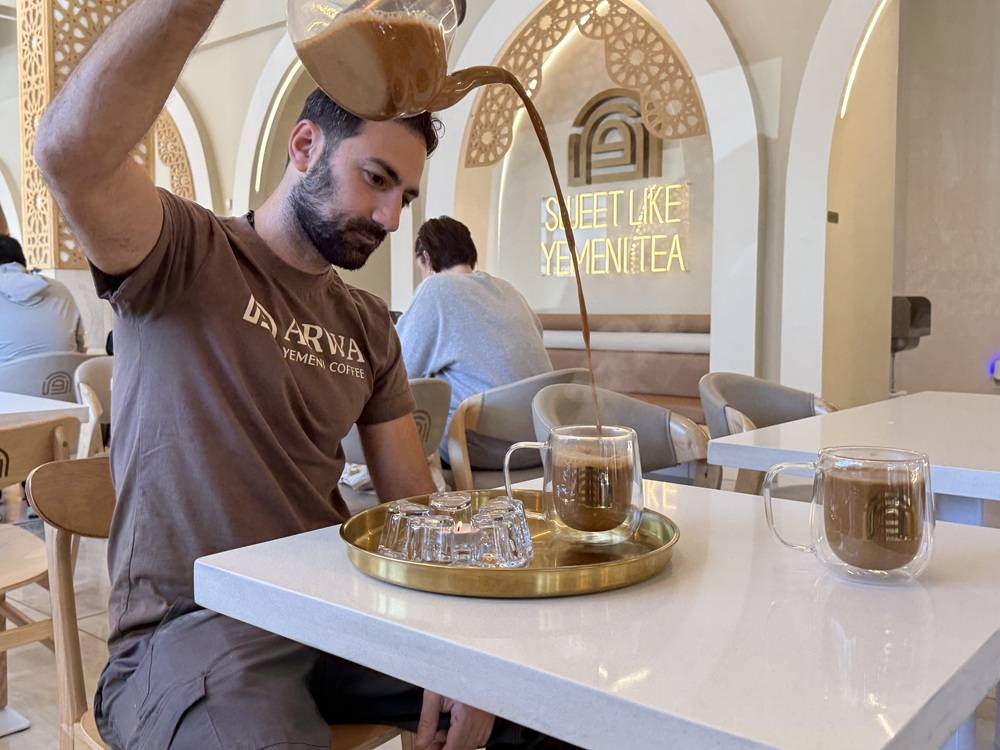
Menus vary, but Yemeni cafes generally serve specialties like Adeni tea, a spiced tea similar to chai, and qishr, a traditional drink made from the dried husks of coffee cherries. Familiar drinks like lattes might contain special spices or honey; at Arwa, lattes features the outline of a camel stenciled in spices.
Bakery cases might contain khaliat nahal, or Yemeni honeycomb bread, a cheese-filled pastry drizzled with honey, or basboosa, a cake soaked in sugar syrup and often flavored with lemon or rose water. Many Yemeni menus also mix in more typical US coffeeshop fare, like matcha lattes or berry refreshers.
Franchisee Samir Irani pours Adeni tea inside Arwa Yemeni Coffee on April 6, 2026, in Sunnyvale, Calif. (AP)
Choices for coffee lovers
Peter Giuliano, a researcher with the Specialty Coffee Association, a California-based nonprofit, said culturally specific cafes have been a key growth driver in the US coffee industry for the last few years. In addition to Yemeni cafes, he cited the Latin-style chain Tierra Mia in California and Nguyen Coffee Supply, a New York-based company that roasts Vietnamese beans.
A customer who visited Badr's shop in Sunnyvale for the first time said an internet search brought her there on a recent weekday. Cindy Donovan said she’s always on the hunt for good coffee and was excited by Yemeni coffees she tried.
“I think they're much more refined and mellow, and much more full of flavor than a regular cup of dark roast, for instance,” Donovan said. “The cardamom in the drinks is fantastic. Very, very flavorful, rich but not heavy.”
Most Yemeni coffee is sun-dried, which enhances its flavor and brings out undertones of chocolate and fruit, Almatrahi said. Yemeni cafes often mix coffee with special spice mixes – or hawaij – that may contain cardamon, ginger, cinnamon, cloves, coriander or nutmeg.
“Our coffee and teas are not just made through a fully automatic machine,” said Mohamed Nasser, the director of operations for Haraz Coffee House, a Dearborn, Michigan-based chain with 50 US outlets and another 50 in development. “We have to manually blend and mix our coffee and tea, boil it with water and evaporated milk, make sure that it comes out (with the) perfect taste, perfect color.”
Yemen's flavorful history
Coffee has a long history in Yemen. While the plant was likely discovered in Ethiopia, by the 1400s it was being cultivated in Yemen, where monks brewed it to stay awake during prayers, according to the National Coffee Association, a US trade group.
Yemen monopolized the coffee trade for around 200 years until Dutch merchants smuggled coffee seeds to Indonesia and began growing plants there.
Almatrahi said a revitalization of the Yemeni coffee industry over the last two decades, led by coffee companies, foundations and young entrepreneurs, helped make the current US boom possible.
Coffee is one of the most promising sectors for economic development in Yemen, where more than 80% of the population lives in poverty, according to the Food and Agriculture Organization of the United Nations.
“We are ambassadors for our culture and our people. So when we open these shops, we want to perform the outreach, to show the hospitality, to show what we have to offer,” Almatrahi said.
Private Museums Bolster Cultural Tourism in Qassim Regionhttps://english.aawsat.com/culture/5268564-private-museums-bolster-cultural-tourism-qassim-region
Private Museums Bolster Cultural Tourism in Qassim Region
A prominent example is the private museum of Abdullah Al-Suhaibani, an expert with over 40 years of experience in gemstones and minerals - SPA
Qassim Region is witnessing a significant rise in private museums, as individual collectors transform personal passions into vital cultural projects. These museums serve as a living memory for the community, preserving rare artifacts, historical documents, antique weapons, and vintage collections that document critical stages of the region's history. By connecting the present with its roots, these sites strengthen national identity and provide essential research resources for scholars and tourists alike, SPA reported.
A prominent example is the private museum of Abdullah Al-Suhaibani, an expert with over 40 years of experience in gemstones and minerals.
His collection features rare agates, fossils from ancient geological eras, and unique rock formations discovered throughout the Kingdom.
The museum acts as a scientific platform, promoting geology and field research while educating the community on the Kingdom’s diverse natural resources and mineral wealth.
Located near Al-Khabra Historical Village, these private initiatives have become key cultural landmarks in Riyadh Al-Khabra Governorate. Their growth aligns with Saudi Vision 2030 goals to develop cultural and scientific tourism, support local content, and position the Kingdom’s heritage and natural sites as premier global destinations.
لم تشترك بعد
انشئ حساباً خاصاً بك لتحصل على أخبار مخصصة لك ولتتمتع بخاصية حفظ المقالات وتتلقى نشراتنا البريدية المتنوعة