
By Thomas Rogers
The 22-year-old Swiss writer Nelio Biedermann has strange memories of visiting his family’s old properties when he was a child. Although he grew up middle-class in Zurich, his father was the descendant of an aristocratic family in Hungary that had, at one point, sold jewelry to royalty, but whose holdings were later seized by the communist regime.
“We would always travel to the castles that used to belong to us,” Biedermann recalled in a recent interview, describing them as “fairy-tale-like.” One property had been turned into a psychiatric institution whose walls were decorated with pictures of his ancestors. “The people there knew who we were,” he said. “I couldn’t identity with that.”
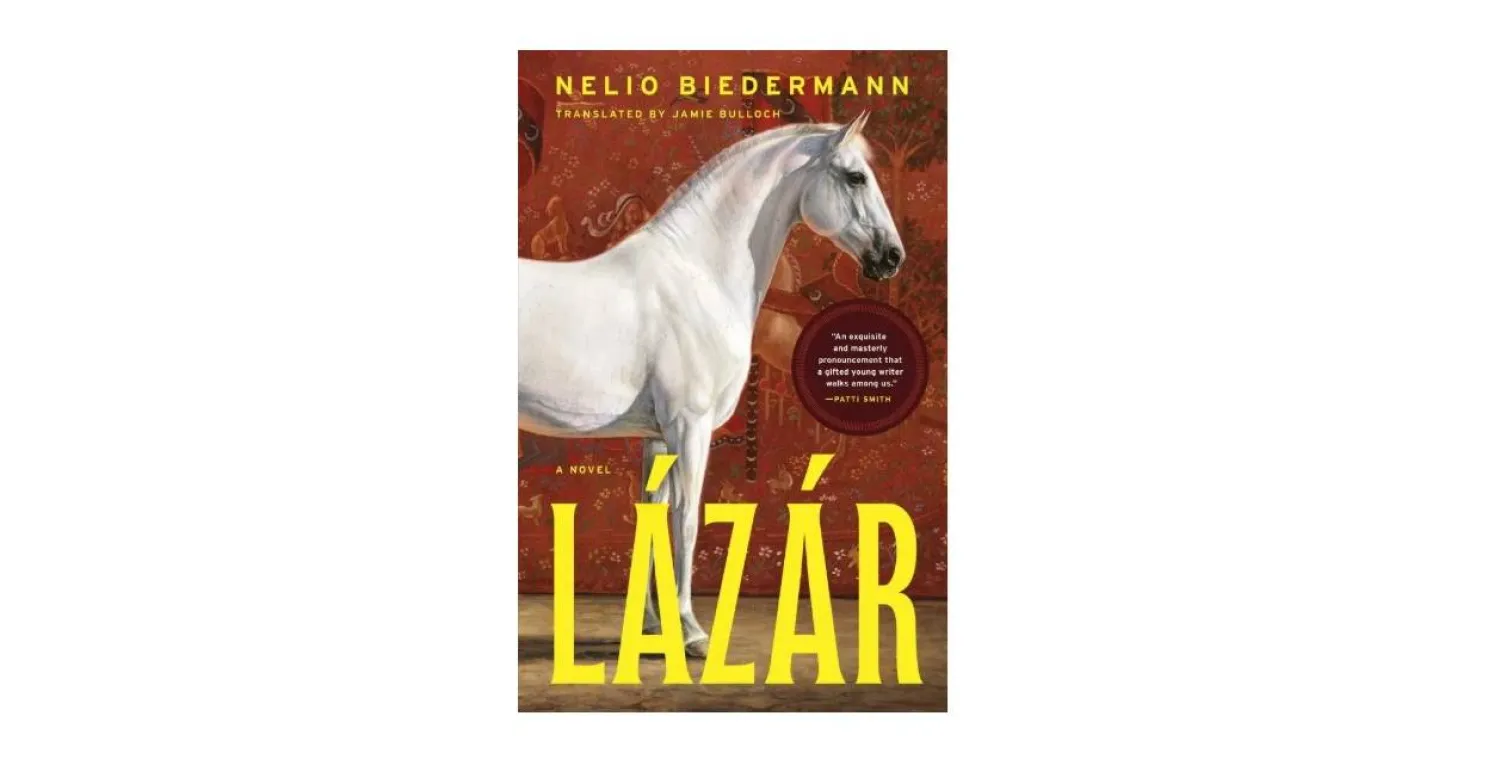
The experience helped inspire Biedermann to begin writing “Lázár,” his novel about an aristocratic family, when he was still a teenager. Published in Germany in September, the book earned a slew of rave reviews (“epic, tragic and traumatic, stormy, wistful and very romantic,” wrote a critic for Süddeutsche Zeitung, one of the country’s biggest daily newspapers).
It spent 29 weeks on the German best-seller list, turning its (shockingly) young author into a literary star overnight and drawing comparisons to “Buddenbrooks,” Thomas Mann’s 1901 family epic. Summit Books is publishing it in English on Tuesday.

Since the fall, the German news media has seemed obsessed with the question of how a teen could write a sweeping, traditional historical novel. “Most people expect a young person’s first book to be about their own life,” Biedermann said, sipping an herbal tea in a cafe in central Zurich. “But even if you discount my age, people found it interesting that the book is stylistically, linguistically old-fashioned.”
Lanky and soft-spoken, with a thin mustache and the kind of floppy haircut popular among Gen Z Swiss men, he is unswervingly modest in conversation. He said he began writing fiction when he was quarantined during the pandemic and his high school organized a writing competition about “ends of the world.”
The result, a short story about a suicidal youth, won him the top prize and 200 francs, or approximately $250. “It was a lot of money,” he said, adding that it led him to consider more ambitious fiction-writing projects.
Like “Buddenbrooks,” his novel follows multiple generations of a single family, the titular von Lázárs, who navigate tumultuous events in Hungary between 1900 and 1956. It begins on a rural estate, with the birth of Lajos, a boy with “translucent” skin, to a baron named Sándor and his wife, Mária. Their lives, along with those of Lajos’ children, Pista and Eva, are ultimately upended by the two world wars, the dissolution of Austria-Hungary and communist repression.
The book’s historical scope and occasionally mystical tone — Lajos’ translucent skin aside, the family’s estate is located next to a seemingly magical forest that swallows up family members and seems to conjure ghosts — have led readers to compare it not only to Mann and Joseph Roth’s “Radetzky March” but Gabriel García Márquez’s “One Hundred Years of Solitude.”
The elements of magical realism allowed Biedermann more freedom to fictionalize true events. “My first attempts were too close to the reality,” he said. “I felt guilty, because I was asking myself if I’m even allowed to change the family history,” he added, explaining that the mystical tone gave him the necessary distance to “write what I wanted.”
Tom Tykwer, the director of “Run Lola Run” and co-creator of the television series “Babylon Berlin,” plans to adapt the book into a movie. In a statement announcing the adaptation, he described it as a “book that drives us through the tides of life — and love — and makes us happy in a disturbingly intense way.”
In an interview, Adam Soboczynski, the literature editor at the German newspaper Die Zeit, said that the hype around the book had emerged partly because of the contrast between Biedermann’s age and the novel’s “great breadth and historical perspective.”
He argued that family novels like “Lázár” are especially popular in Germany “precisely because so many families here have, for many reasons, been shattered or incriminated by the war.” The book, he pointed out, partly deals with two periods that remain especially central to German identity: Nazism and Stalinism.
The tumultuous, early 20th-century setting, he said, might also have appealed to a German readership eager to find some parallels to the current era of European instability. “Though it also might have appealed to readers who want to escape from our weird times into an earlier age,” he said. “These two things are not necessarily contradictory.”
The New York Times