

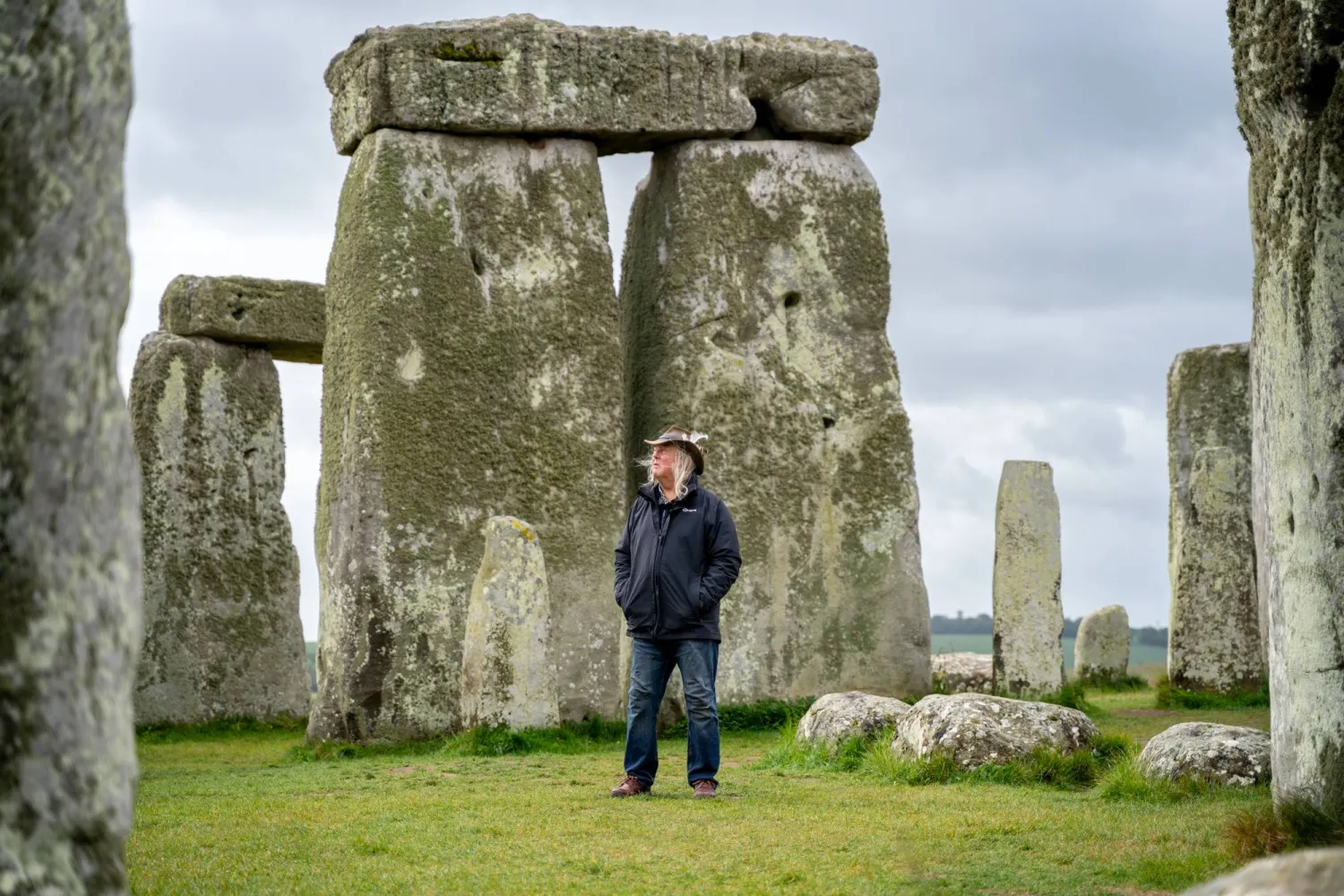

Archaeology Team Unearths 'Prototype' of World-famous Stonehenge Monument Just a Few Miles Away

This photo provided by Wessex Archaeology shows archaeologist Phil Harding standing at Stonehenge in May 2026, near Salisbury, England. (Wessex Archaeology via AP)
TT

Archaeology Team Unearths 'Prototype' of World-famous Stonehenge Monument Just a Few Miles Away

This photo provided by Wessex Archaeology shows archaeologist Phil Harding standing at Stonehenge in May 2026, near Salisbury, England. (Wessex Archaeology via AP)

Archaeologists revealed Thursday that they have discovered a structure near the prehistoric stone circle of Stonehenge in southern England that may have served as a “prototype” for the 5,000-year-old Neolithic monument.

A team from the British firm Wessex Archaeology said the structure would have consisted of two wooden poles 120 meters (394 feet) apart and aligned to point directly at the rising sun during the summer solstice and the setting sun at the winter solstice.

Researchers said the discovery predated Stonehenge by around 500 years, The Associated Press reported.

The team was led by archaeologist Phil Harding, who is well known in the UK through his many years of excavations for Channel 4 TV series “Time Team.”

Harding, 76, said the site, which also turned up a treasure trove of finds including pottery, animal bones and a rare disc-shaped knife, was likely to have been a focus for major religious gatherings.

“Opportunities like this probably only come once in a career, in a lifetime,” Harding said. “I’m probably towards the end of my career now, but thank God I’m still in archaeology long enough to be part of this discovery, because it’s certainly the highlight of my career.”

The findings were released ahead of the summer solstice, which falls this year on Sunday, when thousands head to Stonehenge each year to celebrate the longest day of the year in the Northern Hemisphere.

Stonehenge is a symbol of British culture and history and remains one of the country’s biggest tourist draws. The World Heritage Site was built on the flat lands of Salisbury Plain in stages starting 5,000 years ago, with the unique stone circle erected in the late Neolithic period about 2,500 B.C.

The site’s meaning has been the subject of vigorous debate. The most generally accepted interpretation is that it was a temple aligned with movements of the sun — lining up perfectly with the summer and winter solstices.

Researchers who found the structure near Stonehenge carried out the dig at Bulford, 5 kilometers (3.1 miles) from the main stone circle, as part of archaeological work to support the British defense ministry's program to accommodate troops who have been withdrawn in recent years from Germany, where the army had a big footprint for decades. The area around Stonehenge is one of the largest military training grounds and in the UK and Bulford is home to a barracks.

The original excavation took place between 2015 and 2017, with the findings requiring many years of analyses and tests.

English Heritage said other theories about Stonehenge include that it was a coronation place for Danish kings, a druid temple, a cult center for healing, or an astronomical computer for predicting eclipses and solar events.

Whatever the explanation, thousands of people, many dressed as druids and pagans, will gather at the site on Sunday to see the sun rise.

“What few will realize is that 5,000 years ago on a nearby hillside overlooking modern day Bulford, people were doing the exact same thing — revering and celebrating the sunrise on Midsummer’s Day,” said Harding.


Saudi Culture Ministry Launches Guide to Boost International Cultural Trade

The Saudi Culture Ministry will oversee the national pavilion with participation from several entities
TT

Saudi Culture Ministry Launches Guide to Boost International Cultural Trade

The Saudi Culture Ministry will oversee the national pavilion with participation from several entities

The Ministry of Culture launched the guide to the international cultural trade journey in Saudi Arabia in a regulatory step aimed at enabling cultural exchange, facilitating the import and export of cultural goods and services, and boosting the presence of Saudi culture in regional and international markets, in line with the objectives of the National Culture Strategy under Saudi Vision 2030.

The guide provides a comprehensive framework outlining the international cultural trade journey across its various stages, beginning with an introduction to the cultural sector in the Kingdom and its sub-sectors, followed by an overview of import and export pathways, the identification of supporting and enabling entities, and related regulatory and operational guidelines, SPA reported.

The guide serves as a practical reference for stakeholders, including practitioners, creators, cultural companies, government entities, and investors.

The guide also addresses culture-related goods and services as vehicles for identity, values, and ways of life. It presents their classifications across various cultural sectors, including literature, publishing and translation, music, visual arts, film, theater and performing arts, heritage, museums, and other fields, while clarifying the regulatory and procedural requirements for cross-border trade to ensure compliance with regulations, protect cultural content, and safeguard intellectual property rights.

Publishing the guide is part of the ministry's efforts to build a sustainable cultural sector that diversifies the national economy, enhances the Kingdom's soft power through organized cultural exchange, and expands culture-related exports and imports within Saudi Arabia and around the world.


Literature Commission Inaugurates Saudi Pavilion at Beijing International Book Fair 2026

The participation reflects Saudi Arabia's growing presence in the global publishing industry and its efforts to strengthen cultural ties with China. (SPA)
TT

Literature Commission Inaugurates Saudi Pavilion at Beijing International Book Fair 2026

The participation reflects Saudi Arabia's growing presence in the global publishing industry and its efforts to strengthen cultural ties with China. (SPA)

Saudi Arabia’s Literature, Publishing and Translation Commission inaugurated on Wednesday the Kingdom’s pavilion at the Beijing International Book Fair 2026 that runs through June 21, reported the Saudi Press Agency.

The participation reflects Saudi Arabia's growing presence in the global publishing industry and its efforts to strengthen cultural ties with China.

CEO of the commission Dr. Abdullatif Al-Wasel said the pavilion aims to introduce Saudi literary and intellectual production to Asian audiences, highlight developments in the Kingdom's literature, publishing, and translation sectors, and raise awareness of the Saudi cultural scene through an accompanying program featuring panel discussions and poetry evenings with Saudi writers and intellectuals.

The commission also seeks to strengthen the presence of Saudi publishers in international forums and build professional partnerships with stakeholders in China's publishing industry, supporting opportunities for translation exchange and cultural cooperation, he added.


Louvre Museum ‘Running Out of Steam’, Says New Director

This photograph shows visitors, seen from the Sully wing, queuing in the Cour Napoleon by the pyramid designed by Chinese-US architect Ieoh Ming Pei, to enter the Louvre Museum in Paris on November 19, 2025. (AFP)
TT

Louvre Museum ‘Running Out of Steam’, Says New Director

This photograph shows visitors, seen from the Sully wing, queuing in the Cour Napoleon by the pyramid designed by Chinese-US architect Ieoh Ming Pei, to enter the Louvre Museum in Paris on November 19, 2025. (AFP)

The Louvre museum is struggling to find funding to upgrade its ageing facilities, its new director said Wednesday, following a litany of problems that included a brazen $100-million jewellery heist.

"Despite its imposing majesty, despite the daily commitment of its staff, the Louvre is running out of steam," Christophe Leribault told a Senate committee.

"Its equipment and infrastructure are reaching the end of their life cycle."

Leribault, an art historian and museum director specializing in 18th-century art, took the helm in February, after his predecessor stepped down following an embarrassing daylight theft of imperial jewels in October that laid bare severe security failings.

Home to iconic pieces of art including Leonardo da Vinci's "Mona Lisa", the Louvre is the world's most visited museum, receiving around nine million visitors a year.

It is housed in a vast palace in central Paris on the banks of the Seine River, built over centuries by various French monarchs who at times used it as their official residence.

"Building-related emergencies are piling up, and we're facing a wall in terms of investments," Leribault said.

The museum had struggled with repeated strikes causing loss of revenue, a ticket fraud scheme that may have cost the museum 10 million euros ($11.7 million), a water leak, and other maintenance issues.