

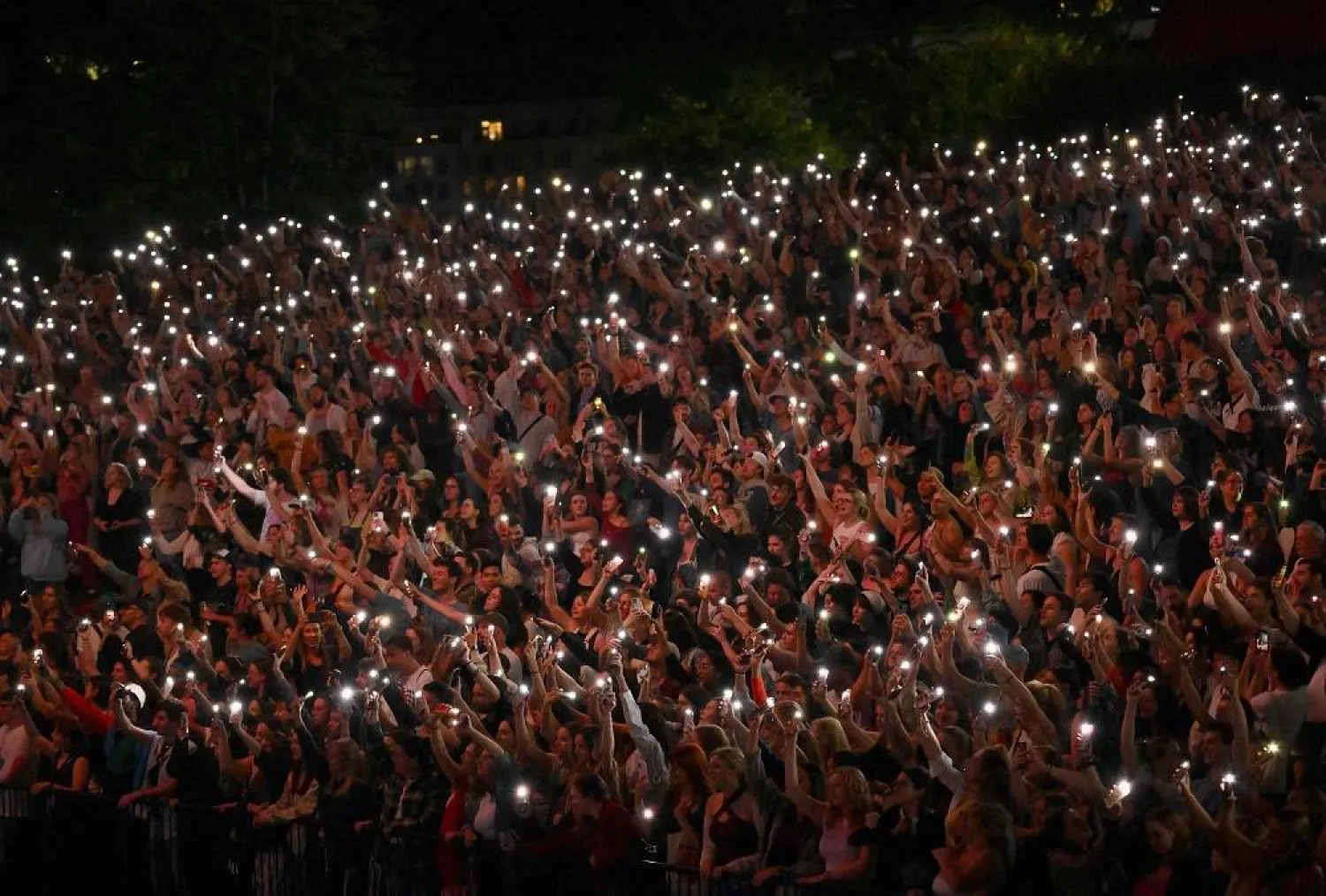

In Face of Corporate Behemoths, an Indie Music Festival Thrives

 People attend the All Things Go music festival at Merriweather Post Pavilion in Columbia, Maryland, on September 30, 2023. (AFP)
People attend the All Things Go music festival at Merriweather Post Pavilion in Columbia, Maryland, on September 30, 2023. (AFP)
TT

In Face of Corporate Behemoths, an Indie Music Festival Thrives

 People attend the All Things Go music festival at Merriweather Post Pavilion in Columbia, Maryland, on September 30, 2023. (AFP)
People attend the All Things Go music festival at Merriweather Post Pavilion in Columbia, Maryland, on September 30, 2023. (AFP)

Back in 2006, Spotify was a nascent start-up, your average stateside concert tickets went for $40 and many fans learned about the best new music from blogs like All Things Go.

Nearly 20 years later, most people find new artists via algorithms and the average US concert ticket costs $250 -- double what it was just five years ago.

All Things Go, however, has grown into a thriving indie music festival in a world where live events are increasingly owned by a handful of companies.

Now in its ninth year, the festival -- whose name derives from a Sufjan Stevens lyric -- embodies the same ethos as that of music blogging's turn-of-the-millennium heyday.

It focuses on emerging artists while prioritizing the experience of live performance over creating viral moments or appealing to social media influencers, both now dominant forces at more corporatized festivals.

The event kicked off its 2023 edition on Saturday at Maryland's historic Merriweather Post Pavilion amphitheater, spanning two days for the first time, with a women-led bill and headliners including Lana Del Rey, boygenius, Carly Rae Jepsen and Maggie Rogers.

The festival's founders first began transitioning from their corner of the internet to live venues by holding monthly club nights in Washington DC, hosting artists who were popular on their blog.

They held their inaugural festival at Washington's Union Market in 2014, later expanding to the Capitol Waterfront in 2016 before moving in 2021 to Merriweather, which can host up to 20,000 people per day.

"I think for us it really is about the music," co-founder Stephen Vallimarescu told AFP. "It's about creating the experience where you want to see the artist at noon as much as you want to see the headliner at 10:00 pm."

And with two stages "we basically set it up so that you can see every single band on the bill."

That's a far cry from the experience fans get at festivals like Coachella, where hundreds of thousands of people gather annually in the California desert for two three-day weekends featuring dozens of artists and six stages, with overlapping set times.

At that event, music is not the only draw: there are giant Instagrammable sculptures, a Ferris wheel, special food and drink attractions, celebrity and influencer-filled VIP tents and after-parties.

All Things Go's organizers are going for a more boutique vibe, said Vallimarescu.

"It is pretty unique to look at our community -- like these are music fans who go to 10, 20, 30 shows a year, and they come to the festival early," he said.

"They're there for the music, they're not there for Ferris wheels, or Instagram posts."

Consolidating festival market

It's no small feat to host an independent music festival these days. All Things Go certainly isn't the only event of its kind, but the landscape is increasingly dominated by giant live performance promoters like AEG and Live Nation, the two largest in the world.

In 2018, a group of indie festivals in Britain decried Live Nation's dominance of the industry there, accusing the California-based behemoth of practices including exclusivity deals with venues that "stifle competition."

In 2022, Live Nation -- which in addition to controlling significant swaths of the touring industry also owns Ticketmaster, the American ticketing titan -- recorded $16.7 billion in revenue, promoting 43,644 events including concerts and festivals worldwide, according to data compiled by Statista.

Most major music festivals are under the umbrella of Live Nation -- Bonnaroo, Lollapalooza and Isle of Wight among them -- or AEG, which owns the company behind Coachella.

Vallimarescu noted that many indie festivals folded as the performance industry took a major hit, especially post-pandemic.

"The reality is that the larger festival ecosystem is very much being consolidated," said fellow co-founder Will Suter.

"Globally it's the reason you see kind of the same headliners across most of festival lineups these days."

All Things Go has lasered in on indie rock, a strategy Suter said works to help it stay competitive in the corporate-dominated festival scene.

"Doubling down on our genre, and really offering value to the consumer that justifies the ticket price" is a goal, he said, with the hope that fans are interested in 12 to 16 artists on the lineup, can actually manage to see them all, and are enticed to come back.

Tickets to All Things Go this year ranged from $105 to $500, the pricier end being heavy on perks.

Suter praised fellow indie festivals across the United States "that are working day in and day out" to keep live music accessible and eclectic.

"It's a community, including with shoulders to cry on," he said.

"It's cool to see different independent festivals still working."


Spotify Down for Thousands of Users, Downdetector Shows

FILE PHOTO: Headphones are seen in front of a logo of online music streaming service Spotify, February 18, 2014 REUTERS/Christian Hartmann/File Photo
TT

Spotify Down for Thousands of Users, Downdetector Shows

FILE PHOTO: Headphones are seen in front of a logo of online music streaming service Spotify, February 18, 2014 REUTERS/Christian Hartmann/File Photo

Music streaming platform Spotify was down for thousands of users on Monday, according to Downdetector.com.

There were more than 30,000 reports of issues with the platform in the US as of 09:22 a.m. ET, according to Downdetector, which tracks outages by collating status reports from a number of sources, Reuters reported.

Outages were reported in Canada with more than 2,900 reports at 9:22 a.m. ET; UK had more than 8,800 app issues as of 9:22 a.m. ET.

Spotify did not immediately respond to a Reuters request for comment.

The actual number of affected users may differ from what's shown because these reports are user-submitted.


Netflix Says its Position on Deal with Warner Bros Discovery Unchanged

FILE PHOTO: A Netflix logo is pictured in Los Angeles, California, US, September 15, 2022. REUTERS/Mario Anzuoni/File Photo
TT

Netflix Says its Position on Deal with Warner Bros Discovery Unchanged

FILE PHOTO: A Netflix logo is pictured in Los Angeles, California, US, September 15, 2022. REUTERS/Mario Anzuoni/File Photo

Netflix's decision to acquire assets from Warner Bros Discovery has not changed and the hostile bid from Paramount Skydance was "entirely expected", its co-CEOs Greg Peters and Ted Sarandos said in a letter to employees on Monday, Reuters reported.

The streaming giant is committed to theatrical releases of Warner Bros' movies, saying it is "an important part of their business and legacy".

"We haven't prioritized theatrical in the past because that wasn't our business at Netflix. When this deal closes, we will be in that business," the letter stated.

Netflix said its deal is "solid" and it is confident that it is great for consumers and can pass regulatory hurdles.


35 Countries to Compete in Next Year’s Eurovision After 5 Countries Announce Boycott over Israel 

Nemo of Switzerland celebrates holding the trophy after winning the Grand Final of the Eurovision Song Contest in Malmo, Sweden, Sunday, May 12, 2024. (AP)
TT

35 Countries to Compete in Next Year’s Eurovision After 5 Countries Announce Boycott over Israel 

Nemo of Switzerland celebrates holding the trophy after winning the Grand Final of the Eurovision Song Contest in Malmo, Sweden, Sunday, May 12, 2024. (AP)

Organizers of the Eurovision Song Contest on Monday announced a final list of 35 countries that will take part in the glitzy pop-music gala next year, after five countries said they would boycott due to discord over Israel’s participation.

Contest organizers announced the list for the 2026 finale, set to be held in Vienna in May, after five participants — Iceland, Ireland, the Netherlands, Slovenia and Spain — earlier this month announced plans to sit it out.

A total of 37 countries took part this year, when Austria's JJ won. Three countries — Bulgaria, Moldova and Romania — will return, after skipping the event for artistic or financial reasons in recent years.

The walkout by some of the contest's most stalwart and high-profile participants — Ireland shared the record of wins with Sweden — put political discord on center stage and has overshadowed the joyful, feel-good nature of the event.

Last week, the 2024 winner — singer Nemo of Switzerland. who won with the pop-operatic ode “The Code.”— announced plans to return the winner’s trophy because Israel is being allowed to compete.

Organizers this month decided to allow Israel to compete, despite protests about its conduct of the Israel-Hamas war in Gaza and allegations that Israel manipulated the vote in favor of its contestants.

The European Broadcasting Union, a group of public broadcasters from 56 countries that runs the glitzy annual event, had sought to dispel concerns about vote-rigging, but the reforms announced weren't enough to satisfy the holdouts.

The musical extravaganza draws more than 100 million viewers every year — one of the world's most-watched programs — but has been roiled by the war in Gaza for the past two years, stirring protests outside the venues and forcing organizers to clamp down on political flag-waving.

Experts say the boycott ahead of the event's 70th anniversary amounts to one of the biggest crises the contest has faced, at a time when many public broadcasters face funding pressures and social media has lured away some eyeballs.

Israeli officials have hailed the decision by most EBU member broadcasters who supported its right to participate and warned of a threat to freedom of expression by embroiling musicians in a political issue.
