


‘Oppenheimer’ Wins 7 Prizes, Including Best Picture, at the British Academy Film Awards 

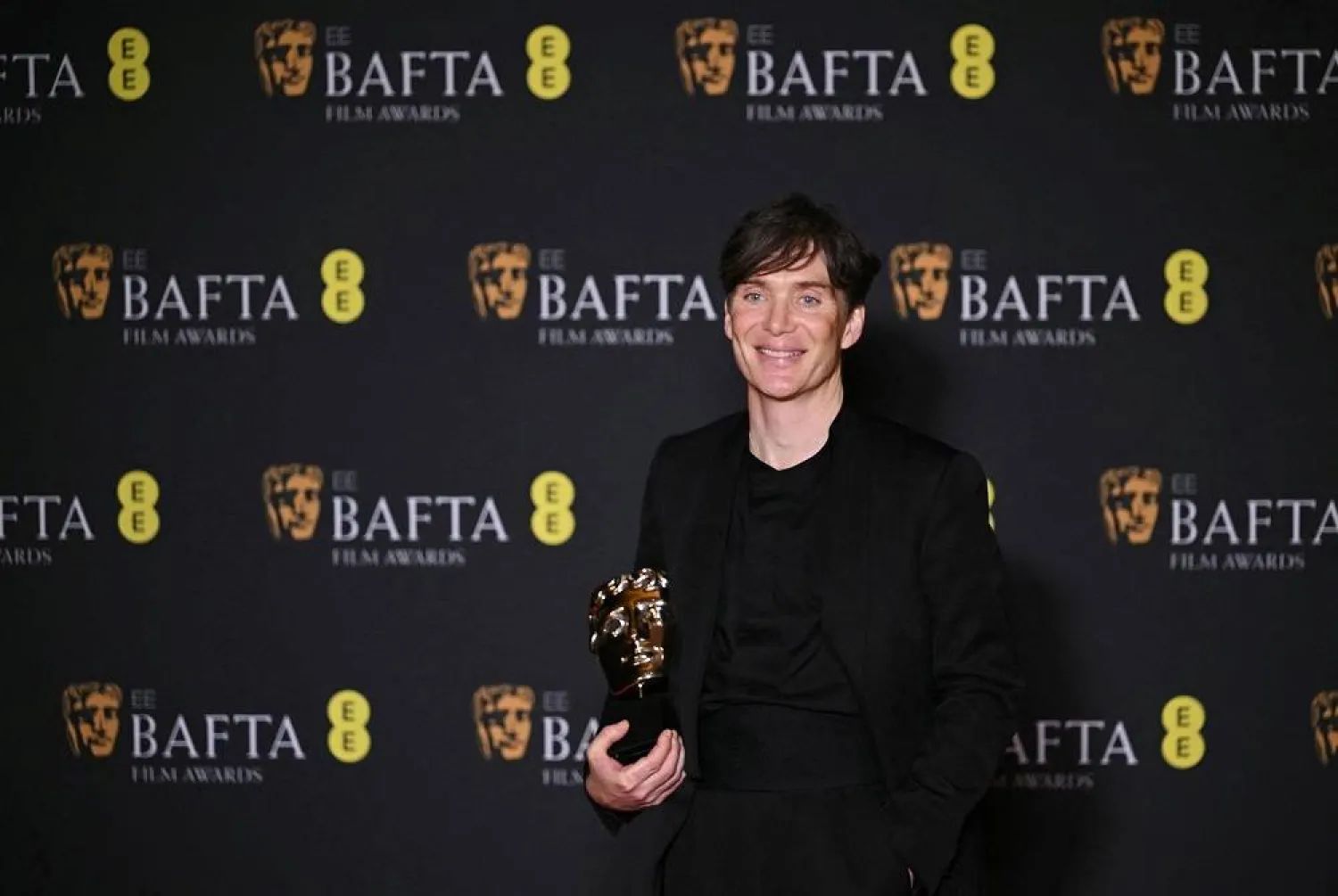
Irish actor Cillian Murphy poses with the award for Best leading actor for his role in "Oppenheimer" during the BAFTA British Academy Film Awards ceremony at the Royal Festival Hall, Southbank Center, in London, on February 18, 2024. (AFP)
TT

‘Oppenheimer’ Wins 7 Prizes, Including Best Picture, at the British Academy Film Awards 

Irish actor Cillian Murphy poses with the award for Best leading actor for his role in "Oppenheimer" during the BAFTA British Academy Film Awards ceremony at the Royal Festival Hall, Southbank Center, in London, on February 18, 2024. (AFP)

Atom bomb epic "Oppenheimer" won seven prizes, including best picture, director and actor, at the 77th British Academy Film Awards on Sunday, cementing its front-runner status for the Oscars next month.

Gothic fantasia "Poor Things" took five prizes and Holocaust drama "The Zone of Interest" won three.

British-born filmmaker Christopher Nolan won his first best director BAFTA for "Oppenheimer," and Irish performer Cillian Murphy won the best actor prize for playing physicist J. Robert Oppenheimer, the father of the atomic bomb.

Murphy said he was grateful to play such a "colossally knotty, complex character."

Nolan noted that nuclear weapons are "a nihilistic subject and the film inevitably reflects that," telling the movie's backers: "Thank you for taking on something dark."

Emma Stone was named best actress for playing the wild and spirited Bella Baxter in "Poor Things," a steampunk-style visual extravaganza that won prizes for visual effects, production design, makeup and hair and costume design.

"Oppenheimer" had a field-leading 13 nominations, but missed out on the record of nine trophies, set in 1971 by "Butch Cassidy and the Sundance Kid."

It won the best film race against "Poor Things,Killers of the Flower Moon,Anatomy of a Fall" and "The Holdovers.Oppenheimer" also scooped trophies for editing, cinematography and musical score, as well as the best supporting actor prize for Robert Downey Jr., who played Atomic Energy Commission head Lewis Strauss.

Da’Vine Joy Randolph was named best supporting actress for playing a boarding school cook in "The Holdovers" and said she felt a "responsibility I don’t take lightly" to tell the stories of underrepresented people like her character Mary.

"Oppenheimer" faced stiff competition in what's widely considered a vintage year for cinema and an awards season energized by the end of actors’ and writers’ strikes that shut down Hollywood for months.

" The Zone of Interest," a British-produced film shot in Poland with a largely German cast, was named both best British film and best film not in English — a first — and also took the prize for its sound, which has been described as the real star of the film.

Jonathan Glazer's unsettling drama takes place in a family home just outside the walls of the Auschwitz death camp, whose horrors are heard and hinted at, rather than seen.

"Walls aren’t new from before or since the Holocaust, and it seems stark right now that we should care about innocent people being killed in Gaza or Yemen or Mariupol or Israel," producer James Wilson said. "Thank you for recognizing a film that asks us to think in those spaces."

Ukraine war documentary "20 Days in Mariupol," produced by The Associated Press and PBS "Frontline," won the prize for best documentary.

"This is not about us," said filmmaker Mstyslav Chernov, who captured the harrowing reality of life in the besieged city with an AP team. "This is about Ukraine, about the people of Mariupol."

Chernov said the story of the city and its fall into Russian occupation "is a symbol of struggle and a symbol of faith. Thank you for empowering our voice and let’s just keep fighting."

The awards ceremony, hosted by "Doctor Who" star David Tennant — who entered wearing a kilt and sequined top while carrying a dog named Bark Ruffalo — was a glitzy, British-accented appetizer for Hollywood’s Academy Awards, closely watched for hints about who might win at the Oscars on March 10.

The prize for original screenplay went to French courtroom drama "Anatomy of a Fall." The film about a woman on trial over the death of her husband was written by director Justine Triet and her partner, Arthur Harari.

"It’s a fiction, and we are reasonably fine," Triet joked.

Cord Jefferson won the adapted screenplay prize for the satirical "American Fiction," about the struggles of an African American novelist

Jefferson said he hoped the success of the movie "maybe changes the minds of the people who are in charge of greenlighting films and TV shows, allows them to be less risk-averse."

Historical epic "Killers of the Flower Moon," Leonard Bernstein biopic "Maestro," grief-flecked love story "All of Us Strangers" and class-war dramedy "Saltburn " all won nothing despite multiple nominations.

"Barbie," one half of 2023’s "Barbenheimer" box office juggernaut and the year’s top-grossing film, also came up empty from five nominations. "Barbie" director Greta Gerwig failed to get a directing nomination for either the BAFTAs or the Oscars, in what was seen by many as a major snub.

Britain’s film academy introduced changes to increase the awards’ diversity in 2020, when no women were nominated as best director for the seventh year running and all 20 nominees in the lead and supporting performer categories were white. However, Triet was the only woman among this year's six best-director nominees.

Before the ceremony, nominees, including Bradley Cooper, Carey Mulligan, Emily Blunt, Rosamund Pike, Ryan Gosling and Ayo Edebiri all walked the red carpet at London’s Royal Festival Hall, along with presenters Andrew Scott, Cate Blanchett, Idris Elba and David Beckham.

Guest of honor was Prince William, in his role as president of the British Academy of Film and Television Arts. He arrived without his wife, Kate, who is recovering from abdominal surgery last month.

The ceremony included musical performances by "Ted Lasso" star Hannah Waddingham, singing "Time After Time," and Sophie Ellis-Bextor, singing her 2001 hit "Murder on the Dancefloor," which shot back up the charts after featuring in "Saltburn."

Film curator June Givanni, founder of the June Givanni PanAfrican Cinema Archive, was honored for outstanding British contribution to cinema, while actress Samantha Morton received the academy’s highest honor, the BAFTA Fellowship.

Morton, who grew up in foster care and children’s homes, said that "representation matters."

"The stories we tell, they have the power to change people’s lives," she said. "Film changed my life, it transformed me, and it led me here today."



AI Revolution Looms Over Berlin Film Fest

Director and screenwriter Yoshitoshi Shinomiya attends a press conference for “A New Dawn” during the 76th Berlin International Film Festival, in Berlin, Germany, 18 February 2026. (EPA)
TT

AI Revolution Looms Over Berlin Film Fest

Director and screenwriter Yoshitoshi Shinomiya attends a press conference for “A New Dawn” during the 76th Berlin International Film Festival, in Berlin, Germany, 18 February 2026. (EPA)

The artificial intelligence revolution sweeping through the entertainment sector was at first glance not evident at this year's Berlin Film Festival, but the potential for widespread changes was still on people's minds.

The festival has had the air of an arthouse bubble when it comes to the topic of AI and the event's leadership is keeping above the fray.

"At present, we do not intend to issue any statements regarding the use of AI in the film industry," the festival said in a statement sent to AFP, adding: "We are monitoring developments with great interest."

Nevertheless, some of the filmmakers present addressed the question of how the technology is changing the industry.

Yoshitoshi Shinomiya, director of the only animated feature in competition, "A New Dawn," told reporters he had briefly considered using AI in his film.

"During production, we weren't entirely sure we would be able to complete the film. At one point we wondered whether we should use AI for the backgrounds," he said.

But Shinomiya concluded that AI is not yet "well-developed enough" to do that sort of work.

Juliette Prissard from Eurocinema, an organization representing French film and TV producers, said it's only a matter of time until the tools improve.

"It's reasonable to think that in one, two or three years... you won't be able to tell the difference anymore," she told AFP.

AI can already "write scripts" and replace extras in crowd scenes or even generate "digital replicas" of someone.

- 'No choice' -

In France, where foreign-language films are frequently shown with dubbing, voice actors have already been raising the alarm about AI's impact on their profession.

But Prissard warns other film industry jobs could be replaced in the "near" future, such as "technicians, the set designers" and even "the producers themselves".

Sevara Irgacheva, secretary general of the European Film Agency Directors' association (EFAD), said that already "junior jobs are disappearing: all the assistant editors, assistant screenwriters".

Despite this, the industry "is leaning toward accepting" AI "because, in any case, we have no choice".

The tools have the potential to help the sector become more efficient and "save time at every stage of production", particularly in the more "bureaucratic" aspects of the process.

A survey carried out in early 2025 by France's National Center for Cinema (CNC) found that 90 percent of film and audiovisual professionals surveyed were already using AI tools in their work.

In Berlin, Austrian director Georg Tiller presented a short film mixing filmed footage and AI-generated images, saying it was an attempt to encourage his fellow filmmakers to fight for a place in the new "digital cinema".

"If we don't then I fear that that we will die a slow death, because it will just steamroll over us," Tiller told AFP.

- The 'temptation' of deregulation -

The issue garnered some relief with a December agreement between OpenAI and Disney, which allowed the use of the entertainment giant's characters on Sora, the AI-generated video platform.

In return, Disney now has "privileged access" to OpenAI's "highly sophisticated" tools, giving it a "technological advantage over the rest of the sector," said Prissard.

But the use of AI in cinema has prompted thorny legal questions over intellectual property and the very notion of authorship, at a time when legislation is only just beginning to grapple with the subject.

Under EU rules, streaming platforms such as Netflix and Amazon Prime must carry at least 30 percent of European content in their catalogues.

Prissard questioned how those enforcing the rules "will be able to tell the difference" between original creations and "synthetic" ones.

Given "the fear of falling behind" the United States and China in developing AI technologies, Prissard said that Europe may succumb to the "temptation to allow more leeway to innovate without obstacles".


Bad Bunny Positioned to Consolidate His Popularity in Brazil with First-Ever Performances

 Puerto Rican singer Bad Bunny performs during his "Debí Tirar Más Fotos" world tour at the Allianz Parque stadium in Sao Paulo, Brazil, on February 20, 2026. (AFP)
Puerto Rican singer Bad Bunny performs during his "Debí Tirar Más Fotos" world tour at the Allianz Parque stadium in Sao Paulo, Brazil, on February 20, 2026. (AFP)
TT

Bad Bunny Positioned to Consolidate His Popularity in Brazil with First-Ever Performances

 Puerto Rican singer Bad Bunny performs during his "Debí Tirar Más Fotos" world tour at the Allianz Parque stadium in Sao Paulo, Brazil, on February 20, 2026. (AFP)
Puerto Rican singer Bad Bunny performs during his "Debí Tirar Más Fotos" world tour at the Allianz Parque stadium in Sao Paulo, Brazil, on February 20, 2026. (AFP)

While Bad Bunny has dominated global charts, the superstar has not had quite the same success in Brazil, a country notoriously hard for foreign stars to win over due to a devotion to national artists.

But a shift that began with his Grammy-winning album "Debí Tirar Más Fotos" may accelerate further after his first-ever gigs in Brazil on Friday and Saturday in Sao Paulo.

Bad Bunny has come to Brazil at the peak of his career so far, following the phenomenal hype around his performance at the Super Bowl halftime show.

"It’s the best time to try and unlock a country like Brazil, at a time when he’s managed to dominate practically the entire world," said Felipe Maia, an ethnomusicologist who is pursuing a doctoral degree on popular music and digital technologies at Paris Nanterre University.

For years, the Puerto Rican artist born Benito Antonio Martínez Ocasio has been one of the most-streamed artists on the planet.

But neither the singer, nor his album, nor his songs were among the most played last year in Brazil, according to Spotify. The most streamed artists in the country on the platform in 2025 were all Brazilian.

In the land of samba, funk, bossa nova, choro, sertanejo, forro and pagode, among other Brazilian music genres, 75% of streaming consumption in Brazil focuses on national artists, according to the 2025 midyear music report of Luminate, a company specializing in entertainment industry data. Brazil is the country that most listens to its own music, it said.

Still, particularly since "Debí Tirar Más Fotos," the fever around Bad Bunny has made headway in Brazil. Only one performance was initially scheduled at the Allianz Parque arena, but it sold out so quickly the artist added an extra date, which also sold out.

By mid-afternoon on Friday, long queues had formed. Brazilian fans mixed with people from El Salvador, Colombia and Venezuela. Many came wearing straw hats — used by Bad Bunny and traditionally worn by jíbaros, rural Puerto Rican farmers.

Tickets on Ticketmaster, the official vendor, ranged from $50 to $210, but resellers on Friday were selling tickets for that same night for more than $830 — more than 2.5 times the minimum monthly wage in Brazil.

Flávia Durante, a Sao Paulo -based DJ who specializes in Latin American music, said that some Brazilians have a tendency to see Spanish-language music as corny due to the association with Mexican telenovelas, but that Bad Bunny pierced a bubble with his latest album.

"Nowadays everyone knows all the songs, they sing along and really get into it. I normally play him at the peak of the night. People request him, even at rock or 80s pop themed parties," Durante said.

Since the half-time Super Bowl show, that popularity has grown. Bad Bunny’s average streams grew by 426% on Spotify in Brazil in the following week compared with the previous one. Many songs experienced massive streaming surges, with "Yo Perreo Sola" leading the growth with a 2,536% increase.

‘Latino resistance’

During Brazil’s Carnival celebrations, Bad Bunny themed costumes were a fixture in Rio’s raucous, dazzling street parties.

Nicole Froio, a Colombian Brazilian writer specializing in Latin American cultural issues, went kitted out in a straw hat and plastic, tropical plants that echo the background of his latest album. It was the third Carnival in which Froio — who has two Bad Bunny tattoos and a third one planned — wore attire that evoked the Puerto Rican artist.

For a long time, Froio was the sole person among her Brazilian friendship group who liked Bad Bunny. She believes that Brazilians in general have trouble identifying themselves as Latino.

"There’s a lot of prejudice around Hispanic music and there were preconceptions against him because of his Puerto Rican accent, because people don’t understand him," she said.

Brazil’s Latino identity exists but it is diffuse and difficult to seize due to the variety within the continent-sized country, said Maia. But Bad Bunny succeeds in giving it emphasis, particularly in cosmopolitan cities such as Sao Paulo and Rio de Janeiro, he said.

Brazil, like other countries in the Americas, was listed by Bad Bunny in the Super Bowl halftime show, when he reminded the world that while "America" is used as a synonym for the US in the US, it is the name used across two continents.

Bad Bunny’s global success, including in Brazil, "reinforces that we’re part of this — that we belong," said 22-year-old Diogo da Luz, a longtime fan of the Puerto Rican ahead of Friday's concert. "He reinforces that we are one people and that we’re very united."

For Froio, who has been waiting to see him live for six years and will see him on Saturday, Bad Bunny "represents a Latino resistance."

She pointed to the fact that other Latin American superstars, including Anitta, Shakira, and Ricky Martin, have recorded full songs in other languages, while Bad Bunny has kept his music almost entirely in Spanish.

"For me, there’s a great authenticity in his sound that inspires me to be who I am and let everyone else deal with it," Froio said.


Political Drama Overshadows Berlin Film Festival Finale

Jury president Wim Wenders at the opening of the Berlin Film Festival which has been rocked by political controversy. Ronny HARTMANN / AFP
TT

Political Drama Overshadows Berlin Film Festival Finale

Jury president Wim Wenders at the opening of the Berlin Film Festival which has been rocked by political controversy. Ronny HARTMANN / AFP

The 76th Berlin Film Festival draws to a close on Saturday after 10 days in which the 22 films in competition were often overshadowed by a row over the role politics should play in filmmaking.

The controversy erupted at the beginning of the festival when jury president Wim Wenders answered a question about the German government's support for Israel by saying: "We cannot really enter the field of politics."

At the same press conference, he had earlier said that films had the power to "change the world" but in a different way from party politics.

"No movie has ever changed the ideas of a politician, but we can change the idea that people have of how they should live," Wenders, 80, said.

But his comments in response to the question on Israel prompted a storm of outrage.

Award-winning Indian novelist Arundhati Roy, who had been due to present a restored version of a 1989 film she wrote, pulled out of the event, branding Wender's words "unconscionable" and "jaw-dropping".

On Tuesday, a letter signed by dozens of film industry figures, including Javier Bardem, Tilda Swinton and Adam McKay, condemned the Berlin festival's "silence on the genocide of Palestinians".

- Films overshadowed -

The letter, drafted by the Film Workers for Palestine collective, accused the Berlinale of being involved in "censoring artists who oppose Israel's ongoing genocide against Palestinians in Gaza and the German state's key role in enabling it".

Director Tricia Tuttle, in her second year at the helm of the Berlinale, has firmly rejected the accusations, describing some of the claims in the letter as "misinformation" and "inaccurate".

She called for "cool heads in hot times" and expressed fears that the controversy was crowding out conversation about the films.

Among the standout entries in the official competition was "We Are All Strangers" by Anthony Chen.

Set in Chen's native Singapore, the film is a moving family drama which playfully satirizes the yawning social disparities to be found in the city-state's glittering skyscrapers.

German actress Sandra Hueller, who gained international acclaim for her roles in "The Zone of Interest" and "Anatomy of a Fall", received audience plaudits for her turn as the title character in "Rose" by Austrian director Markus Schleinzer.

The black-and-white drama tells the story of a woman passing herself off as a man in rural 17th-century Germany to escape the constraints of patriarchy.

- Repression in Iran -

Juliette Binoche, playing a woman caring for her mother with dementia, also moved cinemagoers in "Queen at Sea" by American director Lance Hammer, who had not made a feature film since 2008.

Sensitively, the film portrays the devastation Alzheimer's disease inflicts on a patient's loved ones.

"My husband's got dementia, so I have had a lot of background," a visibly moved actress Anna Calder-Marshall, who plays the ailing mother in the film, told a press conference.

The first major event of the film calendar also provided a platform for Iranian filmmakers to address the deadly crackdown on anti-government protests in their home country.

Director Mahnaz Mohammadi, who has spent time in Tehran's notorious Evin prison, presented "Roya", a searing portrayal of conditions in the jail and the traces they leave on prisoners' psyches.

Dissident director Jafar Panahi, who won the Cannes Palme d'Or for "It Was Just An Accident", also spoke from the Berlinale to denounce the Iranian government's repression of protestors, which international organizations say has left thousands dead.

"An unbelievable crime has happened. Mass murder has happened. People are not even allowed to mourn their loved ones," Panahi told a talk organized as part of the festival.

"People do not want violence. They avoid violence. It is the regime that forces violence upon them," Panahi said.

In December he was sentenced to one year in prison and a travel ban in Iran but has expressed his intention to return nevertheless.