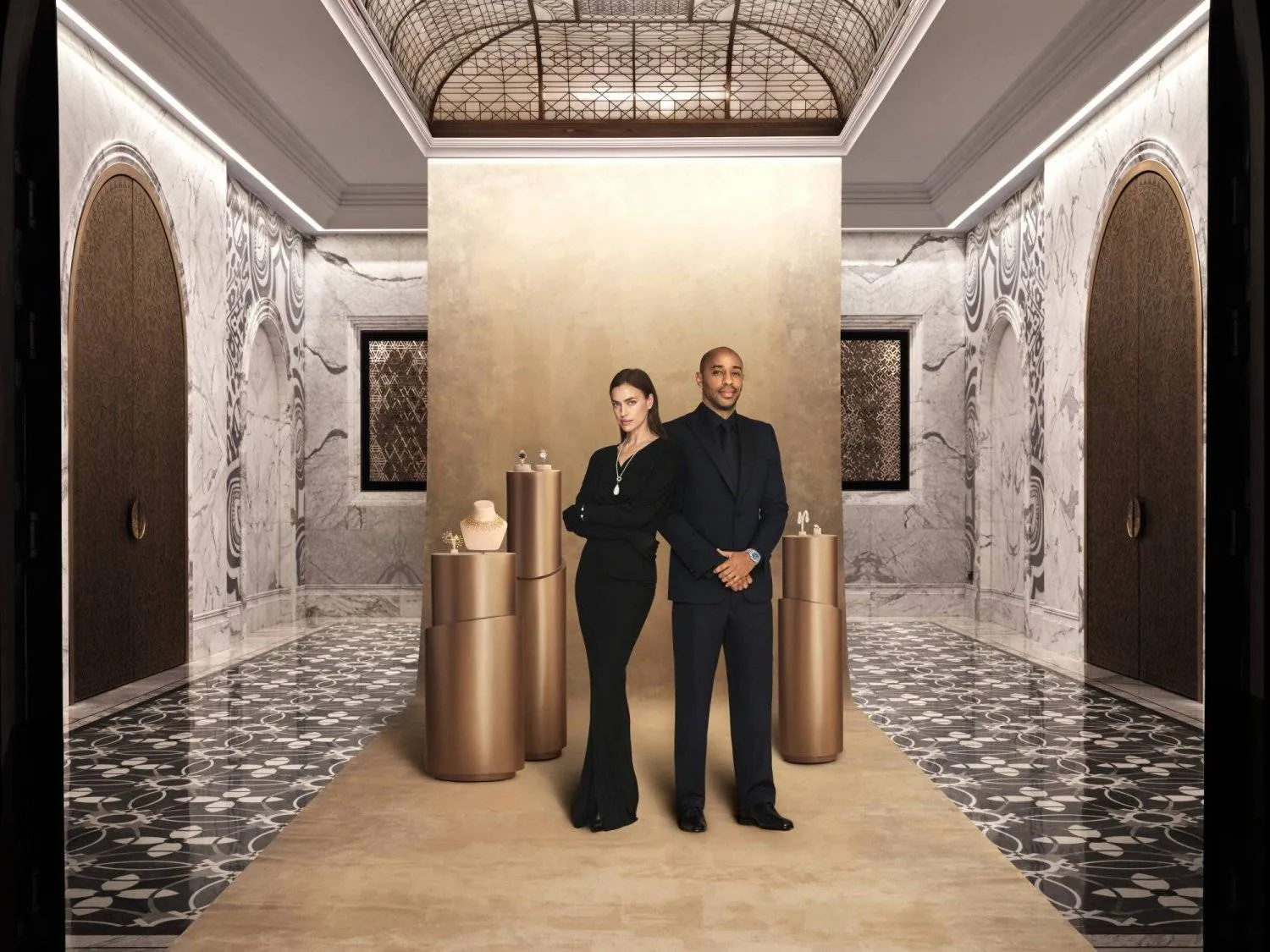
DJWE Promotes 20th Edition with Irina Shayk, Thierry Henry

Irina Shayk and Thierry Henry from DJWE's promotion film.
TT

DJWE Promotes 20th Edition with Irina Shayk, Thierry Henry

Irina Shayk and Thierry Henry from DJWE's promotion film.

The countdown for the Doha Jewelry and Watches Exhibition (DJWE) has started, and so have the preparations to host thousands of guests from the industry and around 500 luxury brands.

For over two decades, DJWE has emphasized its position, not only as a showcase of the world’s most exclusive jewelry and timepieces, but also as “a key driver of development and advancement, promoting Qatar’s position as one of the fastest growing tourism destinations in the region,” said Hessa Al-Thani, head of marketing planning at Qatar Tourism.

Running from February 5 to 11, the exhibition promises its visitors a wide variety of creations and special editions.

The preparation for the highly anticipated event started months ago. Visit Qatar unveiled its new “Jewelry Connoisseurs” campaign for the event, featuring supermodel Irina Shayk and iconic French football Thierry Henry.

Directed by Luca Caon and fashion photographer Rowan Papier, the film shows the two stars with an exclusive collection of extraordinary jewelry and timepieces with the support from the five biggest exhibitors of the event: 51 East, Ali bin Ali, Alfardan Jewelry, Al Majed and Bulgari.

While Shayk and Henry come from two different worlds, they are both passionate about fancy jewelry and timepieces, and this passion clearly manifests in the promotion campaign. The film shows the supermodel and footballer arriving at the exhibition and exploring what it has to offer.

“Throughout my career, I have always appreciated the best in design and luxury. I am a keen follower of the watches industry and admire the dedication, expertise and years of training required for the creation of a timepiece. I am really excited to experience the entire Doha exhibition and all that it has to offer and will be on the lookout for special pieces, designers, and craftsmen,” said Henry, commenting on his film debut for DJWE.

“I am happy and eager for more exploration, and I know their pieces will become family heirlooms to be passed down generation after generation,” said Shayk.

Acclaimed Director Luca Caon and photographer Rowan Papier created a masterpiece of beauty and intrigue. “What is very interesting about this film is that it is of a hybrid genre, between a commercial and fashion film,” said Caon.


China’s Premium Puffer Jacket Push Meets Consumer Resistance

Staff members promote discounted jackets at a store in Beijing, China October 18, 2025. (Reuters)
TT

China’s Premium Puffer Jacket Push Meets Consumer Resistance

Staff members promote discounted jackets at a store in Beijing, China October 18, 2025. (Reuters)

Chinese shoppers are snapping up budget down jackets as the cold weather arrives, with products priced below 500 yuan ($69) selling briskly as consumers question the value of premium brands.

A 399-yuan down jacket filled with 90% goose down and produced for Peking University sold out online in mid-November after attracting widespread attention on Chinese social media. At Walmart-owned Sam's Club, a women's down jacket from US brand Rokka&Rolla priced at 499.9 yuan also sold out, the retailer's app showed.

The trend marks a shift towards more cost-conscious spending in a market where people have long been pushed to buy more luxurious and expensive clothing. Research firm iiMedia said the average price of a down jacket in China more than doubled over the past decade and was forecast to exceed 1,000 yuan in 2025. Yet a survey ‌released this month ‌found jackets priced between 401 yuan and 600 yuan were the most popular ‌among consumers.

Bosideng, ⁠China's largest down-jacket ⁠maker, has said the average price of its core products has risen to about 1,500-2,500 yuan.

A prolonged property slump, weak wage growth and concerns over job security have made many middle-class consumers more cautious about discretionary spending, raising questions about how much extra they are willing to pay for premium outerwear.

"I think Sam's has nailed that with its down jackets," said Mark Tanner, founder and managing director of Shanghai-based consultancy China Skinny.

"Many shoppers are not hunting for the cheapest copy. They want comparable design, function or pleasure without paying a large prestige premium," he said.

The challenge is becoming increasingly apparent for brands seeking ⁠to move further upmarket. Bosideng this month launched its third collection from British ‌designer Kim Jones, but some higher-priced items saw limited sales on its ‌flagship store on Tmall, an upmarket online shopping platform.

A blue jacket featured in advertisements with singer, actor and brand ambassador Wang ‌Leehom carried a price tag of about 2,278 yuan but sold just 16 units in the 30 days ‌to November 13, according to figures displayed on the Tmall store.

Bosideng did not respond to a request for comment.

VALUE OVER PRESTIGE

The diverging fortunes suggest consumers are becoming more selective rather than simply trading down.

More than 30 million down jackets were sold during this year's Singles' Day shopping festival, according to e-commerce giant Alibaba, while Uniqlo and Bosideng ranked first and second by sales, ‌retaining their long-held positions at the top of China's down-jacket market.

Uniqlo surpassed 100 million yuan in Tmall sales within 24 minutes of Singles' Day promotions launching on ⁠October 20, Tmall said, and ⁠the platform listed the brand's lightweight down jacket, which typically retails for around 500 yuan in China, among its top-selling products.

Demand also remains resilient at the top end. Canada Goose said Greater China revenue rose 32.5% in the quarter ended September.

"China is a very healthy region for Moncler," Chief Corporate and Supply Officer Luciano Santel said last month, as the premium outerwear brand continued to outperform a broader luxury slowdown in the world's second-largest economy.

"Like every luxury brand, they'll need to work harder than ever to justify the premium price point," Tanner said.

The contrasting performances reflect a broader divergence in Chinese consumption. As economic uncertainty weighs on middle-class households, many consumers are trading down or demanding greater value for money, while wealthier shoppers continue spending on products they believe offer them quality, performance or status.

"I definitely won't buy another down jacket that costs more than 1,000 yuan," said Lv Jiaming, a 27-year-old factory worker in Shanghai. "To me, there isn't much difference between a jacket priced at 500 or 600 yuan and one that costs more than 1,000 yuan. You can't really feel the difference, unless it's exceptionally good."


Shein Europe Sales Sink as New Import Fees Bite

FILED - 29 April 2024, Berlin: FILE PHOTO - The Shein logo can be seen on a smartphone. Photo: Monika Skolimowska/dpa
TT

Shein Europe Sales Sink as New Import Fees Bite

FILED - 29 April 2024, Berlin: FILE PHOTO - The Shein logo can be seen on a smartphone. Photo: Monika Skolimowska/dpa

Online fast-fashion retailer Shein reported a steep decline in European sales on Wednesday, as new fees on ⁠ecommerce imports slammed ⁠the brakes on growth in its biggest market.

Shein's third-quarter revenue in ⁠Europe fell 27.6% to $2.98 billion, highlighting the impact of €3 fees imposed by the European Union on parcels ordered online from July 1, Reuters reported.

The firm reported overall ⁠revenue ⁠of $10.27 billion for the three months ended September, a nearly 6% drop from last year.


AI Tools Help Brands Curb Black Friday Deals, from Clothes to Skincare

 Shoppers walk through the King of Prussia mall ahead of Black Friday sales outside Philadelphia, Pennsylvania, US, November 21, 2026. (Reuters)
Shoppers walk through the King of Prussia mall ahead of Black Friday sales outside Philadelphia, Pennsylvania, US, November 21, 2026. (Reuters)
TT

AI Tools Help Brands Curb Black Friday Deals, from Clothes to Skincare

 Shoppers walk through the King of Prussia mall ahead of Black Friday sales outside Philadelphia, Pennsylvania, US, November 21, 2026. (Reuters)
Shoppers walk through the King of Prussia mall ahead of Black Friday sales outside Philadelphia, Pennsylvania, US, November 21, 2026. (Reuters)

Consumer brands are increasingly turning to artificial intelligence to help set prices, hoping to reduce discounts to protect profit margins.

That could mean shallower bargains for inflation-weary US shoppers this holiday season, starting with Black Friday, an event synonymous with discounts, according to interviews with five firms that provide AI tools to brands and retailers.

It could also provide an additional headache for US consumers still grappling with inflation and tariff-fueled price hikes. Polls showed the rising cost of living under President Donald Trump was a top concern for voters in midterm elections that delivered the Democratic Party a sweeping majority in Congress.

Brands from Gap to Under Armour are using AI tools to manage inventory levels, recommend retail prices and figure out when and how steeply to discount products. Often, the tools conclude that companies can reduce discounts without dampening demand, the AI pricing firms told Reuters.

Software from retail decision-making company Impact Analytics, which counts Gap as a client, "generally shows you need fewer promos for less time on less products," CEO Prashant Agrawal said. A Gap spokesperson said ‌the brand uses Impact Analytics ‌to make "more informed markdown decisions based on demand and inventory signals."

Tools from AI pricing firm Kapnova advised ‌a ⁠billion-dollar beauty brand to ⁠reduce this year's Black Friday discount on a skincare product to 30% from an initially planned 40%, CEO James Sun said, declining to name the client due to confidentiality.

"As more companies understand their demand... and model it in a more rigorous way, the consumer will see less discounts on Black Friday," Sun said.

Holiday sales are set to rise 4.2% versus 2025 to just over $1 trillion, National Retail Federation estimates show, though the bump would be largely attributable to an inflation rate currently at 3.7%.

The AI pricing firms' algorithms use machine learning to synthesize sales data, inventory levels, competitors' prices, weather and economic conditions to predict shifting demand in real time.

The technology isn't completely new, but it has become more sophisticated over the past two years at predicting demand for products at specific prices, and ⁠adoption is ramping up, experts and industry executives say.

Tools from AI software company First Insight, whose customers include ‌Under Armour and value chain Family Dollar, recently suggested that one brand scale back a buy-one-get-one promotion ‌from 50% to 40% off, said founder Greg Petro, declining to name the client.

FROM VALUE CHAINS TO LUXURY

Companies across the consumer spectrum are dabbling in AI, but ‌few are openly discussing how they use it.

Under Armour and Family Dollar use First Insight to decide what to charge for a product ‌and to estimate how price changes will affect sales, the retail technology company said. AI-driven planning platform Anaplan said LVMH-owned Tiffany, Dolce & Gabbana, and Kering's Yves Saint Laurent use its software for pricing.

More than a dozen brands approached by Reuters, including Under Armour, Family Dollar, Tiffany, Dolce & Gabbana and Yves Saint Laurent, did not respond to multiple requests for comment.

While human managers may be tempted to slash prices to clear stale inventory or lure in new shoppers, AI software "has the confidence to hold its nerve" ‌when a lesser discount will do the trick, said Lindsay Fisher, co-founder of price optimization platform Sparkbox, which works with New Balance. New Balance did not respond to requests for comment.

The effects can be subtle, ⁠and "if done well... consumers won't realize it's ⁠happening," said Ryan Orabone, a consultant at Spaulding Ridge who has built an AI pricing tool.

PROBLEMATIC TOOLS?

AI-informed pricing risks backlash from cash-strapped shoppers.

"It is controversial," Sun, of Kapnova, conceded. "Consumers go, 'We want those discounts,' but retailers are getting smarter and smarter with AI."

The technology is still emerging, and the full scale of its price impact is unknown. But the limited available data and anecdotal evidence suggest discounts may be getting more targeted.

In sportswear, the share of products discounted over the past year increased, but the average discount came down, data compiled by Centric Market Intelligence show. The average on-sale sports bra, for example, was discounted by 32%, against 36% the year before.

Walmart has been using in-house machine-learning software to manage inventory since around 2019, while Dick's Sporting Goods and Ross Stores have used weather-forecasting AI tools to help plan inventory for at least two years.

AI-powered pricing tools are growing more common, said Martin Crepy, global head of consumer at consultancy Simon-Kucher. A 2025 survey by the firm showed that a third of companies now use AI pricing for demand forecasting, and 28% for real-time price optimization.

Predictive algorithms typically stop short of pricing items differently for individual customers — a controversial practice that retailers like Walmart and Target have said they don't engage in, and which several states have taken steps to curb.

But tools that allow retailers to quickly change prices, often called dynamic pricing, sit "one layer removed" from personalized pricing, according to former McKinsey consultant and e-commerce executive Sofia Serra.

"There's a legal and ethical question about it," said Serra. "Regulation is still evolving."