


Tradition Meets AI in Nishijinori Weaving Style from Japan’s Ancient Capital 

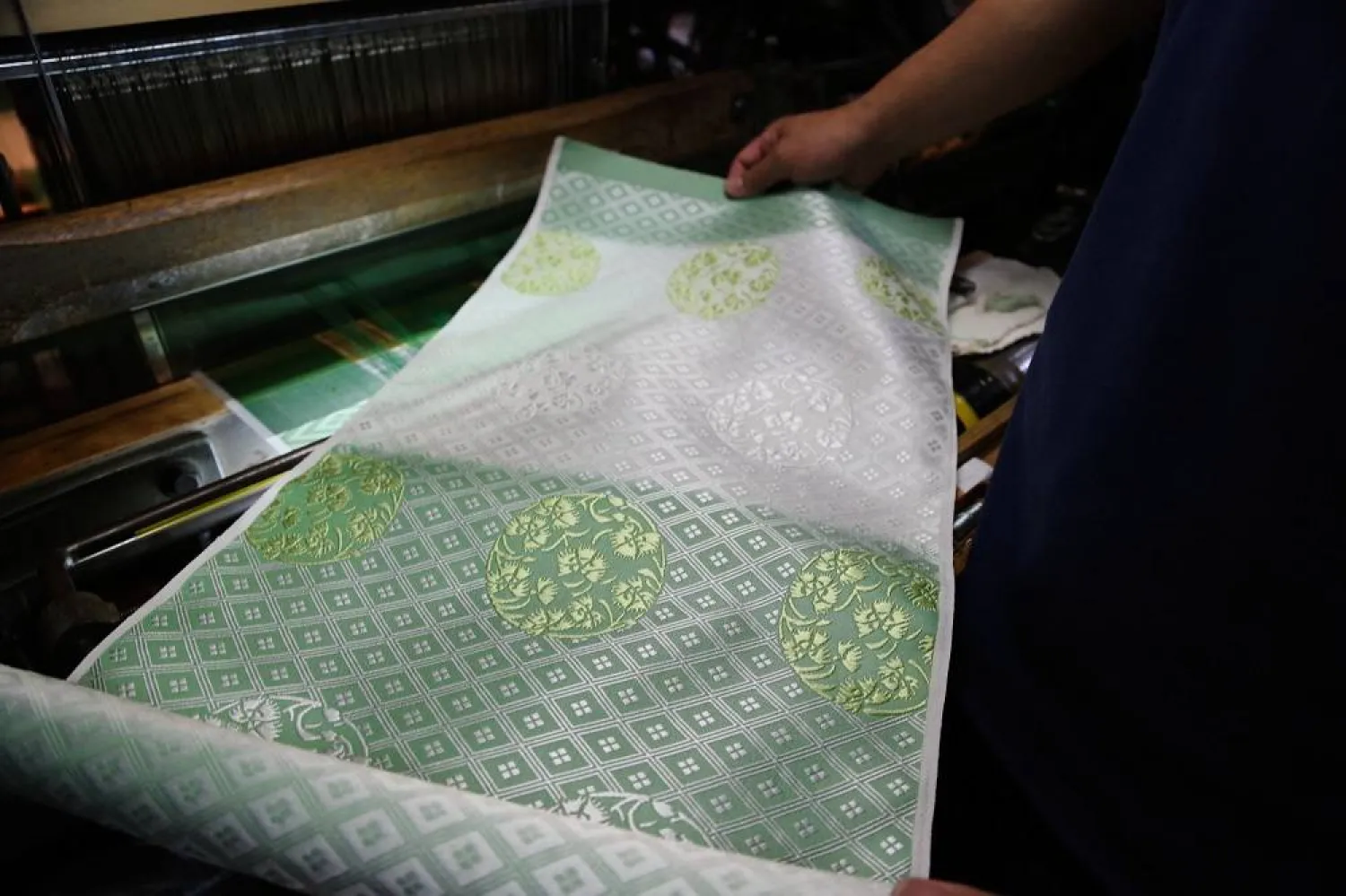
Hironori Fukuoka, the fourth-generation successor to his Nishijinori business, looks at the fabric that is a collaboration with AI in Kyoto, western Japan on July 3, 2025. (AP)
TT

Tradition Meets AI in Nishijinori Weaving Style from Japan’s Ancient Capital 

Hironori Fukuoka, the fourth-generation successor to his Nishijinori business, looks at the fabric that is a collaboration with AI in Kyoto, western Japan on July 3, 2025. (AP)

Nishijinori, the intricate weaving technique for kimonos that dates back more than a thousand years in Japan’s ancient capital of Kyoto, is getting a high-tech collaborator: artificial intelligence.

The revered colorful weaving style associated with “The Tale of Genji” of the 11th-century Heian era, has gone through its share of ups and downs. But its survival is more perilous than ever today, as demand for kimonos nose-dives among Japanese grappling with modernization.

Hironori Fukuoka, the fourth-generation successor to his Nishijinori business, is determined to keep alive the art he’s inherited, even if that means turning to AI.

“I want to leave to legacy what my father has left for me,” he said in his rickety shop in the Nishijin district of Kyoto, a city with statue-filled temples and sculpted gardens that never seems to change.

“I’ve been pondering how the art of Nishijinori can stay relevant to the needs of today,” said Fukuoka.

Besides the AI project, Fukuoka is also working on using his weaving technique to make super-durable materials for fishing rods and aircraft.

Where tradition and technology meet

Giant looms clatter at his shop, called Fukuoka Weaving. The patterns on the gorgeous fabric, slowly turning out from the loom, are repetitive and geometric, which makes it conducive to translating into digital data. Deciding which hand-dyed color thread goes where to make the patterns is much like the on-or-off digital signals of a computer.

Such similarity is what Fukuoka focuses on in exploring how AI might work for Nishijinori, with the help of Sony Computer Science Laboratories, an independent research arm of electronics and entertainment company Sony Corp.

AI only makes suggestions for the designs and doesn’t do any of the actual production work. But that doesn’t bother Fukuoka or the researchers.

“Our research stems from the idea that human life gets truly enriched only if it has both what’s newly innovated and what never changes,” said Jun Rekimoto, chief science officer at Sony CSL, which is also studying how AI can be used to document and relay the moves of a traditional Japanese tea ceremony.

“We don’t believe AI can do everything. Nishijinori is a massive, complicated industry and so it starts with figuring out where AI can help out,” said Rekimoto, also a professor at the University of Tokyo.

What has come of it is a startling but logical turn in thinking, fitting of the art adorning kimonos worn by Japan's imperial family.

The AI was fed various Nishijinori patterns that already existed and instructed to come up with its own suggestions. One was a bold pattern of black and orange that seemed to evoke a tropical motif.

Striking a balance

To Fukuoka, some of AI’s ideas are interesting but simply off. The difference between AI and the human effort is that the former can come up with multiple suggestions in a matter of seconds.

Fukuoka immediately gravitates toward the one that uses a motif of a leaf to define the angular lines of a traditional pattern, something he says a human wouldn’t have thought of. He finds that ingenious.

The kimono the AI collaboration has produced is a luscious soft green, although it doesn’t have a price tag and isn’t in production yet.

The weaving is carried out by the old-style machine under the guidance of the human artist in the traditional way.

Nishijinori kimonos sell for as much as a million yen ($6,700). Many Japanese these days don’t bother buying a kimono and may rent it for special occasions like weddings, if at all.

Putting one on is an arduous, complicated affair, often requiring professional help, making kimonos even less accessible.

A creative partnership

Dr. Lana Sinapayen, associate researcher at Sony CSL, believes AI often gets assigned the creative, fun work, leaving tedious tasks to people, when it should be the other way around.

“That was my goal,” she said in an interview at Fukuoka Weaving, of her intent to use AI in assistant roles, not leadership positions.

Digital technology can’t automatically represent all the color gradations of Nishijinori. But AI can figure out how to best do that digitally, and it can also learn how the human artist fixes the patterns it has produced.

Once that’s all done, AI can tackle arduous tasks in a matter of seconds, doing a pretty good job, according to the researchers.

Artificial intelligence is being used widely in factories, offices, schools and homes, because it can do tasks faster and in greater volume, and is usually quite accurate and unbiased, compared to human efforts.

Its spread has been faster in the US and other Western nations than in Japan, which tends to be cautious about change and prefers carefully made, consensus-based decisions.

But the use of AI in arts and crafts is promising, such as text-to-image generative AI for the creation of visual images from text prompts, according to a study by Henriikka Vartiainen and Matti Tedre, who looked at the use of AI by craft educators in Finland.

“As computers have taken over many routine-like and boring tasks that were previously performed by people, the computer revolution has also been said to liberate time and offer new opportunities for human imagination and creativity,” they said.



China's HongShan Reportedly Eyes $2.9 Billion Golden Goose Deal by Christmas

People walk in a commercial street at the historical Shichahai district in Beijing, China, December 3, 2025. REUTERS/Sarah Meyssonnier
TT

China's HongShan Reportedly Eyes $2.9 Billion Golden Goose Deal by Christmas

People walk in a commercial street at the historical Shichahai district in Beijing, China, December 3, 2025. REUTERS/Sarah Meyssonnier

China's HongShan Capital Group (HSG) has sent a 2.5 billion euro ($2.91 billion) offer to private equity Permira to buy Italian luxury sneaker maker Golden Goose, with the aim of signing the deal by Christmas, daily la Repubblica reported on Friday.

Details still need to be defined but the offer gives the luxury group an enterprise value of 10 times the core profit expected by the end of the year, debt included, the newspaper said.

Golden Goose's revenues totaled 655 million euros in 2024, with an adjusted core profit of 227 million euros.

HSG has asked veteran fashion industry executive Marco Bizzarri to become Golden Goose's future chairman, la Repubblica said, adding that the Chinese private equity aims to expand Golden Goose's directly-managed stores, particularly in Asia, and plans to list the group in the medium-term.

Last year the Venice-based company, which sells sneakers for more than 500 euros a pair, shelved plans for an initial public offering on the Milan Bourse, citing market volatility caused by political uncertainty in Europe.


Debenhams' New Pay Plan Without Vote 'Disgraceful', Says Top Investor Frasers

Debenhams logo is seen on smartphone in front of a displayed Boohoo logo in this illustration taken January 25, 2021. (Reuters)
TT

Debenhams' New Pay Plan Without Vote 'Disgraceful', Says Top Investor Frasers

Debenhams logo is seen on smartphone in front of a displayed Boohoo logo in this illustration taken January 25, 2021. (Reuters)

A move by struggling British online fashion retailer Debenhams to push ahead with a new executive pay scheme without seeking approval from investors was "utterly disgraceful", the finance chief of rival Frasers said on Thursday.

Frasers is Debenhams' biggest investor with a 29.7% stake.

Last week, Debenhams said that one of the reasons it was not asking for a shareholder vote on the new pay scheme worth up to 222 million pounds ($296 million) was because a "major competitor" investor, which it did not name, had tried to block previous resolutions.

Debenhams has been locked in a long-running tussle with Frasers, majority-owned by British retail tycoon Mike Ashley, which unsuccessfully attempted to block its rebrand and oust its co-founder.

Frasers' chief financial officer Chris Wootton said Debenhams' latest move, which could see CEO Dan Finley earn up to 148 million pounds if Debenhams' share price hits 3 pounds over the next five years, was "typical corporate governance from them, utterly disgraceful".

However, he told Reuters that if Debenhams achieved a share price of 3 pounds "shareholders will be happy."

Debenhams shares were trading at 22.25 pence on Thursday, down 3.3%.


Zara Owner Inditex Reports Strong Start to Winter Sales

FILE PHOTO: A person walks by a Zara store in Plaza de Espana in Madrid, Spain, June 11, 2025. REUTERS/Ana Beltran/File Photo
TT

Zara Owner Inditex Reports Strong Start to Winter Sales

FILE PHOTO: A person walks by a Zara store in Plaza de Espana in Madrid, Spain, June 11, 2025. REUTERS/Ana Beltran/File Photo

Zara owner Inditex said sales grew 10.6% in constant currency over the start of its fourth quarter, beating analysts' expectations for the November period that includes the crucial Black Friday sales.

The $178 billion fast fashion giant also reported on Wednesday sales of 9.8 billion euros ($11.41 billion) for its third quarter ending October 31, higher than the 9.69 billion euros expected by analysts according to an LSEG estimate.

The results from Inditex, seen as a bellwether for the global fast fashion sector, provide a first glimpse into how successful the key Black Friday sales weekend was for retailers.

The strong sales growth in the period from November 1 to December 1 compared to a year ago marked an acceleration from the nine-month currency-adjusted growth rate of 6.2%, an encouraging sign for the fourth quarter, its biggest in terms of revenues.