


After Armani, Italian Fashion Houses Are in Flux

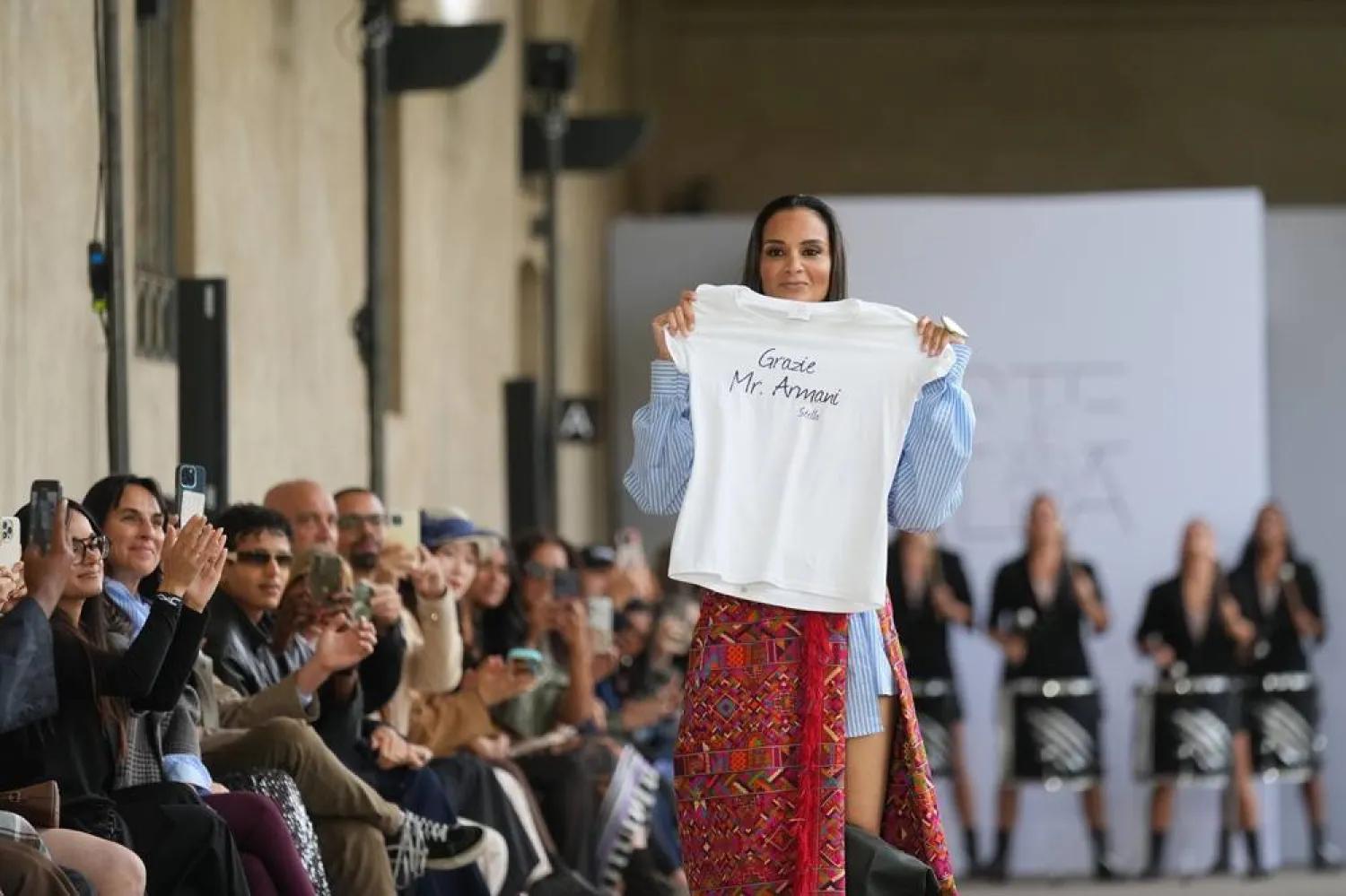
 Fashion designer Stella Jean walks the runway with a tribute to late Italian fashion legend Giorgio Armani who died in Milan on Sept. 4, at the end of her Spring/Summer 2026 collection during Milan Fashion Week in Milan, Italy, Saturday, Sept. 27, 2025. (AP)
Fashion designer Stella Jean walks the runway with a tribute to late Italian fashion legend Giorgio Armani who died in Milan on Sept. 4, at the end of her Spring/Summer 2026 collection during Milan Fashion Week in Milan, Italy, Saturday, Sept. 27, 2025. (AP)
TT

After Armani, Italian Fashion Houses Are in Flux

 Fashion designer Stella Jean walks the runway with a tribute to late Italian fashion legend Giorgio Armani who died in Milan on Sept. 4, at the end of her Spring/Summer 2026 collection during Milan Fashion Week in Milan, Italy, Saturday, Sept. 27, 2025. (AP)
Fashion designer Stella Jean walks the runway with a tribute to late Italian fashion legend Giorgio Armani who died in Milan on Sept. 4, at the end of her Spring/Summer 2026 collection during Milan Fashion Week in Milan, Italy, Saturday, Sept. 27, 2025. (AP)

The first Milan Fashion Week without Giorgio Armani marks the end of an era in Italian luxury, at a time when houses across the sector are already in transition.

After defending his independence throughout his life, the legendary designer, who died this month aged 91, has entrusted his heirs with the task of selling his group.

He cited French companies L'Oreal and LVMH as potential buyers of his multi-million-euro empire, which spans from hotels to haute couture, as well Franco-Italian eyewear giant EssilorLuxottica.

Failing that, his will states the company should be listed on the stock market.

This year also saw the departure of Donatella Versace from the house she ran for three decades, shortly before it was acquired by Prada.

"These are the last years of the first generation of Italian designers. We're in the middle of a major reshuffle," the manager of a major Milanese house told AFP this week on the margins of fashion week.

Roberto Cavalli, the king of sexy dresses and animal prints since the 1970s, also died last year.

But his company had since 2019 belonged to an Emirati conglomerate -- reflecting a wider trend.

In 2012, 76.8 percent of Italian fashion companies with annual revenues exceeding 50 million euros were still managed by the founding family.

This fell to 57 percent in 2022, according to a survey by the Aub Observatory published in 2024.

Over the past 30 years, many of Italy's top fashion names have been snapped up by foreign groups, notably French giants Kering, which owns Gucci and Bottega Veneta, and LVMH, which counts Fendi and Loro Piana among its brands.

Shoe company Sergio Rossi is owned by China's Lanvin Group, and Golden Goose by a London-based private equity fund.

Iconic names such as Dolce & Gabbana and Missoni remain independent, as does Brunello Cucinelli, but their size is limited.

The largest of them, Prada -- with 76-year-old Miuccia Prada still at the helm -- is eyeing combined revenues of around six billion euros after its deal with Versace.

This is far from the 84.7 billion euros in revenue expected by LVMH in 2024 or the 17.2 billion euros of Kering.

Luca Solca, an expert in luxury at Bernstein, said that, despite a few attempts in the past, "Italy didn't have an inspired businessman that could potentially aggregate a conglomerate".

Armani was better than many at building a major brand, but in the end, appeared to have decided there was nobody after him to run it, Solca told AFP.

But the luxury market is changing, and not just because of the hit from a slowdown in Chinese consumer spending.

Some see this as an opportunity for smaller Italian brands.

Bernardo Bertoldi, an economics professor at the University of Turin, said that LVMH and Kering capitalized on the rise of new, rich consumers in Asia and the Middle East, providing an accessible place for luxury goods.

"With a more evolved, more sophisticated consumer, they will stop shopping at the luxury supermarket and go looking for the best high-heeled shoe artisan," he told AFP.

Italian brands make much of their artisanal offerings, with Tod's bringing in a dozen craftsmen and women for their catwalk show on Friday to show guests how handmade handbags and shoes are made.

And in this world, Bertoldi says price is no issue.

Amid an increasingly competitive market, many big brands have installed new creative leads who are debuting this season, from Gucci, Versace and Bottega Veneta, Chanel and Dior.

But Ian Griffiths, lead designer at Max Mara who has been with the family-owned Italian brand since 1987, questioned what this meant for a brand's heritage -- a key selling point.

"I really feel for those designers who get thrown into a house and have to prove themselves within a season or two, produce instant results," the Briton told AFP backstage after his Milan show.

"Because, you know, what happens to the heritage? I had 20 years to learn the Max Mara sartorial codes before I was let loose on any kind of decision making."

Milan Fashion Week wraps up on Monday.



Armani 2025 Revenue Fell 2.8%, CEO Hasn't Met Potential Buyers

FILE - Actress Cate Blanchett, from left, designer Giorgio Armani, and actress Julia Roberts pose for photographers upon arrival at the British Fashion Awards in central London, Dec. 2, 2019. (Photo by Joel C Ryan/Invision/AP)
TT

Armani 2025 Revenue Fell 2.8%, CEO Hasn't Met Potential Buyers

FILE - Actress Cate Blanchett, from left, designer Giorgio Armani, and actress Julia Roberts pose for photographers upon arrival at the British Fashion Awards in central London, Dec. 2, 2019. (Photo by Joel C Ryan/Invision/AP)

Italian fashion group Armani said on Wednesday its revenue fell 2.8% at constant exchange rates last year, weighed by a weak performance of its wholesale channel.

In 2025, the company's revenue totaled 2.2 billion euros ($2.57 billion), while total turnover, including direct licensee sales, was 4 billion euros.

"We face a possible structural change in the approach to luxury and fashion ⁠by current consumers ⁠and potential, which must be taken into account," Reuters quoted Armani group CEO Giuseppe Marsocci as saying in a statement.

Earnings before interest, taxes, depreciation and amortization (EBITDA) rose 3.2% year-on-year to 152.7 million euros, while operating ⁠profit increased 2% to 52.6 million euros.

Trends in the first months of 2026 were in line with the previous year, with unfavorable currency movements weighing on performance.

Giorgio Armani, the group's founder who died last September, instructed his heirs to sell an initial stake in the company to players such as L'Oreal, EssilorLuxottica and French ⁠luxury ⁠giant LVMH.

In an interview with Italy's Sole 24 Ore published on Wednesday, Marsocci said there was no update on the group's shareholding structure, adding that interest in the Armani group remained strong.

"We have not started meetings with the three potential buyers, and there are no tensions among the family members," Marsocci said in a separate interview with WWD magazine.


Ferragamo Expands Leather Mapping Efforts as EU Sustainability Rules Take Shape

James Ferragamo, a chief product officer for the Salvatore Ferragamo group, talks with journalists during an interview with the Associated Press, in Milan, Italy, Wednesday, April 22, 2026. (AP Photo/Antonio Calanni)
TT

Ferragamo Expands Leather Mapping Efforts as EU Sustainability Rules Take Shape

James Ferragamo, a chief product officer for the Salvatore Ferragamo group, talks with journalists during an interview with the Associated Press, in Milan, Italy, Wednesday, April 22, 2026. (AP Photo/Antonio Calanni)

Italian luxury brand Ferragamo said it can map the country of origin for much of the leather used to make its coveted footwear and handbags, a first step in traceability according to experts.

The announcement comes during a wave of European Union sustainability rules that are increasing pressure on fashion brands to account for materials in their supply chains.

The family-run and publicly traded fashion house has been issuing sustainability reports for over a decade, but the 2025 report released March 31 is the first that contains figures on material traceability — notably for leather, which experts say is harder to trace than textile fibers such as cotton.

“We have been using leather in a more sustainable way,’’ James Ferragamo, the brand’s chief product officer and grandson of founder Salvatore Ferragamo, told The Associated Press in an interview last week. “I think it is one of the more sustainable materials in my point of view.”

Most of the tanneries working with the brand “control their water, have fair treatment of the workforce, monitor their supply chain ensuring that they’re buying leather from those who are not deforesting, and taking the right approach also in terms of breeding and animal welfare,” he said.

Traceability in fashion sustainability Traceability of materials is considered a first and necessary step for the fashion industry, which is facing a new EU framework that will require brands and their suppliers to ensure the items they produce are sustainable from the drawing board to end-of-life disposal. Precise terms are still being defined and compliance will be phased in over the coming years.

“Traceability is an essential factor, but it’s not sufficient,’’ said Francesca Romana Rinaldi, a sustainability expert and director of the Monitor for Circular Fashion at SDA Bocconi School of Management. “It enables the implementation of sustainability and circularity.”

She said that any company that is not tracing their materials “doesn’t know their supply chain” and “could be also criticized for greenwashing.”

EU regulations and directives are moving toward full circularity of materials to include measures extending the life cycle of garments, accessories and footwear through repairs and end-of-life management, including recycling and upcycling, she said.

The EU is also phasing in restrictions on destroying unsold apparel, accessories and footwear produced by companies with more than 250 employees and more than 40 million euros ($46.8 million) in annual revenues.

From breeding to assembly The family-run fashion house was founded in 1927 by Salvatore Ferragamo in Florence, after his return from Hollywood, where he had established himself as shoemaker to the stars with clients including Marilyn Monroe and Judy Garland. Material scarcity during World War II pushed Ferragamo to experiment with alternatives, substituting wicker for leather and using cork for soles, the younger Ferragamo said.

In keeping with its origins, Ferragamo remains primarily a footwear and leather goods maker. Together, they comprised 86% of 2025 sales of 976.5 million euros ($1.1 billion).

Ferragamo launched its initiative on leather traceability with the calf leather used for its Fiamma bag, tracing it from breeding to assembly, the group announced in its 2024 annual report.

In 2025, Ferragamo enlisted tanneries supplying 80% of the hides it buys in a project to identify the country of origin of raw materials through supplier declarations. When including textiles such as cotton, silk and nylon, the company says 81% of its materials are certified under third-party sustainability standards.

“Today there is not one single solution, one single technological solution to trace the leather to the birth farm of the cows,’’ said Davide Triacca, Ferragamo’s sustainability director. “We got to that result through a very dedicated and consistent approach and today we are able to trace more than 80% of the entire leather that we supply and the vast majority of which comes from Europe.”

The EU does not require leather to be traceable. Sustainability experts underscore that approaches based on country-level mapping and supplier declarations do not establish a full chain of custody and instead reflect an early stage of traceability.

Ferragamo previously included a capsule collection with silky textiles made from orange fibers in 2017, one of its first research investments. More recently it used nylon from castor oil instead of fossil oil for a men’s tote bag, and its Back to Earth collection featured the brand’s trademark Hug handbag treated with vegetable dyes.

“Research keeps on going. It’s something that we’re doing all the time,'' Ferragamo said.

“We’re trying to find different ways of creating different materials. And sometimes the materials that we produce are not ready for market. But it doesn’t mean that we don’t experiment.”


Adidas Shares Pop After Beating Nike to Sub-Two-Hour Marathon Milestone

Athletics - London Marathon - London, Britain - April 26, 2026 Kenya's Sabastian Sawe celebrates with an Adidas Adizero Adios Pro Evo 3 shoe after winning the men's elite race and setting a new world record with a time of 01:59:30 (Reuters)
TT

Adidas Shares Pop After Beating Nike to Sub-Two-Hour Marathon Milestone

Athletics - London Marathon - London, Britain - April 26, 2026 Kenya's Sabastian Sawe celebrates with an Adidas Adizero Adios Pro Evo 3 shoe after winning the men's elite race and setting a new world record with a time of 01:59:30 (Reuters)

German sportswear maker Adidas' shares rose on Monday after Kenya's Sabastian Sawe became the first person to run a marathon in under two hours in an official race, accomplishing his feat wearing the brand's Adizero Adios Pro Evo 3 trainers. 

Sawe shattered one of athletics' most elusive barriers on Sunday as he stormed to victory at the London Marathon in one hour 59 minutes and 30 seconds. The sub-two-hour marathon has been one of sport's biggest goals for years. 

After the race, Sawe held up his $500 Adizero Adios Pro Evo 3 trainer with "WR" and "sub-2" written on it in black marker pen. He ‌beat the previous ‌world record of 2:00:35 set at the Chicago ‌Marathon ⁠in October 2023 ⁠by the late Kelvin Kiptum. 

The win is a boost for Adidas against arch-rival Nike , after years of lab-backed experiments and near-misses looking to build a so-called "supershoe" to break the record. 

Nike's Breaking2 attempt at Monza in 2017 just fell short though Kenyan great Eliud Kipchoge ran under two hours in INEOS's 1:59 Challenge two years later. Yet those efforts fell outside the sport's official ⁠record books. 

Ethiopia's Yomif Kejelcha finished second in his marathon ‌debut and Tigst Assefa broke her own ‌women-only world record. All three were wearing Adidas' Adizero Adios Pro Evo 3 ‌trainers, which are set to go on sale on Thursday. 

Using innovative foam ‌and carbon-plated soles, and ultra-light components, the Adizero Adios Pro Evo 3 weighs an average 97 grams, 30% less than its predecessor, and improves running economy by 1.6%, Adidas said. 

"The Adidas family is incredibly proud of Sabastian and Tigist's historic ‌achievements," Patrick Nava, general manager at Adidas Running, said in a statement. 

"This is a testament to the years ⁠of hard work ⁠and dedication the have made, alongside our innovation team". 

Adidas shares were up 2% in mid-morning although they are down 18% since the start of this year on concerns about the group's exposure to US tariffs and the impact of the conflict in the Middle East. 

Adidas released its Adizero Adios Pro Evo 1 trainers in late 2023, after Assefa set a new women's marathon world record while wearing them at the women's Berlin Marathon. 

The third iteration of the shoe will be released for $500 a pair exclusively via the Adidas app, with a wider release in the autumn marathon season, according to the company's website, but the steep price tag puts them out of reach of most runners.
