


A Nonprofit in France Is Fighting Fast-Fashion Waste, One Sneaker at a Time

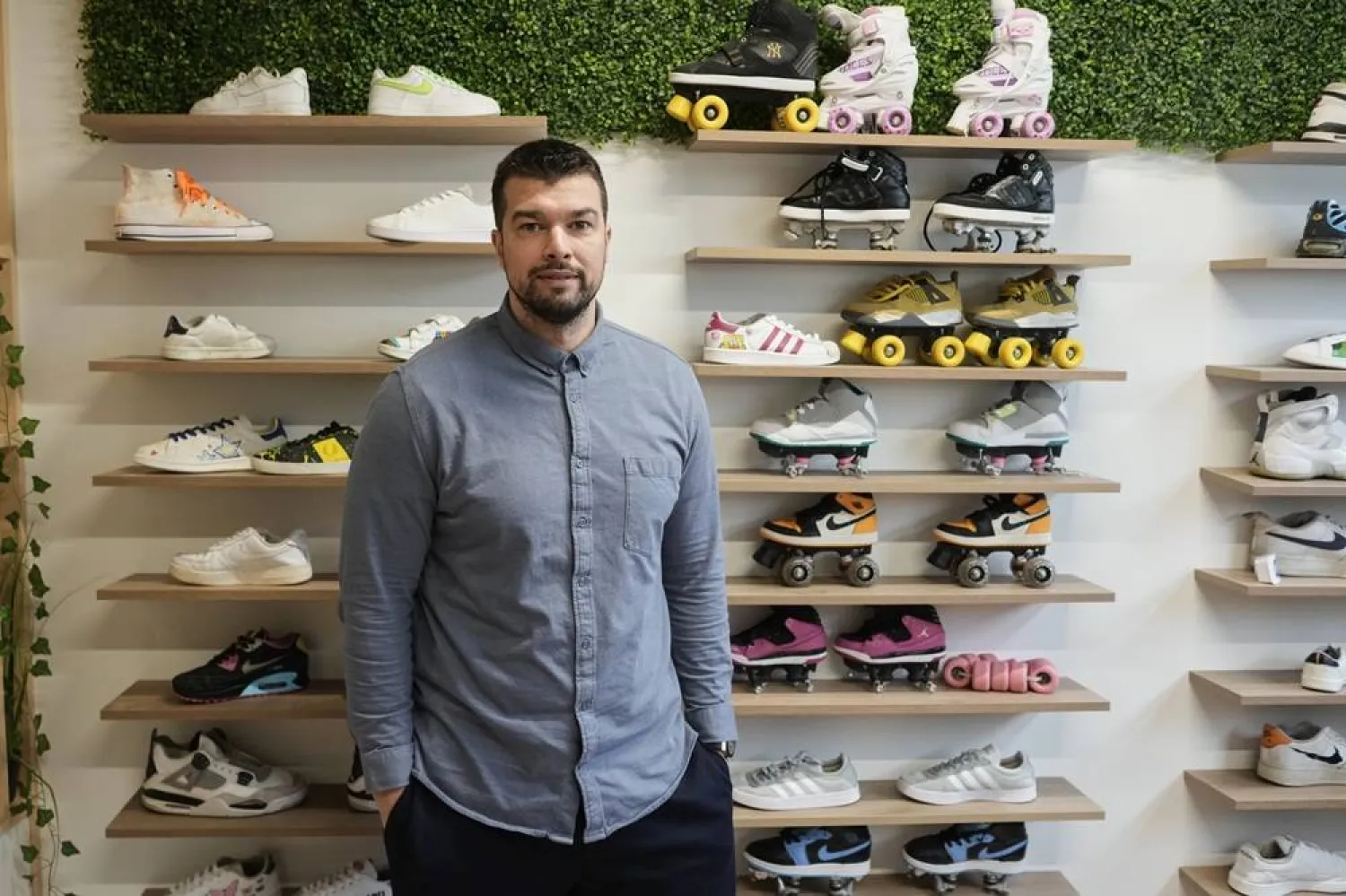
 Mohamed Boukhatem, co-founder and director of SneakCoeurZ, a nonprofit organization giving used footwear a second life, poses in Champs-sur-Marne, east of Paris, Wednesday, March 25, 2026. (AP)
Mohamed Boukhatem, co-founder and director of SneakCoeurZ, a nonprofit organization giving used footwear a second life, poses in Champs-sur-Marne, east of Paris, Wednesday, March 25, 2026. (AP)
TT

A Nonprofit in France Is Fighting Fast-Fashion Waste, One Sneaker at a Time

 Mohamed Boukhatem, co-founder and director of SneakCoeurZ, a nonprofit organization giving used footwear a second life, poses in Champs-sur-Marne, east of Paris, Wednesday, March 25, 2026. (AP)
Mohamed Boukhatem, co-founder and director of SneakCoeurZ, a nonprofit organization giving used footwear a second life, poses in Champs-sur-Marne, east of Paris, Wednesday, March 25, 2026. (AP)

Hundreds of used sneakers arrive each week at a workshop east of Paris, where workers inspect them and ask a simple question: Can a shoe be saved?

The nonprofit SneakCœurZ is in the business of sorting the shoes to check which ones can be resold or redistributed, and which have to be rejected. It says it collected 30,000 pairs of used sneakers last year and resold 2,000 pairs, and wants to scale up that process.

“Today, there is no project of this scale in the sneaker sector,” said Mohamed Boukhatem, the organization's director general and co-founder. “We are the only ones able to industrialize both the processes and the collection of sneakers for reuse.”

The group's work underscores a growing waste problem in France, where the capital Paris is long one of the world’s fashion and luxury hubs.

The stakes are huge: the textile industry is among the world’s most polluting, and the fashion and textiles sector accounts for up to 8% of global greenhouse gas emissions, according to the United Nations. The European Parliament has said textiles were the third-largest source of water degradation and land use in the European Union in 2020.

Refashion, the French government-approved eco-organization for clothing, household linen and footwear, says 259 million pairs of shoes were sold in France in 2024.

It says only about a third of used textiles and footwear are separately collected, with much of the rest left in cupboards or thrown away with household waste.

At its workshop in Champs-sur-Marne, workers for SneakCœurZ inspect the used shoes and check which can be salvaged.

“The structural elements of the shoe are what determine whether we can refurbish it or not,” workshop manager Paul Defawes Abadie said.

“A damaged Velcro strap isn’t a deal breaker. A lace isn’t a deal breaker. Dirt is never a deal breaker,” he said. “What really matters is the wear of the structural materials, especially the outsole.”

Pairs that make the cut are cleaned from the sole upward, disinfected inside and, in some cases, whitened under UV light before being put back into circulation.

The nonprofit says it redistributed more than 7,000 pairs to people in need and helped create 19 jobs.

“Over the next three years, the goal is to triple or even quadruple these volumes and move to an industrial scale,” Boukhatem said.

France has tried to respond to the issue of fast-fashion waste with law, as well as rhetoric.

Its 2020 anti-waste law requires unsold nonfood goods to be reused, donated or recycled instead of destroyed.

Authorities introduced a state-backed repair bonus for clothing and shoes in November 2023. Separately, lawmakers are still working on a bill aimed at reducing the textile industry’s environmental impact.

The bill passed the National Assembly in March 2024 and the Senate in June 2025, and the government said in February that it was still aiming for a joint parliamentary committee this spring.



Cartier-Owner Richemont Quarterly Sales Beat Estimates as Jewellery Demand Continues

 A rock crystal and diamond bracelet by Cartier, estimated at US$1-2 million, during a preview ahead of Christie's auction in Geneva, Switzerland, November 5, 2026. (Reuters)
A rock crystal and diamond bracelet by Cartier, estimated at US$1-2 million, during a preview ahead of Christie's auction in Geneva, Switzerland, November 5, 2026. (Reuters)
TT

Cartier-Owner Richemont Quarterly Sales Beat Estimates as Jewellery Demand Continues

 A rock crystal and diamond bracelet by Cartier, estimated at US$1-2 million, during a preview ahead of Christie's auction in Geneva, Switzerland, November 5, 2026. (Reuters)
A rock crystal and diamond bracelet by Cartier, estimated at US$1-2 million, during a preview ahead of Christie's auction in Geneva, Switzerland, November 5, 2026. (Reuters)

Cartier-owner Richemont reported a faster-than expected quarterly sales increase on Friday, helped by continued demand for its jewellery and bumper growth in the United States and Japan.

The company, which also owns Swiss watch brands Piaget and IWC, said its sales rose by 13% when measured in constant currencies to €5.95 billion ($6.58 billion) in the three ‌months to the end ‌of September.

The figure beat analyst ‌forecasts ⁠for €5.89 billion in ⁠a consensus compiled by Visible Alpha.

Although a slowdown from the 20% growth rate in the prior quarter, the figure showed the resilience of Richemont's largely jewellery-based business and a strong performance in the United States, Japan and Europe, where sales ⁠increased by 15% or more.

The Swiss-based ‌company, which makes ‌brooches, earrings and necklaces under the Cartier, Buccellati, Van Cleef & ‌Arpels and Vhernier brands, has bucked the trend ‌in a struggling luxury industry thanks to its higher exposure to jewellery, with its jewellery brands accounting for about 75% of its revenues.

Sales of Richemont's jewellery ‌unit grew 14% in the quarter, while those of its specialist watchmakers division ⁠rose ⁠12%.

The company, which does not report quarterly earnings, said its first-half net profit improved to €2.53 billion from €1.81 billion a year earlier, ahead of analyst forecasts for €2.26 billion.

"The group delivered a strong first half, carried by sustained excellent performance of our Jewellery Maisons, robust growth at our specialist watchmakers and solid momentum at our fashion and accessories Maisons, despite a challenging fashion market," Richemont Chairman Johann Rupert said in a statement.


Frasers Executive David Epstein Becomes Hugo Boss CEO after Takeover

FILE PHOTO: Plastic toilet cabins are reflected in a window with the logo of Hugo Boss fashion company in central Moscow, Russia, May 8, 2025. REUTERS/Maxim Shemetov//File Photo
TT

Frasers Executive David Epstein Becomes Hugo Boss CEO after Takeover

FILE PHOTO: Plastic toilet cabins are reflected in a window with the logo of Hugo Boss fashion company in central Moscow, Russia, May 8, 2025. REUTERS/Maxim Shemetov//File Photo

Hugo Boss said on Thursday CEO Daniel Grieder would step down and leave the company at his own request, effective January 1, 2027.

The German fashion group said David Epstein from Frasers Group will ⁠succeed him as ⁠CEO, Reuters reported.

Frasers Group, already Hugo Boss's largest shareholder, took majority control of the company in October after raising its stake above 50%, months ⁠after an unsuccessful 2 billion euro takeover bid.

The move follows a series of leadership changes at Hugo Boss this year. In September, the company named Michael Murray, chief executive of Frasers Group, as chairman of its supervisory board.

The British retailer, ⁠controlled ⁠by billionaire Mike Ashley, has been expanding its presence in the premium and luxury segments.

Epstein has served as chief brand partnerships officer at Frasers Group since 2024, overseeing brand partnerships across its Sport, Premium, and Luxury businesses.


Burberry Returns to First-half Profit on Turnaround Plan

© Adrian DENNIS / AFP
TT

Burberry Returns to First-half Profit on Turnaround Plan

© Adrian DENNIS / AFP

Burberry returned to profit in its first half, the British luxury fashion label said Thursday, thanks to progress in its cost-cutting plan launched two years ago.

Net profit stood at £6 million ($8 million) in the six months to the end of September, compared with a loss of £26 million a year earlier, Burberry said in an earnings statement.

Revenue rose six percent to £1.1 billion, and the company's shares jumped more than seven percent in early deals on the London stock exchange, AFP said.

Burberry began a turnaround plan at the end of 2024 aiming to boost sales and cut costs as the global luxury sector suffers from weaker demand in China.

Under chief executive Joshua Schulman, Burberry has refocused on its staple outerwear, including its famed trench coats, in a bid to improve its fortunes.

Comparable retail sales grew four percent in the first half, lifted by sales in its key China market and in the Americas.

"The CEO is now over two years into his tenure and has injected a breath of fresh air into the brand's fortunes," said Richard Hunter, head of markets at Interactive Investor.

He said the company's "strategy is gaining momentum as the brand increasingly resonates with the Gen Z cohort", while noting "the transformation is still in its early stages, and that of course the fashion industry can be a fickle business."

China is a key market for the luxury sector, but as the country's post-pandemic recovery continues to struggle, consumption has flagged, sending jitters across the globe.