


Britain Celebrates Late Queen Elizabeth II as a Style Icon to Mark Her Centenary

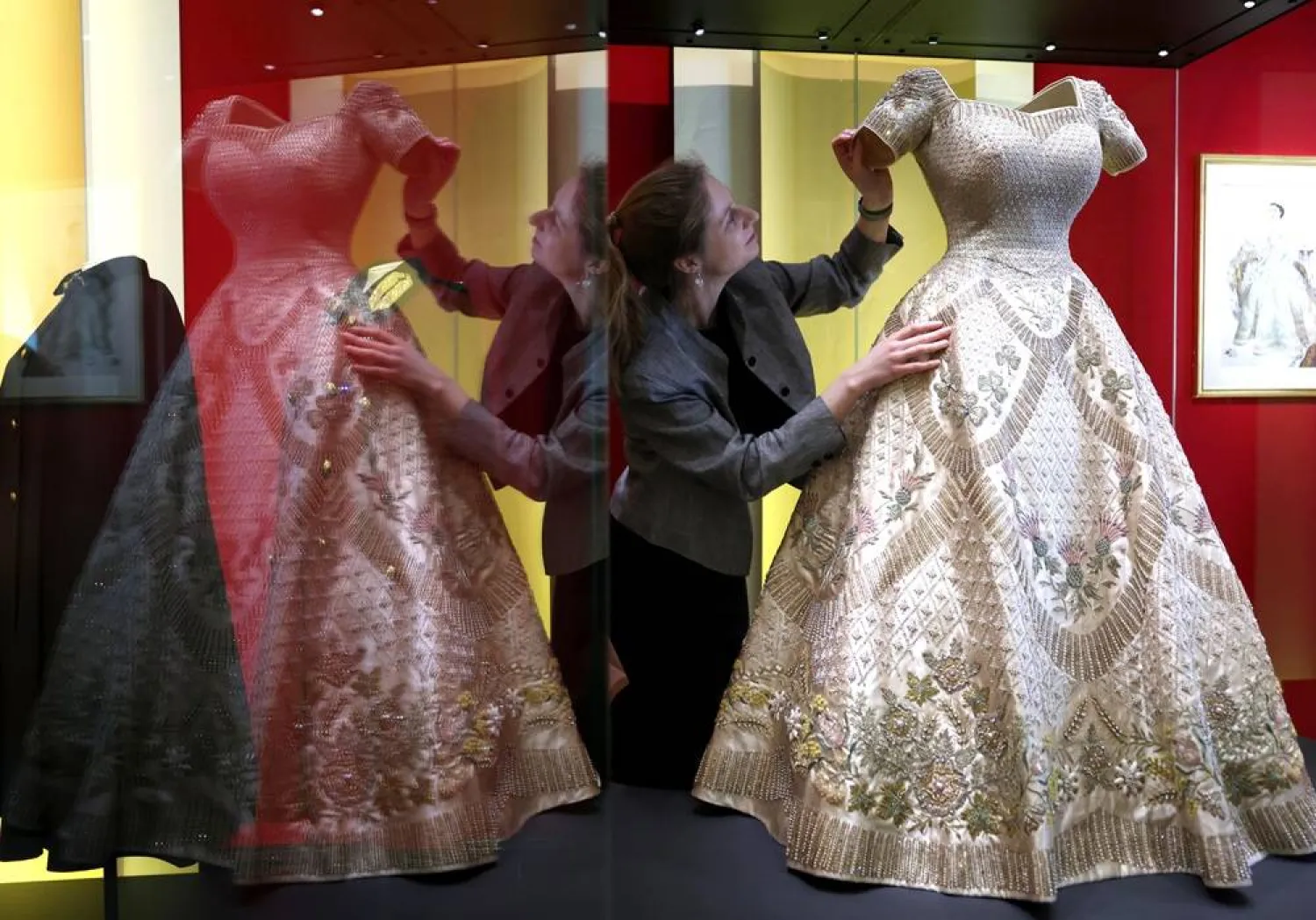
The coronation dress of Britain’s Queen Elizabeth II worn in 1953 is displayed at the exhibition “Queen Elizabeth II: Her Life in Style” at The King’s Gallery, Buckingham Palace in London, Britain, 09 April 2026. (EPA)
TT

Britain Celebrates Late Queen Elizabeth II as a Style Icon to Mark Her Centenary

The coronation dress of Britain’s Queen Elizabeth II worn in 1953 is displayed at the exhibition “Queen Elizabeth II: Her Life in Style” at The King’s Gallery, Buckingham Palace in London, Britain, 09 April 2026. (EPA)

The late Queen Elizabeth II believed the monarch had to be seen to be believed. And she made sure that was true even when Britain’s famously changeable weather intervened, pioneering the use of a clear plastic raincoat so that a stodgy black umbrella didn’t obscure her from public view.

That raincoat is one of some 300 garments and other fashion artifacts that go on display Friday at the King’s Gallery at Buckingham Palace in an exhibit that celebrates the late queen’s life and reign as Britain prepares to mark the centenary of her birth. The most comprehensive exhibition of her style choices ever mounted, the show charts Elizabeth’s story, and her impact on British fashion.

“I think she had a definite sense of what suited her,” exhibition curator Caroline de Guitaut said. “She absolutely knew how she wanted to appear.”

An Olympian moment

Some of the items are easily recognizable since Elizabeth was one of the most photographed people ever. But the ball gowns, tweed suits and trademark headscarves are sometimes strange to see on museum mannequins instead of the queen herself.

And then there are the items that are truly one-offs.

Like the dress, complete with bloomers, that Elizabeth’s stunt double wore during the opening ceremony for the 2012 London Olympics, when the then-86-year-old queen appeared to parachute into the stadium alongside Daniel Craig in his James Bond persona. To complete the illusion, the queen soon emerged in the stands identically attired.

Both dresses, designed by Elizabeth’s longtime dressmaker Angela Kelly, are displayed side by side, though the stunt double’s version has large zipper in back to accommodate the parachute.
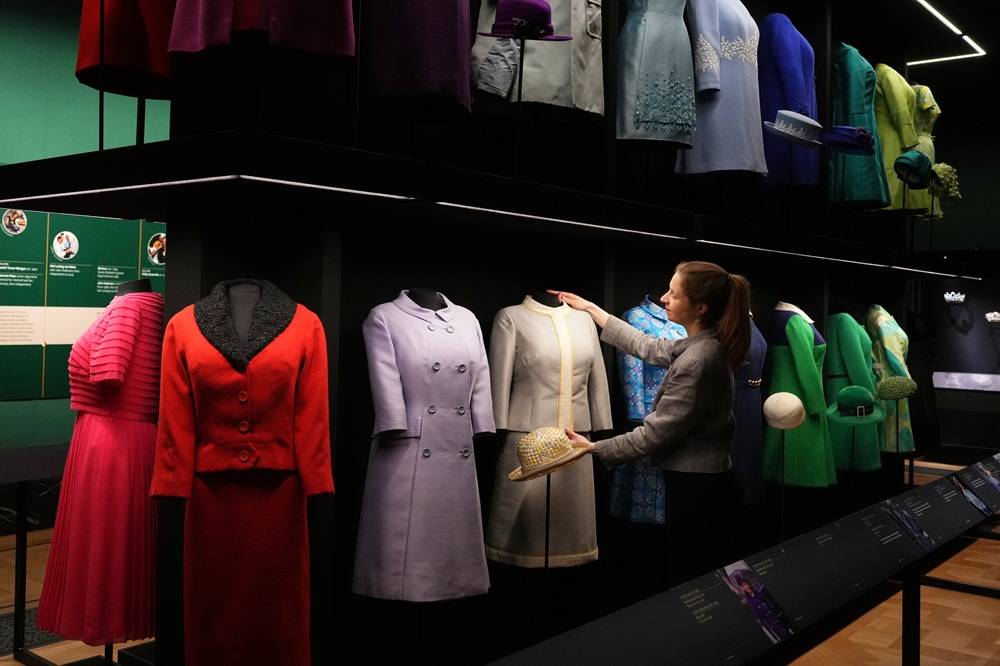
Cecilia Oliver, Textile Conservator at the Royal Collection Trust adjusts day wear worn by Queen Elizabeth II, on display at “Queen Elizabeth II: Her Life in Style” exhibition, to mark the centenary of the late queen's birth, at The King's Gallery at Buckingham Palace in London, Thursday, April 9, 2026. (AP)

Fashion connection to the public

The exhibition, drawn from some 4,000 items once owned by the queen, explores how fashion became one of her most powerful tools of communication as she evolved from a young princess into Britain’s longest-reigning monarch.

That could often be seen in her choice of color and decorative detail, as in the green and white Norman Hartnell gown she chose to wear for the state banquet during her 1961 visit to Pakistan, honoring her hosts by donning their national colors.

“The queen had an intimate understanding of how fashion could lend itself to diplomacy, a trait which, while its origins certainly lay in earlier reigns, the queen developed into nothing short of an art form,” de Guitaut said. “Color or embellishment communicated messages of respect to her host nation before she had even uttered a word in her speech.”

Particularly as she got older, Elizabeth opted to wear bright or distinctive shades during large public events so she could be easily spotted, and visitors could say they had seen the queen.

The exhibit also explores the queen’s off-duty wardrobe. The tweed suits she wore at Balmoral Castle, the royal family’s summer retreat in Scotland, are on display alongside clothes for riding, hiking and other outdoor pursuits. There’s a thick woolen coat Kelly designed during Elizabeth’s later years alongside items by Burberry and British designer Hardy Amies.

Big occasions, big statement gowns

Clothes worn during the many milestones of the queen's long life are also on display, from her christening robe, commissioned by Queen Victoria for the baptism of the future King Edward VII, to dresses she wore for her wedding and coronation.

The exhibit also includes sketches and notes that show just how involved the queen was in designing her wardrobe.

Naomi Pike, commissioning editor for Elle UK, said the collection finally recognizes Elizabeth’s status as a fashion icon, even though other royals, including her younger sister, the late Princess Margaret, and her daughter-in-law, the late Princess Diana, stole the spotlight during her lifetime.

“I think we’re very quick in this day and age to afford people icon status. ... It’s thrown around so easily,” Pike said. “But I think in the case of the queen, she was an icon and so much of that comes down to having a very strong sense of personal style.”
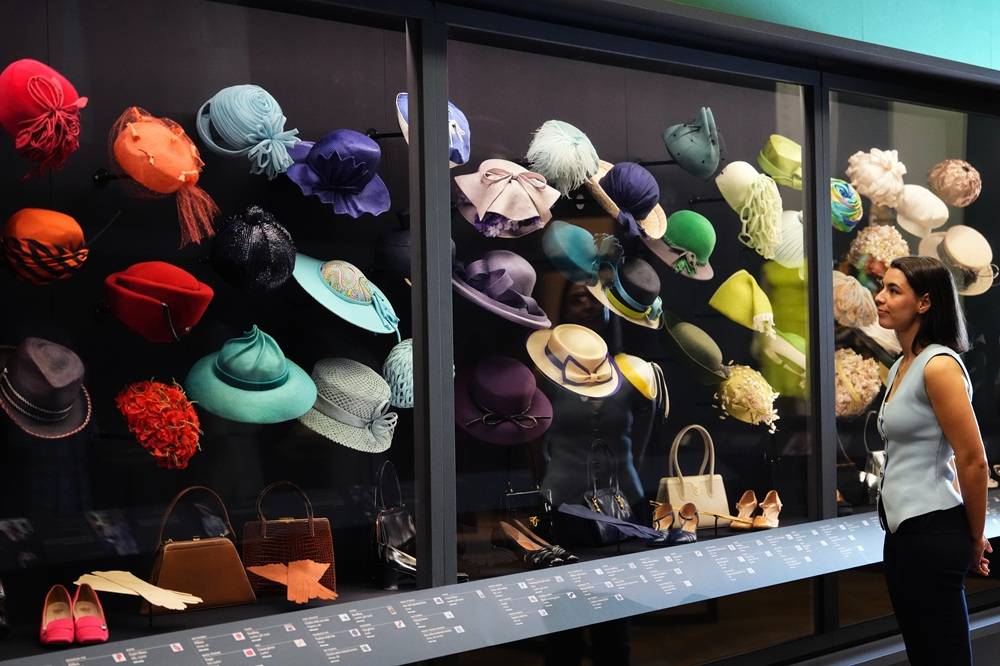
A member of the Royal Collection Trust staff looks towards hats, bags and shoes worn by Princess Elizabeth, on display at “Queen Elizabeth II: Her Life in Style” exhibition, to mark the centenary of the late queen's birth, at The King's Gallery at Buckingham Palace in London, Thursday, April 9, 2026. (AP)

On fairy wings

While the gowns may be the exhibit’s biggest draw, the show also provides a few surprises. With the task of showing us “what the monarch wore,” the curators conjured up a somewhat battered fairy outfit made from a tutu with wings on the back.

The piece is a favorite of Cecilia Oliver, a textile conservator at the King’s Gallery, who described it as the “cutest thing in the world.”

“I think what I love most about it is that it was bought for Elizabeth as a child, and to think of her as this tiny little girl that then grew up into this magnificent woman with all this weight of responsibility on her shoulders, it just feels very, sort of sentimental,” Oliver said.

Oliver grew almost wistful as she described the months of work on the exhibit and the privilege of handling so many things connected to a person familiar to so many but truly known by so few.

“As a conservator, I have a really intimate knowledge of these pieces. I’ve been able to touch them. I’ve been able to smell them. I’ve been able to understand them,” she said. “And through that, I felt really close to her.”

“Queen Elizabeth II: Her Life in Style” runs until Oct. 18 at the King’s Gallery, Buckingham Palace.


Estee Lauder Beats Quarterly Sales Estimates, to Cut More Jobs

Estee Lauder beat Wall Street estimates for third-quarter sales on Friday. (Getty Images via AFP)
TT

Estee Lauder Beats Quarterly Sales Estimates, to Cut More Jobs

Estee Lauder beat Wall Street estimates for third-quarter sales on Friday. (Getty Images via AFP)

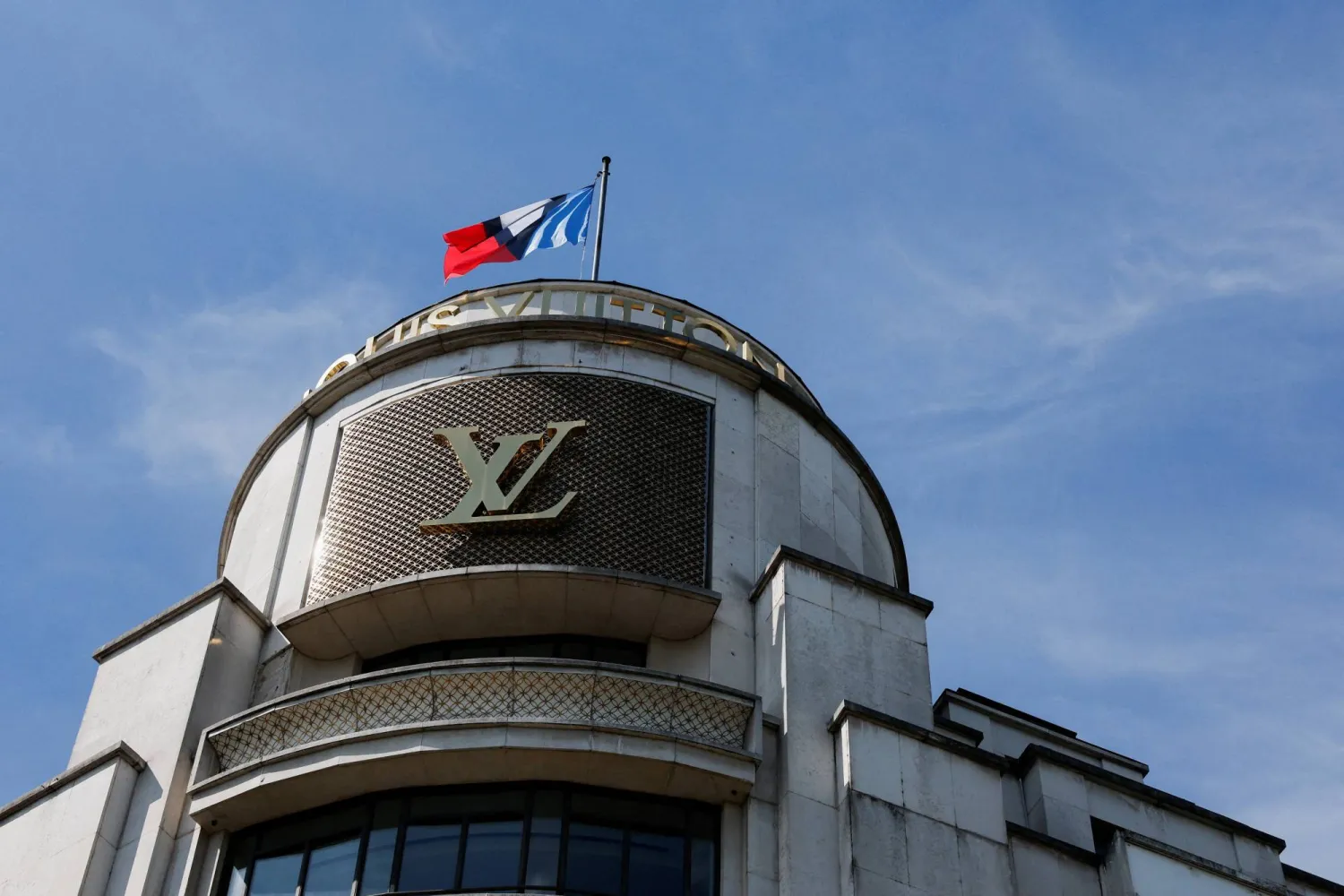
Cosmetics maker Estee Lauder beat Wall Street estimates for third-quarter sales on Friday, driven by improving sales in China ‌and Europe ‌as CEO ‌Stephane ⁠de La Faverie's turnaround ⁠plan takes hold, sending its shares up 16% premarket.

The company, which has ⁠been in talks ‌to ‌merge with Jean ‌Paul Gaultier-owner Puig, posted ‌quarterly sales of $3.71 billion, compared with analysts' estimates of $3.69 billion, according to ‌data compiled by LSEG.

The company ⁠also ⁠revised its job cut target to a range of 9,000 to 10,000 from the previously estimated range of 5,800 to 7,000.


Armani 2025 Revenue Fell 2.8%, CEO Hasn't Met Potential Buyers

FILE - Actress Cate Blanchett, from left, designer Giorgio Armani, and actress Julia Roberts pose for photographers upon arrival at the British Fashion Awards in central London, Dec. 2, 2019. (Photo by Joel C Ryan/Invision/AP)
TT

Armani 2025 Revenue Fell 2.8%, CEO Hasn't Met Potential Buyers

FILE - Actress Cate Blanchett, from left, designer Giorgio Armani, and actress Julia Roberts pose for photographers upon arrival at the British Fashion Awards in central London, Dec. 2, 2019. (Photo by Joel C Ryan/Invision/AP)

Italian fashion group Armani said on Wednesday its revenue fell 2.8% at constant exchange rates last year, weighed by a weak performance of its wholesale channel.

In 2025, the company's revenue totaled 2.2 billion euros ($2.57 billion), while total turnover, including direct licensee sales, was 4 billion euros.

"We face a possible structural change in the approach to luxury and fashion ⁠by current consumers ⁠and potential, which must be taken into account," Reuters quoted Armani group CEO Giuseppe Marsocci as saying in a statement.

Earnings before interest, taxes, depreciation and amortization (EBITDA) rose 3.2% year-on-year to 152.7 million euros, while operating ⁠profit increased 2% to 52.6 million euros.

Trends in the first months of 2026 were in line with the previous year, with unfavorable currency movements weighing on performance.

Giorgio Armani, the group's founder who died last September, instructed his heirs to sell an initial stake in the company to players such as L'Oreal, EssilorLuxottica and French ⁠luxury ⁠giant LVMH.

In an interview with Italy's Sole 24 Ore published on Wednesday, Marsocci said there was no update on the group's shareholding structure, adding that interest in the Armani group remained strong.

"We have not started meetings with the three potential buyers, and there are no tensions among the family members," Marsocci said in a separate interview with WWD magazine.


Ferragamo Expands Leather Mapping Efforts as EU Sustainability Rules Take Shape

James Ferragamo, a chief product officer for the Salvatore Ferragamo group, talks with journalists during an interview with the Associated Press, in Milan, Italy, Wednesday, April 22, 2026. (AP Photo/Antonio Calanni)
TT

Ferragamo Expands Leather Mapping Efforts as EU Sustainability Rules Take Shape

James Ferragamo, a chief product officer for the Salvatore Ferragamo group, talks with journalists during an interview with the Associated Press, in Milan, Italy, Wednesday, April 22, 2026. (AP Photo/Antonio Calanni)

Italian luxury brand Ferragamo said it can map the country of origin for much of the leather used to make its coveted footwear and handbags, a first step in traceability according to experts.

The announcement comes during a wave of European Union sustainability rules that are increasing pressure on fashion brands to account for materials in their supply chains.

The family-run and publicly traded fashion house has been issuing sustainability reports for over a decade, but the 2025 report released March 31 is the first that contains figures on material traceability — notably for leather, which experts say is harder to trace than textile fibers such as cotton.

“We have been using leather in a more sustainable way,’’ James Ferragamo, the brand’s chief product officer and grandson of founder Salvatore Ferragamo, told The Associated Press in an interview last week. “I think it is one of the more sustainable materials in my point of view.”

Most of the tanneries working with the brand “control their water, have fair treatment of the workforce, monitor their supply chain ensuring that they’re buying leather from those who are not deforesting, and taking the right approach also in terms of breeding and animal welfare,” he said.

Traceability in fashion sustainability Traceability of materials is considered a first and necessary step for the fashion industry, which is facing a new EU framework that will require brands and their suppliers to ensure the items they produce are sustainable from the drawing board to end-of-life disposal. Precise terms are still being defined and compliance will be phased in over the coming years.

“Traceability is an essential factor, but it’s not sufficient,’’ said Francesca Romana Rinaldi, a sustainability expert and director of the Monitor for Circular Fashion at SDA Bocconi School of Management. “It enables the implementation of sustainability and circularity.”

She said that any company that is not tracing their materials “doesn’t know their supply chain” and “could be also criticized for greenwashing.”

EU regulations and directives are moving toward full circularity of materials to include measures extending the life cycle of garments, accessories and footwear through repairs and end-of-life management, including recycling and upcycling, she said.

The EU is also phasing in restrictions on destroying unsold apparel, accessories and footwear produced by companies with more than 250 employees and more than 40 million euros ($46.8 million) in annual revenues.

From breeding to assembly The family-run fashion house was founded in 1927 by Salvatore Ferragamo in Florence, after his return from Hollywood, where he had established himself as shoemaker to the stars with clients including Marilyn Monroe and Judy Garland. Material scarcity during World War II pushed Ferragamo to experiment with alternatives, substituting wicker for leather and using cork for soles, the younger Ferragamo said.

In keeping with its origins, Ferragamo remains primarily a footwear and leather goods maker. Together, they comprised 86% of 2025 sales of 976.5 million euros ($1.1 billion).

Ferragamo launched its initiative on leather traceability with the calf leather used for its Fiamma bag, tracing it from breeding to assembly, the group announced in its 2024 annual report.

In 2025, Ferragamo enlisted tanneries supplying 80% of the hides it buys in a project to identify the country of origin of raw materials through supplier declarations. When including textiles such as cotton, silk and nylon, the company says 81% of its materials are certified under third-party sustainability standards.

“Today there is not one single solution, one single technological solution to trace the leather to the birth farm of the cows,’’ said Davide Triacca, Ferragamo’s sustainability director. “We got to that result through a very dedicated and consistent approach and today we are able to trace more than 80% of the entire leather that we supply and the vast majority of which comes from Europe.”

The EU does not require leather to be traceable. Sustainability experts underscore that approaches based on country-level mapping and supplier declarations do not establish a full chain of custody and instead reflect an early stage of traceability.

Ferragamo previously included a capsule collection with silky textiles made from orange fibers in 2017, one of its first research investments. More recently it used nylon from castor oil instead of fossil oil for a men’s tote bag, and its Back to Earth collection featured the brand’s trademark Hug handbag treated with vegetable dyes.

“Research keeps on going. It’s something that we’re doing all the time,'' Ferragamo said.

“We’re trying to find different ways of creating different materials. And sometimes the materials that we produce are not ready for market. But it doesn’t mean that we don’t experiment.”